Cozumel Marine Park Fees 2026: The Ultimate Guide for Divers
The Cozumel marine park fee is 225 Mexican pesos per person per day in 2026, roughly US$13. It is set in pesos rather than dollars, usually wanted in cash, and it is rarely part of the dive price you paid online.
Carmen Novelo · February 19, 2026 · 13 min read
The Cozumel marine park fee is 225 Mexican pesos per person, per day — roughly US$13 at the August 2026 exchange rate of about 16.9 pesos to the dollar. That figure comes straight from CONANP's own listing for Parque Nacional Arrecifes de Cozumel, checked on 23 August 2026, and it matches what dive shops on the island are actually collecting: Dive Paradise's published terms quote $225 MXN per day per person, cash, while operators quoting in dollars are asking $13 to $14.
One thing to fix before anything else: the fee is set in pesos, not dollars. Any guide that gives you a single confident dollar number is quoting a snapshot of the exchange rate, not the rate itself. Budget the peso figure, and treat the dollar equivalent as an estimate that drifts.
The 2026 Rate At A Glance
| Item | Detail |
|---|---|
| Official rate | 225 MXN per person, per day |
| Approximate USD | US$13–14, depending on the shop's exchange rate |
| Set by | CONANP (Comisión Nacional de Áreas Naturales Protegidas) |
| Applies to | Parque Nacional Arrecifes de Cozumel |
| Collected by | Your dive shop or tour operator, on CONANP's behalf |
| Payment | Cash — pesos preferred, USD widely accepted |
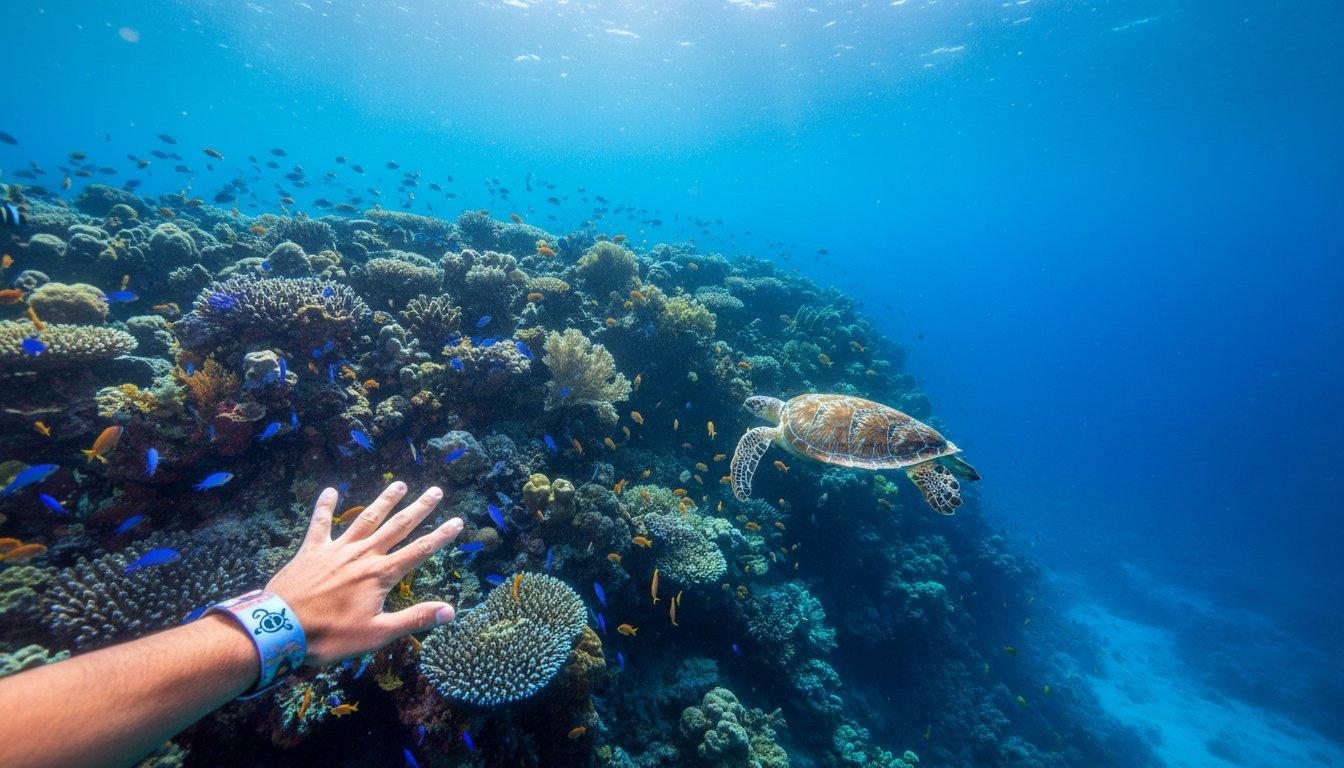
| Proof | A dated wristband, the brazalete |
| Validity | One calendar day |
| Rate checked | 23 August 2026 |
The rate rose on 1 January 2026, according to operators who announced the change to their customers. That followed a much larger jump twelve months earlier: on 1 January 2025 the fee went from 108 pesos to 218.32 pesos, roughly a doubling, and the first adjustment since 2020. CONANP revises these rates periodically, usually with effect from 1 January, so if you are reading this well into 2026 or later, confirm the current number with your shop before you fly. That is the whole reason this page carries a check date. See the marine park fee entry in the terminology guide for the short definition.
Who Pays It
Everyone entering the park pays, per person, per day. It is not a diver-specific charge:
- Scuba divers
- Snorkellers on boat trips
- Passengers on glass-bottom boats and reef tours
- Non-diving companions who ride along on the dive boat
That last one catches people out. If a partner comes aboard to sunbathe while you dive, they are still inside a national park and the fee applies to them too.
Yes, snorkellers pay. There is no reduced snorkeller rate — the charge is for entering the protected area, and it makes no distinction about what you do once you are in it. If you are weighing up the two activities for your trip, the snorkelling versus diving comparison covers the rest of the trade-offs.
CONANP's published schedule does list exemptions and discounts, though they require documentation and are applied inconsistently on commercial dive boats, which tend to charge the flat rate to everyone:
| Category | Official treatment |
|---|---|
| Children under 12 | Free |
| Seniors and pensioners | Free |
| Visitors with disabilities | Free |
| Students and teachers with valid credentials | 75% discount |
| Mexican nationals and foreign residents with official ID | 50% discount |
If you qualify, bring the document and ask at check-in rather than assuming it will be applied automatically.
How And When You Pay
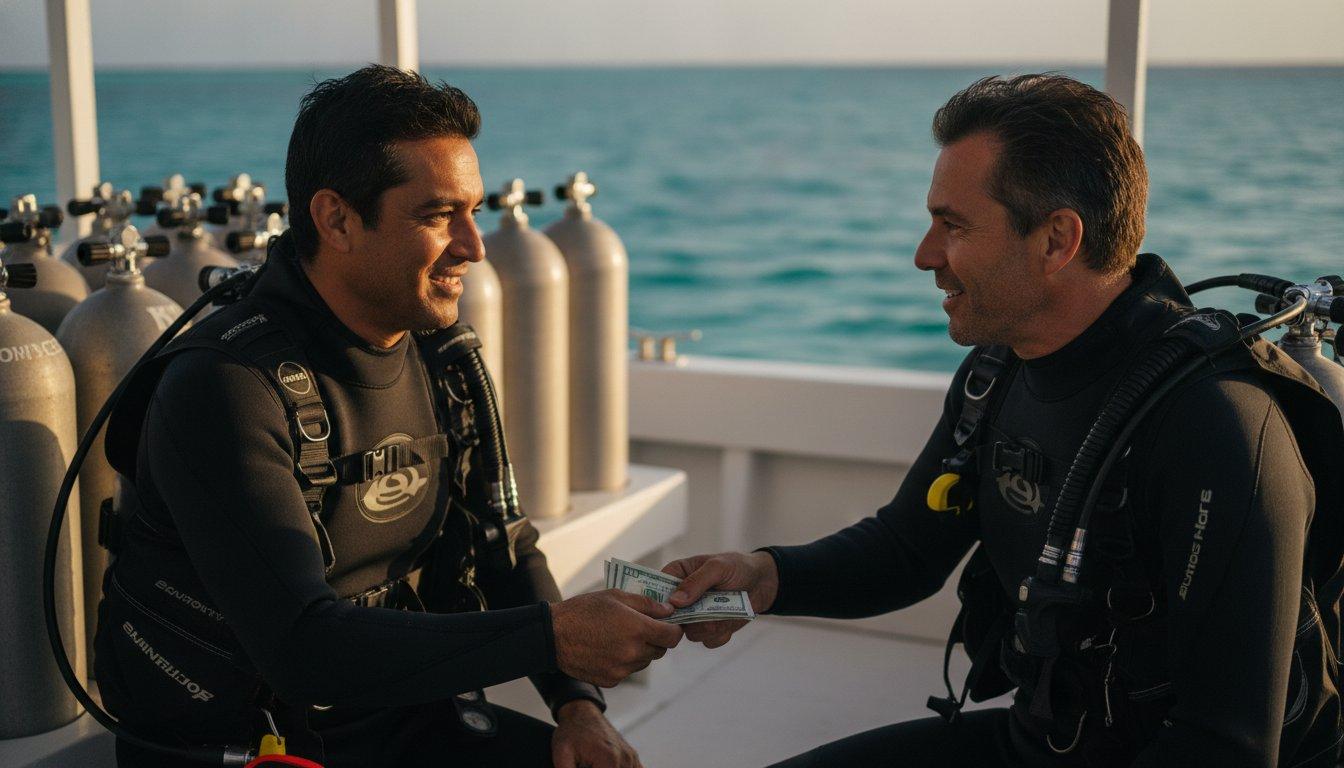
You pay at the dive shop, in cash, when you check in on the morning of your first dive. The shop hands you a dated wristband and remits the money to the park authority. That is the entire process — there is no separate booth to visit, no online step, no queue at a park gate.
Bring cash. This is the single most useful piece of preparation on this page. Shops will happily run your card for the diving itself, but the park fee is a pass-through collection and most operators want it in notes. Pesos are cleanest, because that is the currency the fee is denominated in; if you pay in dollars the shop applies its own exchange rate, which is usually rounded in the shop's favour and is why the dollar quotes range from $13 to $14 for an identical 225-peso charge. The currency guide for divers goes into which currency to carry for what. Keep it separate from your tip money — the fee is not a tip, and crews are not paid from it.
Is It Included In Your Dive Package?
Usually not. The overwhelming convention in Cozumel is that the park fee is quoted separately and collected separately, precisely because it is a government charge the shop passes through rather than revenue it keeps. Dive Paradise states it plainly in its terms; Scuba Du lists it as "not included"; Sand Dollar Sports flags it as an extra payable in cash on the day.
A minority of packages — particularly all-inclusive resort dive programmes and some multi-day prepaid bundles — do fold it in. The only way to know is to ask, in those words: is the marine park fee included, or do I pay it at the shop? Ask when you book, not when you arrive. Comparing operators on the dive centers directory is the moment to raise it, because a quote that excludes the fee looks cheaper than one that includes it while costing the same. For the full picture of what a dive week actually costs, the Cozumel diving cost breakdown puts the fee alongside tanks, gear and tips.
How Long The Wristband Lasts
One day. The bracelet is dated and covers a single calendar day, not a trip and not 24 rolling hours.
The practical upside is that it covers that whole day, not each dive. A two-tank morning and an afternoon single on the same day is one fee. Add a night dive that evening and it is still the same day, still one fee — worth confirming with your shop, since some collect per boat trip out of habit. Come back tomorrow and you pay again.
For a typical week of diving, that is what the arithmetic looks like:
| Days diving | Daily fee total (MXN) | Approx. USD |
|---|---|---|
| 3 | 675 | ~$40 |
| 4 | 900 | ~$53 |
| 7 | 1,575 | ~$93 |
| 10 | 2,250 | ~$133 |
The Annual Conservation Passport
CONANP sells a Pasaporte de la Conservación — an annual pass covering entry to protected areas nationwide for one year from the date payment clears. The listed price on CONANP's site is 3,760 MXN, checked 23 August 2026. It is issued per person and is not transferable.
At 225 pesos a day, that pass breaks even at about 17 dive days. So it is not the automatic saving it is sometimes presented as. For a one-week trip it is a clear loss. It starts making sense if you are here for a month, if you visit the island two or three times a year, or if you also visit other Mexican protected areas — the pass is national, not Cozumel-only, which is where its real value sits for people combining Cozumel with cenotes, Sian Ka'an or a Baja trip.
If you buy one, purchase it through CONANP's own portal, save the digital receipt and QR code to your phone, and carry a printed copy as backup. Show it at check-in in place of paying the daily fee. Note that both these figures — the daily rate and the passport price — are adjusted periodically, so recheck the break-even before buying rather than trusting the number above indefinitely.
What The Money Funds
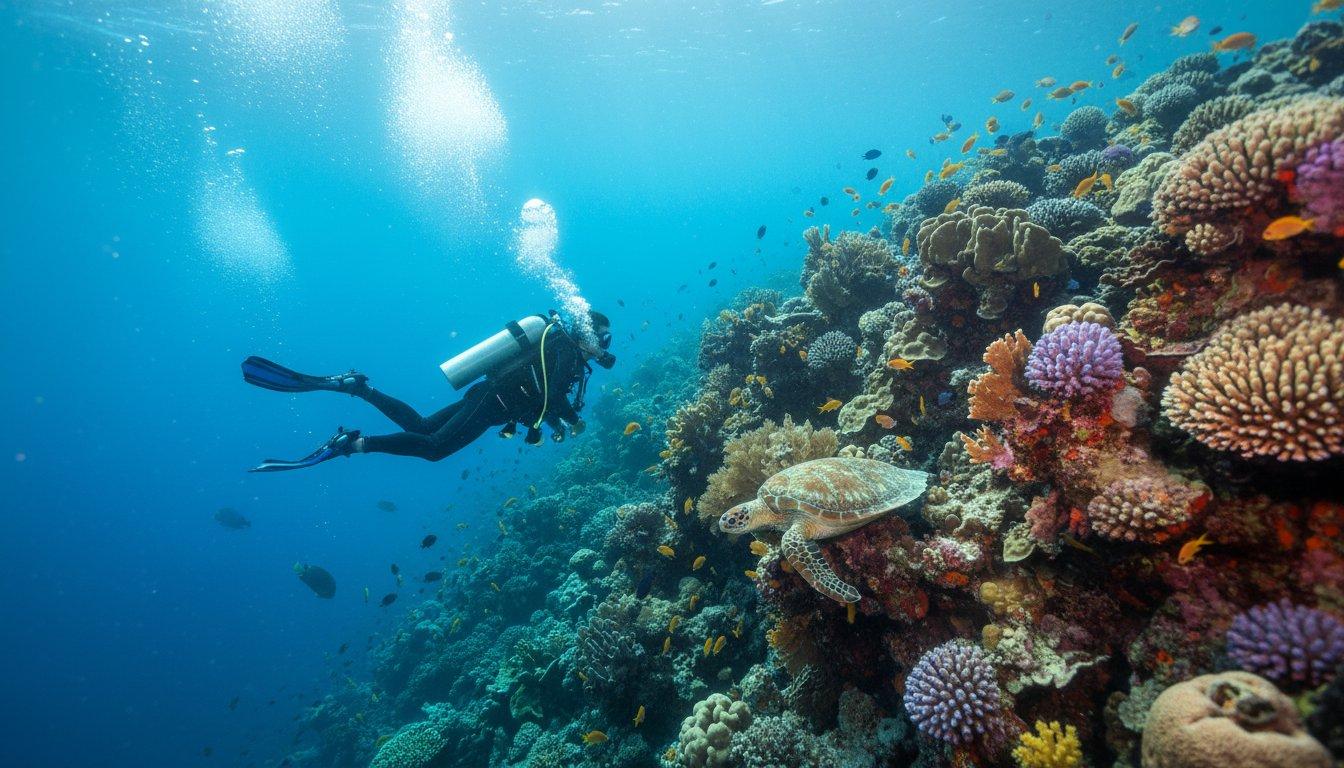
The fee is a conservation charge, not a tourism tax, and Parque Nacional Arrecifes de Cozumel has real running costs. The park was declared in July 1996 and protects roughly 11,988 hectares — about 120 square kilometres — of reef, open water and seagrass along the island's western and southern shores, extending out to the 100-metre depth contour.
Park revenue supports the machinery that keeps that area functioning as a protected area: reef and water-quality monitoring, the mooring buoy network that lets boats tie up instead of dropping anchor on coral, ranger patrols enforcing the no-fishing and no-anchoring rules, and invasive lionfish control. The conservation efforts overview covers that work in more detail.
Paying it is the low bar. The rules that come with it matter more: no-touch diving, no gloves, no collecting, no feeding fish, and reef-safe sunscreen only — mineral formulations, not chemical ones. Buoyancy control is a conservation skill in a drift diving environment where a moment of inattention puts you into a coral head. The responsible diving guide is worth ten minutes before your first dive.
Where The Park Ends
The marine park does not cover the whole island. Its northern limit sits near the international cruise pier on the west coast; from there the protected area runs south, around Punta Sur, and a short way up the eastern shore.
That means essentially every famous Cozumel site is inside it. Paradise Reef is among the northernmost. Everything south of it — Santa Rosa Wall, Palancar Gardens, Columbia Shallows, Punta Sur — sits within the boundary.
Diving outside the park is the exception, not a loophole. The north-end sites — Barracuda and San Juan among them — lie beyond the northern limit and are not subject to the park fee. In practice this saves you nothing, for two reasons. First, those are demanding, current-swept advanced sites that run only in settled conditions and only for experienced divers; nobody sensible picks them to dodge a 225-peso charge. Second, most operators will still collect the fee for the day if any part of your diving crosses into the park, which on a normal two-tank itinerary it will. If a day genuinely stays entirely north of the boundary, ask whether the fee applies before you hand over cash.
Diving inside the park without a valid wristband is a real risk rather than a theoretical one. Rangers patrol, and exposure falls on both the operator's permit and the individual diver. There is no upside to attempting it.
Putting It In The Budget
Line it up as 225 pesos per diving day, in cash, on top of your quoted dive price — then confirm the current rate with your operator when you book, because CONANP moves it. On a seven-day trip that is roughly 1,575 pesos, or about US$93, which is small against airfare and dive packages but annoying to discover at the counter on day one with no cash on you.
Ready to price out the rest of it? Plan your Cozumel dive trip walks through operators, packages, seasons and the costs that sit alongside the park fee.
Frequently Asked Questions
How much is the Cozumel marine park fee in 2026?
Do snorkellers have to pay the Cozumel marine park fee?
Is the marine park fee included in Cozumel dive packages?
Can I pay the Cozumel marine park fee by card?
How long does the marine park wristband last?
Is the annual Conservation Passport worth buying?
What does the Cozumel marine park fee pay for?
Do I pay the fee if I dive outside the park boundary?
What happens if I dive in the park without paying the fee?
Are there discounts or exemptions on the marine park fee?
Share This Article

Carmen Novelo
Carmen Novelo is a Cozumel native and an active scuba instructor and dive guide on the island. She has spent twelve years diving the Cozumel reef system, and writes about its dive sites, conditions and marine life for Cozumel Dive Hub.