How to Tip Your Dive Crew in Cozumel: The Ultimate 2026 Etiquette Guide
The customary tip in Cozumel is roughly 5 to 15 US dollars per tank per diver, so 10 to 30 dollars for a standard two-tank morning. It goes to the whole boat in cash, handed to the divemaster daily rather than in one lump at the end.
Carmen Novelo · June 22, 2026 · 5 min read
Published Cozumel operator guidance and long-running diver forums put the customary tip at roughly 5 to 15 US dollars per tank, per diver — so about 10 to 30 dollars per person for a standard two-tank morning, or the peso equivalent. That is a range rather than a number because operators genuinely differ: some publish 5 to 10 per tank, others publish 12 to 15. All figures on this page were checked against operator FAQs and Cozumel diver forums in August 2026.
The tip normally goes to the whole boat, not one person. You usually hand it to the divemaster at the end of the day and they split it with the captain and deckhand. Cash is standard, pesos and dollars are both accepted, and daily is better than one lump sum at the end of a week because crews rotate.
This page explains where those numbers come from, who is actually on the boat, which currency helps the crew most, and the handful of situations — courses, private charters, all-inclusive packages — where the normal rule does not quite apply.
How Much Should You Tip a Cozumel Dive Crew?
| Situation | Customary range (per diver) | Notes |
|---|---|---|
| Two-tank boat dive | $10–$30 USD total, or roughly 200–500 pesos | Derived from the $5–$15 per tank figures operators publish |
| Single tank / afternoon one-tank dive | $5–$15 USD, or roughly 100–250 pesos | Same per-tank logic |
| Three-tank or full-day trip | $15–$45 USD, or roughly 300–800 pesos | Scale by tanks, not by hours |
| Night dive or specialty dive | Toward the upper end or slightly above | More setup, more crew work, smaller groups |
| Private guide or private charter | Upper end plus a margin | You are getting the crew's full attention |
| Certification course | Commonly framed as a share of course cost | See the course section below |
Two caveats before you treat this as law. First, published operator guidance disagrees: one well-known Cozumel shop's FAQ states $5 to $10 per tank per diver, another states an average of $12 to $15 per tank. Both are current, both are honest, and the gap is real. Second, these are customary ranges, not invoices. Nothing bad happens if you sit at the bottom of the range, and nothing magical happens if you sit at the top.
If you want a simple planning number: budget around $20 to $30 per diver per two-tank day and adjust from there. Over a six-day dive week that is roughly $120 to $180 per person — a line item worth putting into the full cost breakdown for a Cozumel dive trip rather than discovering at the pier.
Who Actually Gets the Tip on a Cozumel Dive Boat?
This is the part most visiting divers get wrong, and it is worth being precise about, because the divemaster and the boat crew are not the same people and do not do the same job.
The divemaster or guide is the person in the water with you. They run the briefing, pick the site based on the day's current, lead the group along the reef, watch everyone's gas and depth, and manage the drift so the group stays together. This is the person most divers think of as "the crew".
The captain never gets in the water and does the job nobody notices when it goes well. On a live boat pickup — which is how nearly all Cozumel drift diving works — the captain tracks a group of bubbles moving along a reef in open water, keeps other traffic clear, and puts the boat exactly where divers surface. In a strong current, that is genuine skill.
The deckhand or boat crew handle tanks, help with gear, rig the boat, rinse and pack equipment, and get you back over the side. On a busy two-tank morning they lift several hundred kilos of cylinders.
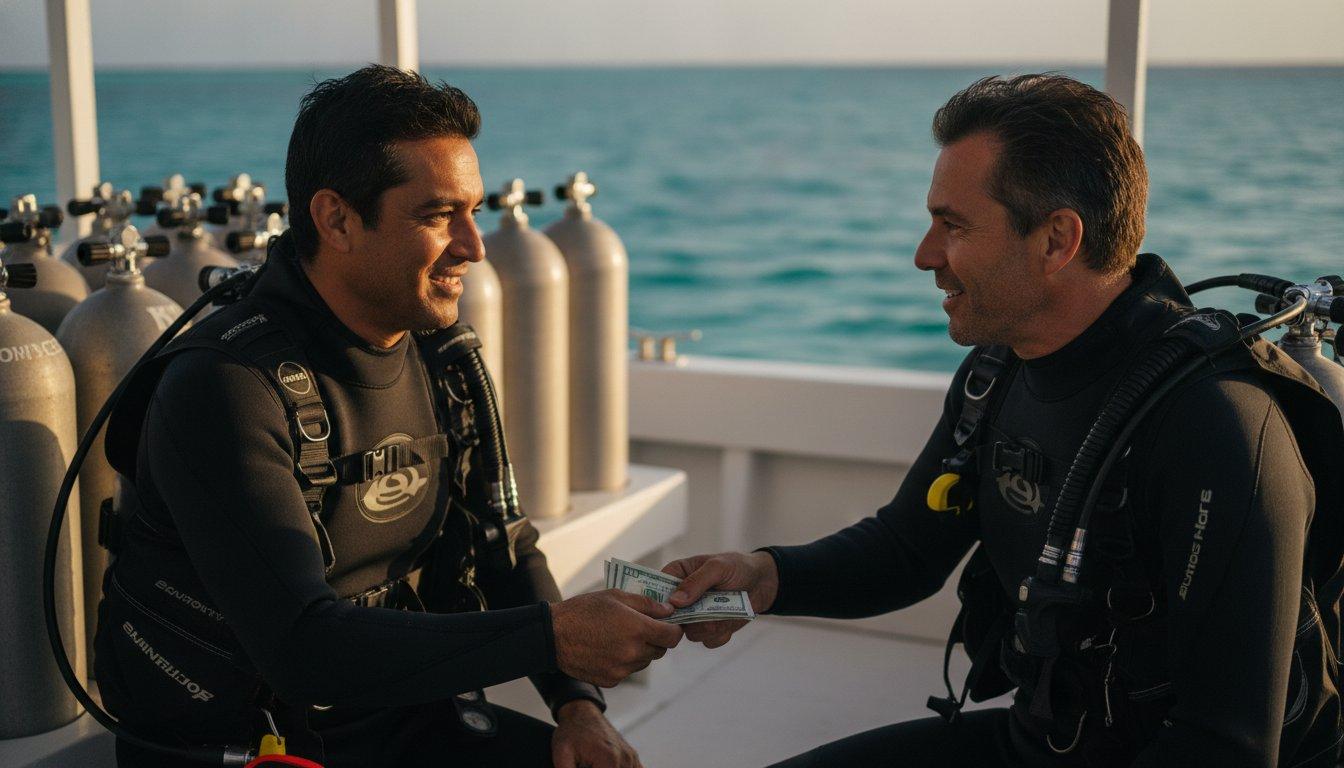
In practice, the money is almost always pooled. The common pattern in Cozumel is that you hand the tip to the divemaster as you leave the boat and they split it with the captain and deckhand afterwards, either by an agreed formula or by shop policy. Some boats keep a tip jar instead. Both are normal.
If you want to be certain the split works the way you expect, the simplest move is to ask at the shop when you book: who should I give tips to, and does it go to the whole boat? Operators answer this question constantly and nobody finds it rude. It is one of the small practical questions worth raising alongside the others in the dive shop selection guide.
Pesos or Dollars: Which Currency Is Better for the Crew?
Both work. Cozumel dive crews handle US dollars every day and nobody will be confused by a twenty. But there is a real difference in what the money is worth once it leaves your hand.
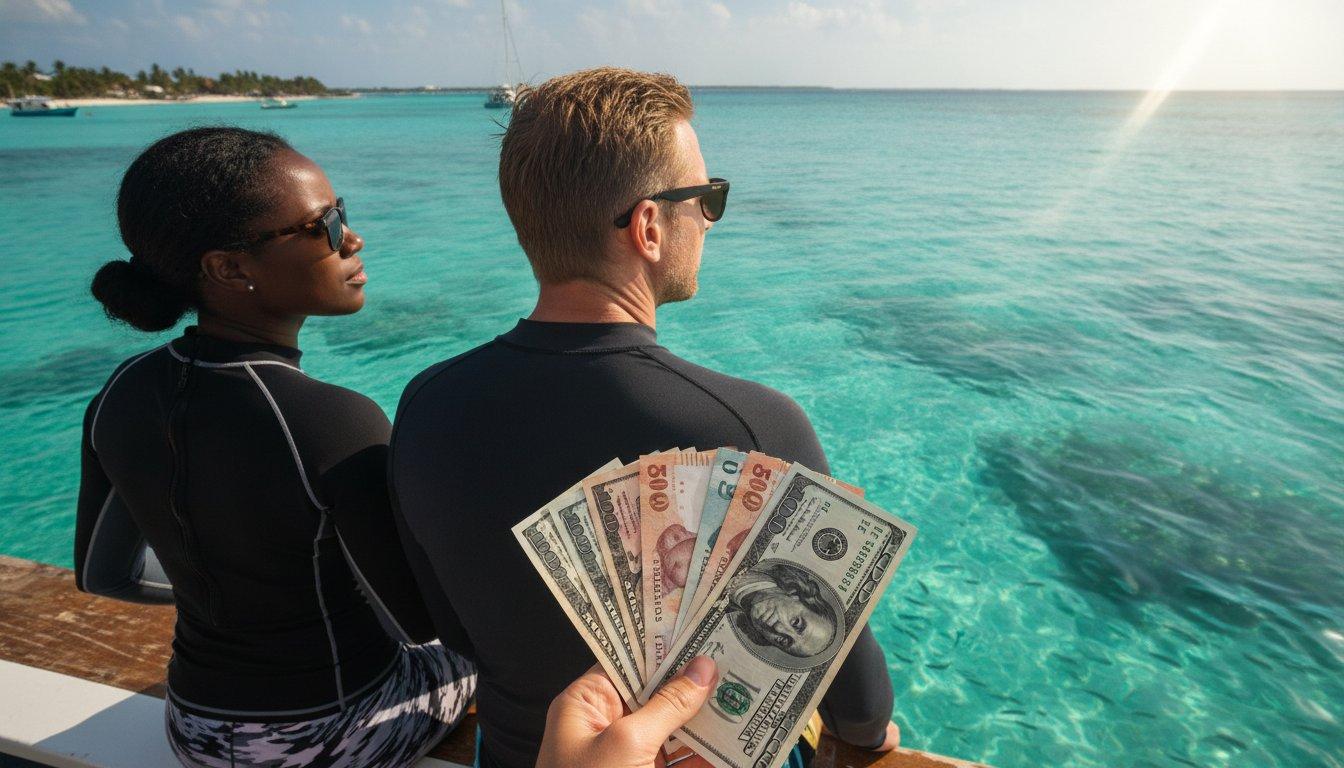
Pesos are cleaner for the recipient. A crew member tipped in pesos can spend it immediately. A crew member tipped in dollars has to convert it, at whatever rate a local bank or exchange house gives that week, which quietly shaves value off the tip. Divers on Cozumel forums who have thought about this tend to land on pesos for exactly that reason — one commonly cited approach is around 400 pesos per day for a two-tank trip.
Dollars are more convenient for the visitor, especially on a short trip or a cruise call where you never accumulate peso cash. Nobody will think less of you for tipping in dollars, and much of the published operator guidance is quoted in dollars in the first place.
Two practical rules if you use dollars:
- Bills must be in good condition. Torn, taped, heavily marked or very worn US notes are frequently refused by Mexican banks and exchange houses, which makes them a problem for the person you just handed them to. Bring clean notes.
- Small denominations matter. A crew of three splitting a single $50 note has a problem. Fives, tens and twenties are what you want.
If you are tipping in pesos, 100, 200 and 500 peso notes are the useful denominations. Coins are generally not used for dive tips. Whichever currency you choose, this sits alongside the wider question of how to handle money on the island, which the Cozumel diving currency and money guide covers in full — including which things on a dive day are strictly cash, such as the marine park fee.
When and How Should You Hand It Over?
Tip at the end of each dive day, not at the end of the week. This is the single most useful piece of logistics on the page. Cozumel crews rotate. The captain on Tuesday may not be the captain on Friday, and a lump sum handed over on your last day rewards whoever happened to be working that morning while the crew from earlier in the week gets nothing. Daily tipping is the norm and it solves this automatically.
Cash, on the boat or at the dock. Hand it over as you leave, with a word about the dive. Most operators cannot easily add gratuities to a card payment, and money handed to the shop's front desk does not always reach the boat crew the way you assume.
Keep it dry. Tip money in a dry bag or a zip-lock in your day bag. Wet, salt-stained notes are a small indignity for everyone involved.
A brief, specific thank-you is worth more than you think. Naming the thing the guide actually did — found the toadfish, sorted your weighting, held the group together in a rip — lands better than the money alone.
If you booked a multi-day dive package, the same daily logic applies. Packages bundle the diving, not the gratuities, unless the operator explicitly states otherwise. The Cozumel diving packages guide covers what is and is not usually included.
Do You Tip on a Certification Course?
Yes, it is customary, but the per-tank framing stops making sense.
An instructor teaching an Open Water course spends two to four days with you across classroom sessions, confined water and open water dives. Published guidance for instructor tipping in Mexico is generally expressed as a share of the course price rather than per tank, and the commonly quoted band sits in the region of 10 to 20 percent of the course fee — the low end for a straightforward course, the high end for an instructor who carried a genuinely nervous student through it.
A few specifics:
- Discover Scuba Diving. A Discover Scuba experience is closer to a guided dive than a course. Tip it like a one-tank dive.
- Continuing education and specialties. Specialty courses tend to be short and priced accordingly; a percentage of course cost still works as a frame.
- Boat crew are separate. If your course dives ran from a boat, the captain and deckhand were still working. They are not covered by what you give the instructor unless it is pooled.
The Open Water certification cost guide gives you the course price to apply that percentage to.
What About Private Charters and All-Inclusive Packages?
Private guide or private charter. You have booked the crew's undivided attention for the day, and the customary tip scales with that. Work from the upper end of the per-tank range and add for the private element. A private guide who spent the day shooting around your camera rig or nursing one nervous diver has done considerably more than lead a group of eight.
Resort or all-inclusive packages. Some dive resorts add a service charge, and some all-inclusive properties state that gratuities are included. Read what the property actually says. "Gratuities included" at a hotel usually refers to bars, restaurants and housekeeping, and frequently does not extend to the dive operation, which may be a separate business entirely. If it is unclear, ask the dive desk directly.
Shops that add a service charge to the bill. Rare in Cozumel diving, but if it appears on your invoice, ask whether it goes to the boat crew. If it does, an additional tip is genuinely optional.
Cruise excursions booked through the ship. The ship's price includes the operator's margin, not the crew's tip. Bring cash for the boat.
Why Tipping Carries Real Weight in Mexico
Worth stating plainly, without turning it into a lecture. Tips are a normal and substantial part of income for service workers in Mexico, and dive crews are no exception. Base wages in the tourism sector are structured on the assumption that gratuities form part of the total. This is not a moral claim about you; it is a description of how the pay works.
The practical implication is only this: if you have budgeted precisely for tanks, gear and the marine park fee and left nothing for tips, you have under-budgeted a real cost rather than skipped an optional extra. Put it in the budget at the start.
And the honest flip side, which most tipping guides refuse to say: a guide who did nothing exceptional still did the job. They still got up at six, hauled the tanks, ran the briefing, and brought everyone back. The standard tip is the payment for the standard job being done properly. You raise it when someone goes beyond that, not as a reward for basic competence — and you are not obliged to feel guilty for tipping in the normal range.
What Not to Do
- Do not skip tipping because service was merely adequate. Adequate is the job. Tip the range.
- Do not tip only on the last day of a multi-day trip with rotating crew.
- Do not hand over torn or heavily worn US notes. They are hard for the crew to bank.
- Do not assume a card payment covered it. Ask if you are unsure.
- Do not tip below the range as a protest about something the crew did not control — boat capacity, site selection dictated by conditions, or a crowded boat are shop decisions, not crew decisions. Raise those with the shop.
- Do not feel obliged to over-tip to compensate for a bad experience. The range exists for a reason.
If the service was genuinely poor — a guide who left the group, a boat that ignored a stated problem — that is a conversation with the shop, and it is more useful to them than a small tip.
Putting Tips Into Your Cozumel Dive Budget
The workable version of all of this fits in a sentence: bring small cash in either currency, budget roughly $20 to $30 per diver per two-tank day, hand it to the guide daily on the way off the boat, and ask at booking how the shop splits it.
Add that to tanks, gear rental and the marine park fee, and you have the true cost of a dive day rather than the advertised one. When you are ready to choose an operator, browse the Cozumel dive centers directory, and work through the rest of the trip decisions with Plan Your Cozumel Dive Trip.
Frequently Asked Questions
How much should you tip a dive crew in Cozumel?
Is tipping mandatory when diving in Cozumel?
Should you tip in pesos or US dollars in Cozumel?
Who do you give the tip to on a Cozumel dive boat?
When is the best time to hand over a dive tip?
Do you tip a scuba instructor for a certification course?
Should you tip more on a private dive charter?
Do all-inclusive packages cover dive crew tips?
Can you add a tip to a card payment in Cozumel?
What should you do if the dive service was disappointing?
Share This Article

Carmen Novelo
Carmen Novelo is a Cozumel native and an active scuba instructor and dive guide on the island. She has spent twelve years diving the Cozumel reef system, and writes about its dive sites, conditions and marine life for Cozumel Dive Hub.