Cozumel Specialty Dive Courses: Master the Art of Underwater Adventure
Three Cozumel specialty dive courses earn their place on a week-long trip: Peak Performance Buoyancy, Enriched Air Nitrox, and Deep Diver if the southern walls are why you came. Most of the rest are better taken at home, or skipped for more diving.
Carmen Novelo · April 23, 2026 · 17 min read
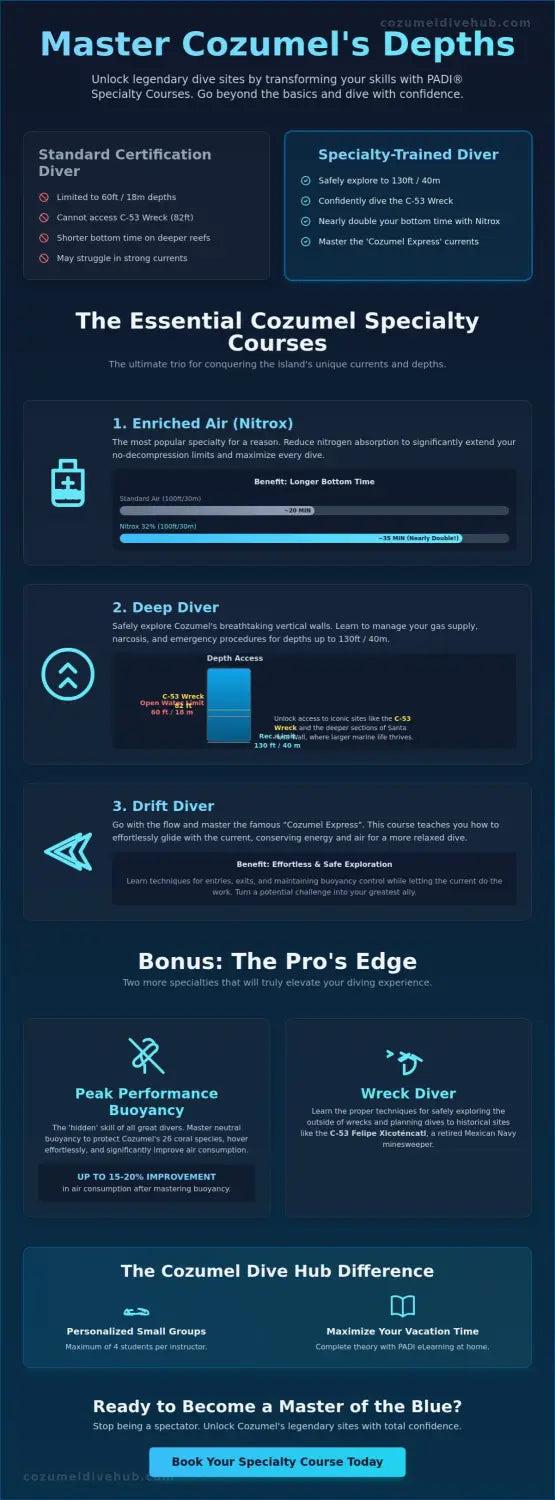
If you already hold Open Water or Advanced Open Water and you have a week of Cozumel diving booked, three courses genuinely earn their place here: Peak Performance Buoyancy, Enriched Air Nitrox, and — only if the deep southern walls are why you came — Deep Diver. Buoyancy control is the single skill that protects the reef and stretches a tank in a drift. Nitrox is cheap, almost entirely dry, and pays off across four or five consecutive diving days. Deep Diver is the card that opens Devil's Throat and the deep Punta Sur profiles. Most of the rest of the specialty menu is better taken at home, or skipped in favour of more diving.
Cozumel Dive Hub is an independent editorial guide. It runs no boats and teaches no courses, which is why this page is free to say that some certifications are not worth your holiday days.
Which Specialties Are Worth Your Cozumel Days?
The question is not which specialty is good in the abstract. It is which one changes your diving here, on a reef where almost every dive is a drift along a wall in warm, clear water, with a live boat picking you up wherever you surface. Ranked for that specific environment:
| Specialty | Verdict For Cozumel | Prerequisite | Training Dives | Typical Duration |
|---|---|---|---|---|
| Peak Performance Buoyancy | Take it first | Open Water, age 10+ | 2 | Half a day |
| Enriched Air Nitrox | Take it, costs almost no water time | Certified diver, age 12+ (PADI) | 2 dives or dry simulations | ~3 hours theory plus a session |
| Deep Diver | Take it only if the southern walls are the goal | Adventure Diver / AOW, age 15+ | 4 | 2–3 days |
| Drift Diver | Optional — the island teaches it anyway | Open Water, age 12+ | 2 | 1 day |
| Underwater Navigator | Low value here; the guide and the current navigate | Open Water | 3 | 1–2 days |
| Wreck Diver | Marginal — one wreck, four dives | Adventure Diver / AOW, age 15+ | 4 | 2 days |
| Digital Underwater Photographer | Good, but only after buoyancy is solid | Open Water | 2 | 1 day |
| Night Diver | Fun, mostly shore-based, not a priority | Open Water, age 12+ | 3 | 2–3 days |
| Sidemount | A gear pathway, not a Cozumel skill | Open Water | 3 | 2 days |
| Search and Recovery | Poor fit; burns boat days on sand work | Adventure Diver / AOW | 4 | 2 days |
Prerequisites above follow current PADI standards. SSI equivalents exist for most of these and are listed on the SSI course pages; the two systems are compared on the PADI vs SSI page.
Why Peak Performance Buoyancy Is The Highest-Value Course On This Island
Buoyancy is the course most divers dismiss as remedial, and it is the one that changes the most in Cozumel. Every dive here happens over protected reef inside a national marine park, at Palancar Gardens, Paso del Cedral, Santa Rosa Wall and the rest. A diver who is over-weighted and finning to stay level is doing two damaging things at once: touching coral they did not mean to touch, and burning gas they will want later in the dive.
PADI opens Peak Performance Buoyancy to Open Water divers from age 10. It runs over two dives and covers weighting, trim, streamlining and hovering. SSI's Perfect Buoyancy is the direct counterpart. Half a day of a week-long trip is a low price for a skill that improves every remaining dive, and the effect on air consumption is usually noticeable on the very next tank — the air consumption guide covers the rest of that picture.
It is also the only course on this list that is essentially a reef conservation measure disguised as a skills class.
Is The Nitrox Certification Worth It For Cozumel?
For a multi-day trip, yes — and it is the easiest yes on this page because it barely costs you any water time.
Enriched air contains more oxygen and less nitrogen than air, which extends no-decompression limits at recreational depths. That matters most on exactly the profile a Cozumel week produces: two tanks every morning, several days running, with nitrogen accumulating across the whole trip. PADI's Enriched Air Diver knowledge development takes about three hours and can be completed by eLearning before you fly, with certification requiring two enriched air training dives or dry pre-dive simulations with an instructor. SSI's Enriched Air Nitrox programme accepts students from age 10 and takes roughly three to six hours.
What nitrox does not do is make you a better diver, and it does not extend a dive that ends because your tank is empty rather than because your computer said stop. The dedicated Cozumel nitrox guide goes further into when the extra bottom time is real and when it is theoretical.
Do You Need Deep Diver For Cozumel's Southern Walls?
If your list includes Devil's Throat, Maracaibo or Colombia Deep, then yes — this is the one depth-based specialty that actually unlocks something in Cozumel.
Advanced Open Water certifies to 30 metres. PADI's Deep Diver specialty certifies to 40 metres, requires four training dives, and takes Adventure Diver or equivalent as its prerequisite with a minimum age of 15. It covers gas management at depth, nitrogen narcosis recognition and emergency decompression procedures. SSI's Deep Diving programme is the equivalent.
The honest qualifier: much of Cozumel's best diving is shallow. Palancar's coral heads, the multilevel reef profiles and the fish life all sit well within 30 metres, and depth here buys you structure rather than better reef. Take Deep Diver because you want the specific southern sites, not because deeper sounds more advanced. The deep diver specialty guide covers the sites it opens in detail.
Is A Drift Diver Course Necessary In The Drift Capital?
This is the awkward one. Cozumel is the most natural place on earth to take Drift Diver, and it is also the place where you are least likely to need it.
The Yucatán Current runs north along the west coast on essentially every dive, so every guided dive here is already a drift dive with a briefing attached. The specialty formalises what you would otherwise absorb: negative entries, buddy positioning in moving water, and deploying a surface marker buoy before a live boat pickup. It takes two dives from Open Water level, minimum age 12.
Worth it if you want the SMB and current-management skills taught deliberately rather than picked up by osmosis, or if you need a fifth specialty. Skippable if you simply want to enjoy the current — the drift diving guide will get you most of the way there for free.
Does One Wreck Justify The Wreck Diver Specialty?
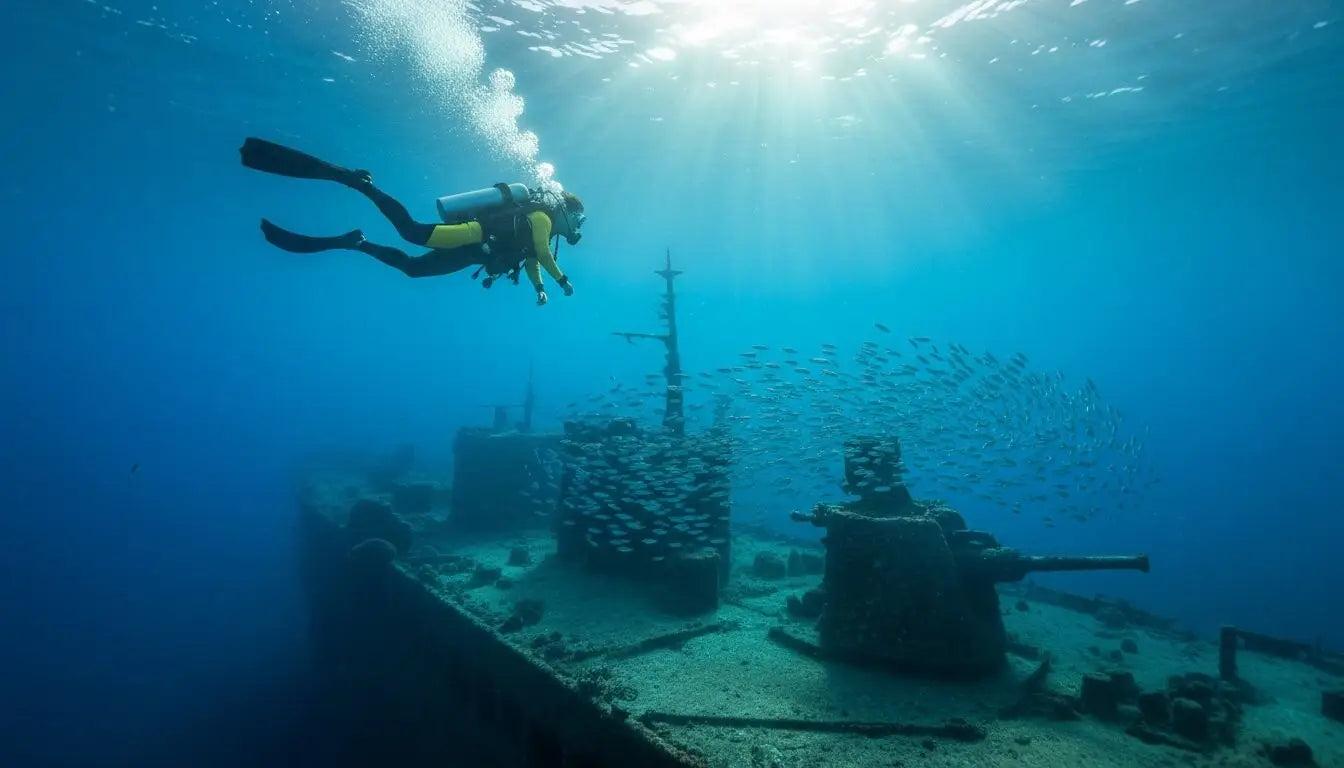
Cozumel has exactly one wreck: the C-53 Felipe Xicoténcatl, a former minesweeper sunk deliberately as an artificial reef and sitting upright in around 24 metres.
PADI's Wreck Diver specialty needs four dives, Adventure Diver or Advanced Open Water, and a minimum age of 15. It covers survey, mapping, line use and limited penetration inside the sunlight zone — it does not cover deep wreck penetration, which requires separate technical training. Four training dives on a single site means seeing the same hull four times.
The skills transfer well to wreck destinations elsewhere, and the C-53's interior is a genuine silt-out risk that rewards a proper frog kick. But if you only want to see the C-53, you can do that on a normal guided dive at Advanced level without the specialty at all. The Cozumel wreck diver guide breaks down what the course adds over a guided visit.
Which Specialties Are A Waste Of A Cozumel Day?
Some courses describe conditions that do not exist on this island. Taking them here means paying Cozumel prices to practise for water you are not in.
| Course | Why It Does Not Fit Cozumel | Where It Makes Sense |
|---|---|---|
| Dry Suit Diver | Water sits near 28°C; nobody dives dry here | Cold or temperate home diving |
| Altitude Diver | The island is at sea level; the course needs a site above 300 m | Alpine and mountain lakes |
| Ice Diver | Nothing freezes in the Caribbean | Nordic and alpine winter diving |
| Search and Recovery | Sand and line work that burns boat days on non-reef skills | Home quarries, lakes, harbours |
| Self-Reliant Diver | Cozumel park diving is guided group diving by design | Building toward solo or technical diving |
| Diver Propulsion Vehicle | The current already moves you faster than a scooter would | Big, still-water sites |
| Cavern Diver | The cenotes are on the mainland, not on Cozumel | A dedicated Riviera Maya trip |
Nothing here is a bad course. They are simply courses whose environment is somewhere else, and a Cozumel dive day is an expensive place to simulate one.
What Does The Master Scuba Diver Rating Actually Require?
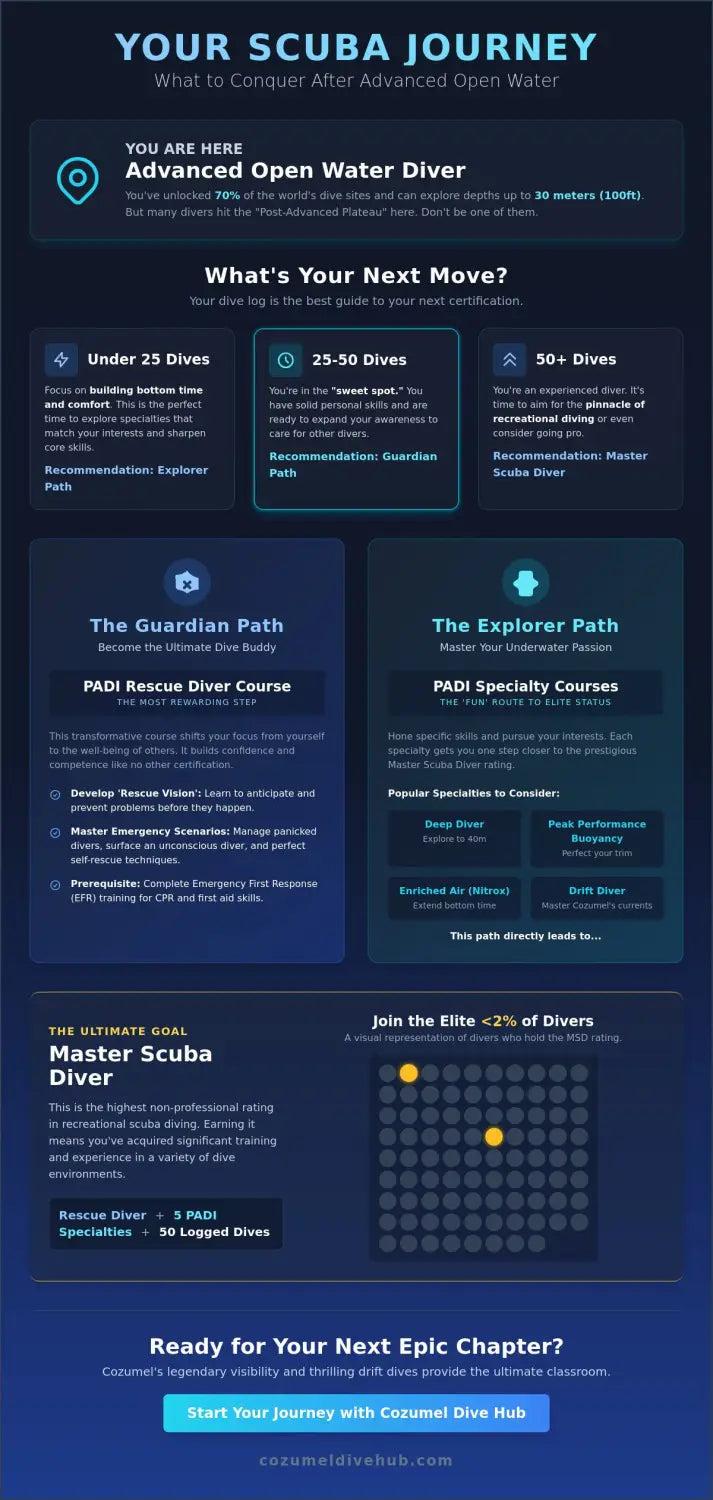
PADI's Master Scuba Diver is a recognition rating rather than a course, and its requirements are specific. According to PADI, you need to be at least 12 years old, hold Open Water Diver, Advanced Open Water Diver and Rescue Diver (or Junior Rescue Diver), complete five PADI specialty diver courses, and have at least 50 logged dives. PADI describes it as the highest non-professional level in its system and states that fewer than 2% of PADI divers hold it.
You then apply for the rating; there is no separate exam or course to sit. Rescue is the substantial piece and the one worth planning around — the Rescue Diver prerequisites guide covers what it demands before you commit a trip to it.
Chasing five specialties purely to reach the number is the wrong way to get there. Collect the ones you would have taken anyway.
What Do Specialty Courses Cost In Cozumel?
Published rates from two Cozumel operators, checked August 2026. Treat these as a range, not a quote — pricing changes and inclusions vary.
| Specialty | Deep Blue Cozumel (SSI) | Deep Blue Cozumel (PADI) | Dive Paradise (PADI) |
|---|---|---|---|
| Enriched Air Nitrox | $150 | $250 | $300 (with 2 boat dives) |
| Buoyancy | $240 | $330 | $191 (2 shore dives) |
| Deep | $420 | $535 | $504 (3 boat dives) |
| Drift | — | $370 | $365 (2 boat dives) |
| Navigation | $230 | $380 | $255 (2 shore dives) |
| Night | $350 | $440 | $332 (3 shore dives) |
Two things routinely sit outside those figures. Dive Paradise lists a separate certification processing fee per PADI course and a daily marine park fee, and states that textbooks and gear rental are not included; the marine park fee guide explains that charge, and the gear rental guide covers the equipment side. For comparison, a standard two-tank morning boat dive on the island runs around $130 at 2026 rates — which is the number that makes the next section worth reading.
When More Fun Dives Beat Another Certification Card
For a lot of visitors, the best use of the money is not a course at all.
A specialty priced at $370 is roughly three two-tank mornings. If you have 25 logged dives and you are still thinking about your buoyancy rather than the reef, ten unhurried fun dives will do more for you than a card earned during two of them. Comfort in the water comes from repetition. Certifications record it; they do not create it.
The exceptions are the two courses at the top of this page, and for the same reason: buoyancy and nitrox both change every dive that comes after them, rather than granting access to a narrow set of conditions. Everything else is a reasonable purchase only once you are already comfortable — and if you are not diving regularly at home, a refresher is a better first spend than any specialty.
If you are newer than this and still building a picture of the island, start with the beginner's guide to scuba diving in Cozumel and the dive sites guide.
How To Fit Training Into A One-Week Cozumel Trip
A realistic week has around ten dives in it. Spending all of them on training wastes the reef; spending none of them wastes an opportunity. A workable split:
- Before you fly: finish nitrox theory by eLearning. It is the only part of any of this that costs nothing but sofa time.
- Day one: dive. Get your weighting sorted and let the boat routine become familiar before adding a course to it.
- Day two: Peak Performance Buoyancy across the morning's two tanks, plus the nitrox sign-off.
- Days three to five: dive on the certifications you now hold, using the buoyancy on the reef rather than on a skills circuit.
- Only if the southern walls are the point: add Deep Diver's four dives, which will occupy most of two more days.
Conditions shape this more than the plan does — a norte can close the port for a day in winter, so build slack into any training schedule. The conditions by month guide shows what to expect when. If you are still working through Advanced Open Water, that comes before any of the specialties above.
Does It Matter Whether You Take Specialties With PADI Or SSI?
For recreational purposes, not much. Both agencies are widely recognised, Cozumel operators generally teach and accept both, and the underlying skills are comparable.
The practical differences are small and worth knowing. SSI specialty pricing on the island tends to run lower than the PADI equivalent for the same content. Minimum ages differ slightly — SSI accepts nitrox students from 10, PADI from 12. And the names diverge: SSI's Perfect Buoyancy is PADI's Peak Performance Buoyancy, SSI's Wreck Diving is PADI's Wreck Diver. The full catalogue for both sits under dive courses, split into PADI and SSI listings, with a side-by-side comparison on the PADI vs SSI page.
If you are mid-pathway with one agency, staying with it keeps your paperwork simple. If you are starting fresh, pick the instructor and the shop, not the logo.
Planning Your Cozumel Training Trip
The short version: buoyancy first, nitrox because it is nearly free in water time, deep only if the southern walls are the reason you booked. Everything else is a fifth specialty, a niche interest, or a course whose environment is somewhere other than this island.
Other specialties worth a look once the basics are solid include underwater photography, which depends entirely on buoyancy being sorted first, sidemount if you are heading toward technical configurations, and conservation-focused options like coral reef conservation and fish identification that add to what you actually see on a dive. The complete list lives in the Cozumel dive courses index.
Work out how many dive days you really have, then decide how many of them you are willing to spend on skills rather than reef. Plan your Cozumel dive trip to get the logistics in order first.
Frequently Asked Questions
Which specialty course is most worth taking in Cozumel?
Do you need the Deep Diver specialty to dive Devil's Throat?
Is the nitrox certification worth it for a Cozumel trip?
What does the PADI Master Scuba Diver rating require?
Which specialty courses are a waste of a Cozumel dive day?
Can you take a specialty course with only an Open Water certification?
How much do specialty courses cost in Cozumel?
Is the wreck specialty worth it when Cozumel has only one wreck?
Should you take another course or just do more fun dives?
Does it matter whether you take specialties with PADI or SSI?
Share This Article
Carmen Novelo
Carmen Novelo is a Cozumel native and an active scuba instructor and dive guide on the island. She has spent twelve years diving the Cozumel reef system, and writes about its dive sites, conditions and marine life for Cozumel Dive Hub.