PADI Rescue Diver Course Cozumel Prerequisites: Are You Ready?
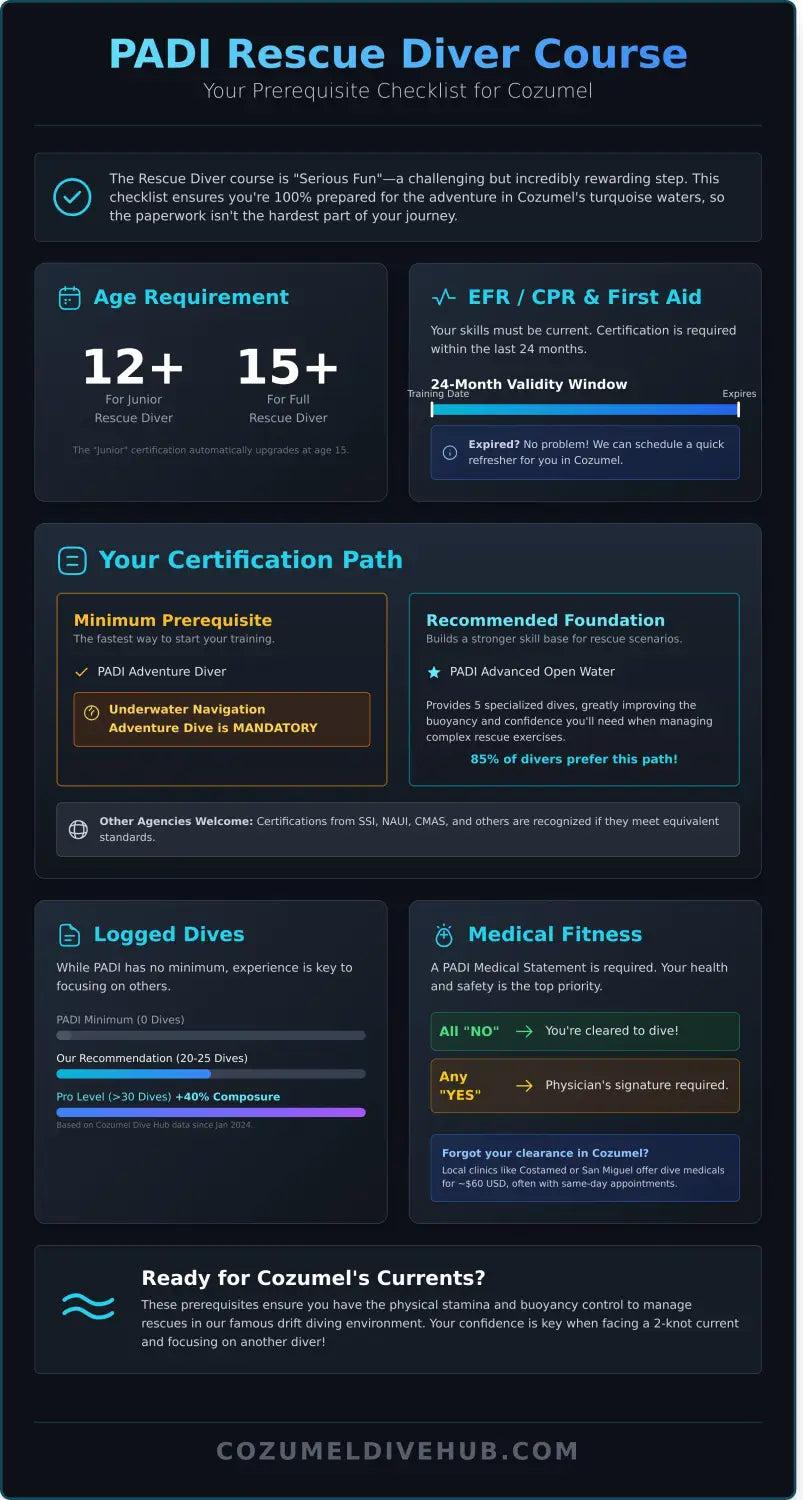
Three prerequisites get you onto a PADI Rescue Diver course in Cozumel, and a logged-dive count is not one of them: you need to be 15, hold Advanced Open Water or Adventure Diver with navigation, and have EFR training under 24 months old.
Carmen Novelo · March 10, 2026 · 18 min read
To enroll in the PADI Rescue Diver course you need three things and nothing else: a minimum age of 15 (12 for Junior Rescue Diver), a PADI Advanced Open Water Diver certification or a PADI Adventure Diver certification that includes the Underwater Navigation Adventure Dive, and Emergency First Response Primary and Secondary Care training completed within the previous 24 months. PADI states these as "PADI (Junior) Adventure Diver with a completed Underwater Navigation Dive OR PADI Advanced Open Water Diver/Junior Advanced Open Water Diver (or qualifying certification)" plus "Emergency First Response Primary and Secondary Care training (or qualifying training) within 24 months." There is no minimum logged-dive requirement. You also complete a medical questionnaire before training, which sends some divers to a physician first.
The requirement that catches people out is the 24-month window on first aid. It is not a lifetime certification and it is not five years. If your CPR card was issued more than two years before your course dates, you cannot certify until you refresh it — which is why so many divers land in Cozumel expecting a two-day course and end up adding a day.
The PADI Rescue Diver Prerequisites Checklist
| Requirement | What PADI Requires | Where People Get It Wrong |
|---|---|---|
| Minimum age | 15 for Rescue Diver; 12 for Junior Rescue Diver | Junior divers can train, but the rating is issued as Junior until the age requirement is met |
| Certification level | Advanced Open Water Diver, or Adventure Diver including the Underwater Navigation Adventure Dive | Full Advanced is not mandatory — but the navigation dive is, and many Adventure Diver cards do not include it |
| First aid | Emergency First Response Primary and Secondary Care within the previous 24 months | Primary Care alone is not enough; both halves are required, and the window is 24 months, not 3 or 5 years |
| Logged dives | None specified by PADI | Operators may set their own comfort threshold; that is a shop policy, not a standard |
| Medical | Diver Medical Participant Questionnaire completed before training | A "yes" answer does not automatically mean a doctor's visit — see the medical section below |
| Other agencies | Qualifying certification and qualifying first aid training accepted | Bring the card and the dated first aid certificate, not just a claim |
If you are still deciding between routes, the Advanced Open Water Diver course gives five adventure dives against the Adventure Diver course's three, and the broader case for doing it in Cozumel is covered in the Advanced Open Water guide. Either route is valid for entry provided navigation is on the card.
Bring a certification card — digital in the agency app is fine at most shops — and your logbook. If your card is missing, sort that before you fly, not on the morning of day one; there is a separate guide on replacing a lost PADI card.
What Does the 24-Month EFR Window Actually Mean?
It means the completion date on your Emergency First Response Primary and Secondary Care certificate must fall within the two years before your Rescue Diver certification is issued. A card completed in June 2024 covers a course finishing in May 2026 and does not cover one finishing in July 2026. There is no grace period built into the standard.
Two details matter. First, both halves count. Primary Care covers scene assessment, barrier use, primary assessment, CPR, serious bleeding, shock, spinal injury and choking management. Secondary Care covers the injuries and illnesses that are not immediately life-threatening — sprains, fractures, dislocations, burns, dental injuries, heat illness, stroke and heart attack assessment. A CPR-only workplace card satisfies half the requirement.
Second, PADI accepts "qualifying training," meaning equivalent first aid and CPR training from another recognized provider. It has to be dated, it has to cover both primary and secondary care, and it has to be inside the window. Whether a specific certificate qualifies is a judgment the instructor makes when they see the document, so send a photo of it ahead of time rather than arriving and hoping. If yours has lapsed, the EFR Primary and Secondary Care course is widely taught on the island and typically runs half a day to a full day.
Note that AED use and emergency oxygen administration are listed by EFR as recommended optional content rather than core requirements. Oxygen administration does appear inside Rescue Diver itself as Exercise 9, and the standalone Emergency Oxygen Provider course goes deeper for anyone who wants it.
What Counts as a Qualifying Certification From Another Agency?
PADI's own wording is "or qualifying certification," which is the mechanism that lets an SSI, NAUI, CMAS or BSAC diver enter the PADI Rescue Diver course without repeating earlier training. The practical test is whether the certification is equivalent in scope to PADI Advanced Open Water Diver — or to Adventure Diver with navigation completed. An SSI Advanced Adventurer card with the navigation dive logged is the usual crossover; an entry-level card on its own is not.
The same principle runs the other way. SSI accepts "equivalent from a recognized training agency" for its own rescue-level training. Cross-agency movement in both directions is normal, and the PADI versus SSI comparison covers how the two systems differ once you are past the paperwork.
What no agency will do is take your word for it. Bring the physical or digital card. If your navigation dive is the question mark, the Underwater Navigator course closes the gap in a single dive, and it is genuinely useful — Exercise 5 of Rescue Diver is a search for a missing diver, and you cannot run a search pattern you cannot navigate.
PADI Rescue Diver vs SSI Diver Stress and Rescue
The two courses cover similar ground and both are widely taught in Cozumel, but their entry requirements are not identical. The SSI figures below come from SSI's published training standards.
| PADI Rescue Diver | SSI Diver Stress & Rescue | |
|---|---|---|
| Minimum age | 15 (12 for Junior) | 12 |
| Certification prerequisite | Advanced Open Water, or Adventure Diver with Underwater Navigation | Open Water Diver or equivalent required prior to certification |
| First aid requirement | EFR Primary and Secondary Care within 24 months | Proof of current O2 Provider, First Aid and CPR training within two years prior to card issue |
| Oxygen provider training | Not required for entry | Required |
| In-water structure | 10 rescue exercises plus 2 open water rescue scenarios | At least 3 pool/confined sessions and at least 3 open water training dives |
| Theory | Knowledge development, five sections with quizzes and a final exam | Academic sessions and final exam per the instructor manual |
| Cross-agency entry | Qualifying certification accepted | Equivalent from a recognized training agency accepted |
The headline difference: SSI folds oxygen provider training into the requirement and does not demand an advanced-level card first, while PADI requires the higher certification level but leaves oxygen provider optional. Neither is harder; they front-load different things. Both the PADI Rescue Diver course and the SSI Diver Stress & Rescue course are offered on the island, as is SSI's React Right first aid program.
What the Course Actually Contains: 10 Exercises and 2 Scenarios
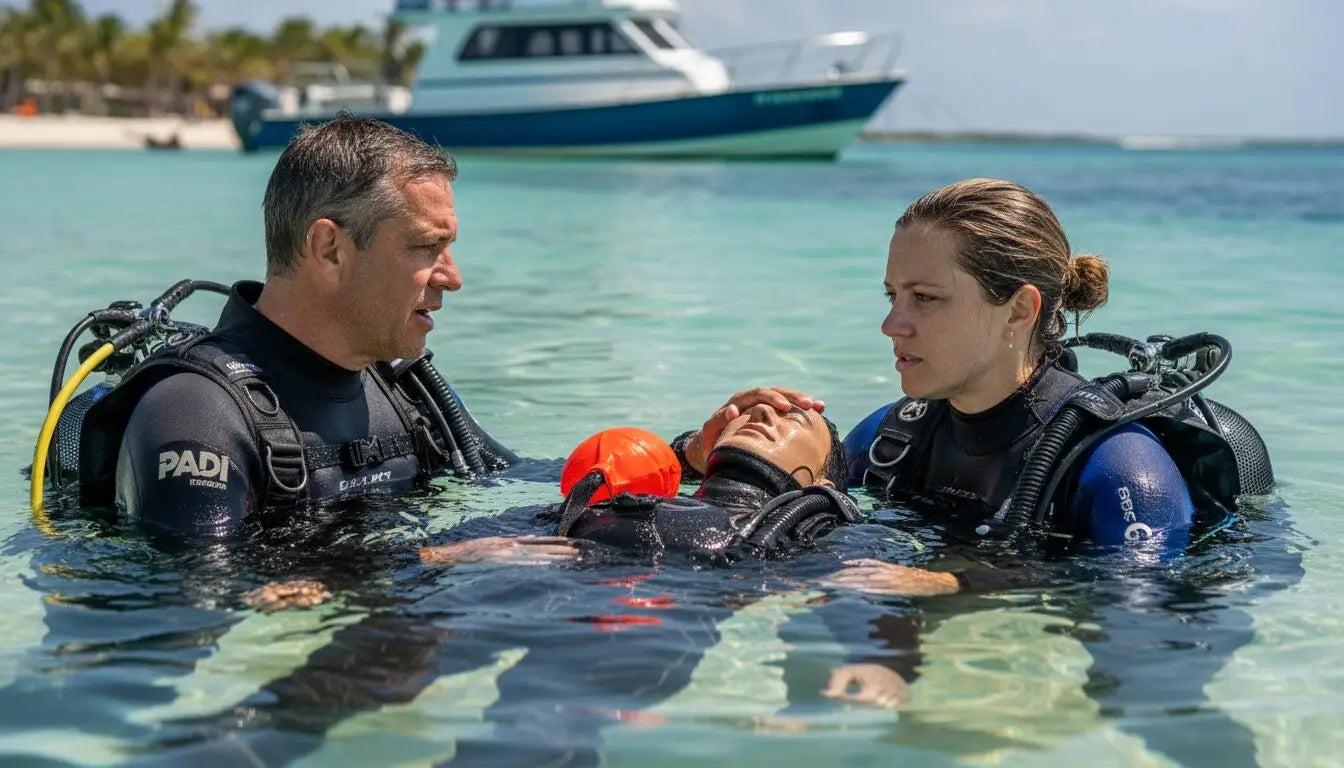
The structure is fixed. Knowledge development comes first — five sections with quizzes, a final exam, tutorial videos and an Accident Management Workslate, completed either in a classroom or through eLearning before you travel. Then ten rescue exercises, then two open water rescue scenarios that PADI describes as the in-water final exam, combining everything from the exercises to rescue an unresponsive diver underwater and an unresponsive diver at the surface.
| # | Exercise |
|---|---|
| 1 | Tired Diver |
| 2 | Panicked Diver |
| 3 | Assisting a Responsive Diver From Shore, Boat or Dock |
| 4 | Distressed Diver Underwater |
| 5 | Missing Diver |
| 6 | Surfacing an Unresponsive Diver |
| 7 | Unresponsive Diver at the Surface |
| 8 | Exiting an Unresponsive Diver |
| 9 | First Aid for Pressure-Related Injuries and Oxygen Administration |
| 10 | Response from Shore or Boat, Unresponsive Diver |
Read that list again and notice what is absent: there is no exercise about you. Every entry-level and continuing-education course up to this point has been about managing your own gas, your own buoyancy, your own ascent. Rescue Diver is the course where the attention turns outward permanently. That is the actual content of the certification — not the tows and the carries, but the habit of scanning the group and noticing the diver who is breathing too fast on the surface before they become Exercise 2.
Why Rescue Is Called the Most Useful and Most Tiring Course
It is the course divers most often name as the one that changed how they dive, and PADI itself describes it as "physically and mentally demanding," requiring candidates to "problem-solve and take immediate action on the go."
The tiredness is structural rather than incidental. Surfacing an unresponsive diver, establishing positive buoyancy for two people, removing two sets of gear at the surface while maintaining rescue breaths, and then getting a limp adult out of the water is genuine physical work, and you repeat it. The mental load compounds it: unlike every previous course, the scenarios are unscripted. Nobody tells you which problem is coming. You surface from Exercise 6 out of breath and then have to think clearly about an airway.
The usefulness is the flip side of the same thing. The prevention half — recognizing stress, spotting the diver whose kit does not fit, breaking the chain early — is what most Rescue Divers actually use, repeatedly, for the rest of their diving lives, usually without anything dramatic ever happening. It is also the mandatory gateway to professional training, so anyone eyeing Divemaster or a longer path into a diving career passes through it.
The Medical Statement: What It Asks and When You Need a Doctor
Every student completes the Diver Medical Participant Questionnaire before in-water training. It has ten numbered questions covering respiratory, cardiac, neurological and other history, with follow-up pages behind several of them.
The commonly repeated claim that any "yes" answer requires a physician's signature is not what the form says. Its directions state that a participant who answers yes to questions 3, 5 or 10, or to any question on page 2, must sign the relevant statement and take all three pages to a physician for a medical evaluation. Other yes answers route through the follow-up pages first. Read the dive medical form directions yourself and complete it honestly and in advance — that is the whole point of the timing.
This guide cannot tell you whether any particular condition, medication or surgical history is compatible with diving. That determination belongs to a physician familiar with diving medicine, and the right time to seek it is before you book flights, not on the pier. If a condition is flagged, understanding where the island's hyperbaric chamber facilities sit is worthwhile background — see the Cozumel hyperbaric chamber guide — and carrying dive insurance is sensible regardless, as the travel insurance guide sets out.
Is Cozumel a Good Place to Do Rescue Diver?
For most of the exercises, yes, and the reason is unglamorous: comfort. Cozumel's water sits in the high 70s to mid 80s Fahrenheit year-round, and visibility is routinely measured in tens of meters rather than a couple of arm-lengths. Compare that with certifying in a cold quarry in a thick wetsuit or drysuit, where you are task-loaded by thermal stress and where losing sight of a "missing diver" at three meters is trivially easy.
That difference is material, not cosmetic. Exercise 5 — searching for a missing diver — teaches you a pattern; running it in clear water lets you actually watch the pattern work rather than groping through green. Exercise 6, surfacing an unresponsive diver, is easier to perform correctly when you can see your ascent line and your buddy from a distance. Warm water also means longer sessions before anyone gets cold and sloppy, and sloppy is when rescue practice stops teaching anything. Month-by-month specifics are in the Cozumel dive conditions guide and the best time to dive breakdown.
Shallow, sheltered sites suit the skills work. Paradise Reef and Chankanaab Shallow Reef are the kind of shallow, easy-access water where exercises get repeated until they stop being clumsy, before scenarios move to reef sites like Palancar Gardens.
The Drift: What Cozumel Makes Harder, Not Easier
Here is the honest counterweight. Cozumel is a drift diving destination, driven by the Yucatán Current running north along the west coast, and a rescue in moving water is a different problem from a rescue in still water.
A tired-diver tow is the clearest example. In a quarry you tow toward a fixed exit point. In a drift you and the casualty are both moving, the boat is repositioning, and the useful question is not "how do I get there" but "how do I stay together and stay visible." That reframes the skills that matter: surface marker buoy deployment stops being an optional flourish and becomes the thing that makes a live boat pickup possible, and separation from the group happens faster than most divers expect. Winter nortes add surface chop that makes rescue breaths at the surface meaningfully harder.
None of this is a reason to certify elsewhere. It is a reason to arrive with your buoyancy already solid, because task-loading in current punishes anyone still thinking about their own trim. If drift is new to you, the Cozumel drift diving guide and the honest assessment in how strong the current really is are worth reading first, and a Drift Diver or Peak Performance Buoyancy session beforehand is time well spent. Divers who have been out of the water a while should consider a refresher before starting.
What Does Rescue Diver Cost in Cozumel?
Prices below are taken from published Cozumel operator pages and checked in August 2026. They are estimates for planning only — rates change, and what is bundled varies enormously between shops. Confirm directly before booking.
| Operator | Rescue Diver | EFR | Notes (checked August 2026) |
|---|---|---|---|
| Blue Note Scuba | $400 USD plus eLearning | $75 plus eLearning | 2–3 days; eLearning purchased separately from PADI |
| Cozumel Dive School | $465 USD | $169 USD | 3 days, or 4 days and $610 for the combined Rescue + EFR package |
| Deep Blue Cozumel | $600 USD | Priced on request | 2–3 days, four beach dives, eLearning included in the quoted figure |
| Aldora Divers | 9,650 MXN | 3,995 MXN | Peso pricing; EFR Primary & Secondary Care listed as one day |
Read those numbers as a band of roughly $400 to $600 USD for the in-water course, with EFR almost always a separate line item rather than an inclusion. The single biggest source of confusion is eLearning: some quotes include the PADI digital materials and some do not, and the gap between two otherwise identical prices is often exactly that. Ask which of the three components — eLearning, in-water training, certification fee — a quoted number covers. Marine park fees and gear rental may also sit outside it.
If you are weighing which continuing-education course to spend the money on, the what to take after Advanced Open Water comparison and the specialty courses overview put Rescue in context. Choosing the shop matters more here than on a fun dive, since instructor attention is the product — the guide to choosing a Cozumel dive shop covers what to ask.
How Many Days Should You Budget?
PADI's own guidance puts the full course at four to seven days including theory and in-water sessions. Cozumel operators commonly schedule two to three days in the water, which works because the knowledge development is done as eLearning before arrival rather than in a classroom on the island. Add roughly a day if you also need EFR.
The realistic planning rule: finish the theory at home, book three days for the water, and do not schedule the course against your flight home. Rescue days are long and physical, and a compressed schedule is the enemy of skills that need repetition. The PADI eLearning process guide explains how to start the digital portion before you travel.
Before You Book: The Five-Minute Check
Look at your certification card and confirm it says Advanced Open Water Diver — or Adventure Diver with the navigation dive logged. Look at your first aid certificate and find the completion date; if it is more than 24 months before your travel dates, budget for EFR. Fill in the medical questionnaire now rather than at the shop, and if it points you to a physician, go before you book. Photograph both cards and email them to the operator when you make the reservation so any gap surfaces weeks out instead of on day one.
Everything else — buddy checks, fitness, a working dive computer, familiarity with your own kit — is preparation rather than prerequisite. It is preparation that decides whether the course is exhausting-and-excellent or just exhausting. Safety awareness is also the theme running through the broader question of whether Cozumel diving is safe, and Rescue Diver is the single course that most improves your own answer to it. When you are ready to line up dates, operators and logistics, start with the Cozumel dive trip planner.
Frequently Asked Questions
What are the prerequisites for the PADI Rescue Diver course?
How recent does my CPR and first aid training need to be for Rescue Diver?
Do I need Advanced Open Water to take the PADI Rescue Diver course?
How many logged dives do I need before the Rescue Diver course?
What is the difference between PADI Rescue Diver and SSI Diver Stress and Rescue?
How long does the PADI Rescue Diver course take?
Is the Rescue Diver course hard?
Does a certification from another agency qualify me for PADI Rescue Diver?
Do I need a doctor's approval to take the Rescue Diver course?
How much does the Rescue Diver course cost in Cozumel?
Share This Article

Carmen Novelo
Carmen Novelo is a Cozumel native and an active scuba instructor and dive guide on the island. She has spent twelve years diving the Cozumel reef system, and writes about its dive sites, conditions and marine life for Cozumel Dive Hub.