How Strong Is the Current in Cozumel?
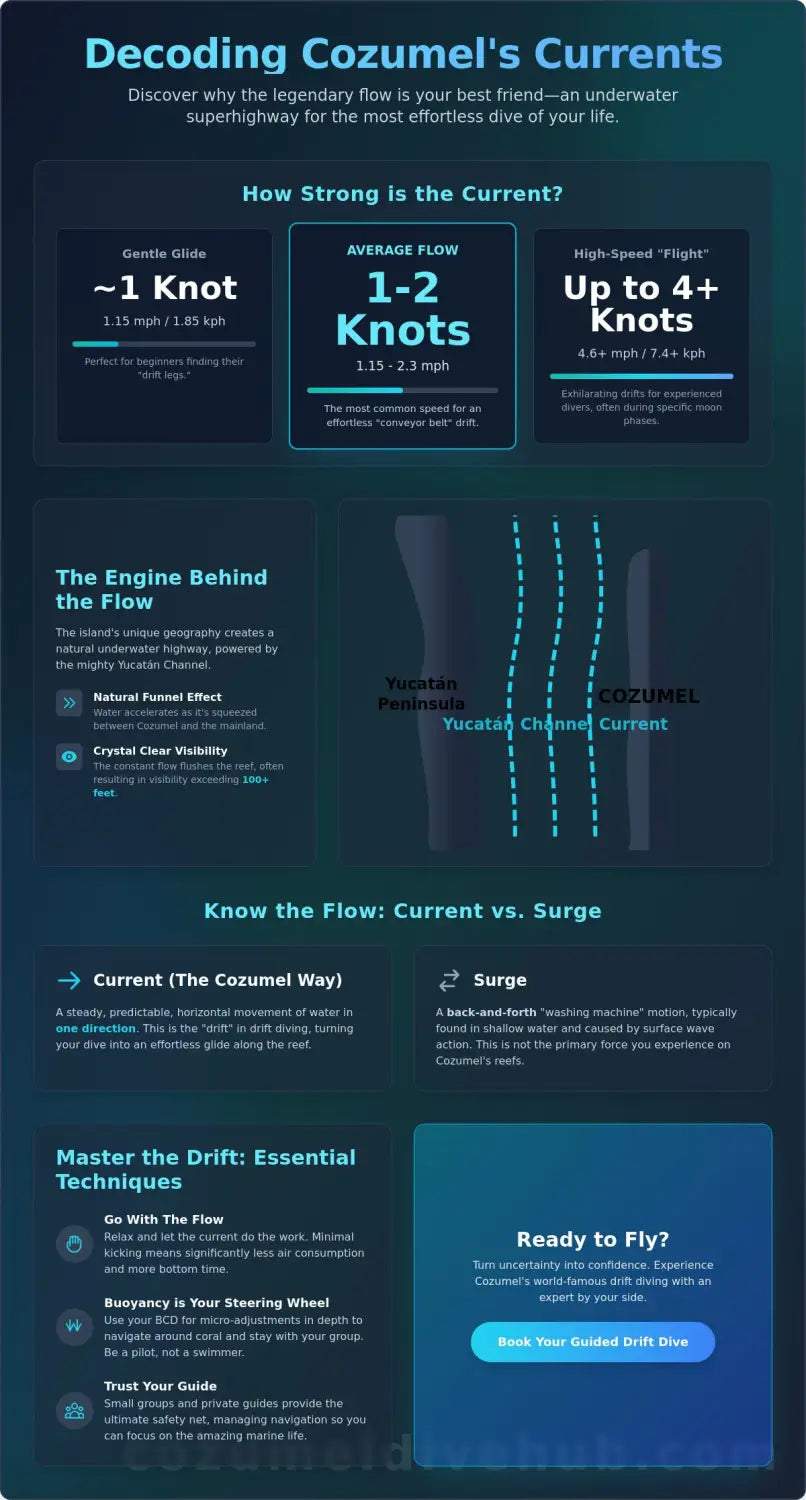
Most Cozumel diving sits in a mild-to-moderate range where you drift comfortably and can tuck behind a coral head to pause. The northern sites on a strong day are different: you are moving fast enough that stopping is not an option.
Luisa Carmona · May 28, 2026 · 6 min read
Anywhere from barely noticeable to about a brisk walking pace, depending on the site and the day.
Most Cozumel diving sits somewhere in the mild-to-moderate range — you drift along comfortably and can tuck behind a coral head if you fancy a pause. On the strongest days up north, though, you’re moving quickly enough that stopping isn’t really an option.
What each strength feels like
Mild. You drift along slowly and could swim against it for a bit if you had to. Most of Paradise, Chankanaab and the sheltered mid-island reefs.
Moderate. You’re moving along steadily. You could swim against it, but it’s tiring and gets you nowhere. This is standard Cozumel diving — Santa Rosa, Yucab, Tormentos and most of Palancar.
Strong. You’re moving fast, there’s no swimming against it, and you stay close to the guide. Barracuda, San Juan, and the southern sites on their day. This is where a separated diver goes out of sight quickly, which is exactly why the SMB and group discipline matter.
Ripping. Happens occasionally, and decent operators just move the dive or call it. If your guide switches sites, that’s not them being difficult — that’s the system working properly.
By site
| Site | Typical | Notes |
|---|---|---|
| Barracuda | Strong | Fastest on the island, advanced only |
| San Juan | Strong | Northern, exposed |
| Punta Sur | Moderate–strong | Plus depth |
| Maracaibo | Moderate–strong | Deep and remote |
| Santa Rosa Wall | Moderate | Classic drift |
| Palancar Gardens | Moderate | Structure gives shelter in places |
| Yucab | Moderate | Steady, predictable |
| Tormentos | Moderate | Coral heads give shelter |
| Paradise Reef | Mild | Beginner-friendly |
| Chankanaab | Mild | Sheltered |
When it runs strongest
Winter, December to March, generally brings the strongest current alongside the best visibility. The two go together — the water movement is what keeps the visibility high.
Summer, June to September, is typically lighter. The month-by-month guide has the full picture.
Tide has a modest effect but this is not tidal current in the way an estuary is. The Yucatán Current runs continuously. Tide modulates it rather than driving it.
Nobody knows how strong it’ll be on the day. Anyone telling you otherwise is guessing. What a good operator does is check when they get there and move the dive if it doesn’t suit the group.
What to do if it is stronger than expected
Get low. Current is usually weaker close to the reef, in the boundary layer.
Get behind structure. Coral heads create calm pockets on the downstream side.
Flatten out. Trim horizontal. Head-up posture turns you into a sail.
Stay with the guide. Do not drop back to look at something. In strong current you will not catch up.
Do not fight it. Every meter swum upstream costs air you will want at the end.
Is it dangerous?
Not in itself. Current is the normal condition here and thousands of divers handle it daily.
It becomes a problem in three situations: separation from the group, which is why you carry an SMB; combined with depth, which is what makes Punta Sur and Maracaibo advanced dives; and a diver out of their depth, literally and otherwise, on a site that does not suit them.
Our Cozumel scuba diving overview brings the island's dive sites, dive shops, courses and prices together on one page.
The full technique guide covers positioning and separation procedure. And if you’re unsure whether a site suits you, ask — the dive centers running small groups are the ones who will actually tell you honestly.
Frequently Asked Questions
How strong is the current in Cozumel?
Is the current in Cozumel always strong?
When is the current strongest in Cozumel?
Can you dive Cozumel in strong current?
What do I do if the current is too strong?
Is the current in Cozumel tidal?
Which Cozumel dive site has the strongest current?
Share This Article

Luisa Carmona is a PADI Master Scuba Diver Trainer based in Cozumel, where she teaches and guides divers on the island's marine park reefs. She contributes to our guides on Cozumel diving and is an expert in all things scuba diving in Cozumel. Follow her @cozumelmermaid.
Guides in this topic
- Cozumel Dive Sites: Every Reef, Ranked by Depth and Skill
- Cozumel Wall Diving: Match Walls to Your Certification
- Cozumel Dive Sites Map: Reef Zones & Layout Guide
- Are There Cenotes in Cozumel? Complete Dive Guide
- Deepest Dive Sites in Cozumel: Diver Guide
- Palancar Reef Cozumel Diving: The Ultimate Guide to the Crown Jewel
- Colombia Reef Cozumel: A Complete Guide to the Island's Underwater Cathedral