What to Expect on Your First Drift Dive: A Beginner's Guide to Cozumel's Underwater Flight
Drift diving in Cozumel is easier than the diving most people were certified in, not braver or more advanced. Nobody navigates, nobody budgets air for a return swim, and nobody kicks. The current does the three jobs you trained to do.
Carmen Novelo · March 24, 2026 · 7 min read
Start with the part that gets buried: drift diving in Cozumel is easier than the diving most people were certified in. Not braver. Not more advanced. Easier.
Think about where you did your open water dives. A quarry, a lake, a bay, a sheltered bit of reef. You kicked out from a fixed point, navigated, watched your gas against the swim back, and came up tired at the same buoy you left. Three separate jobs — propulsion, navigation, and gas budgeting for a return leg — layered on top of simply breathing and looking around.
Cozumel deletes all three. The water moves; you go with it. Nobody navigates, because the route is whichever way the ocean is going. Nobody budgets air for a return swim, because there is no return swim. And nobody kicks, which is precisely why divers who stop kicking here get twenty extra minutes out of the same tank.
The only genuinely new thing is a short list of procedures around the entry and the pickup. That list is what this page covers.
How Cozumel's Current Actually Works
Cozumel sits in a strait — the Cozumel Channel — between the island and the Yucatán Peninsula. Water pushes through that strait as the Yucatán Current, the flow that feeds the Loop Current and eventually the Gulf Stream. It runs one direction: south to north, along the island's western shelf, which is exactly where every boat dive happens.
Measurements bear this out. A study of the flow over Cozumel's insular shelf found the current "predominately flowing in a northerly direction," averaging roughly 0.9 to 1.1 m/s (about 1.7 to 2.1 knots) at 30 m depth across the channel, with peaks near 1.8–1.9 m/s in the northern portion and isolated readings as high as 2.7 m/s (Journal of Marine Science and Engineering, 2019).
Two honest caveats about those numbers. They describe open channel water, not what you feel hugging a reef at 60 feet — reef structure, depth and the shape of the shelf slow and deflect the flow, so a typical dive is gentler than the headline figure. And they are averages: any given morning can be well under or well over. What does not change is the direction. If you remember one fact from this page, make it that one. The current goes north, and so do you.
Three consequences follow, and together they are the whole shape of a Cozumel dive:
- Every dive is one-way. You splash at the southern end of a reef and surface somewhere north of it, often half a mile away. Entry point and exit point are different places by design.
- You never swim back to anything. There is no anchor line, no mooring, no fixed reference to return to. The boat comes to you.
- The boat stays under power. It follows the group's bubbles along the surface and repositions for the pickup. Nothing is tied off.
Negative Entry: Why Boats Here Often Use It
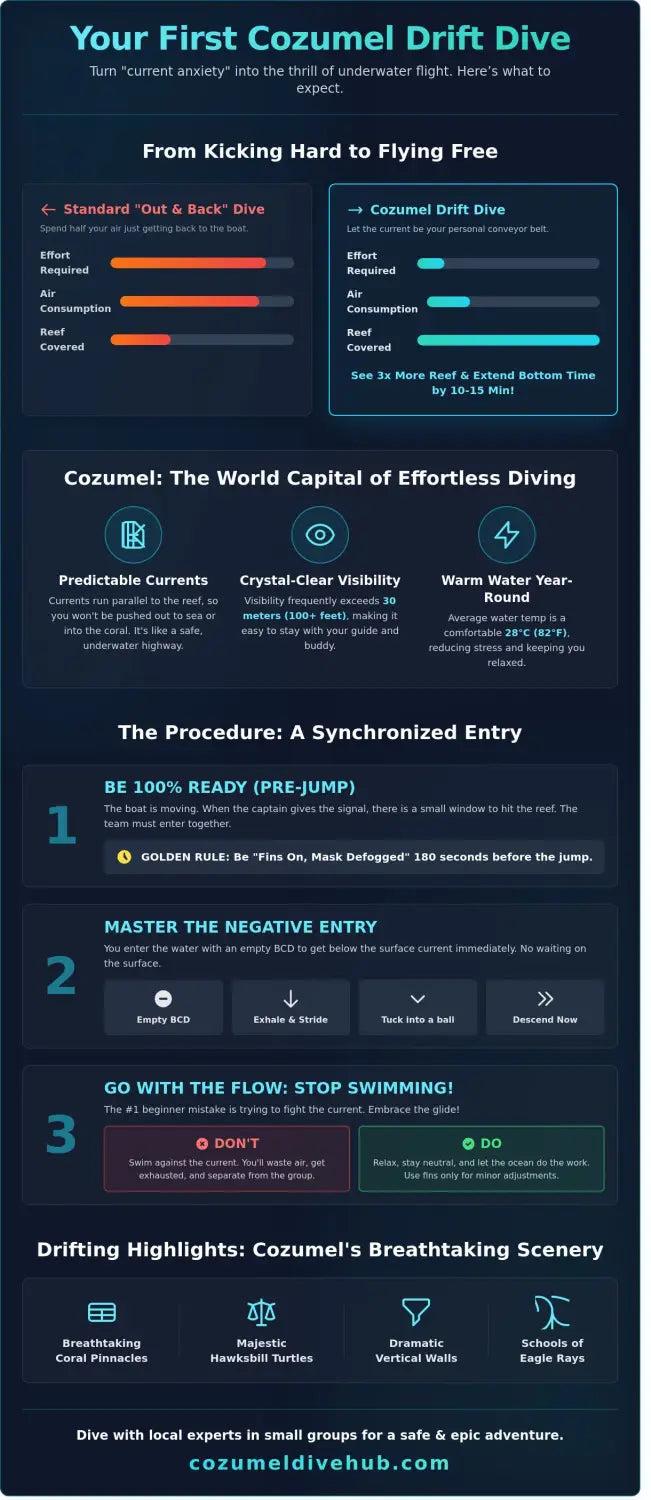
A negative entry sounds intimidating and mostly is not. It means you enter the water with your BCD fully deflated and start descending immediately, instead of floating on the surface doing the usual gauge check while the group assembles.
The reason is arithmetic. If a boat drops eight divers and everyone bobs on the surface for ninety seconds sorting out masks and snorkels, moving water plus wind chop will scatter that group over a considerable stretch of ocean — and scatter them at different rates, because a diver riding high in the water catches more wind than one riding low. Everyone goes under at once, and the group meets at depth where it is calm, quiet and easy to see each other. Grouping below the surface is easier than grouping on it.
What it actually involves, in order:
- Be completely ready before the boat slows. Fins on, mask defogged and on your face, air on, buddy check done, computer awake.
- Dump every bit of air from your BCD. This is the step people forget, and it is the step that makes the entry work.
- Hold your mask and regulator firmly with one hand, weights or waistband with the other, and take a giant stride or back roll on the signal.
- Exhale as you hit the water and keep exhaling. Tuck in — arms close, no starfish — and let yourself sink.
- Equalise early and often, every few feet, starting before you feel pressure. This is the part that catches people out, because you are descending sooner and slightly faster than you may be used to.
- Level off at the briefed meeting depth, find the guide and your buddy, and settle into neutral buoyancy.
If equalising is slow for you, say so before the dive rather than during it. There is nothing wrong with descending a little behind the group along an agreed line, and a guide told in advance will plan for it. Told nothing, they cannot.
Not every Cozumel dive uses a negative entry — plenty of calm mornings at shallow sites use an ordinary entry with a surface gather. The dive briefing tells you which one you are doing. Listen to it.
What You Actually Do Differently Underwater
Here is the short version: less. The commonest first-timer error is doing too much.
Stop finning. Once you are in the flow you are moving at the same speed as the water around you, which means it feels like nothing at all — no rush, no pressure, no sensation of speed. That absence of feedback is what fools people. They see reef passing below, assume they should be swimming, and kick. Kicking against or across the flow is the fastest way to burn a tank; kicking with it just makes you overtake the group. Your fins are rudders here, not engines. Small ankle tilts to steer, and that is it.
Get your buoyancy honest. The reef profile changes under you as you drift, sometimes by twenty or thirty feet in a short stretch as you cross a wall or ride up over a coral head. Anticipate it. Add a touch of gas before you need it rather than chasing the change afterwards. This matters more here than in still water, because the flow will carry you into whatever you failed to rise over.
Stay off the reef. No-touch diving is not a politeness in a national marine park — it is the rule, and it is enforced. Do not grab coral to slow down. If you want to pause, tuck into the still pocket behind a large coral head or in a sand channel, using nothing but your position in the water.
Keep the guide in sight and stay downstream of nobody. Staying with the group is simpler in a drift than it sounds, because everyone is on the same conveyor. Sit slightly behind and to one side of the guide, buddy alongside rather than in front. Line divers up front-to-back and the lead one vanishes; side by side, you can both see each other and the guide.
Breathe like you have nothing to do, because you don't. Divers who genuinely stop working report noticeably longer dives on the same tank — the effect is real and it is mostly just the absence of exertion. If gas has always been your limiting factor, this is the environment where that changes. There is more on reducing your air consumption if you want to work on it deliberately.
Live Boat Pickup and Your SMB
Live boat pickup is the piece that reassures anxious divers fastest once they understand it. The captain does not wait at a fixed point hoping you find your way home. They track the group's bubbles across the surface for the whole dive and are already positioned when heads appear. Surfacing far from where you jumped in is normal, not a problem to be solved.
The surface marker buoy is the group's flag. In most Cozumel diving the guide deploys one — often from the safety stop, so the boat knows where the group will pop up before it does. You will usually not need to deploy your own.
You need your own in exactly one situation: you have surfaced away from the group. That is when a personal SMB stops being optional kit and becomes the thing that gets you seen from a boat deck. Carry one, and know how to inflate and deploy it without becoming tangled — practise that somewhere calm rather than discovering the technique on the day. Separation is rare and usually brief, and the standard response is unglamorous and effective: look for one minute, then ascend slowly, do your safety stop, surface, deploy, and wait. Do not swim anywhere on the surface.
Cozumel Dive Sites by Current Strength
Sites vary enormously, and a good operator picks the site to match the conditions and the group rather than running a fixed schedule. Rough bands, with examples:
| Current Band | What It Feels Like | Example Sites |
|---|---|---|
| Mild | Barely there; you can hold position with small adjustments | San Clemente |
| Mild to moderate | The classic Cozumel glide; easy to stop and look at things | Palancar Gardens, Paradise Reef, La Francesa, Las Palmas, Paso del Cedral, El Cielo |
| Moderate | Steady movement; pausing takes deliberate positioning | Tormentos, Palancar Caves, San Francisco, C-53 wreck |
| Moderate to strong | Real pace; buoyancy and group discipline matter | Santa Rosa Wall, Yucab, Colombia Deep, Punta Sur, Maracaibo |
| Strong to very strong | Advanced only; not a first-drift environment | Barracuda Reef, San Juan |
For a first drift, the mild-to-moderate band is where you want to be. Palancar Gardens is the one most people are handed, and deservedly — shallow enough to be forgiving, structured enough to be spectacular, and gentle enough that you can hover and stare.
The Honest Part: "Northern" Does Not Mean Sheltered
This is the misconception worth correcting properly, because it is common and it is genuinely dangerous.
Cozumel's famous reefs are in the south — Palancar, Colombia, Punta Sur. Newcomers reason from that geography that the northern sites must be the quiet, leftover, beginner-friendly end of the island. The opposite is true.
Barracuda Reef and San Juan, at the far northern end, carry the strongest current on the island. This site's own data rates both as strong to very strong and both as advanced. Independent site guides go further, classing them as expert-level dives on account of fast current and the genuine risk of divers being separated and lost offshore, with a personal surface marker and a properly equipped boat treated as mandatory rather than advisable. These are not a gentle alternative to the southern reefs. They are the hardest diving Cozumel offers, and many operators will not run them at all except in settled conditions with experienced divers.
The second honest thing: a genuinely strong day is not a day for a nervous new diver, and a good operator will tell you so. Current here varies by site, by season, by tide and by the day. Some mornings, a site that is usually a pleasant float is moving fast enough that a first-timer would spend the dive tense and out of position, which is neither safe nor fun. Operators who know the island read that in the morning and move you somewhere else — or say plainly that today is not the day.
That only works if you give them accurate information. When you book, say how many dives you have actually logged, how recently, and how you feel about current. Nobody is grading you. An operator who knows you are on dive twelve rather than dive two hundred puts you at the right site with the right group; one who thinks you are experienced because you did not correct them cannot. Underselling your nerves is the one thing that makes this diving harder than it needs to be.
What to Ask Before Your First Drift
Worth raising with the dive center when you book, not on the boat:
- What site is planned, and what is the current usually like there? Compare against the bands above.
- Will there be a negative entry, and what is the meeting depth?
- What is the group size per guide, and does the guide carry an SMB?
- What is the lost-diver procedure, and how long do I look before ascending?
- Given my experience, is this the right boat for me today?
Any dive center worth booking answers all five without hesitating. If the answers are vague, that is information too. It is worth comparing operators on how they handle exactly these questions, and worth reading up on how strong the current in Cozumel really gets before you arrive.
Putting It Together
Your first Cozumel drift dive will involve one procedure you have probably not done (the negative entry), one habit you need to break (finning), and one thing you can stop worrying about entirely (getting back to the boat). Everything else is diving you already know how to do, with the hardest parts removed.
The nerves are normal and they are usually gone about ninety seconds after you level off at depth, when the reef starts moving past and it becomes obvious that the ocean is doing the work. Cozumel drift diving earns its reputation not because it is demanding, but because it is the most relaxed way there is to see a lot of reef.
Further reading while you plan: a fuller treatment of how Cozumel drift diving works, an honest look at whether Cozumel suits beginners, conditions month by month, and — if the boat ride is your real worry rather than the dive — avoiding seasickness on Cozumel dive boats.
Ready to build the trip around it? Start with the Cozumel dive trip planner.
Frequently Asked Questions
Is drift diving in Cozumel harder than the diving I trained in?
What is a negative entry?
Which direction does the current run in Cozumel?
How do I get back to the boat after a drift dive?
Do I need to bring my own surface marker buoy?
Are the northern dive sites in Cozumel gentler than the southern ones?
What is the most common mistake on a first drift dive?
Do I need a drift diver certification to dive in Cozumel?
What should I do if I lose the group underwater?
How strong is the current on a typical dive day?
Share This Article

Carmen Novelo
Carmen Novelo is a Cozumel native and an active scuba instructor and dive guide on the island. She has spent twelve years diving the Cozumel reef system, and writes about its dive sites, conditions and marine life for Cozumel Dive Hub.