15 Pro Tips for Better Scuba Air Consumption
Most of the air you waste goes on two things: fighting your own buoyancy, and finning when you don't need to. Fix those and your air consumption drops further than any clever breathing pattern will move it.
Carmen Novelo · April 3, 2026 · 16 min read
You surface with 1,100 psi after twenty-eight minutes, your buddy is sitting on half a tank, and the whole ride back to the pier you are quietly doing arithmetic about how much reef you just cost everybody. That feeling, not the physics, is what sends most people looking for advice on this.
So here is the short version before the detail. The biggest variable in how fast you empty a cylinder is not lung size, not willpower, and not a clever breathing pattern. It is how much physical work you are doing underwater, and for most recreational divers nearly all of that work comes from two things: fighting your own buoyancy, and finning when you do not need to. Fix those two and your consumption drops further than everything else on this page combined.
The second thing worth knowing immediately is that this is measurable. Air consumption is a number you can calculate from a dive you have already logged, and once you have it you can predict how long a tank will last you at a given depth instead of guessing. Almost nobody writes the arithmetic out clearly, so it goes first.
How To Calculate Your SAC Rate
Surface Air Consumption (SAC) is how fast you use tank pressure, normalised back to the surface. Respiratory Minute Volume (RMV) is the same idea expressed as a volume of gas — cubic feet or litres per minute. RMV is the more useful of the two, because it describes you rather than the cylinder you happened to be breathing, so it transfers between an aluminium 80 in Cozumel and a 12-litre steel at home.
You need three numbers off a logged dive: the average depth, the time spent at it, and the pressure consumed over that stretch. A dive computer gives you average depth directly. Then, following the method Divers Alert Network publishes:
- Pressure used per minute — starting pressure minus ending pressure, divided by minutes.
- Absolute pressure at your average depth — depth in metres ÷ 10 + 1, or depth in feet ÷ 33 + 1. That gives atmospheres absolute (ata).
- SAC = pressure per minute ÷ ata.
- RMV = SAC × the cylinder's conversion factor, where the conversion factor is the cylinder's rated volume divided by its rated pressure.
A Worked Example
Take a real second dive at Paso del Cedral: 25 minutes at an average depth of 60 feet (18 m), gauge down from 3,000 psi to 1,100 psi, on a standard aluminium 80.
| Step | Imperial | Metric |
|---|---|---|
| Gas used | 3,000 − 1,100 = 1,900 psi | 207 − 76 = 131 bar |
| Time at average depth | 25 min | 25 min |
| Pressure per minute | 1,900 ÷ 25 = 76 psi/min | 131 ÷ 25 = 5.24 bar/min |
| Average depth | 60 ft | 18 m |
| Absolute pressure | 60 ÷ 33 + 1 = 2.8 ata | 18 ÷ 10 + 1 = 2.8 ata |
| SAC rate | 76 ÷ 2.8 = 27 psi/min | 5.24 ÷ 2.8 = 1.87 bar/min |
| Cylinder factor | 77.4 cu ft ÷ 3,000 psi = 0.0258 | 11.1 L internal volume |
| RMV | 27 × 0.0258 = 0.70 cu ft/min | 1.87 × 11.1 = 20.8 L/min |
Both columns describe the same diver, which is a useful sanity check on your own maths: 0.70 cubic feet is about 20 litres.
For context, a relaxed and well-trimmed recreational diver commonly sits somewhere around 0.4 to 0.6 cu ft/min (roughly 12 to 17 L/min). The 0.70 above is on the high side but not alarming. If you calculate 0.9 or 1.0, you are almost certainly working harder underwater than you realise, and that is good news, because effort is fixable in a way that anatomy is not.
Do this for three or four dives before you draw conclusions. A single number from a dive where you chased a turtle is noise.
Why Depth Matters So Much
Every breath you take fills your lungs at ambient pressure, so a lungful at depth contains more gas molecules than a lungful at the surface, in direct proportion to absolute pressure. At 10 metres you are at 2 atmospheres absolute, so you use gas twice as fast as at the surface. At 20 metres, 3 ata, three times as fast. At 30 metres, four times.
That is a linear relationship with absolute pressure, not with depth, which is why the first ten metres are the expensive ones. Going from the surface to 10 m doubles your consumption; going from 20 m to 30 m only adds a third.
Here is the same 0.70 cu ft/min diver, on an aluminium 80 filled to 3,000 psi, holding roughly 59 cu ft of usable gas above a 700 psi reserve:
| Average depth | Absolute pressure | Gas used per minute | Minutes of gas |
|---|---|---|---|
| Surface | 1.0 ata | 0.70 cu ft | 85 |
| 10 m / 33 ft | 2.0 ata | 1.40 cu ft | 42 |
| 18 m / 60 ft | 2.8 ata | 1.96 cu ft | 30 |
| 20 m / 66 ft | 3.0 ata | 2.10 cu ft | 28 |
| 30 m / 100 ft | 4.0 ata | 2.80 cu ft | 21 |
| 40 m / 130 ft | 5.0 ata | 3.50 cu ft | 17 |
Two caveats keep this honest. These are flat-profile numbers, and a real Cozumel wall dive is multi-level — you drop deep at the start and drift progressively shallower, so your actual average depth is much less than your maximum. And below about 30 metres your no-decompression limit starts running out at roughly the same time as your gas, which is why a deep site like Punta Sur has a short bottom time for everyone on the boat, not just for you. On shallower reefs the operator's own turn rule sets the limit instead, so a shop that states a 700 PSI turnaround and around sixty minutes of bottom time — Scuba Reef Divers does — is giving you a number you can plan against.
The practical consequence: staying five metres shallower for the back half of a dive buys more minutes than any breathing technique will.
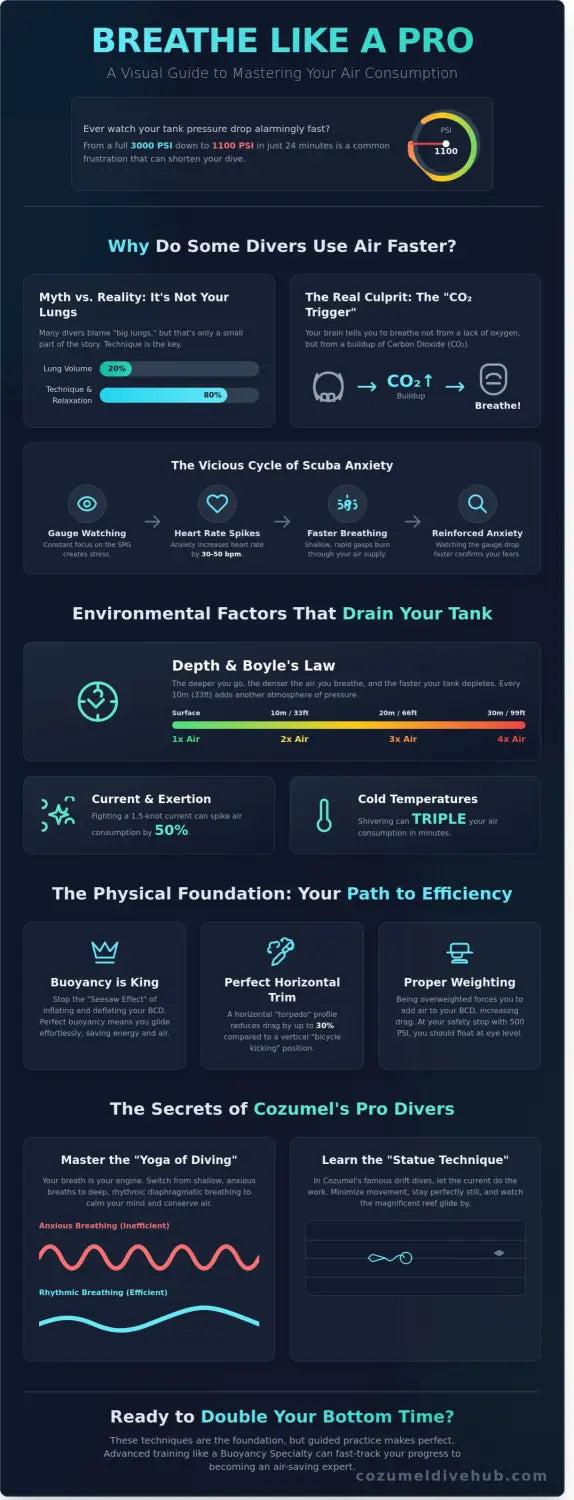
Buoyancy And Trim Are The Whole Game
If you only change one thing, change this. A diver who is not in control of their buoyancy is constantly making small corrections — a kick to stop sinking, a puff into the wing, a dump, a sink, another kick. Each of those is muscular work, each burns gas twice (once out of the cylinder into the BCD, once out of your lungs), and the cycle keeps your heart rate elevated for the whole dive.
Neutral buoyancy means you hold depth with no input at all. Get there and you can stop finning entirely, which is the single largest reduction in workload available to you.
Trim is the other half. A diver angled feet-down presents a large frontal area to the water and, worse, every fin kick has a vertical component, so some of your effort is spent driving yourself upward and then correcting for it. Flat and horizontal, your fins push you where you are looking. You do not need to be perfect; you need to stop being 45 degrees head-up.
Fixing trim is mostly about where weight sits, not how much finesse you have. Shifting a couple of pounds from your waist to trim pockets on the tank band, or moving the tank up or down in the band, usually does more than any amount of concentration. If it is not clicking on your own, the PADI Peak Performance Buoyancy course exists specifically for this and takes two dives.
Most Divers Are Overweighted
Excess lead has to be offset by air in your BCD, which makes you bigger, draggier and less stable — and it means every depth change requires a larger correction. It is a compounding problem, and it is very common in rental gear, where instructors tend to err heavy on day one and nobody ever revisits the number.
Do a proper weight check: at the end of a dive with roughly 500 psi left, empty BCD, holding a normal breath, you should float at eye level and sink slowly as you exhale. If you are sinking with a full breath, drop two pounds and check again on the next dive. Bear in mind that an aluminium cylinder becomes buoyant as it empties — a standard aluminium 80 swings roughly four pounds positive between full and empty — which is exactly why the check belongs at the end of the dive. A steel tank swings far less and lets you carry less lead in the first place.
Getting weighting right is worth doing on your first day rather than your last, because everything else depends on it.
Breathe Slower And Deeper — But Never Skip-Breathe
This is where most articles go wrong, so be careful here.
Helpful: a slow, deep, continuous cycle. A long, complete exhale matters more than a big inhale, because it clears carbon dioxide out of the dead space in your airway and regulator. Something in the region of a four-second inhale and a six-second exhale is comfortable for most people; the goal is smooth and unhurried, not any particular count.
Harmful: skip-breathing, meaning holding the breath between cycles to stretch the gas. It does not work and it is dangerous. DAN Europe describes it plainly as producing "suboptimal breathing patterns and CO2 retention due to insufficient exhalation" — you end up needing to breathe more, not less, because the urge to breathe is driven by carbon dioxide levels rather than by lack of oxygen. Retained CO2 brings on headache, breathlessness, dizziness and, at worst, a panic response or loss of consciousness. It also worsens nitrogen narcosis at depth. Combined with any breath-hold during ascent, it carries lung overexpansion risk on top of everything else.
The distinction is simple: keep the air moving continuously and slow the rate. Never hold it.
Your lungs are also a fine-tuning device. Small rises over a coral head can be handled with a slightly deeper inhale and settled with a fuller exhale, rather than reaching for the inflator. That saves gas and keeps you stable.
Stay Warm, Stay Streamlined, Stay Fit
Three smaller levers, all real.
Warmth. Cozumel water sits in the high twenties Celsius for most of the year, which sounds warm enough to ignore — but on a two-tank morning with a long surface interval in the wind, plenty of people are quietly cold by the second dive. Shivering raises metabolic rate substantially, and metabolic rate is what your breathing is serving. A 3 mm suit instead of a shorty, or a hooded vest, is a cheap fix. This shows up on the second dive of the day, not the first.
Streamlining. A dangling octopus, console, camera lanyard and loose gauges all add drag and all snag. Clip them close. It protects the reef too.
Fitness. Better aerobic conditioning genuinely lowers the ventilation you need for a given workload, which is part of why guides who dive daily tend to have low rates. It is a slow lever — months, not a trip — but it is real, and it compounds with everything above.
The Cozumel Angle: Stop Swimming
Here is the thing that makes this island unusual. Cozumel is a drift diving destination. The current does the transport. In theory you should barely move a fin from the moment you descend at Santa Rosa Wall until the guide signals the ascent.
In practice, almost every visitor over-swims on their first day. Habit is powerful: if you learned to dive in a quarry or off a shore entry, swimming is diving, and it takes conscious effort to stop. So people fin along the reef at Palancar Gardens, overtaking a current that was already carrying them, and burn through a tank in half an hour wondering why.
The correction is uncomfortable but simple: fold your hands, stop kicking entirely, and let the reef come to you. If you find you are catching up to the guide, you are swimming too much. That is the whole technique. It also makes Cozumel probably the easiest place in the world to improve your SAC rate, because the environment removes the workload for you — provided you let it. Run the calculation on your first dive here and again on your fifth and the difference is usually obvious.
Three specifics worth knowing:
- Currents vary enormously by site and by day, from a gentle push to a genuine ride. How strong the current runs in Cozumel is worth reading before you go.
- Sitting slightly higher off the reef usually means faster, smoother water and less need to correct.
- Do not fight your way back to something you drifted past. It is gone; that is what drift diving is. Chasing it costs you five minutes of bottom time at the end of the dive.
If drift diving is new to you, what to expect on your first one covers the mechanics.
Just Ask For A Bigger Tank
This is the practical answer, and it usually goes unsaid because it sounds like giving up. It is not. If you breathe heavily, carry more gas.
The default cylinder in Cozumel, as almost everywhere in the recreational world, is the aluminium 80. Larger cylinders are widely available here and cheap — Dive Paradise, for one, lists a 100 cu ft upgrade at ten dollars, and Aldora Divers built its reputation on running steel 120s specifically so people can stay down longer. Most operators will sort you out if you ask when you book rather than on the boat at 7 a.m.
| Cylinder | Rated capacity | Service pressure | Usable gas above 700 psi | Minutes at 18 m at 0.70 cu ft/min |
|---|---|---|---|---|
| Aluminium 80 | 77.4 cu ft (11.1 L) | 3,000 psi | ~59 cu ft | 30 |
| Aluminium 100, filled to 3,000 psi | ~90 cu ft delivered | 3,300 psi rated | ~69 cu ft | 35 |
| Aluminium 100, filled to 3,300 psi | 98.8 cu ft (13.2 L) | 3,300 psi | ~78 cu ft | 40 |
Note the middle row. A 100 only delivers its full advantage if it is actually filled to its rated 3,300 psi, and boat fills are frequently closer to 3,000. Look at your gauge before you assume you have bought yourself ten extra minutes.
And note the comparison hiding in the numbers: that same diver, on the original aluminium 80, improving from 0.70 to 0.55 cu ft/min through buoyancy and trim alone, gets 38 minutes. Technique is worth roughly as much as the upgraded cylinder, and it is free. Do both.
If you are renting everything anyway, tank size is a line item worth raising along with the rest — the gear rental price guide covers what to expect. When you are comparing shops, the dive center directory lists what each one runs.
Does Nitrox Help?
Not with gas consumption, no. You breathe exactly the same volume of gas from a nitrox fill as from an air fill at the same depth and workload. Anyone telling you nitrox makes a tank last longer is confusing two different limits.
What nitrox does is extend your no-decompression limit, which matters on repetitive deeper dives. On a Cozumel two-tank morning at 25 to 30 metres, that can be the difference between a full second dive and a truncated one — but only if no-deco time was what stopped you, not gas. Work out your SAC first: if you are surfacing with plenty of no-deco time left and an empty tank, nitrox solves nothing and a bigger cylinder solves everything. Diving Cozumel with nitrox goes into where it does and does not pay.
The tank-size and gas-mix decisions are separate. Do not let a shop bundle them in your head.
Being First To Turn Pressure Is Not A Failure
This is the part the search is really about, so it deserves saying directly.
Group dives are planned around the diver who uses the most gas. That is not a concession; it is how the plan is supposed to work. A guide doing the job properly is watching everyone's gauge, has already identified who will hit turn pressure first, and is shaping the profile around it — shallower, closer, shorter transits. If a dive ends when you signal, the plan worked exactly as intended.
Some practical framing:
- Say at the briefing that you tend to breathe heavily. It is genuinely useful information and nobody thinks less of you for it. It changes how you get positioned in the group and how the profile is run.
- A 35-minute dive is not a failed 60-minute dive. Bottom time is not a score.
- Ask to be placed near the front of the group and close to the guide, where you do less catching up.
- Check your gauge on a schedule — every ten minutes, say — rather than constantly. Constant checking feeds anxiety, and anxiety raises consumption.
- If you are consistently the limiting diver on a boat, that is an argument for a larger cylinder, not for diving less.
It genuinely improves with experience, and faster than people expect. Most of the reduction arrives in the first thirty or forty dives, and it comes from familiarity rather than from any technique — you stop task-loading, your heart rate settles, and your buoyancy corrections shrink. Continuing education compresses that timeline. Working through the PADI course path with an instructor watching your trim in real time finds problems that are invisible from inside your own mask.
Where To Start
Four things, in order: calculate your RMV from your next logged dive so you know your actual number; get your weighting checked properly on day one; stop finning on the drift; and ask for a 100 if you want the margin. Deep sites like Palancar Caves open up quickly once the arithmetic is on your side, and your safety stop stops feeling like a countdown.
Plan your Cozumel dive trip — including which operators run larger cylinders and how to structure your first days so the drift works for you rather than against you.
Frequently Asked Questions
How do I calculate my SAC rate?
What is a normal SAC or RMV rate for a recreational diver?
Why do I use air faster than everyone else on the boat?
Does nitrox make a tank last longer?
Is a bigger tank the answer to high air consumption?
Does skip-breathing save air?
Why does depth affect air consumption so much?
Does air consumption improve with experience?
Does being cold increase how much air I use?
Is it a problem if I always end the dive first?
Share This Article

Carmen Novelo
Carmen Novelo is a Cozumel native and an active scuba instructor and dive guide on the island. She has spent twelve years diving the Cozumel reef system, and writes about its dive sites, conditions and marine life for Cozumel Dive Hub.