
Best Cozumel Dive Sites for Marine Life: A Local Expert's Guide (2026)
Toadfish, hawksbills and eagle rays are not spread evenly across Cozumel dive sites or across the calendar. This guide matches species to specific reefs and months, with an honest read on how likely each encounter really is.
Carmen Novelo · March 22, 2026 · 18 min read
A splendid toadfish wedged under a ledge with only its striped head showing. A hawksbill working at a sponge while you drift past. A loose line of spotted eagle rays crossing the blue off Cantarel in February. These are the encounters people fly to Cozumel for, and they are not spread evenly across the island's dive sites or across the calendar.
This guide matches species to sites and to months, with an honest read on how likely each encounter actually is. It also covers the part most site guides skip: how to tell one fish from another once you are in the water, and where the small, cryptic animals hide. Nothing underwater is guaranteed, and any page that promises you a checklist is selling something. What follows is simply where the odds are best.
How To Read The Likelihoods
Four words are used throughout, and they mean specific things:
- Reliable — expect a sighting on most dives at the right site, in the right habitat, if you are looking.
- Common — present often enough that several dives at the right sites should produce one.
- Seasonal — the odds swing hard by month. Outside the window, downgrade it to a lucky day.
- Lucky day — genuinely documented here, but not something to build a trip around.
Species By Site And Season
| Species | Where the odds are best | When | Likelihood |
|---|---|---|---|
| Splendid toadfish | Paradise, Chankanaab, Yucab, Tormentos, La Francesa | Year-round | Reliable if you search ledges; easy to miss at drift pace |
| Hawksbill turtle | Palancar chain, Paso del Cedral, Santa Rosa Wall | Year-round | Common |
| Green turtle | Punta Dalila, shallow grassy areas | Year-round | Occasional |
| Spotted eagle ray | Cantarel, Villa Blanca Wall, Yucab, Colombia Deep | Nov–Mar, peaking Jan–Feb | Seasonal |
| Nurse shark | Palancar Bricks, Santa Rosa Wall, Punta Tunich, most mid-reef sites | Year-round, daytime | Common |
| Green moray | Las Palmas, Paso del Cedral, Playa Corona, C-53 wreck | Year-round | Common |
| Spotted moray | Chankanaab Bolones, Yellow House, Paradise | Year-round | Common |
| Southern stingray | Paso del Cedral, La Francesa, Palancar Gardens | Year-round | Occasional — a sand animal, not a reef animal |
| Caribbean reef shark | Colombia Deep, Punta Sur, Palancar Bricks | Year-round, deeper profiles | Lucky day |
| Octopus | San Clemente, Palancar Gardens, Columbia Shallows | Year-round, best after dark | Occasional by day, common on night dives |
| Seahorse | San Clemente, C-53 wreck, Paso del Cedral | Year-round | Lucky day |
| Lionfish (invasive) | Everywhere, especially ledges and wrecks | Year-round | Reliable — and not a good sign |
The Splendid Toadfish
Sanopus splendidus is the fish Cozumel is known for among divers, and the one most worth understanding before you go looking.
Almost every dive shop on the island will tell you it exists nowhere else on Earth. That is very slightly overstated. The Smithsonian Tropical Research Institute records its range as Cozumel Island, Mexico, and Glover's Reef, Belize. That correction does not really diminish the animal: a range spanning two locations is still among the most restricted of any Caribbean reef fish, and Cozumel is unmistakably the center of it. This is where you actually see one.
It reaches around 24–29 cm and lives between roughly 8 and 25 metres, tucked under coral ledges with a sloping sand patch at the entrance to the den. Usually only the broad head is visible: horizontal white and dark stripes, fleshy barbels along the lower jaw, and vivid yellow fin margins that catch a torch beam. It is assessed as Endangered on the IUCN Red List, driven by that tiny range and by habitat pressure in exactly the shallow reef zones divers use most.
The practical point is that toadfish are motionless and shaded, and a standard drift dive carries you past a den in about two seconds. Shallow, low-current sites with long bottom time are what make the difference — Paradise, Chankanaab, Yucab, Tormentos and La Francesa all fit. A deeper dive into finding one covers the search technique in detail.
Turtles: Two Different Stories
Cozumel's turtles split neatly into what you see underwater and what happens on the beaches, and conflating the two is the most common error in marine-life copy about the island.
On the west-side reefs, the turtle you meet is usually a hawksbill. Its narrow, pointed beak is built for prising sponges and invertebrates out of reef structure, which is why it works the coral rather than the sand. The Palancar buttresses, Paso del Cedral and Santa Rosa Wall are all good, but hawksbills turn up across the whole reef tract — this is one of the few Cozumel species where site choice matters less than dive time.
Green turtles are the seagrass grazers, so you find them over shallow, grassy ground more often than on the wall; the site data flags Punta Dalila among the more consistent spots. Loggerheads are seen far less often by divers on the reefs.
Nesting is a separate event and it happens on the east coast, not on the dive side of the island. Green and loggerhead turtles come ashore on those Caribbean-facing beaches roughly from May through November. Those beaches are not dive sites, and nesting activity is not something you encounter on a boat dive. If turtles are your priority, the turtle diving guide separates the two properly.
Spotted Eagle Rays: A Winter Animal
This is the most strongly seasonal encounter on the island, and the one most worth timing a trip around.
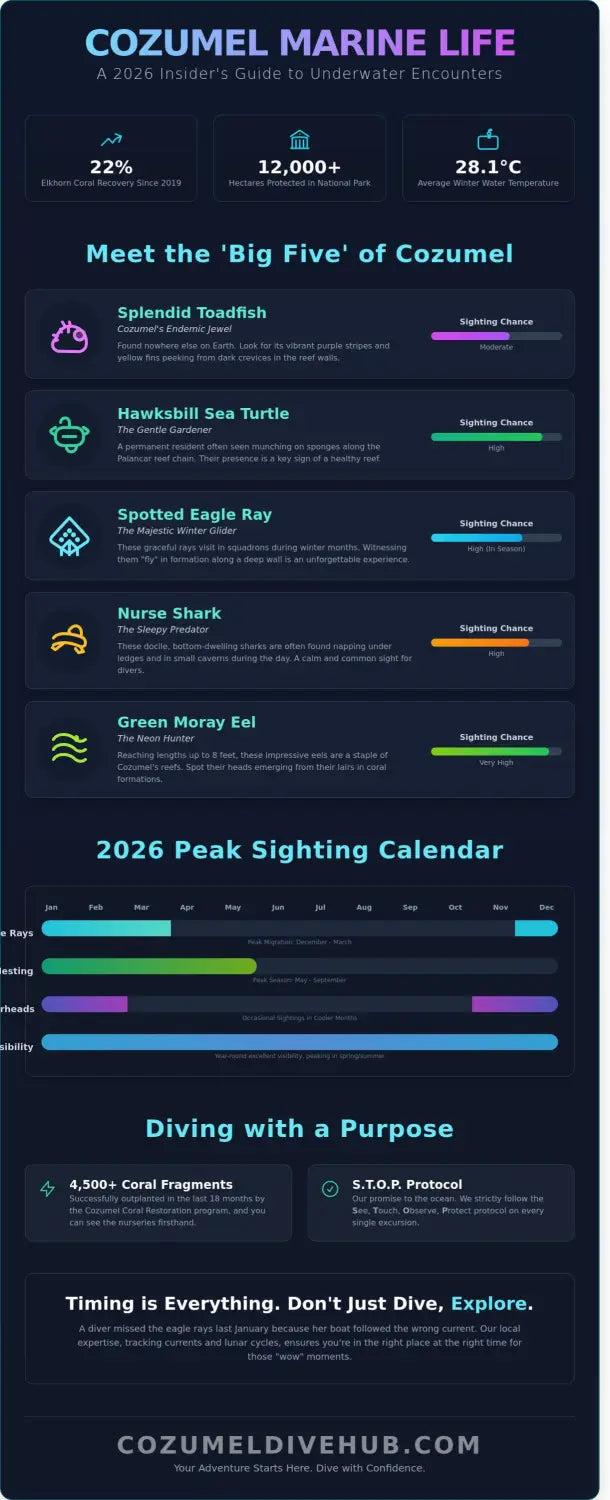
Photo-ID research on Aetobatus narinari in Cozumel, published in Environmental Biology of Fishes, found peak sightings between November and March, with the rays behaving as seasonal residents showing high site fidelity — of 493 identified individuals, around 65% of resightings occurred at the same dive site, one animal across a span of more than seven years. That is unusually good evidence for what divers had long observed anecdotally.
January and February are the strongest months. Cantarel is the site most associated with them, which is why it is often called Eagle Ray Wall; Villa Blanca Wall, Yucab and the deeper Colombia profiles also produce. They tend to move along the drop-off edge rather than over the reef top, so keeping one eye on the blue matters more than scanning the coral.
Outside that window, an eagle ray is a bonus, not an expectation. The eagle ray timing guide goes month by month.
Nurse Sharks
Nurse sharks are the most dependable large animal on a Cozumel dive, provided you understand their schedule. They are nocturnal hunters, so during the day they rest on sand and under overhangs, returning repeatedly to the same caves and crevices. Adults commonly run around 2.3–2.4 metres.
That means daytime sightings come from looking under things, not out into the blue. Palancar Bricks, Santa Rosa Wall and Punta Tunich all have the deep overhang structure they favour, and they turn up across most mid-reef sites.
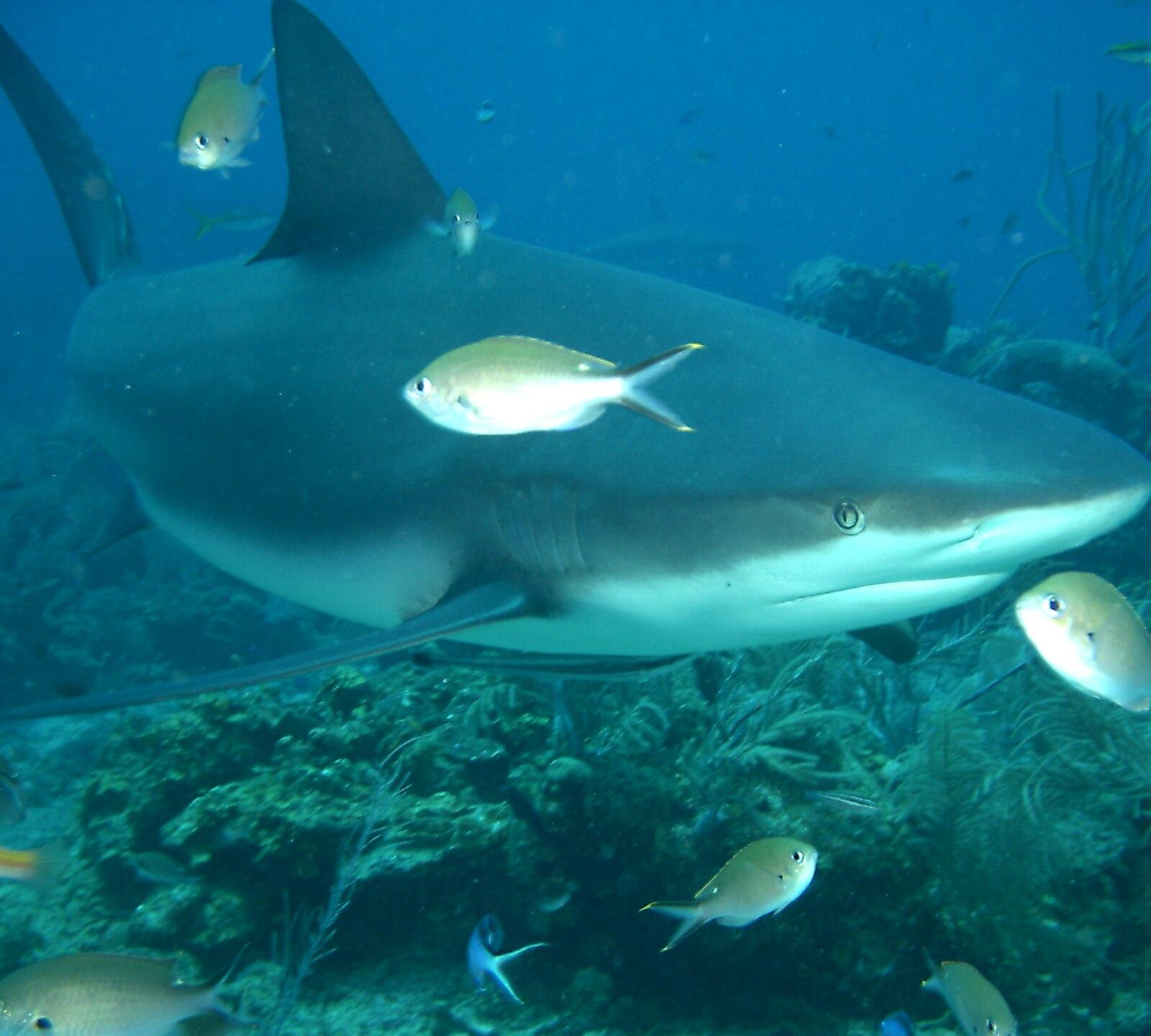
They are docile and normally move off when approached, but they are not props — a disturbed nurse shark can bite hard, and the recorded incidents overwhelmingly involve people touching or grabbing them. Caribbean reef sharks are the other shark you might see, usually on deeper profiles at Colombia Deep or Punta Sur, and they remain a lucky-day animal here rather than a reliable one. The Cozumel shark encounter guide covers the full picture.
Moray Eels: Green And Spotted
Two morays dominate. The green moray is the big one — up to about 2.5 metres, though most are nearer 1.8 — and it is not actually green. The skin is brown or grey; a yellow mucus coating produces the green cast. The spotted moray is smaller and patterned in dark blotches on white.
Both spend the day with the head out of a hole and the body back in the recess. The constant open-and-close of the jaw is respiration, not a threat display — they pump water over the gills that way. Las Palmas, Paso del Cedral, Playa Corona and the C-53 wreck are consistently productive; Chankanaab Bolones and Yellow House are good for spotted morays specifically.
Southern Stingrays
Southern stingrays are a sand animal. They forage by grazing along sandy bottoms, using electroreception to find buried prey, and they bury themselves to hide — which is why they are far more often missed than absent. Look at the sand channels between coral heads, not at the reef itself.
The site data records them at Paso del Cedral, La Francesa, Palancar Gardens and Palancar Bricks. They feed day and night, so time of day matters less than whether your profile includes open sand.
Lionfish: The One Nobody Hopes For
Lionfish are the one species on this page you will almost certainly see, and their abundance is a problem rather than an attraction. They are an invasive Indo-Pacific predator in the Caribbean, and stomach-content work on Mexican Caribbean specimens has identified prey from 34 native fish species, with a marked preference for juveniles — wrasses and gobies feature heavily, and cannibalism has been documented.
Cozumel runs an organised removal programme within the marine park. As a visiting diver, the correct response is to point one out to your guide and leave it alone. Their dorsal spines are venomous, and culling is restricted to authorised, trained personnel with the proper equipment.
How Do You Tell Cozumel's Reef Fish Apart?
Site pages tell you what lives where. They do not tell you what you are looking at, and most divers surface from a Cozumel reef having seen forty species and been able to name four.
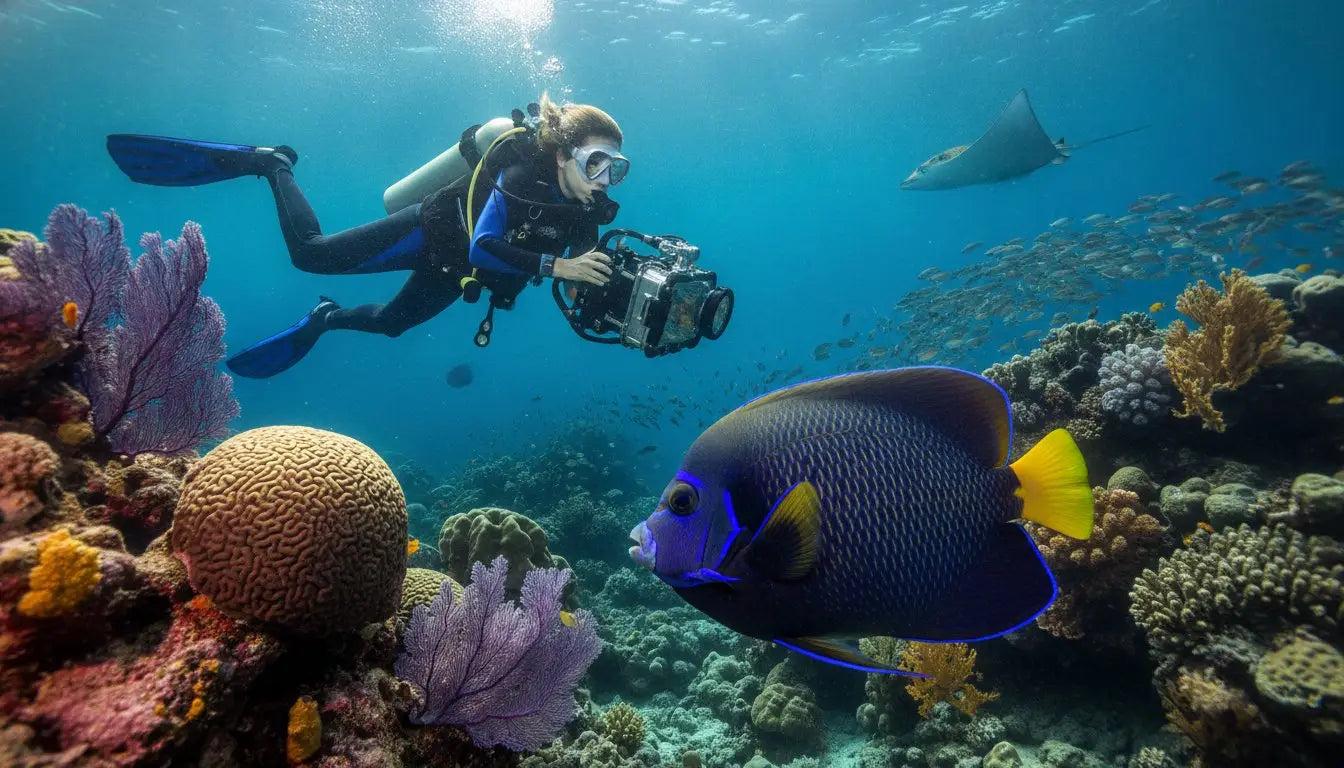
The fish below are the ones you will actually encounter on almost any west-side reef, listed with the single feature that separates each from its usual lookalike. None of them require a rare-animal hunt; they are simply in front of you already.
| Fish | What you notice first | The identifying feature | Where the site data records it |
|---|---|---|---|
| Queen angelfish | Yellow-and-blue plate-sized fish, unhurried | Dark blue "crown" spot ringed in electric blue on the forehead; tail solid yellow | Yucab, Colombia Deep, Santa Rosa Wall, Playa Corona, Las Palmas, Paradise |
| French angelfish | Same shape and size, but black | Black body with yellow-rimmed scales, dark tail, yellow bar at the base of the pectoral fin | Chankanaab, San Francisco Reef, Tikkila |
| Stoplight parrotfish | An audible crunch on coral before you see it | Terminal males: green body, yellow spot behind the gill, yellow crescent on the tail | Almost every reef |
| Blue tang | Flat blue discs grazing in loose shoals | A pale scalpel-like spine at the base of the tail; juveniles are bright yellow | Playa Corona and shallow reef generally |
| Sergeant major | Small fish clouding around moorings and structure | Five vertical black bars over a yellow-topped body | Moorings, wrecks, shallow reef |
| Blue chromis | Electric-blue slivers hovering above coral heads | Deep forked tail with fine dark edging; always above the coral, never in it | Above coral heads on every reef |
| Foureye butterflyfish | Small pale fish, nearly always in twos | A black eyespot near the tail — a decoy eye facing the wrong way | Shallow and mid reef |
| Queen triggerfish | Oval body that keeps turning to watch you | Two curved blue lines running across the snout | Villa Blanca Wall, sand-and-reef margins |
| Barracuda | A motionless silver log in midwater | Underslung jaw and two dorsal fins set far apart | Barracuda Wall and open water at most sites |
| Splendid toadfish | Nothing — you swim straight past it | Striped head under a ledge, barbels along the jaw, yellow fin margins | Paradise, Chankanaab, Yucab, Tormentos, La Francesa, Punta Tunich |
Queen Or French? The Only Angelfish Test You Need
These two are the pair divers most often mix up, because both are the size of a dinner plate and both cruise the reef at the same unbothered pace.
The queen angelfish (Holacanthus ciliaris) is the yellow-and-blue one, and the giveaway is on its forehead: a dark blue crown spot outlined in bright blue, sitting just above and behind the eyes. Its tail is solid yellow. The French angelfish (Pomacanthus paru) is black at a glance, but each scale is rimmed in yellow so the body reads as flecked gold in a torch beam, and the tail stays dark. French angelfish are usually in pairs and will often come to look at you; queens are more often alone and keep more distance.
Grey angelfish is the third of the group and is regularly logged as a French. It is paler, more uniformly grey-brown without the yellow scale rims, and its tail is cut square rather than rounded.
Juveniles of both queen and French are black with vivid bars, which is where most misidentifications happen. The French juvenile's bars are straight and vertical; the queen juvenile's bars curve.
Why The Same Species Looks Like Two Fish
Parrotfish and wrasses change both sex and colour through their lives, which is the single biggest source of confusion on a Caribbean reef. An initial-phase stoplight parrotfish is mottled brown with a red belly. The terminal-phase male of the same species is bright green with yellow markings. They look nothing alike and are frequently logged as separate species.
Parrotfish are also the animals doing the most visible work on the reef. Their fused beak scrapes algae off hard coral, which keeps the coral from being smothered, and the ground-up carbonate they pass through becomes reef sand. That crunching you hear through the whole dive is the reef being maintained.
The Cleaning Stations Most Divers Miss
Look for a larger fish — a grouper, a parrotfish, a big snapper — hanging motionless with its mouth open and gill covers flared, usually over a specific coral head. That is a cleaning station, and small cleaner gobies or shrimp are picking parasites off it.
Stations are used repeatedly at the same spot, so a guide who dives the site daily knows where they are. Hover, do not approach, and the queue will keep working.
The Invertebrates Most Divers Swim Past
The big animals get the attention, but most of what is alive on a Cozumel reef has no backbone. Nearly all of it is under ten centimetres, stationary, and coloured to disappear — which is exactly why a fast drift erases it from the dive.
This is the layer of the reef that most rewards a shallow, slow profile at somewhere like Paradise, Playa Corona, Chankanaab or Columbia Shallows, and the layer where a dive light makes the largest difference, because red and orange are the first colours the water takes away.
| Invertebrate | Rough size | Where to look | What gives it away |
|---|---|---|---|
| Christmas tree worm | Crowns 2–4 cm | Embedded in living brain coral and star coral heads | Two spiral fir-tree crowns; they snap out of sight the instant your shadow crosses them |
| Flamingo tongue | 2–3 cm | Crawling on sea fans and sea plumes | Orange leopard-spot pattern — which is living tissue, not the shell |
| Arrow crab | Body 2 cm, legspan to 10 cm | Under overhangs and beside anemones | Sharp triangular head, absurdly long legs, violet claw tips |
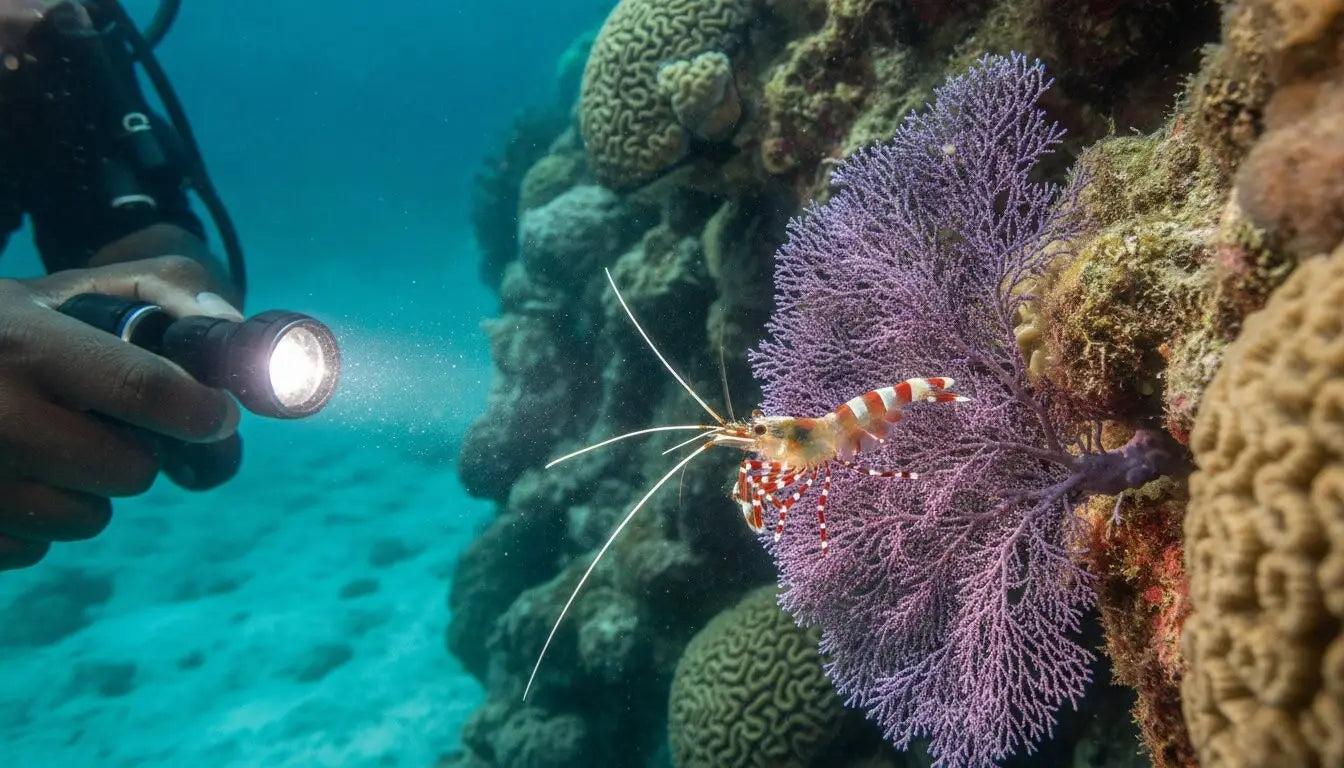
| Banded coral shrimp | 5–6 cm | Upside down at the back of crevices | Red-and-white banded claws and very long white antennae waving out of a hole |
| Pederson cleaner shrimp | 2–3 cm | Beside a corkscrew anemone | Almost transparent with violet markings; waves its antennae at passing fish |
| Caribbean spiny lobster | Large, obvious once seen | Back of ledges and overhangs | Two long spiny antennae crossed at a hole entrance; no large claws |
| Octopus | Varies | Ledges by day, open reef at night | A scatter of broken shells at a hole entrance marks the den |
| Bearded fireworm | 5–15 cm | Crawling over dead coral and rubble | White bristle tufts along both flanks — look, do not touch |
The Flamingo Tongue Is Not The Shell
This is the most useful single fact in Caribbean macro. Cyphoma gibbosum is a snail that feeds on gorgonians, and the vivid orange-and-black leopard pattern everyone photographs is its mantle — living tissue extended over the outside of the shell. Underneath, the shell itself is a plain cream-white.
Which means that when someone picks one up for a photograph, the mantle retracts and the animal loses the exact thing they wanted to photograph, on top of being pulled off its food. Find them on sea fans and sea plumes, and photograph them where they sit.
Cleaner Shrimp And Where They Set Up
Banded coral shrimp are usually hanging upside down at the back of a crevice, and the first thing you see is a pair of long white antennae protruding from a hole. The Pederson cleaner shrimp is easier once you know its trick: it lives alongside a corkscrew anemone, so find the anemone and the shrimp is generally within a few centimetres of it.
Both are cleaners. Fish present themselves and the shrimp works over their skin, mouth and gills. Watching a full cleaning cycle takes a couple of minutes of staying still, which is why it is a shallow-site activity rather than something you catch on a wall drift.
Octopus: The Den Is Easier To Find Than The Animal
Octopus are the classic night-dive animal in Cozumel, and the site records list them at San Clemente, Palancar Gardens, Columbia Shallows, Punta Sur and Maracaibo. By day they are folded into a hole and textured to match the rock, so hunting the animal directly rarely works.
Hunt the rubbish instead. An octopus discards the shells of what it eats at the entrance to its den, so a neat scatter of broken crab and bivalve shells in front of a hole is a far better search image than the octopus itself. A night dive removes the problem entirely, because they come out and hunt across open reef.
What Not To Touch
The bearded fireworm is the main hazard in this group. Its white bristles are hollow and break off in skin, delivering a burning sting that can last for days, and it is common on dead coral and rubble at exactly the depths where you will be searching for everything else. Fire coral does something similar and is easy to brush with a fin.
Both are good arguments for the no-touch rule that already applies throughout the national park. Nothing on this reef needs to be handled, moved, or repositioned for a photograph, and doing so is prohibited inside the park regardless of intent.
Seahorses: The Honest Answer
Longsnout seahorses (Hippocampus reidi) do live here, and they are the single most over-promised animal in Cozumel marine-life content. One long-time local diver puts it plainly: well over a thousand Cozumel dives, about a dozen confirmed seahorses.
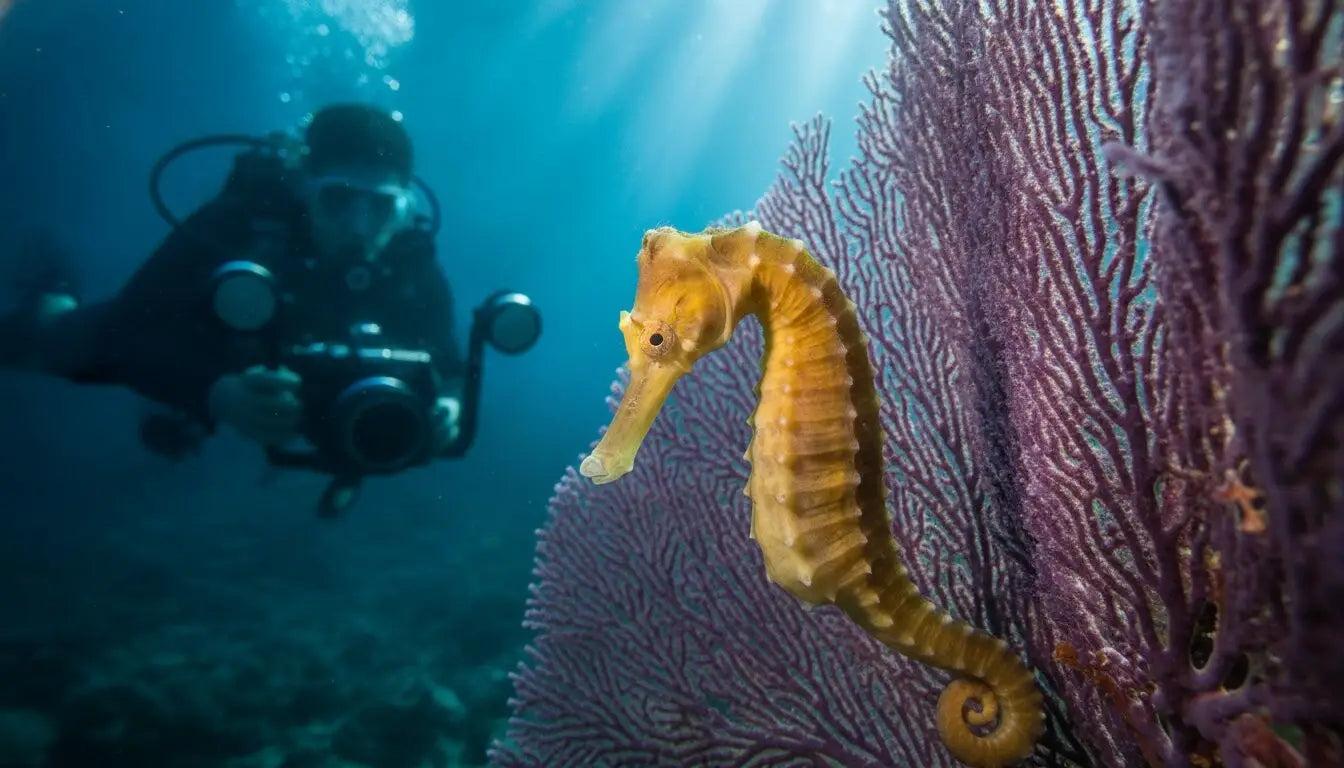
Treat any sighting as a genuinely lucky day. The site records flag seahorses at eleven Cozumel dive sites, including San Clemente, the C-53 wreck, Paso del Cedral, Paradise, Punta Dalila, Chankanaab, Las Palmas, La Francesa, Punta Tunich and Cantarel. Read that list correctly: it is where seahorses have been reported over many years, not a prediction of your odds on any given dive.
What you are actually looking for is a vertical shape where everything else is horizontal. A longsnout seahorse is roughly the length of your finger, holds its head at a right angle to its body, and anchors itself with a prehensile tail wrapped around a sea plume stem, a gorgonian branch, a sponge or a piece of rope. Colour is no help at all — they occur in yellow, orange, red, brown and near-black, often speckled, and they match whatever they are holding on to. The upright silhouette and the tail curl are the search image, not the colour.
Shallow, sheltered, slow profiles give you a better chance than a fast wall drift, simply because searching gorgonian stems takes time you do not have at drift pace. Nobody can put you on one. Any operator advertising a guaranteed seahorse dive is selling hope.
If you do find one, keep your distance, do not touch it and do not reposition it or the stem it is holding. Repeated flash at close range is the specific thing to avoid — take one or two frames and move on. Every seahorse species is listed on CITES Appendix II, and inside the marine park all handling of marine life is prohibited.
Matching Sites To What You Want To See
If you want the small, cryptic stuff — toadfish, morays, seahorses, invertebrates, juveniles — dive shallow and slow. Paradise, Chankanaab, Playa Corona, Las Palmas and La Francesa sit in the 20–70 ft band with mild to moderate current, which is exactly what macro searching needs.
If you want turtles and reef density, the Palancar chain and Paso del Cedral give you buttresses, swim-throughs and enough sponge cover to keep hawksbills feeding.
If you want rays and open water, go in winter and dive the wall edges: Cantarel, Villa Blanca Wall, and the deeper Colombia and Punta Sur profiles. Several of these are advanced sites with moderate to strong current, so honest self-assessment matters more than ambition.
If you want everything after dark, a night dive rearranges the whole cast — octopus and squid come out, toadfish become bolder, parrotfish sleep in mucus cocoons. The full Cozumel dive site directory lets you check depth, skill level and current for each site before you commit.
The Thing That Actually Determines What You See
Here is the part most marine-life guides leave out, because it does not help sell a specific site.
The single biggest variable in what you see on a Cozumel reef is not which mooring the boat ties to. It is whether you slow down and let your guide show you things. A splendid toadfish is a motionless, shadowed head at the back of a ledge. A seahorse is four centimetres of camouflage. A spotted moray is a pattern in a hole. A flamingo tongue is a thumbnail on a sea fan. All of them are invisible at drift pace to a diver who is watching their computer and swimming.
Good buoyancy is the enabling skill — it lets you hover next to structure without crashing into it or fanning silt over the animal you came to see. Good air consumption buys you the extra fifteen minutes in which most interesting sightings actually happen. And a guide who knows individual dens will find in four seconds what you would swim past forty times.
Tell your guide before the dive what you are hoping to see. It costs nothing and it changes the route.
Two smaller factors worth knowing: visibility is excellent almost year-round here and rarely the limiting factor, and winter nortes — strong northerly winds — can close the harbour for a day or two between roughly November and March, which is also peak eagle ray season. Build slack into a winter trip. Every diver also pays a national park fee that funds the protection making all of this possible; the marine park fee guide explains how it works.
Before You Book
Cozumel's reefs sit inside a national marine park declared in July 1996, covering roughly 12,000 hectares. Three decades of protection are the reason the species list on this page is as long as it is.
Match your months to your priorities: winter for eagle rays and accepting some wind risk, summer for calm water and long shallow macro dives, year-round for toadfish, turtles and morays. Then pick sites by habitat rather than by reputation, and give yourself the bottom time to actually look. If photography is the goal, the underwater photo guide covers lighting these subjects properly, and if whale sharks are on your list, they are a mainland day trip rather than a Cozumel reef dive — the whale shark season guide explains where and when.
Plan your Cozumel dive trip — compare sites, seasons and operators, and build an itinerary around the animals you actually want to see.
Frequently Asked Questions
What is the best dive site in Cozumel for seeing a splendid toadfish?
Is the splendid toadfish really found only in Cozumel?
When is eagle ray season in Cozumel?
Which sea turtles will I see while diving in Cozumel?
Are nurse sharks dangerous to divers?
Can I see seahorses while diving in Cozumel?
How do you tell a queen angelfish from a French angelfish?
What is the orange spotted snail on Cozumel sea fans?
What should I do if I see a lionfish on the reef?
What is the difference between a green moray and a spotted moray?
Share This Article
Carmen Novelo
Carmen Novelo is a Cozumel native and an active scuba instructor and dive guide on the island. She has spent twelve years diving the Cozumel reef system, and writes about its dive sites, conditions and marine life for Cozumel Dive Hub.