Cozumel Diving for Technical Divers: The Ultimate Guide to Deep Walls and Decompression
Cozumel is a recreational drift destination that happens to have deep water. The deepest published site profile reaches 150 feet, helium is not a shelf item on the island, and only a handful of operators support decompression diving at all.
Carmen Novelo · July 8, 2026 · 15 min read
Cozumel is a recreational drift-diving destination that happens to have deep water, not a technical diving destination. The reef itself tops out well inside recreational limits — the island's deepest published dive site profile reaches 150 feet, and most of the famous sites finish shallower than 120 — and the overwhelming majority of the island's operators run guided no-stop reef dives on a single cylinder and nothing else. A visiting technical diver can absolutely get good deep dives here, on genuinely dramatic walls, with a small number of operators who choose to support it. But helium is not a shelf item on this island, the marine park framework is built around guided recreational diving with CONANP-authorised boats and guides, and the real hazard on a Cozumel deco dive is not depth — it is running an obligation in a two-knot drift with no fixed reference. Plan around a handful of operators, arrange gas months ahead, and do not expect Truk or Bikini.
Is Cozumel a Technical Diving Destination?
Not primarily, and it is worth being blunt about why.
Three things define the island's diving. It is warm, it is drifting, and it is shallow relative to what technical divers travel for. The Yucatán Current pushes north along the west coast every day of the year, which is what makes Cozumel one of the best drift diving destinations anywhere. The reef structure sits on a shelf that drops away, but the named, moored, dived sites overwhelmingly sit between 40 and 120 feet. And the commercial model on the island is a two-tank morning for six to twelve recreational divers, priced accordingly.
That is not a criticism. It is an extraordinarily good product at what it does. But it means that a technical diver arriving expecting a tec-ready fleet, a blending station on every corner and guides who dive doubles daily will be disappointed. Technical diving in Cozumel is a niche inside a niche, run by a small number of operators as a deliberate specialism, usually on private charter, usually arranged well in advance.
If your interest is depth within recreational limits rather than decompression, the honest recommendation is that a Deep Diver specialty plus enriched air gets you almost everything Cozumel's topography has to offer, on any boat, on any day.
What Does CONANP Actually Permit Inside the Marine Park?
Most of Cozumel's diving happens inside Parque Nacional Arrecifes de Cozumel, administered by CONANP, Mexico's national protected areas commission. Understanding what the park framework does and does not say matters, because a lot of confident nonsense circulates on this point.
Here is what CONANP publishes for the park. The activities listed for visitors are buceo, contemplación de paisajes, educación ambiental — diving, landscape appreciation and environmental education. Visitors are instructed to contratar embarcaciones y guías autorizados por la CONANP — hire boats and guides authorised by CONANP. Divers must keep 1.5 metres from the reef, must not touch it, must not wear sunscreen, and must not disturb marine fauna. Anchoring is prohibited, which is why the park is served by mooring lines (CONANP). The park's management programme carries a dedicated administrative-rules section on diving, Del buceo, within its Reglas Administrativas (Programa de Manejo).
Now the important part, stated carefully. CONANP's published visitor rules do not set out a park-wide maximum depth, and they do not establish a permit category for decompression or technical diving. The framework is built around one thing: that you dive with a boat and a guide authorised by CONANP, and that you do not damage the reef. It is a conservation and access framework, not a dive-planning one.
What follows from that in practice:
- The limits that actually bind a technical dive here are your agency's standards, your certification, and — decisively — the individual operator's policy and insurance. Not a park rule.
- Because the park requires authorised boats and guides, running a tec dive means finding an operator inside the authorised system who is willing to take you. You cannot bring your own boat and self-guide.
- Anything a shop tells you about what the park does or does not allow for decompression diving should be treated as that shop's policy. Ask them to say so plainly rather than attributing it to CONANP.
- Marine park fees are charged per diver per day regardless of configuration or profile.
Where does technical diving here actually happen? On the deep southern walls, from private or small charters, run by operators who have made tec a deliberate line of business. It is not something you add to a scheduled two-tank morning.
Where Is the Depth in Cozumel?
This is the honest inventory. These are the island's published deep-site profiles, and they are the sites a visiting technical diver comes for.
| Dive site | Depth range | Skill level | Current |
|---|---|---|---|
| Maracaibo Reef | 70–150 ft | Advanced | Moderate to strong |
| Barracuda Wall | 90–130 ft | Advanced | Moderate to strong |
| Devil's Throat | 80–130 ft | Advanced | Moderate to strong |
| Colombia Deep | 60–120 ft | Advanced | Moderate to strong |
| Punta Sur | 90–120 ft | Advanced | Moderate to strong |
| Santa Rosa Wall | 50–120 ft | Advanced | Moderate to strong |
| San Francisco Wall | 45–120 ft | Intermediate | Moderate |
| Punta Tunich | 50–120 ft | Intermediate | Mild to moderate |
| Palancar Caves | 50–120 ft | Intermediate | Moderate |
| Palancar Horseshoe | 50–110 ft | Intermediate | Mild to moderate |
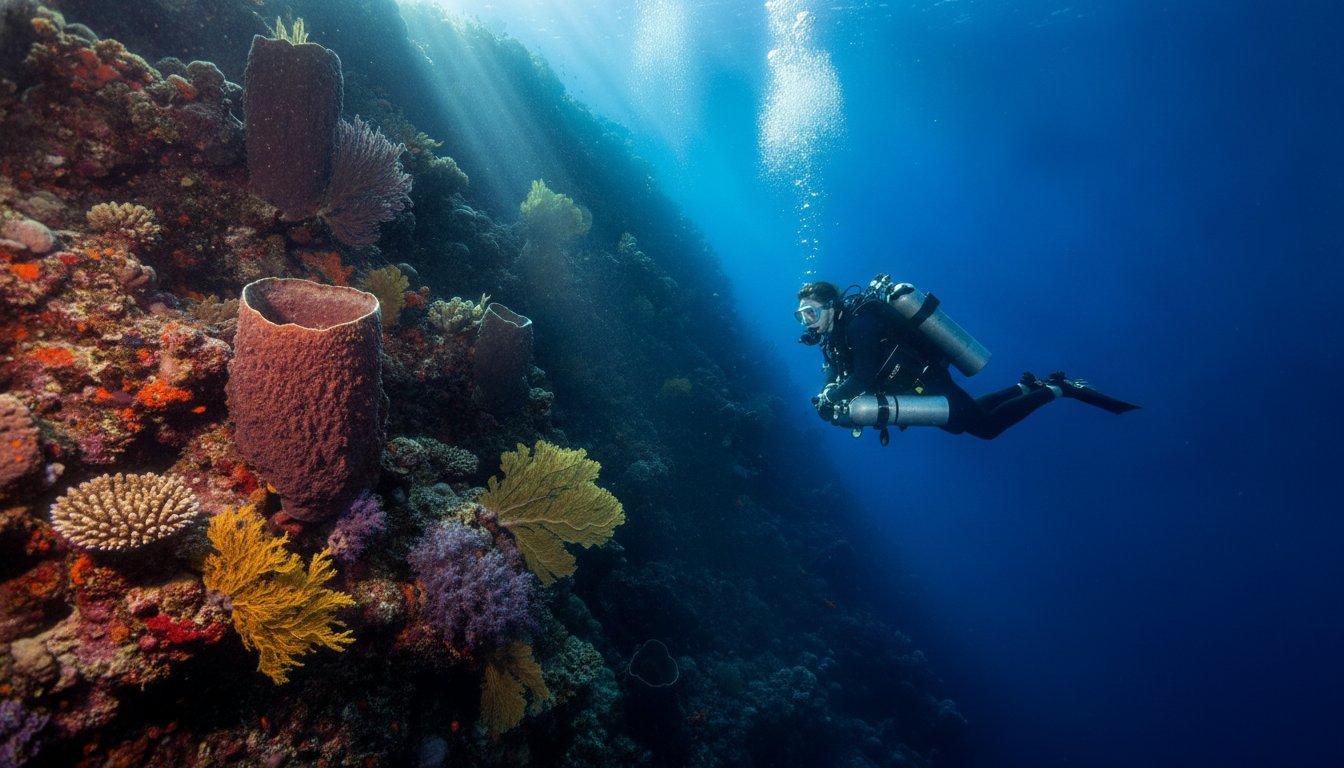
Read that table properly and the picture is clear. Exactly one published site profile on the island exceeds 130 feet. Everything else is recreational-accessible depth on a wall that continues past the point the guides turn around. The genuine technical opportunity in Cozumel is the wall face below the published profiles at Maracaibo, Punta Sur, Colombia Deep and the southern drop-offs — real vertical relief into blue water, with sponge and gorgonian structure and open ocean beside you. That is a good dive. It is not a wreck field.
On which point: Cozumel has no technical wreck. The C-53 Felipe Xicoténcatl sits in 40 to 55 feet of water. It is a pleasant, thoroughly recreational wreck dive and nothing about it requires or rewards technical gear. The full site inventory is in the Cozumel dive sites guide, and depths across the island are covered in the reef depth guide.
Can You Get Trimix and Helium Fills in Cozumel?
Assume no, until an operator tells you otherwise in writing, with a date and a price.
Here is what can be verified. Air and nitrox are universally available — enriched air is ordinary retail across the island. Oxygen for accelerated decompression is available at least from operators running PADI TecRec courses: Cozumel Dive School publishes Tec 40, Tec 45, Tec 50 and Tec Sidemount on its own technical diving page, including accelerated decompression on up to 100% oxygen and profiles using two gas blends of 50% and 100% O2 (Cozumel Dive School). That is a verified, published capability, and it covers a large share of what recreational-adjacent technical diving in Cozumel actually needs. Mexicandiver also lists Tec 40, Tec 45 and Tec 50, taught by PADI Course Director Alex Vina.
Helium is a different matter. No Cozumel operator publicly advertises trimix or helium fills on its own website that this guide could verify. The most detailed published first-hand account of running technical deep drift dives here — a GUE project write-up — describes helium as something the author had to go and find, listing the practical problem as needing to find a way to get helium, Softnolime, and a reliable boat operator, and only securing it after repeated meetings with local businesses (InDEPTH). That is the realistic picture: helium exists on the island when someone arranges it, and it is not something you walk in and buy on a Tuesday.
What this means for planning:
| Gas | Realistic availability in Cozumel | How to plan |
|---|---|---|
| Air | Universal | No action needed |
| Nitrox up to 40% | Widely available retail | Confirm price and analyser access |
| Oxygen (50% / 100% deco) | Available from operators running TecRec courses | Confirm cylinder count, O2-clean stages and pricing before booking |
| Trimix / helium | Not publicly advertised; must be arranged privately | Ask months ahead, get a written quote, expect market-rate helium pricing and a minimum order |
| Rebreather sorb | Not publicly advertised | Assume you are bringing it, subject to airline rules |
The training pathways exist on the island even where the gas logistics are thin — Tec 40, Tec 45, Tec 50, Tec Trimix, Tec Gas Blender and SSI Technical Extended Range Trimix are all taught here. If you are simply curious rather than committed, the Discover Technical Diving experience is the low-commitment way to find out whether the discipline suits you.
Why Current, Not Depth, Is the Real Hazard
This is the single most important paragraph in this guide.
A decompression obligation is a manageable, well-understood thing when you can hang on a line. You clip in, you watch your computer, the boat is above you, and if something goes wrong there is a physical connection between you and the surface. That is how most of the world's technical diving is conducted.
Cozumel does not work that way. Anchoring is prohibited inside the park, boats operate as live boats following divers, and the current runs continuously. A deco obligation here is served drifting — you, your team and your obligation moving north at one to two knots through open water, with nothing fixed to hold. Every failure mode changes character:
- Separation is permanent. Lose the team in the blue water with 30 minutes of stops remaining and there is no line to regroup on and no reef to navigate back to. Your redundancy has to be individual, not shared.
- Surface marking is not optional. A surface marker buoy deployed at depth is the only thing telling the boat where a drifting team is. Carry more than one, and be able to deploy from depth in current without losing buoyancy control.
- Downcurrents are a live problem on wall faces. Getting pushed deeper mid-ascent is far more consequential when you already owe decompression than when you are inside no-stop limits.
- Boat traffic is real. Cozumel's west coast carries cruise-ship and ferry traffic. A team surfacing unmarked after a long drift is surfacing into a working waterway.
- Nortes close the port. Between roughly November and March, north winds can cancel diving entirely for a day or two, which is a scheduling risk on a trip built around a small number of specific dives.
The current guide covers how the drift behaves day to day, and the broader conditions and safety picture is worth reading before you commit. The short version: the depths here are unremarkable by technical standards, and the drift is what will actually catch you out.
What Chamber Coverage Exists on the Island?
Cozumel has hyperbaric treatment on the island, which is one of the genuine reasons the island supports serious diving at all. Know the locations, the numbers and the procedure before you dive an obligation, not after — the hyperbaric chamber guide covers where the facilities are and how access works.
Two related pieces of planning belong here. First, dive insurance that explicitly covers technical depths and decompression — many recreational policies exclude both — which the Cozumel dive insurance guide addresses directly. Second, ask what emergency oxygen the boat carries and whether the crew is trained to administer it. On a recreational boat this is a courtesy; on a tec charter it is part of the dive plan. And because decompression profiles change your surface interval arithmetic, review the flying after diving guidance against your departure date.
What Should a Visiting Technical Diver Confirm Before Booking?
| Question for the operator | Why it matters |
|---|---|
| Do you run decompression dives, and under whose standards? | Some shops decline outright. An honest no now saves a wasted trip. |
| Which agency certifications do you accept, and what proof do you need? | TDI, GUE, PADI TecRec and SSI pathways all exist; requirements differ by shop. |
| Is this a scheduled boat or a private charter, and what does that cost? | Tec in Cozumel is almost always private charter. Budget for the whole boat. |
| Can you supply doubles or sidemount cylinders, and in what sizes? | Cylinder availability, not gas, is often the binding constraint. |
| What deco gases can you actually fill, and can I analyse them myself? | Verify per-gas, in writing, with a price. |
| Can you source helium, at what notice and what price? | Assume months of notice and a minimum order. |
| Who guides, and how many divers per guide? | The park requires an authorised guide. Team size on a deco drift should be small. |
| How does the boat track a drifting team through a deco hang? | This is the specific competence that makes tec here work or fail. |
| What oxygen and first aid is aboard, and is the crew trained on it? | Distance to the chamber is short, but the boat is your first response. |
The Honest Verdict on Technical Diving in Cozumel
A visiting technical diver can get genuinely good deep dives in Cozumel. The southern walls have real vertical relief, the visibility is exceptional, the water is warm enough to dive long profiles in minimal exposure protection, and the drift makes a deco hang unusually pleasant when the logistics are right. There is a small number of operators who know exactly how to run it.
But this is not a technical destination in the sense that Truk Lagoon or Bikini Atoll are. There is no wreck field, no deep artefact diving, no meaningful body of exploration-grade sites, and no supporting infrastructure of blending stations and tec-configured boats. The island's economy is built on recreational reef diving and its fleet reflects that. Helium is a favour, not a product.
The right way to come here as a technical diver is with modest expectations, a specific plan, and a relationship with one of the few operators who do this deliberately. Approach it as excellent deep recreational-adjacent diving with the option of an obligation, and Cozumel will exceed expectations. Approach it as a technical expedition destination and it will not.
If Cozumel is one leg of a wider Yucatán trip, the mainland is where the technically interesting overhead diving actually is — the cenotes are a separate discipline with their own training pathway, and sidemount is the standard configuration there.
Planning a Technical Trip to Cozumel
Start earlier than you would for anywhere else, because the constraints here are people and gas rather than dive sites. Identify the operators who run tec, contact them directly, get gas and cylinder availability confirmed in writing before you book flights, and build slack into the itinerary for weather. Then plan the rest of the trip — season, sites, logistics and surface days — with the Cozumel dive trip planner.
Frequently Asked Questions
Is Cozumel a good destination for technical diving?
Does CONANP allow decompression diving inside the Cozumel marine park?
How deep are Cozumel dive sites really?
Can you get trimix or helium fills in Cozumel?
Is oxygen available for accelerated decompression in Cozumel?
Why is current more dangerous than depth for technical diving in Cozumel?
Is there a hyperbaric chamber in Cozumel?
Are there technical diving wrecks in Cozumel?
What technical diving courses are taught in Cozumel?
How should a technical diver plan a Cozumel trip?
Share This Article

Carmen Novelo
Carmen Novelo is a Cozumel native and an active scuba instructor and dive guide on the island. She has spent twelve years diving the Cozumel reef system, and writes about its dive sites, conditions and marine life for Cozumel Dive Hub.