Cenote Diving from Cozumel: Your Ultimate Guide to the Mayan Underworld
There are no cenotes to dive on Cozumel. Cenote diving from Cozumel is a mainland day trip of 10 to 13 hours door to door: ferry, road transfer, two guided cavern dives in 24 to 25C fresh water, and almost no marine life.
Carmen Novelo · July 15, 2026 · 16 min read
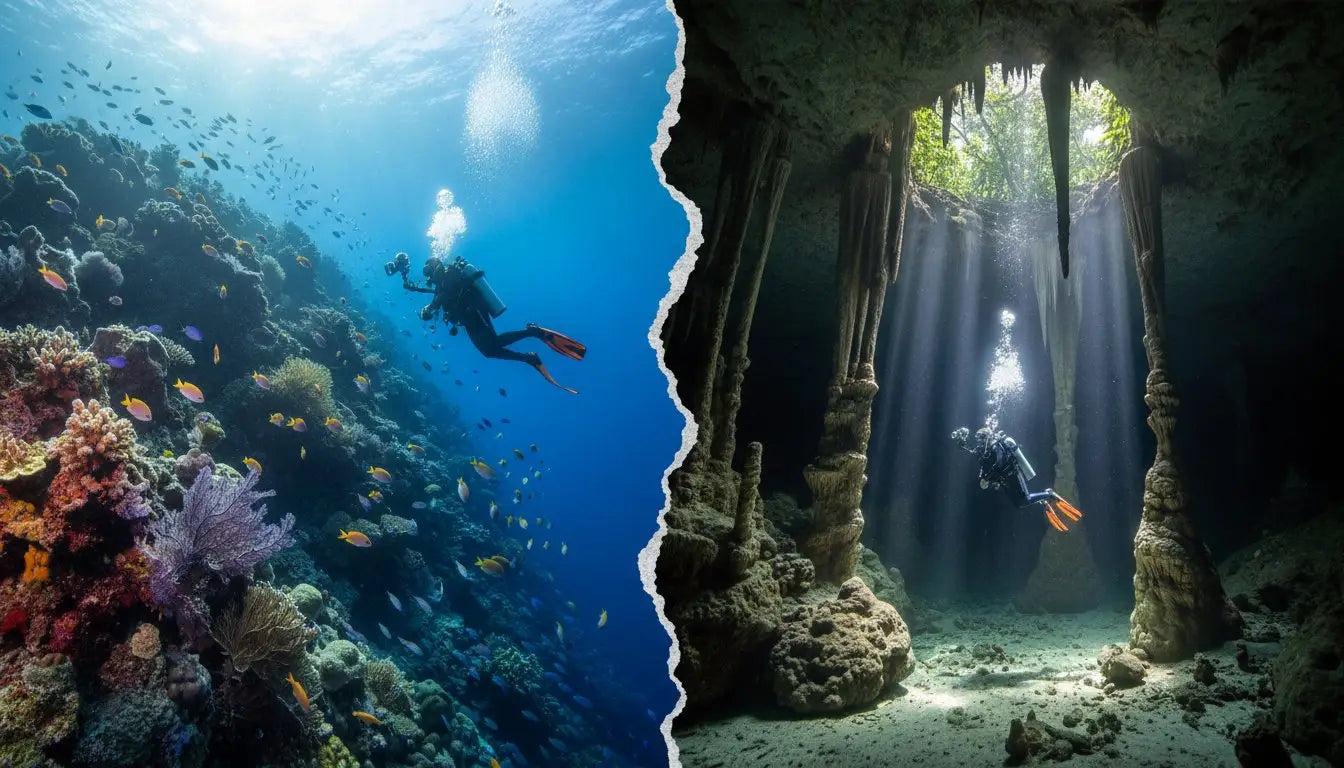
There are no recreational cenotes to dive on Cozumel. Cenotes are freshwater sinkholes in the mainland limestone of the Riviera Maya, so cenote diving from Cozumel is a mainland excursion rather than a local dive: a 40 to 45 minute ferry to Playa del Carmen, 20 to 55 minutes by road, two guided cavern dives, then the same journey in reverse — realistically 10 to 13 hours door to door. The diving itself is shallow, still, freshwater at 24 to 25°C (75 to 77°F), almost empty of marine life, and takes place inside an overhead environment. A guided cavern dive needs no cave certification, but it does demand steadier buoyancy and trim than any Cozumel reef drift.
Why Are There No Cenotes to Dive on Cozumel?
A cenote forms when the roof of a limestone cavern collapses and exposes the groundwater beneath it. The Yucatán mainland sits on a vast, porous limestone shelf threaded with flooded conduits, and every cenote that appears on a dive operator's site list — Dos Ojos, Chac Mool, Tajma Ha, Carwash, The Pit — belongs to one of those mainland systems, spread between Playa del Carmen, Puerto Aventuras, Akumal and Tulum.
Cozumel is a separate island across a deep channel. It does have flooded freshwater and brackish systems of its own, Aerolito de Paraíso and Jade Cavern being the best known, but those are fragile, access-restricted and firmly in the territory of cave-trained divers rather than the guided cavern tours visitors are actually searching for. So the honest answer to "can I dive a cenote in Cozumel" is no — you dive a cenote from Cozumel, as a planned day off the island.
The operators, entry logistics and site pairings are collected in the Cozumel cenote diving day trip guide, and Aquamarinas is one of the Cozumel centers that lists cenote dives alongside its reef diving. This article covers the part that guide does not: what the diving is genuinely like, what the limits are, and whether it is the right use of one of your holiday days.
How Long Does a Cenote Day Trip From Cozumel Really Take?
Longer than most divers budget for. The dives are short and shallow; the travelling is what consumes the day. Ferries run between Cozumel and Playa del Carmen from around 6:00 AM until late evening, roughly every half hour to hour across Ultramar and Winjet, and the crossing takes about 40 to 45 minutes.
| Stage | Typical Time | Notes |
|---|---|---|
| Hotel to the Cozumel ferry pier | 15–30 min | Walkable from central San Miguel; a taxi from the hotel zones |
| Ferry crossing to Playa del Carmen | 40–45 min | Sit low and central if you are prone to seasickness |
| Pier meeting point, paperwork, loading the van | 20–30 min | Have your certification card and logbook ready |
| Road transfer to the cenote | 20–30 min to Puerto Aventuras sites; 45–55 min to Dos Ojos or Casa Cenote | Highway 307 runs at sea level the whole way |
| Briefing, kitting up, first dive | 60–90 min | Cavern briefings are far longer than a reef briefing |
| Surface interval, tank change, lunch | 60–90 min | Usually taken at the cenote or a roadside palapa |
| Second dive, rinse, repack | 60–90 min | Often a second cenote a short drive away |
| Return road transfer and ferry | 60–105 min | Aim for a ferry no later than the early evening |
| Total, door to door | 10–13 hours | Leaving around 6:30–7:30 AM, back on the island 5:00–7:00 PM |
That shape has consequences. A cenote day is not something you slot in beside a morning two-tank reef trip, and it is a poor choice for the final day of a trip. Treat it as a whole day removed from your Cozumel diving, and plan the rest of the week around it.
Cavern Diving vs Cave Diving: What Is the Actual Difference?
This is the distinction that matters most, and it is the one people get killed by. Cavern diving stays inside the daylight zone — the natural light of the entrance is visible throughout the dive, the exit is a known short swim away, and a continuous guideline runs from the diver back out to open water. Cave diving goes past that point into permanent darkness, and it is a separate technical discipline with its own multi-level training pathway, redundant gas and equipment configuration.
| Cavern Diving | Cave Diving | |
|---|---|---|
| Natural light | Daylight from the entrance visible throughout; the sun is the primary light source | Beyond the reach of daylight, in permanent darkness |
| Distance from the surface | PADI Cavern Diver standards cap the dive at 40 m / 130 ft from the surface, vertical and horizontal distance combined; TDI's Cavern Diver limit is 61 m / 200 linear ft | No daylight constraint; bounded by gas planning, training level and team agreement |
| Depth | PADI recommends a 21 m / 70 ft maximum and prohibits exceeding 40 m / 130 ft on air | Routinely deeper, frequently with mandatory decompression |
| Guideline | A continuous guideline back to open water, laid and maintained by the guide | Continuous guideline plus jumps, gaps, directional markers and complex navigation |
| Lights | At least three light sources under PADI standards: the sun, a primary light and a backup | Three independent battery lights minimum, with no natural light at any point |
| Gas rule | Rule of thirds — turn the dive with two thirds of the starting supply still in the cylinder | Thirds or more conservative, with genuinely redundant gas |
| Certification | PADI Cavern Diver requires Advanced Open Water and a minimum age of 18; guided Riviera Maya cavern tours are commonly run for Open Water divers under a cavern- or cave-trained guide | Full Cave certification. No exceptions and no "just this once" |
The accident record is not abstract. CREER's published analysis of cave and cenote fatalities in the Riviera Maya between 1987 and 2015 documents 24 deaths, of which roughly two thirds were open-water-certified divers who entered an overhead environment without cave training. The recurring causes were monotonously consistent: no continuous guideline back to open water, diving beyond the level of training, and failing to hold back enough gas for the exit, with a silt-out turning a recoverable problem into a fatal one.
None of that is exotic. It is what happens when an ordinary recreational diver treats an overhead like open water. A properly run guided cavern dive sits comfortably on the safe side of that line — the guide lays the line, the daylight stays visible, the depths are modest and the group is small. The danger begins the moment somebody decides the rules are for other people.
If the overhead itself is what draws you rather than the day out, the PADI Cavern Diver specialty is the formal first step, and everything past the daylight zone belongs to technical diving.
What Does a Cenote Dive Actually Feel Like?
Quiet, still, cool and strangely solemn. Cenote water holds at 24 to 25°C (75 to 77°F) all year, against 26 to 30°C (79 to 86°F) in the Caribbean off Cozumel — see the month-by-month conditions guide for the ocean side. A few degrees sounds trivial. It is not, because you barely move in a cavern, there is no sun on your back, and freshwater strips heat faster than the sensation suggests. A 5 mm full wetsuit is the working standard, and divers who feel the cold add a hood without embarrassment.
There is no current whatsoever. That is the opposite of Cozumel, where the Yucatán Current does the swimming for you. In a cenote you propel yourself for every metre of the dive, slowly and deliberately, which is a different kind of tiring.
There is also, effectively, no marine life. A few small freshwater fish, some shrimp, the occasional catfish, and at Casa Cenote a well-known resident crocodile that keeps to the mangrove edges. No coral, no turtles, no splendid toadfish. What you are there for is geology: stalactites and stalagmites that formed while the passages were dry, columns where the two have met, flowstone curtains, and marine fossils sitting in the walls tens of kilometres from the sea. The visibility is extraordinary — the water is essentially filtered rainwater, and 60 m or more is normal until somebody stirs the floor.
What Is a Halocline and Why Does It Look Like Blurred Oil?
A halocline is the boundary layer where light freshwater floating on top meets denser saltwater intruding from the sea below. The two have different refractive indices, so light bends differently through each. Where they mix, the water shimmers, smears and doubles, exactly as though someone had stirred oil into water or smeared petroleum jelly across your mask. Descend through it and your own fins go blurry beneath you; look back and your buddy appears to have been cut in half and reassembled slightly wrong.
It is purely optical and completely harmless. It settles within seconds once the group has passed. Two practical notes: your buoyancy shifts marginally as you cross into the denser saltwater below, and photographs taken across a halocline will not focus, so shoot above or below it rather than through it.
Are the Light Beams Guaranteed?
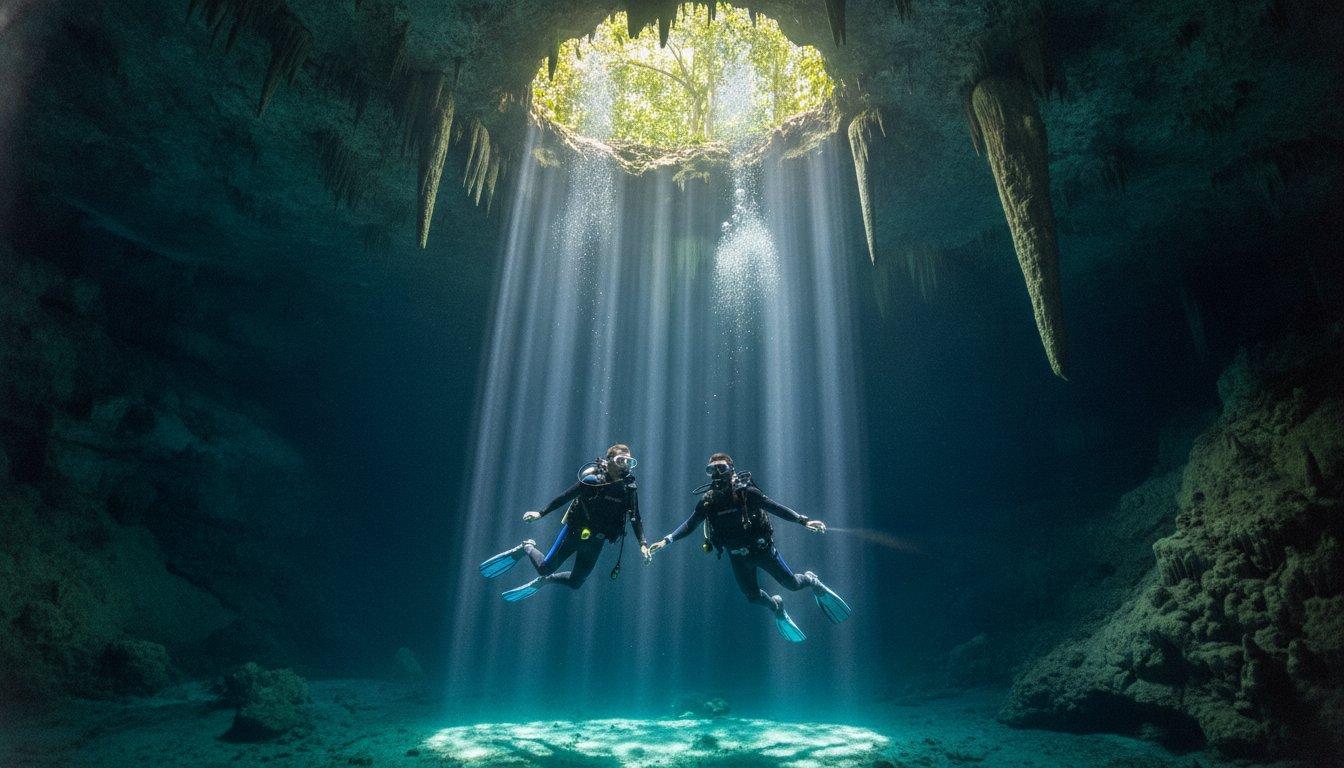
No. The famous shafts of light need a cenote with the right overhead opening, a high midday sun, a clear sky and reasonable timing — which is why operators schedule certain sites for the middle of the day and not the first dive of the morning. On an overcast day in the rainy season you may get none at all. Book the day for the geology and treat the beams as a bonus.
Cenote Diving vs Cozumel Reef Diving: An Honest Comparison
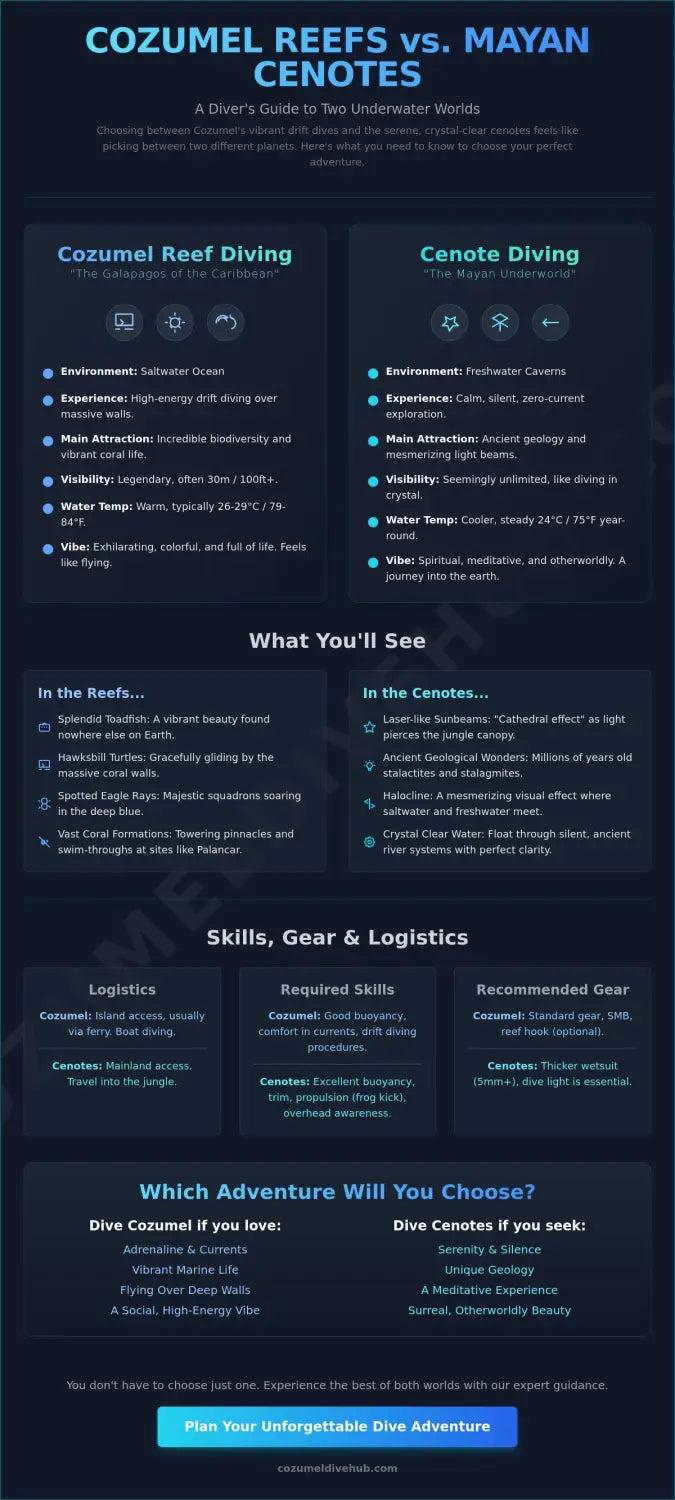
These are not competing versions of the same activity. They are two different sports that happen to use the same equipment.
| Cozumel Reef Diving | Cenote Cavern Diving | |
|---|---|---|
| Water | Salt, 26–30°C (79–86°F) | Fresh, 24–25°C (75–77°F), constant year-round |
| Exposure protection | Rash guard, shorty or 3 mm | 5 mm full suit, often with a hood |
| Movement | Effortless drift; the current does the work | No current at all; you swim the entire dive |
| Overhead | None, beyond short swim-throughs with the surface always available | Yes — rock between you and the sky for most of the dive |
| Typical depth | 12–30 m and beyond on the walls | 8–16 m on standard cavern routes |
| Visibility | 20–40 m, weather- and season-dependent | 60 m or more, and almost never bad |
| Marine life | 500-plus fish species, turtles, eagle rays, endemic toadfish | Almost none; a handful of small freshwater fish |
| Colour | Saturated — sponges, corals, fish, blue water | Monochrome — grey, white, tannin brown, shafts of blue |
| Skill demand | Moderate; a buoyancy error costs you coral contact | High; a buoyancy error costs the whole team its visibility |
| Cost drivers | Boat, guide, marine park fee | Ferry, road transport, and cenote entry fees paid to the landowning communities |
| Feeling | Loud, social, exhilarating, easy | Quiet, still, geological, faintly solemn |
Neither one is better. Cozumel's reefs are among the most enjoyable dives anywhere precisely because they ask so little of you — you fall in, the drift carries you along Palancar Gardens or Santa Rosa Wall, and the reef delivers colour and life for an hour. A cenote asks a great deal and gives back something the reef cannot: silence, structure and the specific unease of a ceiling.
Reef diving suits divers who want wildlife, warmth, easy days and the social rhythm of a dive boat, and anyone still building confidence — start with the beginner's guide to diving Cozumel and the drift diving guide. Cenote diving suits divers who are drawn to landscape over wildlife, who are comfortable moving slowly and precisely, and who genuinely want the overhead rather than tolerating it. Divers who dislike enclosed spaces, or who are still working on hovering without sculling, will have a better day on the reef.
Which Named Cenotes Are Genuinely Cavern Dives?
Operators sell a wide range of sites under the single word "cenote", and the differences matter. Some are true cavern dives in the daylight zone. One or two are open-water sinkholes with no overhead at all but serious depth. A few are cave dives that no responsible operator will run for a recreational diver.
| Cenote | Typical Working Depth | Environment | Realistic Requirement |
|---|---|---|---|
| Chac Mool / Kukulkán | ~14 m | Cavern, daylight zone, strong light effects | Open Water with a cavern-trained guide |
| Jardín del Edén (Ponderosa) | ~15 m | Cavern with a large open basin | Open Water |
| Tajma Ha | ~15 m | Cavern, reliable light beams | Open Water |
| Dos Ojos (Barbie Line, Bat Cave) | ~10 m | Cavern, heavily decorated, long bottom times | Open Water |
| Carwash / Aktun Ha | ~16 m | Cavern with an open basin and surface life | Open Water |
| Casa Cenote | ~8 m | Open-water mangrove channel, no overhead | Open Water |
| The Pit | 30–40 m | Deep cavern shaft with a sulphide layer | Advanced Open Water plus real deep experience |
| Angelita | 30–35 m to the sulphide cloud, floor beyond 60 m | Open-water sinkhole, no overhead — but deep and narcotic | Advanced Open Water plus real deep experience |
| Zapote (Hell's Bells) | ~30 m and beyond | Deep, with extremely fragile formations | Advanced Open Water plus deep experience |
| Dreamgate | ~10 m | Exceptionally delicate; most routes are cave, not cavern | Full Cave for the majority of the system |
The two that get miscategorised most often are The Pit and Angelita. They are marketed alongside Dos Ojos as "cenote dives", but they are deep dives first. Angelita is not an overhead environment at all — it is a vertical sinkhole open to the sky. What makes both demanding is depth: nitrogen narcosis, fast gas consumption and a genuinely tight no-stop limit at 35 m. If your logbook does not already contain comfortable dives at that depth, the Advanced Open Water course and some deep experience should come first — the Cozumel walls are a far better place to build it than a cenote.
Why Cenote Diving Is a Completely Different Skill Set
On a Cozumel reef, poor buoyancy is untidy. In a cavern it is the hazard. Three things change.
Trim becomes non-negotiable. Fins-down, knees-below-hips trim points your thrust at the floor. In a cavern the floor is fine silt and clay that has been settling undisturbed for a very long time, and it does not resettle quickly. Horizontal trim and a frog kick push water backwards instead of downwards, which is why guides insist on both from the first minute.
A silt-out is the real emergency, not the ceiling. Visibility in a cenote can go from 60 m to nothing in about four seconds, and unlike open water there is no upward exit. That is precisely why the continuous guideline exists: it is what you follow out when you cannot see your own gauges. This is also why groups are kept to around four divers per guide — one careless pair of fins ruins the dive for everyone behind them.
There is a ceiling, and you cannot ascend. The instinctive response to almost any problem in open water is to go up. In an overhead that instinct is wrong, and overriding it takes composure. If you are not certain you can stay calm and follow a line to an exit you cannot currently see, the cenote is not the right dive for this trip.
None of this makes cenote diving reckless. It makes it a skills dive. If your hovering is inconsistent, or you have not been in the water in a year, a session of Peak Performance Buoyancy or SSI Perfect Buoyancy on the reef beforehand is worth more than any amount of reading, and it also protects the formations — the no-touch rule matters even more here, because a stalactite snapped by a fin took thousands of years to grow and will not grow back.
What Changes in Your Gear and Weighting on the Mainland
Freshwater is less dense than seawater, so you are less buoyant in it and need less lead. Most divers drop somewhere around 2 to 3 kg (4 to 6 lb) from their Cozumel weighting, but the figure depends on your suit, cylinder and body, so do an actual weight check at the surface rather than guessing. Being over-weighted in a cavern is worse than being over-weighted on a reef, because the correction is a fin kick into the silt.
You will also want a dive light. Operators supply a primary torch for cavern dives; carrying your own compact backup is normal practice and, under cavern standards, is the third light source after the sun and the primary. Sunscreen, insect repellent and cosmetics are banned in the water at every serious cenote, so apply nothing before the dives and rely on a rash guard and shade instead. Everything else you already carry for Cozumel works — the Cozumel packing list covers the rest, and photographers should read the underwater photography guide before trying to shoot light beams handheld.
Flying After Diving: Why the Timing of Your Cenote Day Matters
The DAN consensus guidelines recommend a minimum 12 hour surface interval before flying after a single no-decompression dive, and a minimum of 18 hours after multiple dives in a day or several days of repetitive diving. A cenote trip is two dives, and it comes at the end of a week in which you have almost certainly been diving repetitively, so the 18 hour figure is the one that applies to most people.
That collides badly with the length of the day. If your second cenote dive ends at 3:00 PM and you are back on Cozumel at 6:00 PM, an 8:00 AM flight the following morning gives you roughly 17 hours from the last dive — inside the guideline, with no margin at all, after a long, hot, dehydrating day. The sensible move is to schedule the cenote day in the middle of your trip rather than at the end, and keep the final day for a shallow reef dive or nothing at all. The full picture is in the flying after diving guide.
Two things that are not a problem: the drive inland along Highway 307 stays at sea level, so the transfer adds no altitude exposure, and the ferry crossing is irrelevant to your off-gassing. These are published consensus guidelines rather than advice for your particular profile — follow your computer, add your own conservatism, and know where the hyperbaric chamber is before you need it.
How to Choose an Operator for a Cenote Day From Cozumel
The single most useful question is who is actually guiding the dive. A cavern guide should hold a cavern or full cave certification, not simply a divemaster rating with local knowledge — ask directly, and ask which agency. After that: what is the group size (four divers per guide is the working standard in the cenotes and there is a good reason for it); is the trip run by the Cozumel shop's own staff or handed to a mainland subcontractor once you step off the ferry; and what happens if you decide underwater that you want out.
On money, be precise rather than trusting. Ferry tickets, road transport, cenote entry fees, gear, torches and lunch are sometimes bundled and sometimes not, and cenote entry fees are set and collected by the landowning communities and change over time. Ask for the inclusions in writing before you pay, and confirm current fees on the day rather than relying on a figure printed in any article, including this one. The guide to choosing a Cozumel dive shop covers the wider vetting process, and the dive courses overview lists what is available on the island if you decide to build skills first.
Should a Cenote Day Be Part of Your Cozumel Trip?
If you have four or more diving days on the island, one cenote day is an easy recommendation: you get a genuinely different environment, and it makes the reef feel new again when you go back to it. If you have two or three days, spend them on the reef — Cozumel's dive sites are the reason you came, and a cenote day would cost you a third to a half of your diving for one long commute.
Book it mid-trip, book it with an operator whose guide is cavern-certified, go in with honest buoyancy, and treat the overhead with the seriousness it deserves. Then get back on the ferry and go and drift a wall. When you are ready to lay out the week, start with how to plan your Cozumel dive trip.
Frequently Asked Questions
Are there any cenotes you can dive on Cozumel itself?
How long does a cenote day trip from Cozumel take?
What is the difference between cavern diving and cave diving?
Do I need a cave certification to dive a cenote?
How cold is the water in a cenote compared to Cozumel?
What is a halocline and what does it look like?
Is cenote diving harder than reef diving in Cozumel?
Which cenotes can an Open Water diver dive?
Can I fly the day after diving a cenote?
Will I see any marine life in a cenote?
Share This Article

Carmen Novelo
Carmen Novelo is a Cozumel native and an active scuba instructor and dive guide on the island. She has spent twelve years diving the Cozumel reef system, and writes about its dive sites, conditions and marine life for Cozumel Dive Hub.