Planning a Dive Trip to Cozumel from USA: The 2026 Ultimate Guide
Planning a dive trip to Cozumel from the USA comes down to five decisions: nonstop into CZM or Cancun plus the ferry, passport and entry rules, 225 pesos a day in cash for the park, dive accident cover, and keeping your last day dry.
Carmen Novelo · April 20, 2026 · 17 min read
Planning a dive trip to Cozumel from the USA comes down to five decisions: fly nonstop into Cozumel International Airport (CZM) or fly into Cancún (CUN) and take the bus-and-ferry route; carry a valid passport and check what Mexican immigration now issues on arrival, because the paper tourist card has largely been replaced by a passport stamp; budget the marine park fee of 225 pesos per person per day in cash; carry dive accident cover as well as trip insurance, because they pay for different things; and keep your final day dry, since Divers Alert Network recommends a minimum 18-hour surface interval before flying after multi-day repetitive diving. Get those five right and the rest of the week takes care of itself.
Cozumel Dive Hub is an independent editorial guide to diving the island. This page explains the logistics as they actually work in 2026, with figures you can check against the sources named throughout. Prices, fees and immigration procedures do change, so treat everything here as a starting point and confirm the current position before you book.
How Do You Get to Cozumel From the United States?
There are two routes, and the trade-off between them is straightforward: the nonstop into CZM is dramatically less hassle, and it usually costs more.
Cozumel has its own international airport, CZM, on the island itself. It sits roughly 2 km from the center of San Miguel, so the taxi from the terminal to a downtown hotel takes under ten minutes. There is no ferry, no bus, no second leg. You land, you clear immigration, you are on the island.
The alternative is flying into Cancún International (CUN) on the mainland, taking a bus south to Playa del Carmen, then crossing to Cozumel by passenger ferry. CUN is one of the busiest airports in Latin America, so fares are lower and the schedule choice is far wider — but you are adding a transfer of roughly two and a half to three hours on top of your flight, at both ends of the trip.
Which US Cities Have Nonstop Flights to Cozumel?
Three US routes run year-round, and a cluster of others operate seasonally, weighted towards the winter dive season:
- Houston (IAH) — United, the highest-frequency US route into CZM
- Dallas/Fort Worth (DFW) — American
- Miami (MIA) — American
- Atlanta (ATL) — Delta, seasonal, roughly 2h 35m
- Charlotte (CLT) — American, seasonal, roughly 2h 55m
- Chicago (ORD) — American and United, seasonal, roughly 3h 35m–4h
- Denver (DEN) — United, seasonal, roughly 4h 25m
- Minneapolis/St Paul (MSP) — Delta and Sun Country, seasonal, roughly 4h 10m–4h 30m
If you are not starting from one of those cities, a single connection through Houston, Dallas or Miami usually still beats the Cancún route on total door-to-door time. Schedules and seasonal start dates shift year to year, so check the airline directly rather than relying on last season's pattern.
Is It Cheaper to Fly Into Cancún and Take the Ferry?
Usually yes on airfare, and the gap can be large enough to justify the extra legs — particularly for a group, where the saving multiplies. Here is what each route actually involves.
| Nonstop to CZM | CUN, Then Bus and Ferry | |
|---|---|---|
| Airport | Cozumel International (CZM) | Cancún International (CUN) |
| US nonstops | 3 year-round routes, ~5 seasonal | Very wide choice from most US hubs |
| Transfer after landing | Taxi, under 10 minutes | ADO bus to Playa del Carmen, then ferry |
| Bus leg | None | ~1h 25m–1h 50m, around 270 pesos |
| Ferry leg | None | ~40–45 minutes, roughly 250–300 pesos each way |
| Added transit time | None | ~2.5–3 hours each way |
| Typical extra ground cost | Taxi fare only | Roughly US$27–29 per person each way |
| Airfare | Usually higher | Usually lower |
| Best for | Short trips, tight schedules, early first dive | Longer stays, budget-led trips, flexible arrivals |
The bus is run by ADO from the CUN terminals and drops you in central Playa del Carmen, a short walk or a very short taxi hop from the ferry pier. Two operators run the crossing — Ultramar and Winjet — with departures roughly hourly through the day, first sailings in the early morning and last sailings in the evening. Fares and timetables change; confirm at the pier or on the operators' own sites.
The honest summary: if you are flying in on a Saturday and diving on Sunday morning, either route works. If your flight lands late, or you are travelling with a young family, or you want to be certain a delayed inbound flight does not cost you the last ferry of the night, the nonstop into CZM removes an entire category of problem. That is what the fare premium buys.
Should You Bring Your Own Gear or Rent on the Island?
Cozumel is warm-water, boat-based diving, so the gear that genuinely repays hauling across a border is small: your own mask, computer and exposure protection. Regulators and BCDs are widely available to hire, and airline baggage fees on a heavy dive bag can easily exceed a week's rental. If you do fly with a full kit, read our guide to flying with dive gear to Cozumel first, and compare it against current scuba gear rental prices in Cozumel before you decide.
What Do US Citizens Need to Enter Mexico in 2026?
Three things: a passport, an entry record issued at the border, and — for Quintana Roo specifically — the state visitor tax. All three are worth checking again close to your departure date, because the middle one has changed materially in the last few years.
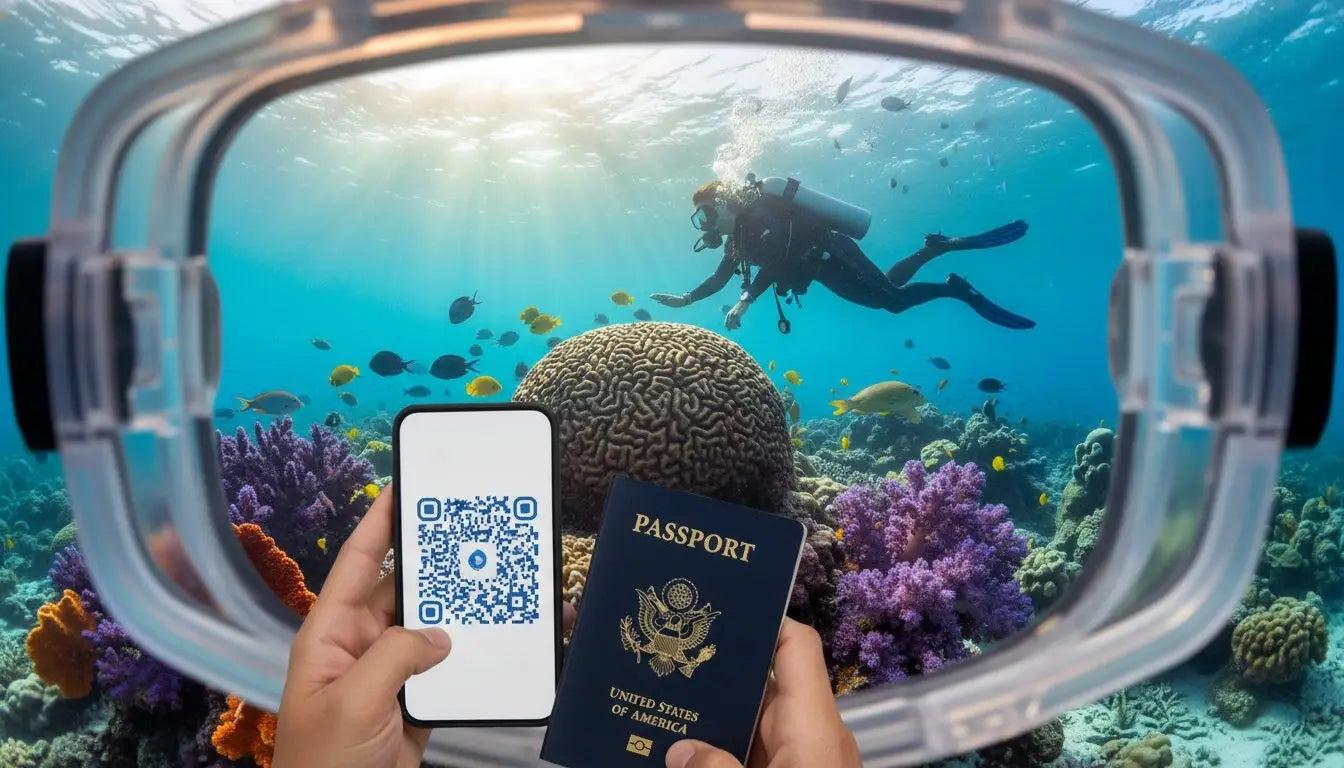
Passport. US citizens need a valid passport book to enter Mexico by air. A passport card is not accepted for air travel. Some airlines and destination countries apply their own validity rules, so check that your passport is valid comfortably beyond your return date rather than assuming the minimum is enough.
The tourist card, and what replaced it. For decades, arriving visitors filled in a paper FMM (Forma Migratoria Múltiple) and kept the stub until departure. Mexico's immigration authority, the INM, has been phasing that paper form out since 2022, and at most major airports it is now gone. In its place, air arrivals typically receive a passport stamp with the number of days granted written beside it, and the entry is recorded digitally. Two things follow from that. First, the number of days you are given is written on the stamp and is not automatically 180 — officers and the automated system both exercise discretion, and travellers report receiving considerably shorter periods. Second, there is no longer a piece of paper to lose, but there is also nothing in your hand to prove your status, so check the stamp before you leave the immigration counter and photograph the page.
The rollout has been graduated rather than uniform, and land crossings still differ from airports. Verify the current requirement on the State Department's Mexico country information page and with Mexico's Instituto Nacional de Migración before you travel. This is guidance on where to look, not individual immigration advice — for anything specific to your circumstances, ask the official source or a qualified professional.
The Quintana Roo visitor tax (Visitax). Cozumel sits in the state of Quintana Roo, which levies a tax on international visitors of roughly 283 pesos per person, around US$15. It is paid online through the state portal at visitax.gob.mx, which issues a QR code to show on departure. Exemption rules and the exact amount have both moved since the tax was introduced, so confirm the current position on the official portal rather than on a third-party site — several look-alike sites charge a markup.
Arriving by cruise ship. The document rules differ if you reach Cozumel on a ship rather than a flight. US citizens on a closed-loop sailing — one that departs from and returns to the same US port — have historically been permitted to travel on a birth certificate and government photo identification rather than a passport book. For a diver that is a poor trade even where it is allowed. If you miss the ship, or a diving injury means you need to be flown home, you cannot board an international flight without a passport book, and one cannot be issued to you overnight in Mexico. Carry the book regardless. Cruise-line and federal documentation rules are revised periodically, so confirm the current position with your cruise line and on the State Department's travel pages before you sail.
How Long Should You Wait Before Flying Home After Diving?
This single question shapes the last two days of a Cozumel trip more than anything else, and it is where badly planned itineraries go wrong.
Divers Alert Network's consensus guidelines, drawn from its Flying After Diving workshop, are:
| Type of Diving | DAN Minimum Preflight Surface Interval |
|---|---|
| A single no-decompression dive | 12 hours |
| Multiple dives per day, or multiple days of diving | 18 hours |
| Dives requiring compulsory decompression stops, or heliox/trimix | Substantially longer than 18 hours |
A normal Cozumel week is multi-day repetitive diving, so 18 hours is the figure that applies to almost every visiting diver. DAN is explicit that these are minimums, not guarantees: the underlying trials were run in a dry chamber with resting volunteers, and DAN notes that longer intervals may be needed for divers who were immersed and working. That caveat is the reason many divers and operators add a margin and treat 24 hours as the working rule.
Practically, this means your last dive should be finishing at least a full day before your flight, not the same morning. A two-tank boat trip finishing at noon on Friday clears an 18-hour interval for a Saturday flight after about 06:00 — but leaves no room at all if the boat runs late or you add a third dive. Building in a dry day is simpler than doing the arithmetic at the dock. Our dedicated guide to flying after diving in Cozumel works through the edge cases, including cruise-ship timings and connecting flights.
One further point on altitude: the guidance is about ascent to altitude generally, not only about aircraft. Cozumel itself is flat, but if you are tacking a mainland excursion onto the end of your trip, check whether it involves any meaningful elevation gain before you assume the surface interval only matters on flight day.
What Does a Realistic Cozumel Dive Week Look Like?
Most guides show you a list of dive sites. What US divers actually need is the shape of the week — which days you dive, which days you cannot, and where the constraints sit. Here is a Saturday-to-Saturday trip built around a morning departure home.
| Day | Plan | Why |
|---|---|---|
| Day 1 (Sat) | Arrive, no diving | Travel day. Clear immigration, settle in, register with a dive center, sort rental gear and sign paperwork so the first boat is not delayed |
| Day 2 (Sun) | Two-tank morning boat | First dives of the trip on easier reefs — Paradise Reef or Paso del Cedral — to re-set buoyancy and weighting |
| Day 3 (Mon) | Two-tank morning boat | Step up to the walls now that trim and air consumption have settled: Santa Rosa Wall |
| Day 4 (Tue) | Two-tank morning boat | Palancar Gardens and the swim-throughs; afternoon free for town |
| Day 5 (Wed) | Two-tank morning boat, or a surface day | The natural point to rest, do a mainland trip, or take a non-diving day if fatigue is building |
| Day 6 (Thu) | Two-tank morning boat | The far south, conditions permitting: Punta Sur. Last dives of the trip |
| Day 7 (Fri) | No diving | The flying-after-diving buffer. Beach, town, the island's east side, packing |
| Day 8 (Sat) | Fly home | Comfortably beyond DAN's 18-hour minimum, with room for a delayed boat on Day 6 |
That gives five dive days and around ten dives on a seven-night trip. If you want a sixth dive day, the tighter version is to dive a two-tank morning on Day 7, be out of the water by noon, and take an afternoon or evening flight on Day 8 — which still clears 18 hours, but only if nothing runs late. The dry-day version is the one worth defaulting to.
Two adjustments are worth knowing about. Between roughly November and March, a norte — a winter north wind — can close the port for a day or two and cancel all diving island-wide, which is the strongest argument for a seven-night trip rather than four. And if you are diving five days back to back, nitrox is worth considering for the extra margin on repetitive profiles. For the month-by-month picture of conditions, see our best time to dive Cozumel guide and the dive conditions by month breakdown.
What Will the Diving Actually Be Like?
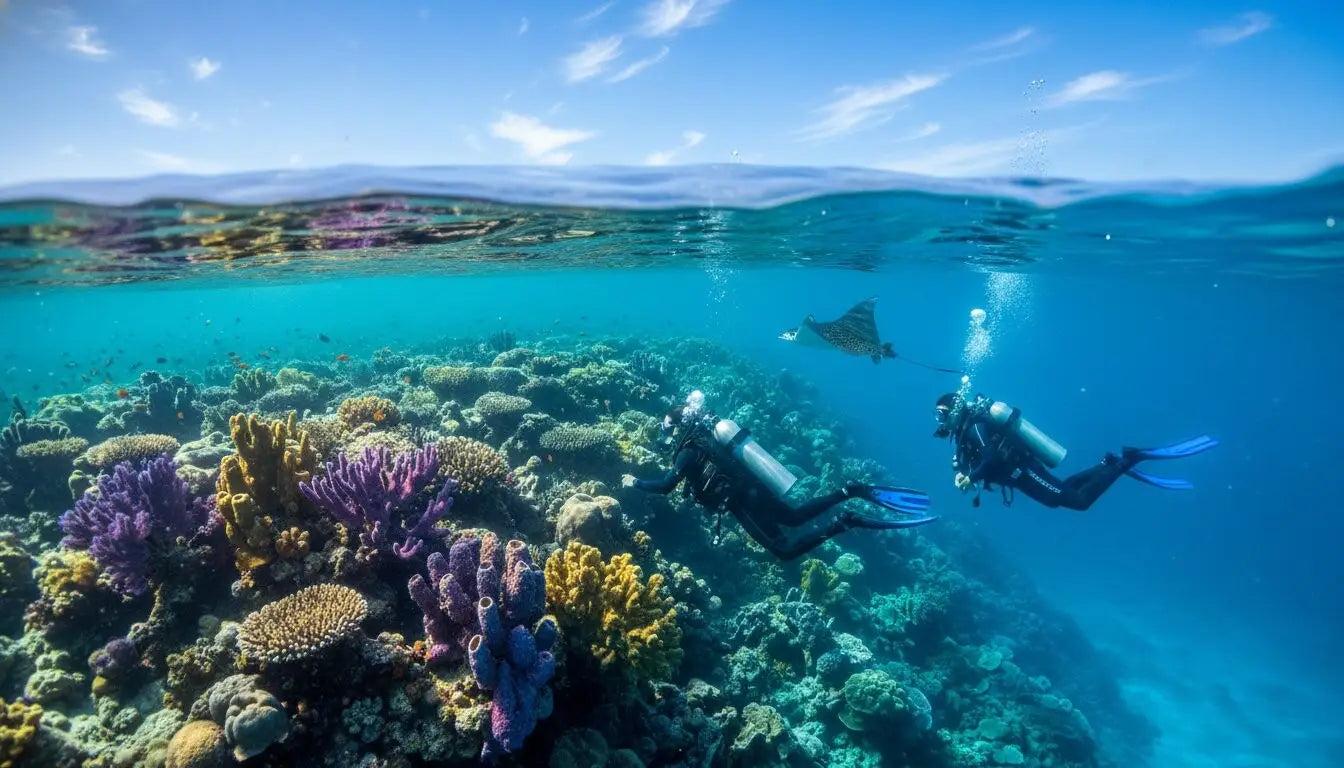
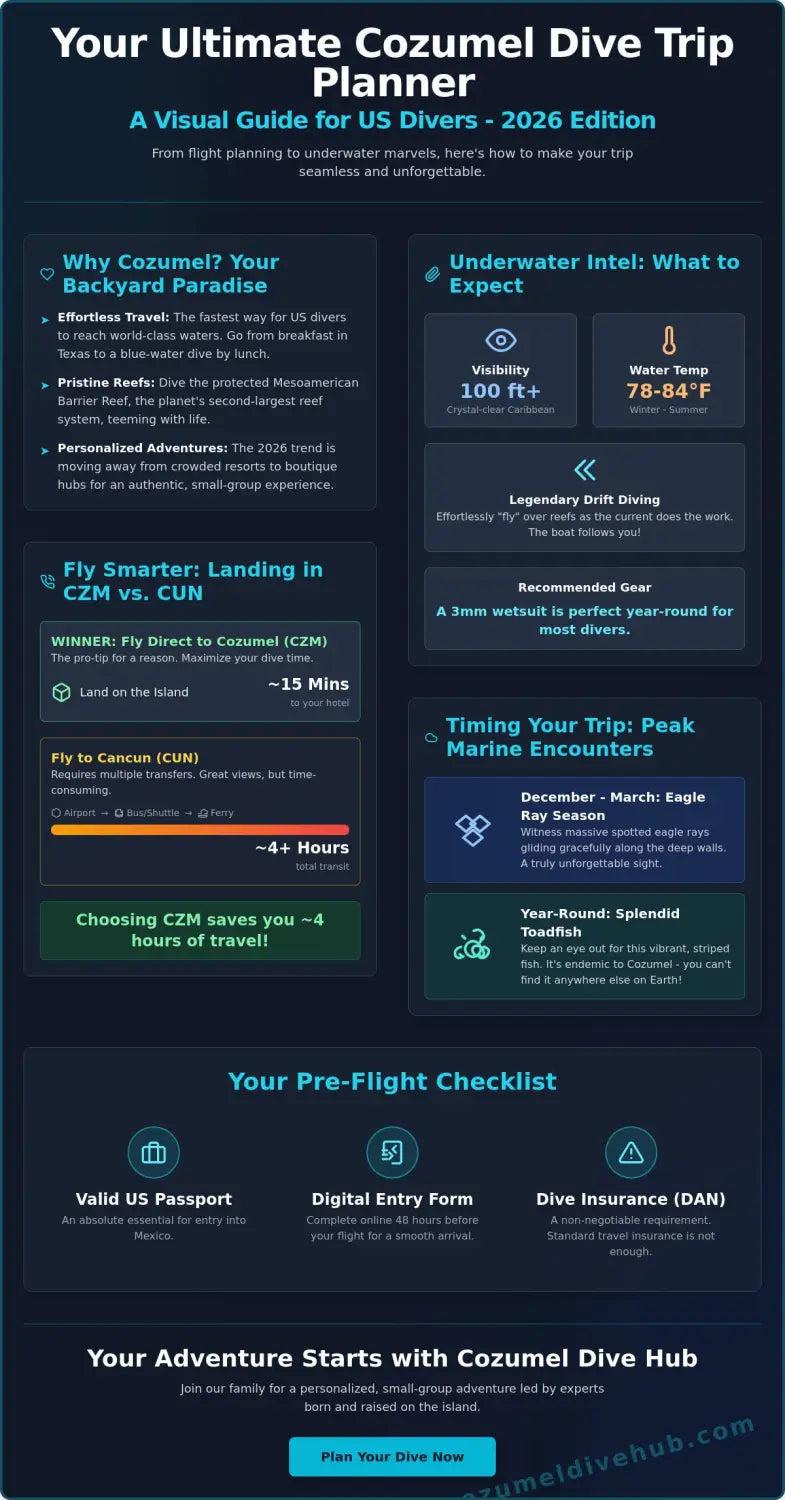
Cozumel is drift diving. The Yucatán Current runs south to north along the island's west coast, the boat follows your bubbles, and you cover ground without swimming. Water temperature ranges from about 79°F in February to about 85°F in September, and visibility typically runs 80 to over 100 feet year-round. Most US divers are comfortable in a 3mm wetsuit in winter and a shorty or rash guard in summer.
If drift diving is new to you, read what to expect on your first drift dive and our Cozumel drift diving guide before you arrive. Newer divers should also look at the complete beginner's guide to scuba diving Cozumel. Keep an eye out for the splendid toadfish, which is endemic to these reefs and found nowhere else on Earth.
Do You Need Dive Insurance, Travel Insurance, or Both?
They are different products covering different risks, and one does not substitute for the other.
Travel insurance covers the trip: cancellation for illness, accident or job loss, flight delays, lost baggage, and similar. What it generally does not cover is the medical consequences of a diving accident. DAN states plainly that very few travel protection plans cover scuba diving incidents, and that chamber treatments are not typically covered by medical or travel insurance.
Dive accident insurance covers the diving: ambulance transport to a hospital or hyperbaric chamber, the chamber treatment itself, associated hospital charges, and in many policies disability benefits and equipment loss arising from a diving accident. That is the specific gap that ordinary policies leave open, and a chamber ride is exactly the kind of bill that turns a good holiday into a financial event.
DAN's own position is that divers benefit from both, because they cover non-overlapping risks. This guide does not recommend particular providers and cannot advise on your individual circumstances — read the actual policy wording, check specifically whether recreational scuba is covered and to what depth, and confirm any exclusions with the insurer before you buy. Our overview of travel insurance for Cozumel scuba diving sets out the questions worth asking, and it is sensible to know where the island's hyperbaric chamber facilities are before you need them.
Dollars or Pesos: How Should You Pay in Cozumel?
Bring both, but think in pesos.
Many businesses in San Miguel will accept US dollars. The catch is the exchange rate they apply, which is set by the business rather than the bank and is routinely worse than the mid-market rate. Paying in pesos for anything of size is simply cheaper. Withdraw from ATMs attached to established banks rather than the standalone machines in tourist areas, decline the machine's offer to convert to dollars for you — that is dynamic currency conversion, and it always costs you — and check your own bank's foreign withdrawal fee before you travel.
Cards are widely accepted in hotels, restaurants and the larger dive centers, though many operators add a card surcharge of roughly 3–5% and prefer cash. Budget cash for three things in particular:
- The marine park fee. Diving inside Parque Nacional Arrecifes de Cozumel carries a federal marine park fee of 225 pesos per person per day as of 2026 — around US$13 to US$14 depending on the exchange rate. It roughly doubled from 108 pesos on 1 January 2025 and has been adjusted again since. It is usually collected separately at the dock before your first dive of the day, and it is charged for every day you dive, not once per trip. Our Cozumel marine park fees guide covers the annual pass option and how the fee is administered — and, since federal fee schedules are revised periodically, confirm the current rate before you travel.
- Tips for boat crew. Cash, in pesos or dollars, handed over at the end of the day.
- Taxis, small restaurants and beach clubs. Cozumel taxis do not use meters — fares are set by zone, and drivers are required to show the official rate sheet on request. Agree the fare before you get in, and pay in pesos: the taxi union's dollar exchange rate is noticeably worse than the bank rate.
For the wider budget picture, see our complete price breakdown for diving Cozumel.
What Should You Pack for a Cozumel Dive Trip?
The packing question is really a weight-versus-comfort question, and the answer skews towards taking the small personal items and hiring the bulk.
Take your own mask, because fit is personal and a leaking rental mask ruins a dive. Take a dive computer you know how to read, since five days of repetitive diving is exactly when nitrogen loading starts to matter. Take exposure protection appropriate to the season, a surface marker buoy if you own one, and your certification card and logbook. Add reef-safe sun protection, a microfibre towel, motion-sickness remedies if you are prone, and a spare mask strap.
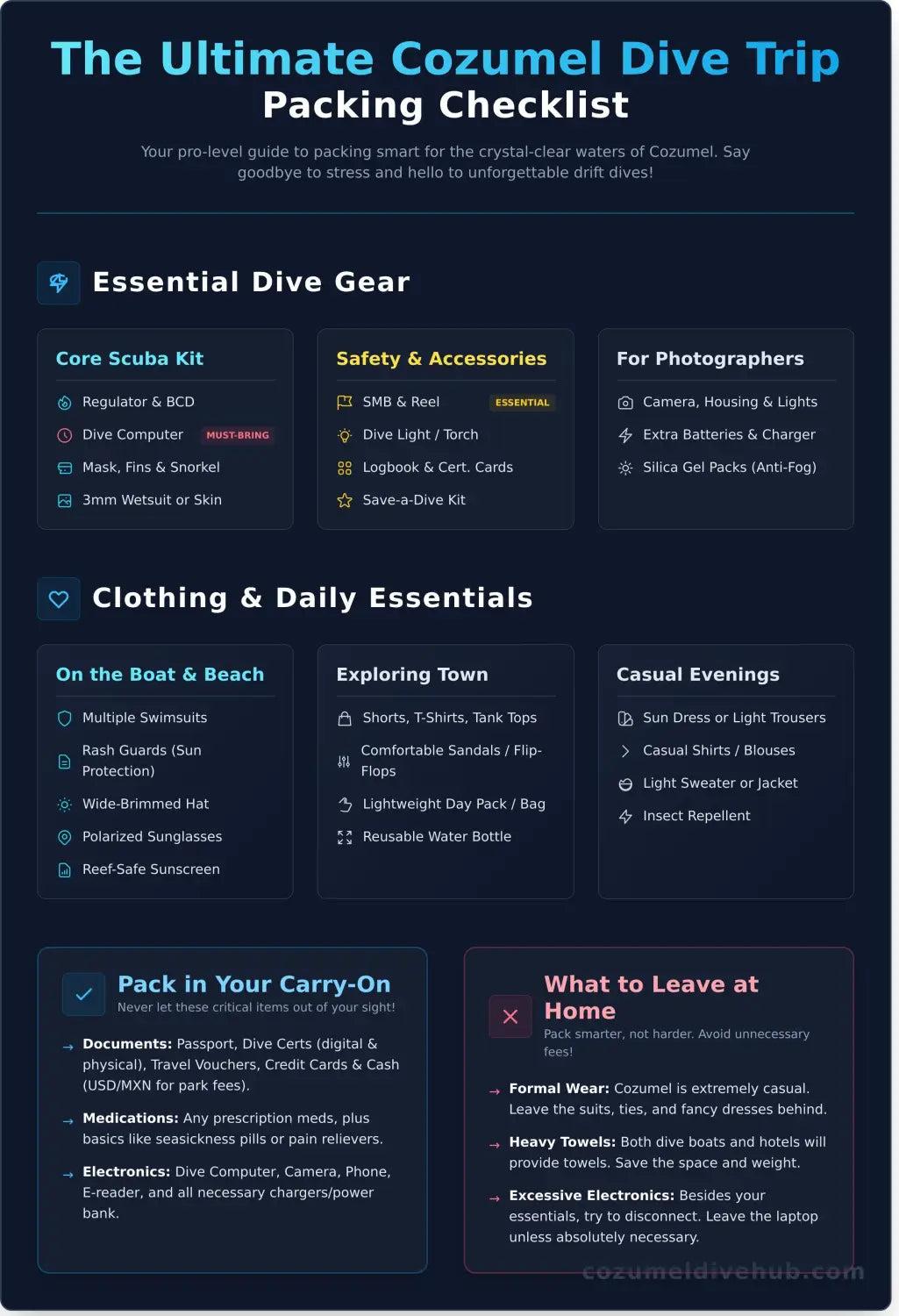
Essential items to pack for a Cozumel dive trip.
Only biodegradable, reef-safe sunscreen is permitted in the marine park, and applying it well before you enter the water — or wearing a long-sleeved rash guard instead — keeps it off the coral. Our full Cozumel scuba packing list covers the rest.
Where Should You Stay, and How Do You Choose a Dive Center?
Accommodation on Cozumel splits roughly into downtown San Miguel, the hotel zones north and south of town, and the all-inclusive resorts further out. The practical difference for a diver is pickup logistics: downtown puts you within walking distance of most dive shops and the ferry pier, while the southern hotel zone puts you closer to the southern reefs and further from restaurants. A late arrival matters less than it sounds: Studio Blue, locally owned for more than thirty years, keeps its shop open until 9 p.m. Our guide to where to stay in Cozumel compares the areas properly, and the dive resorts with an on-site dive operation are compared separately.
On dive centers, the single most useful filter is boat size. A six-pack boat — capped at six divers — is shorthand for small-group diving and the best predictor of how much guide attention you will get. A larger boat is not automatically worse, but the group moves at group pace and the dive ends when the first person reaches their reserve. Beyond that, ask what is included in the quoted price (the marine park fee often is not), what the cancellation policy is if the port closes, whether the boat carries emergency oxygen, and whether the crew is trained to use it.
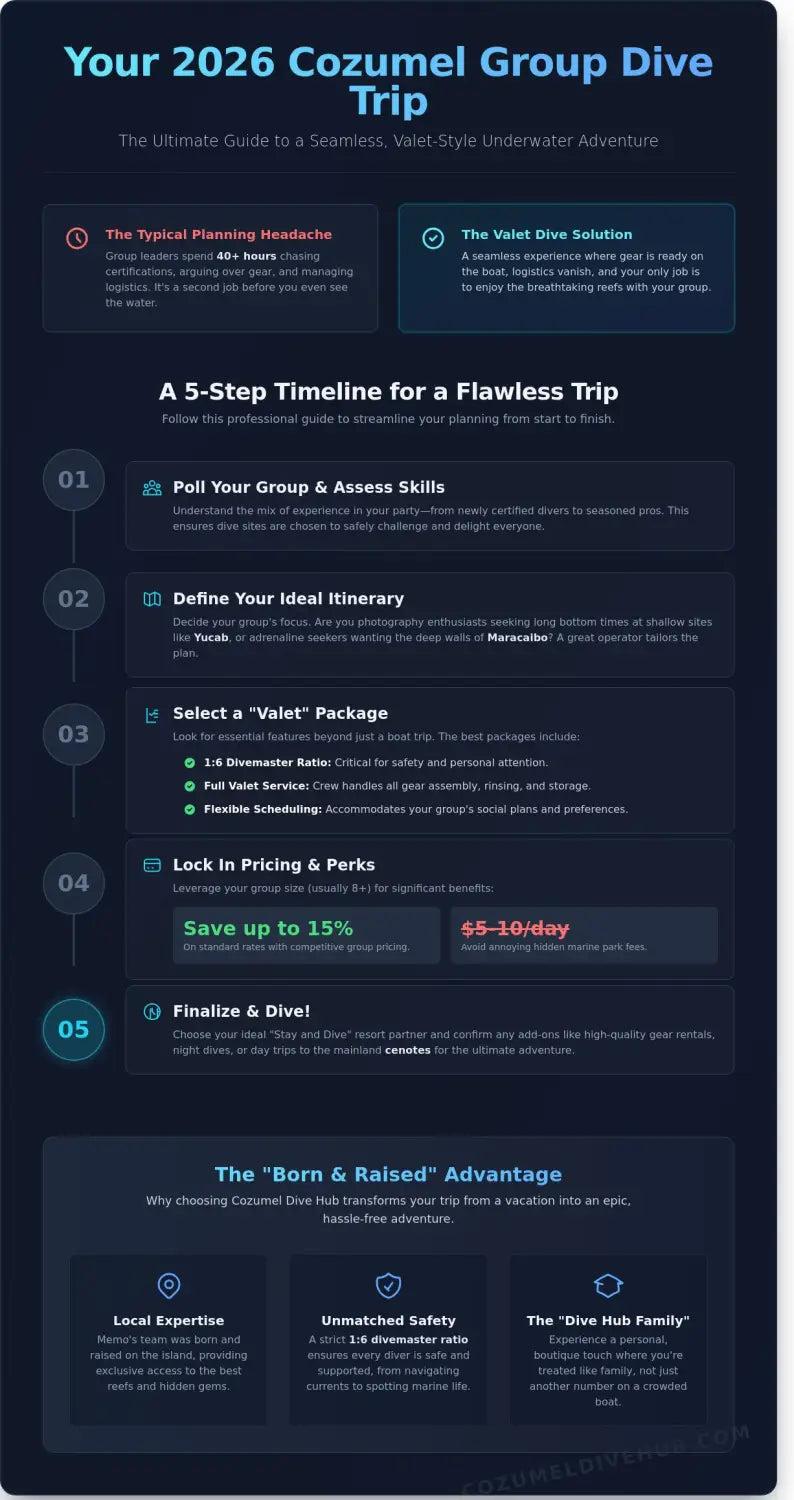
Group and dive club trips are a common way US divers visit the island.
Browse the independent directory of Cozumel dive centers to compare operators, and the Cozumel dive sites index to see which reefs suit your certification level. If you are travelling alone, our guide to Cozumel diving for solo travellers covers how single divers get paired up on boats.
Can You Certify or Upgrade While You Are There?
Yes, and Cozumel's conditions make it a good place to do it — though a course eats dive days, so factor it into the week. Entry-level certification typically takes three to four days; read our guide to getting a PADI certification in Cozumel before you commit a chunk of the trip to it. Certified divers looking to go deeper on the walls should look at the Advanced Open Water course in Cozumel, which can usually be folded into two dive days.
Your Cozumel Pre-Trip Checklist
Everything above, in the order it needs doing. The dates are indicative — the point is the sequence, because two of these items have lead times that cannot be compressed in the final week.
| When | Task | Why It Sits Here |
|---|---|---|
| 3–6 months out | Book flights and accommodation | Nonstop CZM or CUN plus the ferry. Between November and March a norte can close the port for a day or two, which is the argument for seven nights rather than four |
| 2–3 months out | Arrange dive accident cover and travel insurance | Two separate products. Check the policy wording says recreational scuba is covered, and to what depth |
| 2–3 months out | Check your passport | A passport book, not a card, and valid comfortably beyond your return date |
| 1–2 months out | Order or service any gear you are bringing | Regulator servicing, prescription mask lenses and replacement parts all run to weeks, not days |
| 1 month out | Sort your certification card | Keep it in the agency app and photograph it. If you arrive without it, most shops can verify your certification with the training agency using your full name and date of birth — but that is a phone call nobody wants to make at 7am on the dock |
| 1 month out | Complete the dive medical form honestly | If any answer flags, you need a physician's sign-off in writing. Getting it at home is straightforward; getting it on the island the morning of a dive is not |
| 2 weeks out | Pay the Quintana Roo visitor tax | Use the official state portal only — look-alike sites charge a markup. Save the QR code offline |
| 1 week out | Plan your cash | Pesos for the 225-peso daily park fee, crew tips and taxis. Small notes |
| 1 week out | Fix your last dive day | Work backwards from the flight so the final day is dry. This decides how many dive days the trip actually has |
| On arrival | Check the immigration stamp | Confirm the number of days written beside it before you leave the counter, and photograph the page |
Two of those deserve emphasis because they are the ones people leave too late. Anything involving a laboratory or a workshop — corrective mask lenses, a regulator service — is measured in weeks. And a medical question that needs a doctor's signature is trivial to resolve at home and genuinely trip-ending at the counter on the morning of your first dive.
What Else Should Be on the Radar?
Hurricane season runs June through November across the Caribbean basin. It rarely ruins a trip, but it is the period when travel insurance earns its premium and when flexible bookings are worth paying for — see our hurricane season diving safety guide.
Whale sharks are a mainland day trip, not a Cozumel dive. They aggregate near Isla Mujeres in summer, it is snorkel-only under Mexican law, and it is a long day involving a ferry and a van. Our whale shark season guide has the timings.
Eagle rays peak in the cooler months, when the currents run harder along the deep walls — January diving in Cozumel covers what that season actually looks like, nortes included.
Tap water. Drink bottled or purified water, as most visitors and residents do.
Cozumel rewards planning more than most Caribbean destinations, because the two things that constrain the trip — port closures at one end and the flying-after-diving interval at the other — are both entirely predictable. Book the nonstop if the fare works and the ferry route if it does not, carry cash for the park fee, and keep the last day dry.
Start planning your Cozumel dive trip with our independent guide to the island.
Frequently Asked Questions
Do I need a passport to dive in Cozumel as a US citizen?
Can I fly direct to Cozumel from the United States?
Is it cheaper to fly into Cancun and take the ferry to Cozumel?
How long should I wait after diving before flying home?
Do I need dive insurance as well as travel insurance?
Should I pay in US dollars or Mexican pesos in Cozumel?
How many dive days should I plan for a week in Cozumel?
How much is the Cozumel marine park fee?
Do I still need to fill in an FMM tourist card for Mexico?
Is there a tourist tax for visiting Cozumel?
Share This Article

Carmen Novelo
Carmen Novelo is a Cozumel native and an active scuba instructor and dive guide on the island. She has spent twelve years diving the Cozumel reef system, and writes about its dive sites, conditions and marine life for Cozumel Dive Hub.
