Cozumel Diving Hurricane Season Safety: A Local Expert's Guide for 2026
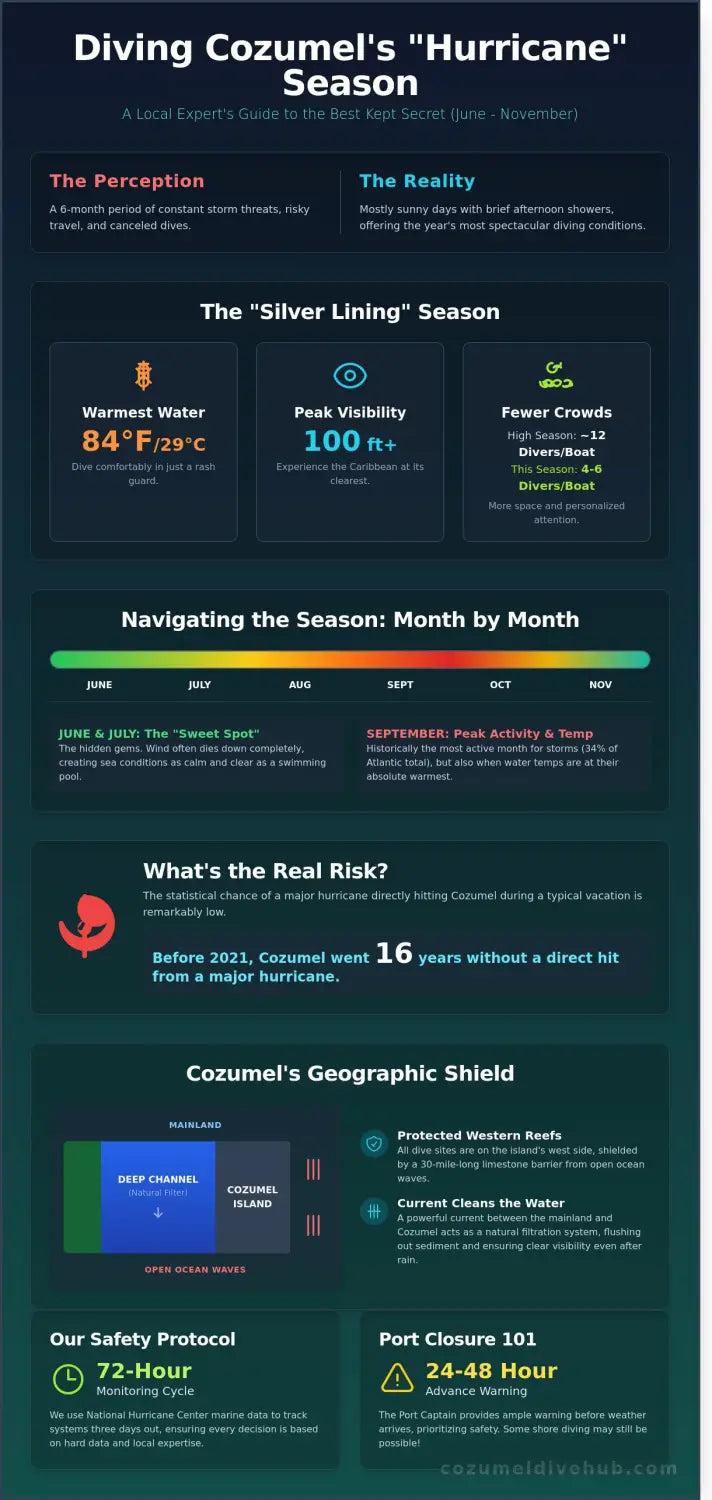
Atlantic hurricane season runs 1 June to 30 November, and for divers the honest risk in those months is disruption, not danger. The port closes to small craft, the boats stay tied up, and you lose a day or two of diving.
Carmen Novelo · March 22, 2026 · 9 min read
The Atlantic hurricane season runs from 1 June to 30 November, and Cozumel sits inside it. For divers, the honest risk in these months is disruption, not danger. Nobody dives through a hurricane, and no responsible operator tries. What actually happens is that the Capitanía de Puerto closes the port to small craft, every dive boat stays tied to the dock, and you lose a day or two of diving. NOAA's National Hurricane Center puts the climatological peak of the season on 10 September, with most activity falling between mid-August and mid-October. The last major hurricane to make landfall on the island was Wilma, which came ashore on Cozumel as a Category 4 on 21 October 2005 with 130-knot winds. So the three questions worth answering before you book are: how likely is a cancellation, who pays if it happens, and is the diving actually worse. Short answers: the odds of losing a whole week are low, your travel insurance policy decides the money, and the water is at its warmest of the year — about 29°C (85°F) — in exactly the months most visitors avoid.
When Is Hurricane Season In Cozumel, Exactly?
The season is a calendar definition, not a weather forecast. The National Hurricane Center defines the Atlantic hurricane season as 1 June through 30 November, covering roughly 97 percent of Atlantic tropical activity. Within that six-month window the risk is nothing like evenly spread. NHC climatology places the peak on 10 September and describes most activity as occurring between mid-August and mid-October. June and early July are statistically quiet. Late November is quiet again, though for a different reason — by then the first nortes arrive.
That distinction matters more to divers than the hurricane calendar does. A Norte is a winter north wind, not a tropical system, and it affects Cozumel roughly from November through March. Nortes produce rough surface conditions and are the single most common cause of a closed port across the year. If you dive Cozumel in January and lose a day to weather, it was almost certainly a norte, not a hurricane.
For context on the current season, NOAA's May 2026 outlook predicted a below-normal Atlantic season — 8 to 14 named storms, 3 to 6 hurricanes and 1 to 3 major hurricanes — with a 55 percent chance of below-normal activity, driven by expected El Niño conditions increasing wind shear across the basin. A seasonal outlook tells you nothing about whether a storm will hit one island on one week, so treat it as background rather than a booking decision.
How Often Is Cozumel Actually Affected By A Hurricane?
There is no clean official percentage for "chance of a hurricane during your week," and anyone quoting one to two decimal places is guessing. What can be counted is the historical record.
HurricaneCity, which tallies storms passing within roughly 60 miles of a given point using NOAA's HURDAT track database, records Cozumel as brushed or hit 65 times in the 154 years from 1871 to 2025 — an average of once every 2.37 years. Narrow that to hurricane-strength systems and the figure is 25 events, about once every 6 years. Narrow it again to major hurricanes (Category 3 and above) and it is 6 events across the whole record, roughly once every 26 years.
Read those numbers carefully, because they are easy to misuse. "Brushed" includes tropical storms passing at a distance and produces nothing worse than a rough couple of days. Direct major-hurricane strikes — the kind that close hotels and reshape reefs — are genuinely rare events on Cozumel. Emily and Wilma in 2005 remain the reference points, and named storms since then that affected the island, such as Delta and Zeta in October 2020, Grace in August 2021 and Beryl in July 2024, made landfall on the mainland coast rather than on Cozumel itself.
The practical translation for a one-week trip in September: the odds that a hurricane ends your holiday are small. The odds that weather of some kind costs you a dive day are meaningfully higher, and that is what you should plan and insure for.
Month-By-Month Risk And Conditions, June To November
| Month | Tropical Activity | Water Temp | Typical Visibility | Avg Rainfall | Crowds & Price |
|---|---|---|---|---|---|
| June | Low | 28°C / 83°F | ~95 ft | 190 mm | Low, prices soft |
| July | Low to moderate | 29°C / 84°F | ~90 ft | 115 mm | Moderate, summer holidays |
| August | Rising sharply | 29°C / 85°F | ~85 ft | 140 mm | Moderate |
| September | Peak of the season | 29°C / 85°F | ~75 ft | 240 mm | Lowest of the year |
| October | Still high | 29°C / 84°F | ~85 ft | 245 mm | Low |
| November | Falling; nortes begin | 27°C / 81°F | ~105 ft | 125 mm | Rising towards high season |
Rainfall averages are from published Cozumel climate records; September and October are the two wettest months of the year, at roughly eight times March's total. Water temperature and visibility figures match the seasonal ranges set out in the Cozumel dive conditions by month guide. For a wider look at how each month trades off against the others, the best time to dive Cozumel guide covers the full year, and July diving conditions get their own breakdown.
What Happens When A Storm Approaches: The Port Captain Closes The Port
This is the single most important operational fact about diving Cozumel in any season, and it surprises visitors every year: the decision to stop diving is not made by your dive shop.
Maritime activity in Mexico is controlled by the Capitanía de Puerto, the port captaincy, which sits under SEMAR — the Secretaría de Marina, the Mexican Navy. SEMAR publishes the live operational status of every Mexican port through its Unidad de Capitanías de Puerto y Asuntos Marítimos. When conditions warrant it, the Capitanía issues a cierre de puerto a la navegación and no vessel in the affected class leaves the dock.
Closures are usually issued by vessel class rather than as a blanket ban. The most common form is a closure to embarcaciones menores — small craft, which is every dive boat on the island, from a panga up to a six-pack boat and beyond. Larger vessels, including the passenger ferries to Playa del Carmen, may keep running through a closure that has already grounded every dive boat. Closures can also be geographically limited, applying to the exposed east coast and the northern tip while the sheltered west side stays open.
Some points worth understanding:
- No operator can override it. A shop that offers to take you out during a closure is breaking the law and carrying no insurance cover. This is a reason to walk away, not a favour.
- There is no single published wind number. The port captaincy weighs sustained wind, direction, sea state and forecast together. Local practice is that winds out of the north, west or south trigger closures far sooner than the everyday easterly trade winds do.
- Most closures are short. One or two days is the normal pattern, whether the cause is a tropical system or a norte.
- Notice for a named storm is measured in days, not hours. Hurricane forecasting gives several days of warning before a system reaches the western Caribbean, so a genuine hurricane threat is visible long before your dive day.
- Shore diving may still be possible. If the closure applies to navigation rather than to all water activity, and the sea state at the entry is safe, shore entries can remain an option. If a full closure to all aquatic activity is in force, they are not. The Cozumel shore diving guide covers which entries are workable in which conditions.
Checking the port status yourself is straightforward — SEMAR's port portal lists every capitanía, and local operators monitor it continuously. Knowing that the closure comes from a naval authority rather than from a shop trying to save fuel changes how you read a cancellation message.
Does Travel Insurance Cover A Hurricane Cancellation?
This is where trips are actually won or lost, and where most divers make an expensive assumption. Trip insurance is not one product. The two things people conflate — standard trip cancellation cover and "Cancel For Any Reason" cover — behave very differently when a storm is on the map.
| Standard Trip Cancellation | Cancel For Any Reason (CFAR) | Dive Accident Cover | |
|---|---|---|---|
| What it is | Base benefit in most travel policies | Optional add-on to a base policy | Separate medical policy |
| What triggers a payout | Only the specific covered reasons listed in the policy | Any reason at all, including a forecast you dislike | Injury, chamber treatment, evacuation |
| Covers "I saw the forecast and cancelled"? | Generally no | Yes, that is its purpose | Not applicable |
| Typical reimbursement | Up to 100% of insured prepaid, non-refundable cost | Typically 50–75%; most plans pay 75% | Medical and evacuation costs per policy limits |
| When you must buy it | Varies; often any time before departure | Usually within 14–21 days of your first trip deposit | Any time before diving |
| Deadline to cancel | Per the covered reason | Typically at least 2–3 days before departure | Not applicable |
| Typical extra cost | Included in base premium | Around 3% of trip cost; a 40–60% premium increase | Priced separately |
| Covers a lost dive day due to port closure? | Rarely on its own | Only if you cancel the whole trip in advance | No |
Three things follow from that table.
Standard cover is narrower than it sounds. It pays out for defined events — a hurricane rendering your accommodation uninhabitable, a mandatory evacuation order, an airline cancellation, a destination made inaccessible. It does not pay because the forecast looked bad and you changed your mind.
Timing is the trap. Most policies only cover events that were unforeseeable when you bought them. Insurers commonly treat a storm as foreseeable once the National Hurricane Center has named it, which means a policy purchased after a system already has a name will typically exclude losses from that system. Buying insurance at the same time as your flights is the behaviour that makes it work.
CFAR is the product that covers hesitation, and it is partial by design. It reimburses a percentage, not the whole cost, it must be bought early, and it requires you to cancel the whole trip a set number of days out — not on the morning of departure.
Separately, dive insurance from a diver-specific provider covers medical treatment, chamber costs and evacuation. It is not trip cancellation cover and does not replace it. Most divers travelling in these months end up carrying both. The Cozumel travel insurance guide goes into the diving-specific exclusions in more detail, and the hyperbaric chamber guide explains what treatment on the island actually involves.
One caveat that applies to all of the above: policy terms vary by insurer, by plan and by the state or country where the policy is issued, and the figures here describe the market rather than any specific contract. Read the certificate of insurance before you buy, and if the wording on named storms or weather is unclear, ask the insurer to point you to the clause.
Is The Diving Actually Worse In Hurricane Season?
Mostly, no — and in several measurable ways it is better.
Water temperature peaks. August through October sits around 29°C (85°F), the warmest of the year. A rash guard or a shorty is enough, where January divers are in 3mm.
Surface conditions between systems are the calmest of the year. Late summer is when the trade winds slacken. Days with genuinely flat water are far more common in August than in February.
The current is gentler. The Yucatán Current that drives Cozumel's drift diving runs lighter in summer than in winter, which suits newer divers and photographers. The current guide covers how each strength actually feels.
The reefs are emptier. September and October are the quietest tourist months on the island. Boats are smaller, sites are less crowded, and prices soften accordingly — which is the practical reason to look at this window at all. The Cozumel diving cost breakdown shows where the seasonal difference shows up.
The honest trade-off is visibility. Cozumel's winter reputation of 130 feet is real, and summer does not match it. September typically runs closer to 75 feet, thanks to rain runoff, occasional sargassum at the surface and post-storm surge stirring sediment in the shallows. Seventy-five feet is still excellent visibility by almost any other destination's standards. It is simply not Cozumel at its absolute best.
Sites also behave differently. Deep walls like Santa Rosa Wall and the southern reefs clear faster after rain than shallow inshore sites such as Paradise Reef or the C-53 wreck, which sit closer to shore and to any sediment coming off the land.
What Hurricane Wilma Did To Cozumel's Reefs
Dive-shop folklore around Wilma runs from "it destroyed everything" to "you would never know." The documented picture sits between the two, and it is worth knowing because it explains the shape of some sites you will dive.
Wilma made landfall on Cozumel on 21 October 2005 as a Category 4 hurricane, with maximum sustained winds of 130 knots and a minimum central pressure of 926 millibars, according to the National Hurricane Center's tropical cyclone report. It then moved slowly across the northeastern Yucatán, taking the better part of a day to clear the peninsula. That slowness is what made it exceptional — the island was under hurricane conditions for an extended period rather than a few hours. Emily had already passed through the region three months earlier, in July 2005.
The reef impact was measured rather than guessed. Álvarez-Filip, Millet-Encalada and Reyes-Bonilla surveyed six reef sites inside the Cozumel marine protected area before the hurricanes, after Emily and again after Wilma, and published the results in the Bulletin of Marine Science in 2009. They recorded a cumulative decline of 56 percent in live coral cover across the two storms. Their analysis found the loss spread fairly evenly across coral genera rather than concentrated in one type, and detected a shift towards a more homogeneous species composition even though broad community-structure indices barely moved.
Recovery has been slow. A 2020 meta-analysis in Diversity covering 254 benthic surveys at 48 reef sites along roughly 400 km of the Mexican Caribbean found hard coral cover increased by only 6.4 percent between 2005 and 2016, while macroalgae expanded more than twice as fast. The authors describe this as slow against recovery rates of roughly 25–35 percent over 11–13 years reported elsewhere. Cozumel specifically stood out for relatively stable macroalgae cover compared with reefs further south.
What that means underwater today: the shallow sections took the worst of it, and some structures visibly shifted. The deep walls and the buttress formations at sites like Palancar Gardens are geological features and were not going anywhere. Cozumel remains one of the Caribbean's better reef systems, and the reasons to protect it are covered in the reef conservation guide.
How To Build A Trip That Survives A Storm
None of this requires elaborate planning. Five habits cover almost all of it.
- Buy insurance when you book, not later. Named-storm exclusions make late purchases far less useful. Decide about CFAR at the same time, because its purchase window closes 14–21 days after your first deposit.
- Front-load your diving. Put the dives you most want on the first days of the trip and keep the tail end as buffer. If a two-day closure lands mid-week, you have somewhere to move them to.
- Read the cancellation policy before you pay a deposit. The question to ask in writing is specific: what happens to money already paid if the Capitanía closes the port. Refund, credit or nothing are all real answers, and shops differ.
- Book flexible accommodation. A free-cancellation rate costs a little more and is worth it in this window.
- Respect the flying after diving interval when you reshuffle. Compressing three lost dive days into the day before your flight is the version of this that ends badly.
Choosing the shop matters too, because weather policy is where operators differ most. The guide to choosing a Cozumel dive shop covers what to ask, and the dive center listing shows who runs small groups. Cruise passengers face a tighter version of the same problem and should read the cruise port diving guide before booking anything independently. A full pre-trip run-through lives in the Cozumel dive trip planning checklist.
What To Do On A Closed-Port Day
A closure is a lost dive day, not a lost day.
Cenotes. The freshwater sinkholes on the mainland are inland, overhead-environment sites entirely unaffected by ocean swell. They require the ferry to run, which during a small-craft closure it often still does, and cavern-level training or a qualified guide. The cenote diving guide explains what is involved.
Sheltered shore entries. If the closure permits it and the sea state at the entry point is safe, west-coast shore sites such as Money Bar Reef can still work. The island's leeward geography is doing real work here — Cozumel is about 48 km long and 16 km wide, lying 19 km off Playa del Carmen, and it shields its own west coast from anything driven in from the east.
Skills and theory. A closed day is a reasonable time to start a course that has an academic component, or to work through the dive terminology glossary if briefings have been going over your head.
Above water. The east coast in heavy weather is genuinely worth seeing, from land. That is the same exposed side that makes the west coast diveable.
The Bottom Line On Diving Cozumel In Hurricane Season
Hurricane season is a six-month calendar window, not a six-month storm. The realistic downside for a diver is a closed port for a day or two, decided by a naval authority rather than by any dive shop, and the realistic protection against losing money is a policy bought at the time of booking with terms you have actually read. Against that sits the warmest water of the year, the lightest current, the quietest reefs and the lowest prices — which is why experienced divers keep going back in September. If you want the full picture of conditions and safety across the year, the Cozumel diving safety guide and the drift diving guide are the next things to read.
Ready to put dates on it? Start with the Cozumel dive trip planner.
Frequently Asked Questions
Can you dive in Cozumel during hurricane season?
When is hurricane season in Cozumel?
Will my Cozumel dive trip be cancelled by a hurricane?
Do I need special insurance to dive Cozumel during hurricane season?
What is the difference between standard trip insurance and cancel for any reason cover?
Is the diving worse in Cozumel during hurricane season?
What happens if the port closes while I am in Cozumel?
Is September a bad time to dive Cozumel?
Did Hurricane Wilma damage Cozumel's reefs?
Can you shore dive in Cozumel when the port is closed?
Share This Article
Carmen Novelo
Carmen Novelo is a Cozumel native and an active scuba instructor and dive guide on the island. She has spent twelve years diving the Cozumel reef system, and writes about its dive sites, conditions and marine life for Cozumel Dive Hub.