The Ultimate Guide to Cozumel Shore Diving Locations: Explore Like a Local
Cozumel is a boat-diving island, and shore diving here serves three people: the diver with a free afternoon, the photographer who wants ninety unhurried minutes, and anyone on a rest day who does not want to give up a whole morning to a boat.
Carmen Novelo · March 15, 2026 · 20 min read
Cozumel is a boat-diving island. The reefs that made its reputation — Palancar, Santa Rosa, Colombia — sit a mile or more offshore in water too deep and too fast-moving to reach from a beach. Almost every diver who comes here dives from a boat, twice a morning, and goes home having never entered the water from land.
So shore diving here is a minority activity, and it is worth being honest about who it actually serves. It suits three people. The first is the diver who got back from the boat at half past twelve, has a full afternoon and no interest in wasting it. The second is the photographer who wants ninety minutes on a shallow reef with nobody signalling them onward — the kind of dive where you spend twenty minutes on one blenny. The third is the person on a rest day, or a non-diving family day, who does not want to surrender a whole morning to a boat schedule but would still like to get wet.
If you are none of those three, book the boat. If you are one of them, this is a guide to which entries are actually usable, what they cost, where the air comes from, and the two things that make a Cozumel shore dive genuinely different from a shore dive anywhere else in the Caribbean.
What Shore Diving Here Gets You, And What It Does Not
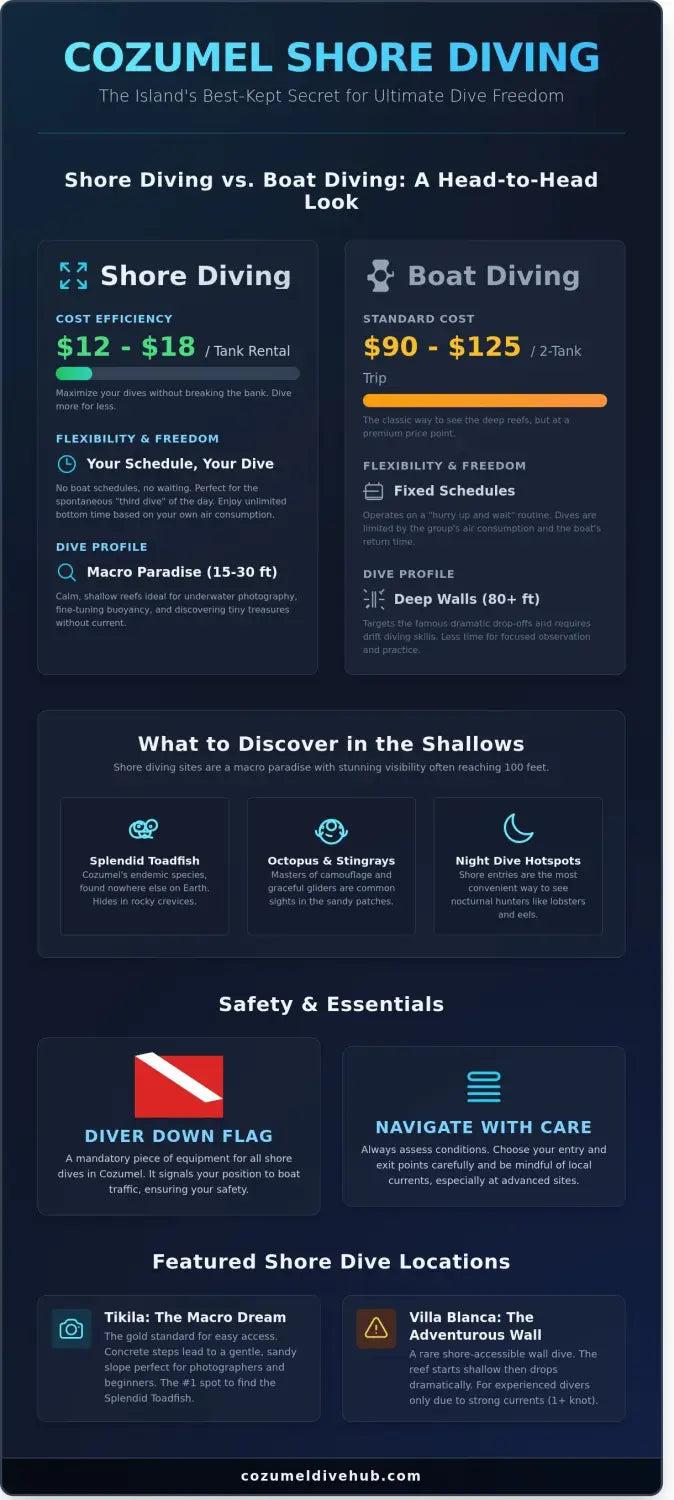
The shallow shore reefs run in a strip along the leeward west coast, typically between ten and forty feet. That is a different kind of diving from the walls. You get colour without a strobe, long no-decompression limits, and time. What you do not get is the drama — no drop-offs falling into blue haze, no swim-throughs at ninety feet, no eagle rays cruising a wall.
What lives in the shallows is worth going for on its own terms. Splendid toadfish tuck into rubble ledges and under coral heads in ten to twenty feet of water, which is exactly where a slow shore diver is best placed to find them. There are octopus, southern stingrays on the sand flats, juvenile fish in the rubble, and after dark the whole strip changes character. If toadfish are the reason you are getting in, the dedicated toadfish guide covers where and when to look properly.
The other honest limitation is logistics. You need a tank, and tanks come from dive shops — a PADI 5 Star IDC center that runs guided shore dives like Dive Boutique is one way around that. Very few shore entries in Cozumel have a compressor on the beach, which means most shore dives here start with a stop at a shop in town, a rental vehicle, and a tank rolling around in the back. That friction is the real reason shore diving stays a minority activity, not the quality of the reef.
The Shore Entries, Compared
Access terms at these places change. Several are inside beach clubs that have moved from pay-as-you-go to an entry fee or a minimum spend within the last few years, and a fee that was accurate last season may not be accurate this one. Treat the figures below as a starting point and confirm by phone or message before you load a tank into a car.
| Entry Point | Access And Fee | Air On Site | Entry Type | Depth | Who It Suits |
|---|---|---|---|---|---|
| Money Bar / Dzul-Ha | Beach club, roughly km 6.5 south. Reports conflict: some sources say no gate fee with an expected food or drink spend, divers have reported a per-person charge around 340 pesos credited against the bill. Confirm before going | Not confirmed. Listed as offering scuba services, but a working compressor on site was not verified | Shallow sand and rubble shelf off the club frontage | Roughly 10–20 ft | Afternoon second dive, toadfish hunting, macro |
| Playa Corona | Small beach club and restaurant with showers. A per-diver charge of about 10 USD is documented even when you eat there; divers have more recently reported 13 USD with a chair, or 18 USD including food | Not confirmed on site | Shoreline steps into the water | Roughly 20–40 ft | Quiet, uncrowded shallow dive |
| Sky Reef | Beach club at km 10+183, open roughly 8:00–19:00. Formerly pay-as-you-go, now reported as roughly 10 USD for a chair or 20 USD for a package. Not confirmed with the operator | Snorkel rental confirmed, dive tanks not confirmed | Club frontage, entry method not verified | Shallow patch reef | Divers happy to combine a dive with a beach day |
| Chankanaab | National park, admission confirmed at 31 USD adult and 22 USD child, Mon–Sat 08:00–16:00 | Yes — four dive operations on the beach, one-tank dive around 45 USD certified | Steps and inlet entry inside the park | Roughly 35–40 ft | Divers who want air, gear and a guide handled in one place |
| Villa Blanca | Reef sits opposite the Villablanca hotel, between the two cruise piers. Public shore access and any fee could not be confirmed | No | Ironshore or hotel ladder, depending on access | Site record: 50–100 ft, intermediate | Almost nobody, as a shore dive — see below |
| Las Rocas / Paradise stretch | Shore access here runs through hotel and dive-resort property. Public access could not be confirmed | Only where a resort dive operation serves its own guests | Property ladders and piers | Roughly 30–40 ft | Guests of a hotel on that stretch |
Two entries on that table need saying out loud rather than leaving in a cell.
Villa Blanca should not be treated as a casual shore dive. The site as it is normally dived is a boat drift on a wall between fifty and a hundred feet, with moderate-to-strong current and an intermediate skill rating. It is possible to rent tanks in town and swim the shallow part from shore, and reef guides that describe this option specifically do not recommend it. The reason is that the site sits between the two cruise piers, where ship traffic, ship intakes and port security all apply. If you want Villa Blanca, take it as a boat dive on the wall.
Paradise Reef is a boat site that people confuse with a shore option. Paradise runs roughly thirty to forty feet just north of the main hotel strip and is dived from boats all day. The shore entries near it — the Las Rocas rocks, and the piers at the dive resorts along that stretch — belong to properties, and several dive resorts there run shore and night diving for their own guests only. Staying on that strip is usually the only reliable way in.
The Entries Worth The Trip
Money Bar And The Dzul-Ha Shelf
This is the entry most divers mean when they say "shore diving in Cozumel". The reef starts close in, the bottom is a shallow shelf of sand, rubble and low coral heads, and the site record puts it at roughly ten to twenty feet. That is shallow enough that a single aluminium 80 can give you well over an hour if you are relaxed.
It is also the strongest bet on the island for splendid toadfish, precisely because the depth lets you go slowly and look under things. The catch is access. Money Bar is a beach club with a restaurant, and its terms have shifted. Some current descriptions say there is no gate fee but a food and drink purchase is expected; divers have reported being charged a few hundred pesos per person that was then credited against the bill. Whether a dive shop with a compressor is operating on the beach could not be confirmed for this season — assume you are bringing your own tank until someone tells you otherwise.
Playa Corona
Corona is quieter, deeper and less social. Steps take you off the shoreline into water that runs roughly twenty to forty feet over the reef, matching the site record. There is a restaurant with showers, which matters more than it sounds after an hour in salt.
Be realistic about the reef itself. Long-running reef surveys describe the structure here as significantly knocked about by past storms, with sparse fish life across most families. People still dive it, and the appeal is space and quiet rather than density of life. The documented diver charge is around ten dollars a head even if you eat there, with more recent reports in the thirteen to eighteen dollar range depending on what is included.
Chankanaab
Chankanaab is the one entry where the whole problem of air, weights and access is solved for you. It is a national park, admission is published at thirty-one dollars for an adult and twenty-two for a child, it runs Monday to Saturday from eight until four, and there are four dive operations working from the beach inside it. A one-tank dive with a certification card is around forty-five dollars on top of admission.
The shallow reef here sits in the mid-thirties to forty feet, with the underwater statues and small caverns that make it a popular first dive for cruise passengers. That popularity is the trade-off — it is the least solitary shore dive on the island, and it closes at four, so it is not an evening option. But if you want to shore dive without renting a car, this is the answer.
Sky Reef
Sky Reef sits further south at km 10+183 and opens roughly eight until seven, which is a longer day than most. It is a genuine shallow patch reef and popular with snorkellers and freedivers. What could not be confirmed here is the part divers care about: whether tanks or air are available on site, and what the current entry terms are. Snorkel gear rental is confirmed. Divers on forums report the club moving from pay-as-you-go to something in the region of ten dollars for a chair and twenty for a package, but that was not verifiable with the operator directly. Message them before committing your morning.
Hotel House Reefs
The unglamorous truth is that the most reliable shore diving on Cozumel is bought with a hotel booking. Several dive-focused properties along the west shore run their own pier or ladder entry, keep a compressor on site, and let guests dive the house reef unlimited, including at night. The relevant shallow reefs — the shelf in front of the El Presidente stretch at twenty to seventy feet, and the Coral Princess shallows at ten to twenty — are principally reached this way. If shore diving is a priority for your trip rather than an afterthought, choosing the hotel around it does more than anything else on this page. The dive center directory shows which operations are attached to a property with water access.
The Current Runs Along The Shore Too
This is the single thing that catches out divers who have shore dived elsewhere. Cozumel's current sets from south to north, and it does not stop at the reef line — it runs along the shallow shore strip as well. It is usually gentler inshore than out on the walls, but it is there, and on some days it is strong enough that you will not make headway against it.
The consequence is a hard rule. Swim south, into the current, at the start of the dive. Drift back north to your exit on the way home. Get that backwards — head north with a full tank because it feels effortless — and you finish the dive a long way down the coast with a tank that is nearly empty and a current you cannot swim through. Divers get into real trouble this way, and the mistake is always made in the first five minutes.
Before you go in, read the water. Watch which way turtle grass leans, or drop a bit of floating debris and see where it goes. If it moves faster than you can comfortably walk, the dive is off, or it becomes a one-way drift with a planned pickup further north rather than an out-and-back. Plan a concrete entry point and a concrete exit point before you gear up, including a fallback exit downstream, because on a shore dive nobody is following your bubbles. If you want a fuller picture of how the current behaves across the island and across the seasons, the current guide goes into it properly.
Boat Traffic Makes A Surface Marker Buoy Non-Negotiable
The west shore of Cozumel is a working waterway. Dive boats run the reef line all morning, the ferries to Playa del Carmen cross constantly, cruise ships work the piers, and small craft cut inside. A diver's head on the surface is close to invisible from a boat at speed.
So carry a surface marker buoy and deploy it before you ascend, every time, on every shore dive here. Not "if the current takes you". Every time. A towed float with a dive flag on it is better still, because it marks you for the whole dive rather than only at the end — displaying a diver-down flag is also the expected practice for shore diving in Mexican waters, and boat operators are required to keep clear of one. Neither device is expensive and neither is optional on this coast.
The corollary is that surfacing away from your exit is not a small inconvenience. If you drift past your entry, stay down and shallow rather than swimming on the surface along a boat lane, come up close inshore, and walk. Carry enough pesos for a taxi back with your gear.
Fees, Air And Getting There
Two costs sit on top of whatever the beach club charges. Dives inside the marine park require the park wristband, sold by dive shops and at park entrances — the current rate and where to buy it are covered in the marine park fee guide, and the fee applies whether you arrived by boat or on foot. The other is the tank itself, rented by the day from shops in San Miguel; multi-day rates are normal if you are diving the same entry all week.
Transport is the practical bottleneck. Tanks and taxis do not mix well, and drivers are within their rights to refuse dripping gear. Most people who shore dive here more than once end up renting a car or a jeep for the days they plan to do it. When you park at a quiet entry, take everything of value with you and leave nothing visible in the vehicle.
If you are diving off a cruise ship rather than staying on the island, the timing maths is different and tighter — the cruise port diving guide covers what actually fits inside a port day.
Night Diving From Shore
The shallow shore reefs are the most practical place on the island to do a night dive, because you are not committing to a boat departure and a fixed return. Octopus come out over the rubble, lobster walk in the open, and reef fish that were skittish at noon sit still.
Everything in the safety section above applies harder in the dark. The current does not sleep. Boat traffic is thinner at night but faster and less expectant of divers, so a lit float on the surface matters more, not less. Do it at an entry you have already dived in daylight, so you know the exit by feel. The night diving guide covers lights, signalling and how to run the dive.
A Note On The East Side
The site database lists a handful of east-coast shore entries, including Punta Morena in the ten to twenty-five foot range. Read those with care. The east coast faces open Caribbean with no reef crest to knock the swell down, it has surf, undertow and no boat cover, and it is not where shore diving on this island normally happens. On the rare genuinely flat day it is possible, and locals who know those beaches do it. It is not a substitute for the west shore, and it is not somewhere to work out your entry technique.
The west-shore shallows — the Tikkila shelf at fifteen to thirty feet is a good example — do everything the east side would, in protected water, with a road behind you.
What Could Not Be Confirmed
Being straight about the gaps is more useful than filling them with confident numbers. As of this writing, the following were not verifiable from the operators themselves: whether a working dive compressor is on the beach at Money Bar or Sky Reef; Sky Reef's current entry price; Money Bar's current fee structure, which sources describe inconsistently; and whether Villa Blanca or the Las Rocas stretch have any public, non-guest shore access at all. Beach club terms in Cozumel change season to season and sometimes faster. A five-minute message to the club or a call to a dive shop in town will save you a wasted morning and a car rental.
Plan It Around The Boat, Not Instead Of It
Shore diving in Cozumel is a good addition and a poor replacement. Book the boat mornings for the walls, then use the afternoons for a shallow entry with a camera, or an evening for a night dive off a house reef. That is the shape that actually works here, and it is the shape most people who dive this island for a week settle into by day three.
Start with the trip planner to work out where to stay, how many boat days to book, and which shore entries make sense from your base.
Frequently Asked Questions
Is shore diving in Cozumel worth doing?
Which way does the current run when shore diving in Cozumel?
Do you need a surface marker buoy to shore dive in Cozumel?
Where do you get tanks for a Cozumel shore dive?
Is there an entry fee at Cozumel shore diving spots?
Can you shore dive Villa Blanca?
How deep is shore diving in Cozumel?
Can you night dive from shore in Cozumel?
Does the marine park fee apply to shore divers?
Should you shore dive on Cozumel's east coast?
Share This Article

Carmen Novelo
Carmen Novelo is a Cozumel native and an active scuba instructor and dive guide on the island. She has spent twelve years diving the Cozumel reef system, and writes about its dive sites, conditions and marine life for Cozumel Dive Hub.