Ear Equalization Problems Scuba Diving: The Ultimate Guide to Pain-Free Descents
Two rules cover most of what goes wrong with ears underwater: equalize before you feel pressure rather than after, and never keep descending against pain. Cozumel adds negative entries, which remove the surface pause slow ears depend on.
Carmen Novelo · April 11, 2026 · 7 min read
Two rules cover most of what goes wrong with ears underwater. Equalize before you feel pressure, not after it arrives. And never keep descending against pain. Divers Alert Network states the second one without hedging: "Pain is not acceptable. If there is pain, you have descended without adequately equalizing. Ascend a few feet until the pain stops."
Nearly every painful descent, aborted dive and ruined dive week traces back to breaking one of those two rules. Cozumel adds a local wrinkle that general equalization guides never mention: boats here frequently use a negative entry, which removes the unhurried surface pause that slow ears depend on. That is worth understanding before you step off the platform.
This is an editorial guide, not medical advice. Every technique and warning below is attributed to Divers Alert Network (DAN) or to an ENT source. If your ears are giving you trouble, the answer is a doctor, not an article.
What Equalization Actually Is
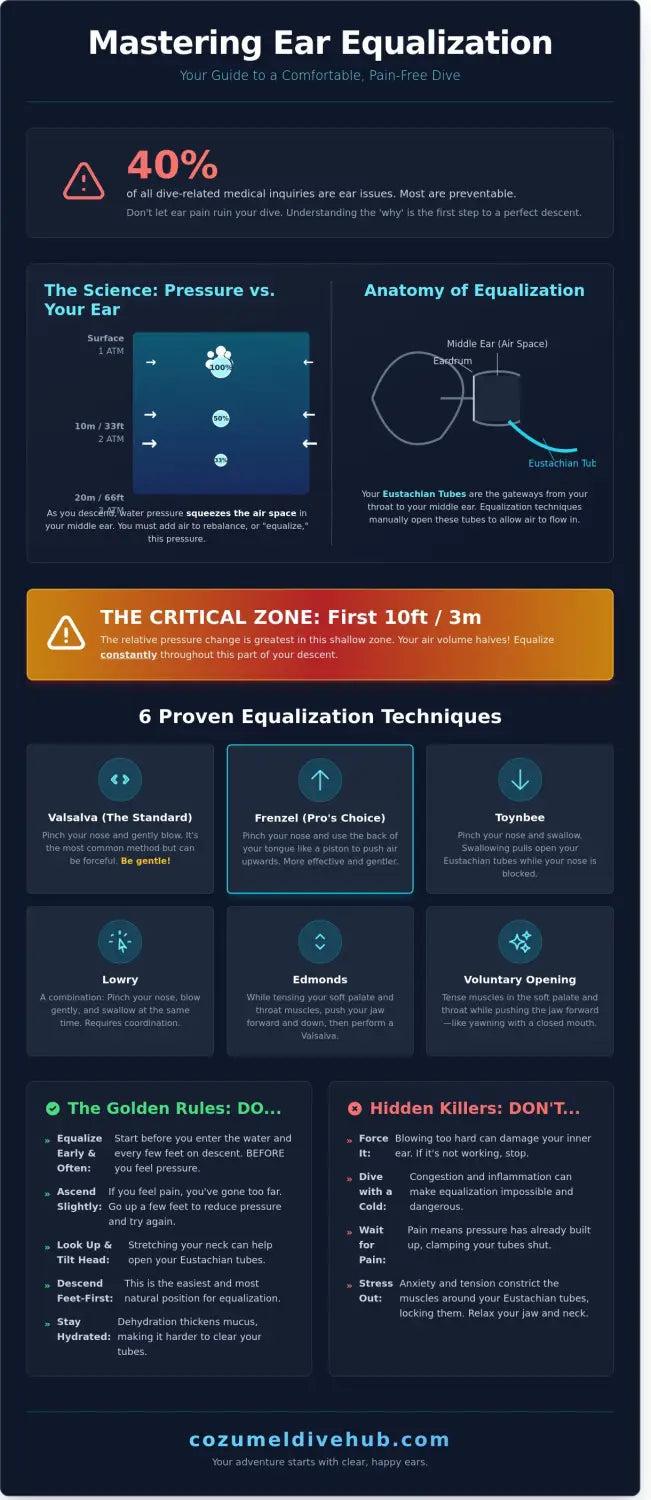
Your middle ear is a sealed air pocket behind the eardrum. Its only connection to the outside world is the Eustachian tube, a narrow passage running to the back of your throat that is normally closed and opens briefly when you swallow or yawn.
As you descend, water pressure rises and squeezes that air pocket. Boyle's law says the volume shrinks as pressure climbs, so unless you actively push air up the Eustachian tube to refill the space, the eardrum gets pulled inward. That inward pull is the "squeeze," and it is the first stage of ear barotrauma. Equalization is simply the act of adding air to that space fast enough to keep up with the water.
Why The First 10 Metres Are The Dangerous Part
Pressure doubles between the surface and 10 metres, from roughly one bar to two. Over the next 10 metres it rises by only half again. In relative terms nothing you do later in the dive comes close to what happens in the first 33 feet, which is exactly why most equalization injuries happen in water shallow enough to swim up from.
DAN's guidance reflects that. Pre-pressurize gently at the surface before you leave it, then "inflate your ears gently every few feet for the first 10 to 15 feet." Descend feet first when you can, because that lets air travel upward into the Eustachian tube in its natural direction, and use a descent line so you can stop instantly rather than sinking while you fumble.
The Six Techniques, Compared
Most divers learn one method and stop there. That is a mistake, because the technique everyone learns first is also the one most capable of causing serious injury. The six methods below are the ones DAN documents; the ENT literature covers the same ground with the same names.
| Technique | What You Actually Do | Best Used For | Risk And Notes |
|---|---|---|---|
| Valsalva | Pinch the nostrils and gently blow through the nose | Descent, when done early and gently | Can force the tubes shut if you are late; forceful attempts raise intracranial pressure and can rupture the round window |
| Toynbee | Pinch the nostrils and swallow | Ascent, and gentle descent equalizing | Low pressure method; DAN specifically names it as good for equalizing during ascent |
| Frenzel | Pinch the nostrils, contract the throat muscles and make the sound of the letter "k" | Fast or head-down descents, freediving | Uses the tongue as a piston rather than the chest, so far less force reaches the inner ear; takes practice |
| Lowry | Pinch the nostrils, gently blow out through the nose while swallowing at the same time | Stubborn ears that resist a single method | Valsalva meets Toynbee; still needs to be gentle |
| Edmonds | Push the jaw forward, then apply Valsalva or Frenzel | Tubes that need mechanical help to open | Combination method; the jaw thrust does part of the work so less pressure is needed |
| Voluntary Tubal Opening | Tense the throat and soft palate to hold the tubes open, no hands | Hands-free continuous equalizing | DAN notes up to 30 percent of divers can master it. Most cannot, and that is normal |
Why Valsalva Is The One Most Likely To Hurt You
Valsalva is the technique nearly everyone is taught first, because it is easy to explain and it works. The problem is what happens when it does not work.
DAN's explanation of inner-ear barotrauma is specific: the Valsalva maneuver increases intracranial pressure, that pressure transmits through the cochlear fluid, and the round window bulges outward. If a diver blows hard against a tube that is already locked shut by a pressure differential, the round window or, less commonly, the oval window can tear, leaking inner-ear fluid. DAN calls the result a perilymph fistula, and warns it can cause permanent hearing damage unless it heals promptly or is surgically repaired.
Two things follow from that. First, Valsalva should always be gentle. The American Academy of Otolaryngology describes it as holding the nose and mouth closed and gently trying to blow the nose, and the emphasis on "gently" is theirs. Second, if a gentle Valsalva is not working, blowing harder is the single worst response available to you. Ascend a little and try a different method instead. That is what the other five techniques are for.
DAN also offers one small tip that catches a lot of divers out: look up. Extending your neck tends to open the Eustachian tubes, not close them.
Equalize Early And Often
The habit that separates divers who never think about their ears from divers who dread every descent is almost embarrassingly simple: they equalize before there is anything to fix.
DAN's practical checklist runs roughly like this. Before you board the boat, swallow and listen for a pop or click in both ears; if one side is silent, that is information worth acting on before you gear up. Start gently equalizing well ahead of the dive and chew gum during the surface interval. Pre-pressurize at the surface. Go down feet first. Look up. Use a line if there is one. Equalize often enough that you maintain a slight positive pressure in the middle ear rather than chasing a deficit. Keep your mask clear, because water irritating the nasal passages produces the mucus that clogs the tubes. Skip tobacco and alcohol, both of which irritate the mucous membranes.
None of that is exotic. All of it is free.
Never Descend Against Pain
Pain is not a hurdle to push through. It is the signal that the pressure differential has already locked your Eustachian tubes shut, and forcing the issue is how eardrums perforate. DAN's tip list puts it as "Don't try to push through pain." The ENT guidance is blunter still: stop descending, ascend to reduce pressure, and if it still will not clear, signal your buddy and end the dive. Do not try to push through the pain.
When your ears stop cooperating, the reset is short:
- Stop descending immediately. Not in a moment, not after two more metres.
- Ascend until the fullness completely disappears. A metre or two is usually enough. The feeling must go away entirely, not merely fade.
- Try a different technique. Swallow, wiggle the jaw, push the jaw forward, try Toynbee or Lowry instead of another Valsalva.
- Descend again slowly, equalizing continuously. If it locks up again at the same depth, the dive is over. There will be another one.
Ending a dive over your ears costs you 45 minutes. Pushing through can cost you the rest of the week, or your hearing.
Reverse Block On The Way Up
A descent problem is inconvenient. An ascent problem is genuinely dangerous, for one reason: descending is optional, ascending is mandatory.
A reverse block happens when air expands in the middle ear on ascent and cannot escape because the Eustachian tube is obstructed, usually by congestion or swollen mucus. Pressure builds, and it causes fullness, pain and sometimes vertigo on the way up. You cannot simply stay down until it resolves, because your gas supply and your no-decompression limit are both finite.
If it happens, stop your ascent and descend slightly until the pressure eases, then try to ascend as slowly as your gas and your computer allow. Toynbee, the pinch-and-swallow method, is the one DAN names for equalizing during ascent, because it does not add more air to a space that already has too much. Signal your buddy and your Divemaster so someone knows what is happening and stays with you.
There is a related and nastier ascent problem worth recognising. Alternobaric vertigo occurs when the two ears equalize unevenly on the way up and the pressure difference stimulates the vestibular system. DAN describes the hazard directly: the inability to tell up from down, the difficulty following safe ascent procedures, and the risk of vomiting underwater. It usually passes quickly once pressures equalize, but if you have ever experienced it, mention it in the dive briefing.
Barotrauma: Middle Ear Versus Inner Ear
These are two different injuries with two very different outlooks, and the distinction matters.
Middle-ear barotrauma is the common one. A blocked Eustachian tube on descent creates a relative vacuum in the middle ear, and DAN describes the progression from there: tissue swelling, the eardrum bulging inward, fluid leaking into the space, and in the worst cases bleeding or perforation of the eardrum. Symptoms run from a clogged, blocked sensation through to severe pain, then fluid and blood. DAN advises evaluation if ear pain and fullness last more than a few hours.
Inner-ear barotrauma is rarer and much more serious. It is the round window or oval window injury described above, and it can follow a forceful Valsalva against a blocked tube. Its symptoms are not subtle.
Symptoms That Mean Stop Diving And See A Doctor
Stop diving and seek medical evaluation for any of the following:
- Vertigo or severe dizziness, particularly if accompanied by nausea and vomiting. DAN states that severe vertigo and nausea after diving require emergency medical care.
- Hearing loss, including muffled or distorted hearing. It often affects higher frequencies first and may not be obvious straight away.
- Tinnitus — ringing or roaring in the ear.
- Fluid or blood draining from the ear canal. The ENT guidance treats bleeding from the ear as an emergency-room symptom.
- Ear pain or fullness lasting more than a few hours after the dive.
DAN Europe's position on continuing to dive with these symptoms is worth quoting in full, because it is more forceful than most divers expect: "Divers with these symptoms should probably end the days, and possibly the week's diving as continuing to dive might result in severe injury."
For suspected inner-ear barotrauma DAN advises stopping any further attempts to equalize, keeping still, and seeking urgent evaluation by an ENT specialist. DAN's emergency hotline runs 24 hours a day at +1-919-684-9111; for a life-threatening emergency, contact local emergency services or get to the nearest medical facility first, then call DAN. Confirm what your travel and dive insurance actually covers before you leave home rather than in a clinic waiting room.
What DAN Says About Decongestants
Divers ask about decongestants constantly, and the honest answer is more cautious than the internet's.
DAN's core objection is not that decongestants fail. It is that they may succeed on the way down and quit on the way up. As DAN puts it: "Descending is optional; ascending is mandatory. Use of a decongestant might allow a diver to get to depth, but if the medication wears off during the dive it could cause a painful and dangerous reverse block or reverse squeeze."
There is a second mechanism behind that. Decongestants work by constricting blood vessels; when they wear off, DAN Southern Africa explains, the vessels become more engorged with blood than they were before. That is the rebound effect, and rebound swelling in the Eustachian tubes at depth is precisely the situation you do not want. Nasal sprays carry the same rebound risk, and the ENT guidance limits sprays such as oxymetazoline to no more than two or three days of use in any case.
DAN's actual recommendation is to work with your doctor rather than self-medicate, and it notes that a physician may suggest options that do not cause rebound. It also says that if you are often unable to clear your sinuses, or you get frequent ear pain or nosebleeds when diving, you should call DAN or see an ENT specialist for evaluation.
Nothing in this article is a recommendation to take any medication. That conversation belongs with your own doctor, ideally before your trip, and it is the same conversation the dive medical form is designed to prompt.
The Cozumel Problem: Negative Entry
Here is the thing almost no equalization guide tells you, and it matters enormously on this island.
Cozumel is a drift diving destination. The current runs south to north along the west coast and does not wait for anybody, so boats commonly ask divers to perform a negative entry: BCD fully deflated, roll or stride in, and descend immediately without floating on the surface first. It keeps the group together, puts everyone on the reef at the right spot, and stops the boat drifting away from six divers still bobbing around adjusting their masks.
It also deletes the single most useful thing a slow-eared diver has: an unhurried minute at the surface, pre-pressurizing and starting down at their own pace. Dive publications are explicit that negative descents are not recommended for divers who need a long time to equalize.
Say Something In The Briefing
This is the genuinely useful part. If your ears are slow, say so out loud during the briefing, before anyone is in the water. Three requests are entirely reasonable and cost nothing:
- Ask to descend on the line if the boat is using one, so you can stop and hold at any depth.
- Ask to go last so nobody is waiting on you and you are not tempted to rush.
- Ask whether a normal surface entry is possible at that particular site. On a calm day at a mild-current site it very often is, and the answer depends on the conditions that morning.
Nobody on a Cozumel boat will think less of you for it. Guides would far rather adjust the entry than deal with an injured ear at 18 metres. Divers new to these conditions may also want to read up on what a first drift dive involves and how strong the current actually gets before the trip, and choosing an operator that runs small groups makes this conversation much easier — that is covered in the guide to picking a Cozumel dive shop.
Wall sites like Palancar deserve particular care, because the temptation to keep dropping past a spectacular drop-off while your ears complain is real. The reef will still be there at 15 metres.
Day Four Is The Problem, Not Day One
The other thing repetitive diving does to ears is cumulative, and it catches out visitors on a full dive week.
A typical Cozumel schedule is a two-tank morning, sometimes an afternoon single, for five or six days straight. Each descent that involves a bit of straining leaves the middle ear slightly inflamed. Day one is fine. Day two is fine. By day four the tissue that was mildly irritated on Tuesday is swollen enough that ears which cleared easily at the start of the week suddenly will not.
That pattern is normal, and it is a reason to change the plan rather than push harder. Options that actually help: take a genuine day off and let the tissue settle, which is what surface-interval days are for; drop the third dive; stay shallower; and rinse the outer ears with fresh water after each day, since salt left in the canal irritates the skin. Leave cotton buds out of it — pushing softened wax deeper into the canal makes the next day worse, not better. Anything beyond a fresh-water rinse and a towel dry is a question for a doctor, not a boat.
Enriched air does nothing for your ears, incidentally. It manages nitrogen, not pressure on the eardrum.
Practising Before The Trip
Equalization is a motor skill, and motor skills respond to rehearsal. Frenzel in particular is hard to learn on a boat with the current running and five people waiting, and much easier to learn dry, at home, with a mirror and no time pressure. Spend a few minutes a day in the week before you travel finding the "k" sound at the back of your throat and feeling what the tongue does. Practise the jaw thrust of the Edmonds technique. See whether you are one of the minority who can hold the tubes open voluntarily.
Divers coming back after a long break should also consider a refresher, and anyone whose ear trouble is really anxiety wearing a disguise — a jaw clenched tight makes equalizing measurably harder — will find the guide to diving nerves more useful than another technique list. If you are new to all of this, start with the beginner's guide to diving Cozumel.
If Something Goes Wrong On The Island
Cozumel is better set up for dive medicine than most Caribbean destinations. The island has hyperbaric chamber facilities and physicians who see dive injuries routinely, which is one reason it remains a comfortable place to dive despite the demanding conditions — the details are in the guide to Cozumel's hyperbaric chamber locations.
An ear injury is not a chamber case. Barotrauma is a job for an ENT or a general physician, not recompression, and the two should not be confused. But knowing where medical help is, and having insurance that pays for it, belongs in the same mental folder. The broader picture of conditions, risk and infrastructure is covered in the guide to whether Cozumel diving is safe.
One last piece of sequencing: if an ear problem does end your diving mid-trip, it does not change the flying-after-diving intervals you already owe from the dives you did do. And if boat motion is part of your problem, the seasickness guide is worth a look, since some remedies for one interact with the other.
Build The Trip Around The Ears You Have
Slow ears are not a disqualification. They are a planning input. Choose a shallower first day, ask for the line, go last, keep the third dive optional, and treat the first sign of pain as a full stop rather than a suggestion. Divers who do that dive for decades. Divers who blow harder end up in a clinic.
Ready to put the plan together? Start with the Cozumel dive trip planner and build a week that gives your ears room to work.
Frequently Asked Questions
What is the safest way to equalize my ears while scuba diving?
Why is the Valsalva maneuver considered risky?
How often should I equalize during a descent?
What should I do if my ears will not clear on descent?
What is a reverse block and why is it more dangerous?
What symptoms after diving mean I should see a doctor?
Can I dive with a cold or sinus congestion?
Do decongestants make equalizing safer?
What is a negative entry and what does it mean for slow ears?
Why do ear problems get worse later in a dive week?
Share This Article
Carmen Novelo
Carmen Novelo is a Cozumel native and an active scuba instructor and dive guide on the island. She has spent twelve years diving the Cozumel reef system, and writes about its dive sites, conditions and marine life for Cozumel Dive Hub.