Cozumel Dive Briefing: What to Expect Before You Hit the Water
A Cozumel dive briefing runs five to ten minutes and covers the site, maximum depth, current direction, entry method, turn pressure, the ascent plan and the lost-diver procedure. It is short because it assumes you already know how to dive.
Carmen Novelo · May 20, 2026 · 16 min read
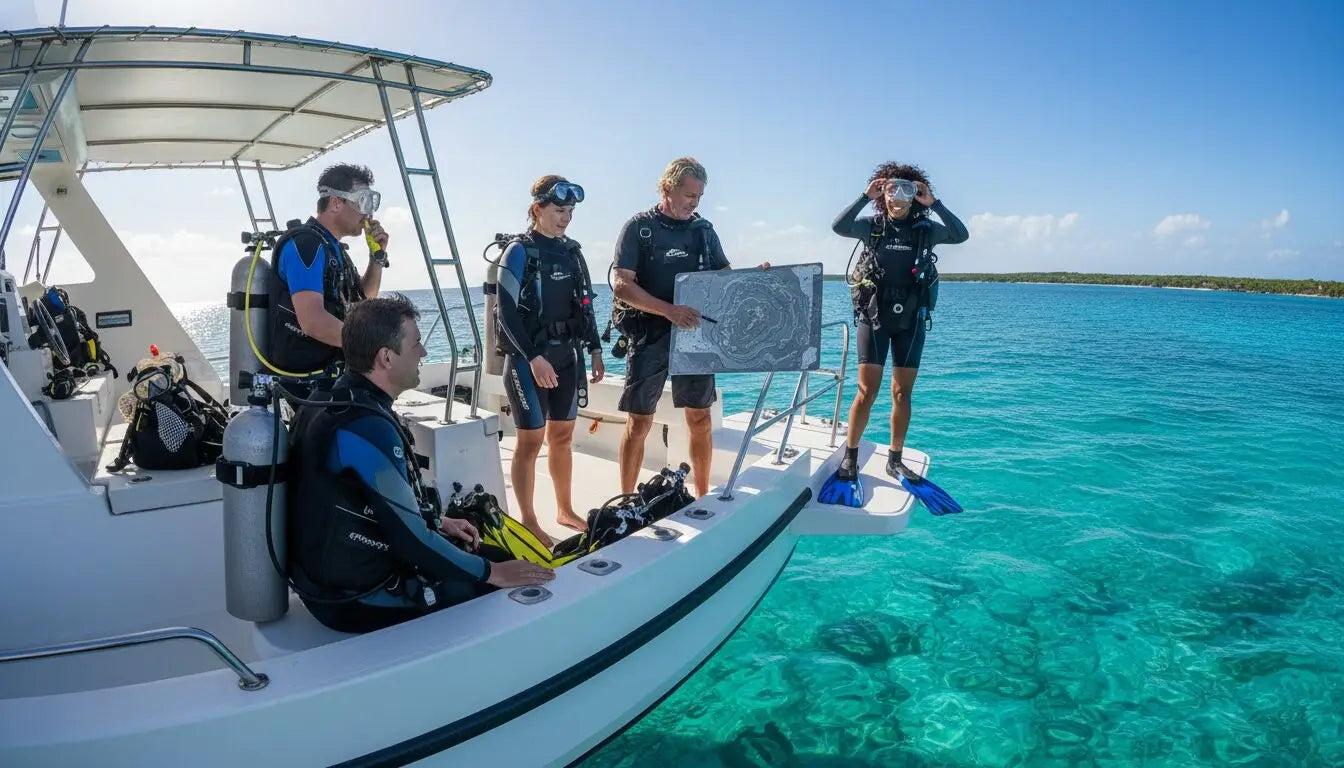
A Cozumel dive briefing is the short talk a guide gives on the boat before each dive. It covers the site name, the maximum depth, the expected current direction and strength, the entry method, the planned bottom time, the tank pressure at which you are expected to signal the guide, the ascent and safety stop plan, and the lost-diver procedure. Most last five to ten minutes. They are markedly shorter than briefings in many other destinations because they assume you already know how to dive — and that assumption, more than the current itself, is what unsettles first-time visitors.
That brevity is not carelessness. Cozumel's diving is repetitive in structure: almost every dive is a drift along a reef running roughly south to north, finished with a live boat pickup. Once a guide has explained that pattern on dive one, dive two does not need it again. What a briefing must give you every time is what changed: which reef, how deep, how fast the water is moving, and how you are getting into it.
What a Cozumel Dive Briefing Actually Covers
Use the table below as a mental checklist. If a briefing skips a row, that is a question worth asking before the boat slows down.
| Element | What you should hear | Why it matters |
|---|---|---|
| Site name and layout | The reef by name, plus whether it is a wall, a slope, a sand-channel system or a wreck | Tells you what to expect visually and how far off the bottom you should be swimming |
| Maximum depth | A hard number in feet or metres, and the depth the group will actually spend most of the dive at | Lets you check the plan against your certification and your own comfort |
| Current direction and strength | Which way the water is running and roughly how hard | Determines which way you face on entry and how much finning you will do |
| Entry method | Back roll, giant stride, or a negative entry | Changes how you prepare your gear in the minutes before you jump |
| Planned bottom time | Usually 40 to 50 minutes on a first dive, sometimes longer on a shallow second | Sets your expectation so you are not surprised when the guide turns the dive |
| Turn and signal pressure | The pressure at which you show your gauge to the guide, and the pressure at which the group ascends | This is the single most commonly mumbled part of a briefing — get the numbers |
| Ascent and safety stop | Where the group will ascend, whether the stop is on a line or in open blue water | An open-water stop in a moving current is a different skill from hanging on a line |
| Boat pickup | Whether the boat follows the group and how it approaches surfaced divers | Cozumel almost always uses live boat pickup, so you surface where the drift ends |
| Lost-diver procedure | How long to search and what to do next | The one procedure most likely to be needed and least likely to be practised |
| Marine park rules | No gloves, no touching, no taking, reef-safe sun protection | Enforced by CONANP inside the national park, not a courtesy request |
| Site-specific hazards | Swim-throughs, downcurrent potential, boat traffic overhead | Varies hugely between a shallow reef and a southern wall |
Why Cozumel Briefings Assume You Already Know How to Dive
Cozumel is a certified-diver destination first and a training destination second. The typical boat carries people who arrived with a logbook and an expectation of two tanks a day for a week, and guides brief to that room: a compressed, professional talk delivered at speed, often over engine noise, sometimes in a second language for both parties.
For a diver with fifteen logged dives that compression can read as indifference. It usually is not — but it does shift the burden of comprehension onto you. The fix is entirely within your control: listen for the numbers, and ask about anything you missed while the boat is still moving. If you have not dived in a year, say so before the trip rather than during the briefing. A refresher resets the skills a briefing takes for granted, and spares you admitting mid-boat that you cannot remember how to deploy an SMB.
What Is a Negative Entry and How Do You Prepare for One?
A negative entry means entering the water with an empty BCD and descending immediately, rather than floating on the surface, gathering the group, and going down together. You hit the water already sinking.
Cozumel boats use it regularly, and it catches people out. The reason is structural: on a moving reef in a running current, a group that assembles on the surface has already drifted past the mooring-free entry point the guide picked. Descending straight away keeps everyone on the reef instead of thirty metres downstream of it.
What actually changes for you:
- Your BCD is fully empty before you jump, not after. Vent it on the boat.
- Mask and regulator go in place before the count. There is no surface pause to sort them out.
- You get one descent, and it starts immediately. Equalise early and often, beginning before your head is under. If you have a cold or equalise slowly, say so — the usual accommodation is a normal entry and meeting the group at depth.
- Everyone goes at once, on a single count or hand drop. Waiting three seconds puts you behind the group.
A negative entry is not a difficulty test and it is not compulsory. A guide told quietly that you have never done one will almost always adjust, usually by having you enter last with a short surface pause. What a guide cannot adjust for is something you did not mention. If the concept is new, read the drift diving guide and the first drift dive walkthrough before you travel.
Which Hand Signals Should You Confirm Before You Get In?
Signals vary between training agencies, countries and individual guides. The core set is stable; the edges are not. A good briefing covers the ones that matter for that dive — if yours does not, run through them with the guide during kit-up.
| Signal | Widely understood meaning | Where it goes wrong |
|---|---|---|
| Thumb and forefinger circle | OK — both a question and an answer | Never means "good" as a thumbs-up would; a thumbs-up means go up |
| Thumb up | Ascend, end the dive | Regularly misread by new divers as approval |
| Thumb down | Descend | Rarely confused, but easy to miss in poor light |
| Flat hand, palm down, wobbled | Something is not right, a problem | Sometimes given as "so-so" in casual use, which muddies it |
| Hand across throat | Out of air | Must be instant and unmistakeable; practise it |
| Fist on the chest or shoulder tap | Get my attention, stay close | Highly guide-specific in how it is used |
| Numbers on fingers | Remaining pressure in hundreds of PSI or bar | The unit is the ambiguity — confirm whether the boat runs PSI or bar |
| Flat hand held level, moved slowly | Stay at this depth, level off | Often used on walls to stop divers sinking |
| Species signals | Turtle, ray, shark, eel, toadfish | Almost entirely local and improvised — ask for the two or three the guide uses most |
Two clarifications are worth asking for explicitly on every new boat. First, the pressure unit: a guide holding up a single finger may mean 1,000 PSI or 100 bar, and the difference is enormous. Second, how the guide signals "we are turning the dive" — some tap a tank, some use a shaker, some simply expect you to be watching them. Read up on hand signals in advance so the review is a confirmation rather than a lesson.
What Happens If You Lose the Group?
The standard procedure, and the one almost every Cozumel guide states, is: search for roughly one minute — turn a full circle, look up as well as along the reef, check for bubbles — then make a controlled ascent, do a safety stop if gas allows, surface, and inflate your SMB.
Cozumel's version has one important local feature: because boats run live pickup rather than sitting on a mooring line, surfacing alone is not the emergency it would be where the boat is a fixed point half a mile away. The boat is already following the group's bubbles, and a diver who surfaces with a marker deployed is visible and expected. Surfacing early and being collected is a boring outcome; staying down and searching is the one that causes problems. This is why an SMB is not optional here even though the guide carries one — if you have never deployed one from depth, say so, and read the separated-from-your-group guide before the trip.
When Should You Ask a Question?
Before the boat stops. Not after.
Once the engines drop and the crew starts moving tanks, the window has closed — the entry sequence is time-critical because the boat is holding position against moving water. A question at that moment gets a fast answer at best and a distracted one at worst.
The best moments to ask are during the ride out, when the guide is standing and talking anyway, and during kit-up, when they are moving between divers checking gear. Reasonable things to raise, none of which mark you as a problem diver: what pressure the guide wants you to signal at; whether the entry is negative; how deep the group will actually spend the dive; that you have not dived in eight months and would like to enter last; that you equalise slowly and need the descent at your own pace; which way the current runs from the entry point; and whether the safety stop is on a line or in blue water.
Guides are far more comfortable with a diver who asks than with one who nods and then has a problem at twenty metres. If you find that asking is met with visible impatience, that is information about the operator, not about you.
What Does a Bad Briefing Look Like?
This is the part most guides will not say out loud, so it is worth stating plainly. A rushed, vague or absent briefing is a genuine warning sign, and it correlates with other things you cannot see — maintenance standards, group sizes, whether the boat carries emergency oxygen.
Warning signs, roughly in order of seriousness: no briefing at all, or one given only to part of the group; no lost-diver procedure mentioned, which is the sign that should end your relationship with an operator; no depth or current information beyond a site name and "follow me"; a group so large the briefing is inaudible from the back of the boat, with no attempt to repeat it; questions treated as an inconvenience; no check that everyone understood, particularly when the boat holds a mix of first languages; and a described dive plan that exceeds the certification level of people on board, with no acknowledgement of the mismatch.
None of these are about friendliness. A brusque guide who covers all eleven rows of the table above is running a safer boat than a charming one who covers four. If you are still choosing, the dive shop selection guide and the notes on avoiding crowded boats cover what to ask before you book, and the dive center directory lists operators on the island.
How Briefings Differ by Site
The variables that change most between sites are depth, current exposure, and whether there is anything overhead.
| Site type | Example | What the briefing emphasises |
|---|---|---|
| Shallow training reef | Paradise Reef | Buoyancy, staying off the coral, boat traffic overhead |
| Classic mid-depth drift | Palancar Gardens | Drift pattern, group spacing, where the dive ends |
| Wall dive | Santa Rosa Wall | Depth discipline, not sinking, watching the blue |
| Deep drift | Colombia Deep | No-decompression limits, gas planning, turn pressure |
| Swim-through system | Palancar Caves | Single-file order, fin control, opting out |
| Exposed southern site | Punta Sur | Experience prerequisites, downcurrent response, group discipline |
| Wreck | C-53 | Penetration limits, silt, entry and exit points |
The full dive site index lists depths and skill levels for every reef, which is the easiest way to check a briefing against reality before you are on the boat.
What a Briefing Will Not Cover
A briefing sets the plan. It does not manage your day. Your own no-decompression limits remain yours to track — the guide's computer reflects their week of diving, not yours. Nobody else watches your SPG, so if you breathe heavily the air consumption guide is worth reading before you travel. A proper weight check on dive one saves the rest of the week, guided groups blur but do not abolish the buddy system, and seasickness or a short night degrades performance more than divers admit — the seasickness guide covers that, and the hyperbaric chamber guide covers what exists on the island if something goes wrong.
Before Your First Cozumel Boat Day
A briefing lands better when you already know how the Yucatán Current shapes the diving, roughly how strong the current runs in the month you are visiting, and what the marine park rules require. The conditions-by-month guide covers water temperature and visibility; the marine park fee guide explains the daily charge. If nerves rather than knowledge are the issue, the notes on overcoming fear of diving help more than rereading procedures.
Ready to build the trip around it? Start with plan your Cozumel dive trip for logistics, certification routes and a week-by-week structure, or browse more diving guides for the specific questions that come up before a first Caribbean drift.
Frequently Asked Questions
How long does a Cozumel dive briefing usually last?
What is a negative entry in Cozumel diving?
Do I have to do a negative entry if I am not comfortable with one?
What information should a dive briefing always include?
What should I do if I lose my dive group in Cozumel?
Why do hand signals vary between dive operators?
When is the right time to ask the guide a question?
Is a short dive briefing a bad sign?
What are the warning signs of a poor dive operator briefing?
What does a briefing not cover that remains my responsibility?
Share This Article

Carmen Novelo
Carmen Novelo is a Cozumel native and an active scuba instructor and dive guide on the island. She has spent twelve years diving the Cozumel reef system, and writes about its dive sites, conditions and marine life for Cozumel Dive Hub.