Lost Your Group? What to Do if You Get Separated From Your Dive Group
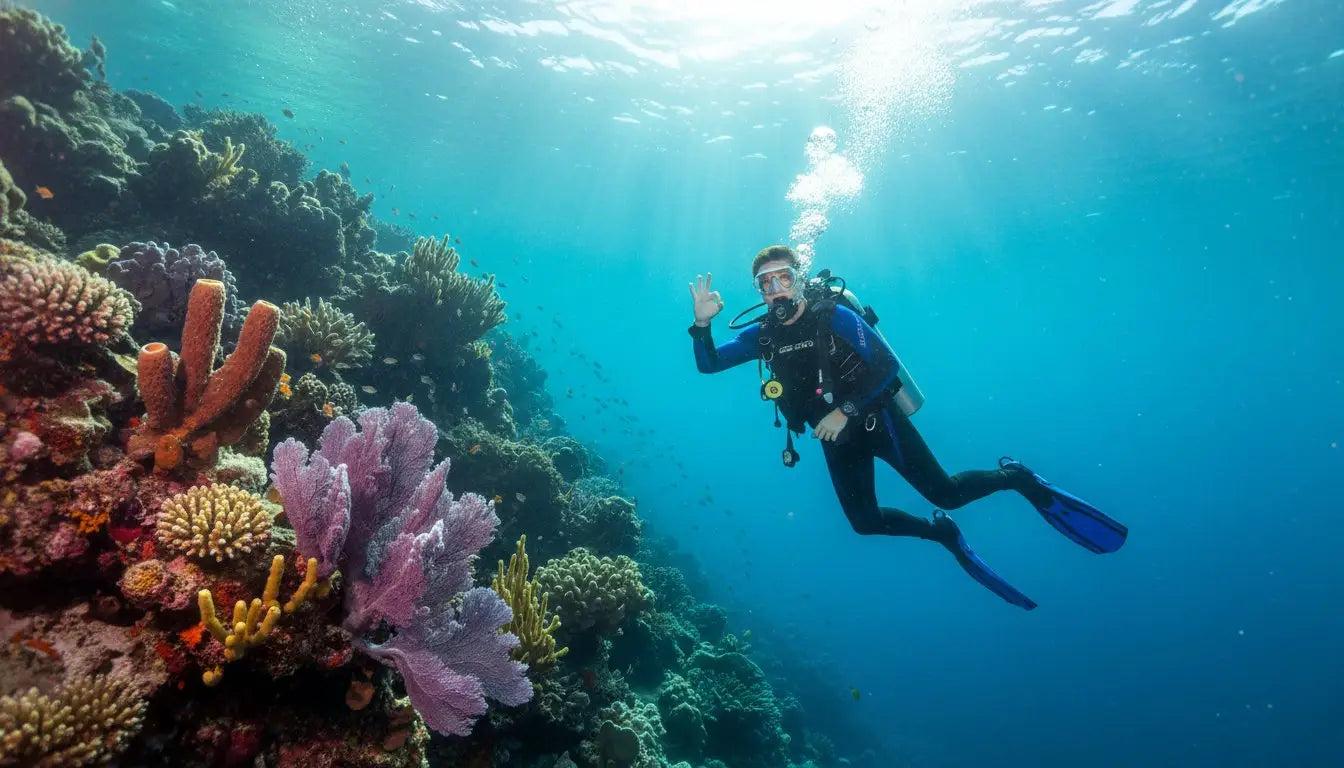
If you lose your dive group in Cozumel, turn a slow 360 while looking up, give it about one minute, then end the dive: ascend, deploy your SMB, safety stop if you can, and wait on the surface. The live boat is already following bubbles.
Carmen Novelo · July 1, 2026 · 18 min read
If you lose your dive group in Cozumel, stop where you are, turn slowly through a full 360 degrees while looking up as well as around, and give that search roughly one minute — no longer. If you still cannot see bubbles or silhouettes, end the dive: ascend at no more than 18 metres/60 feet per minute, deploy your surface marker buoy on the way up, and make a normal three-minute safety stop at 5 metres/15 feet if your gas supply and no-decompression limit allow it. On the surface, inflate your BCD fully, hold the SMB upright and stay exactly where you are — do not re-descend to search.
That last line is the part Cozumel changes. Almost every dive here is a drift dive with a live boat: the captain is under power, following the group's bubbles, moving at the same speed as the water you are floating in. A diver who surfaces alone is not lost. They are a diver the boat now has to collect, which happens on Cozumel reefs most days of the week and is treated as routine rather than as an emergency.
What Exactly Is The Lost-Group Procedure?
The procedure taught by the major training agencies is short on purpose, because a long underwater search is the thing that turns a separation into a real problem. PADI's own ReActivate knowledge review states it in a single clause: search together underwater for a minute and reunite on the surface if not found. Everything below is that instruction, unpacked.
- Stop. Do not chase. Hold your depth. Changing depth while you search moves you out of the visual plane your group is in, and out of the plane they will be scanning for you.
- Turn slowly through 360 degrees, and look up. Divers above you are the easiest ones to miss and the easiest to spot, because their bubbles and silhouettes sit against a bright surface. A slow pivot beats a frantic spin — you actually see more.
- Listen. Sound carries well underwater. A tank banger, a rattle or the hiss of exhaust from behind a coral head can locate a group your eyes cannot.
- Give it about one minute, then stop searching. Not five. In a current, every extra minute spent looking is more distance between you and everyone else.
- Begin a normal ascent. No faster than 18 metres/60 feet per minute — the ceiling set in PADI's Standard Safe Diving Practices. Keep looking around and upward as you go, and watch for boat traffic.
- Deploy your SMB. From your safety stop depth if you are practised at it, or on the surface if you are not. Either way it goes up.
- Make your safety stop if gas and NDL allow. PADI's guidance is 5 metres/15 feet for three minutes or longer. Being alone is not a reason to skip it.
- On the surface: inflate the BCD, keep the SMB up, stay put. Establish positive buoyancy, keep a regulator or snorkel in reach, and wait.
- Do not go back down. Re-descending to search removes you from the surface exactly when the crew is scanning for a head and a buoy.
| Phase | What You Do | Roughly How Long | Why It Matters |
|---|---|---|---|
| Search | Hold depth, slow 360, look up, listen | About 1 minute | Long enough for a genuine reunion, short enough to limit drift separation |
| Ascend | Normal rate, no more than 18 m/60 ft per minute | Depth-dependent | A fast ascent is the real hazard, not the separation |
| Signal | Deploy SMB on the way up or at the surface | Seconds | Tells the captain where you are before your head appears |
| Safety stop | 5 m/15 ft for 3 minutes, if gas and NDL allow | 3 minutes | Standard practice; solo status does not change the physiology |
| Wait | Positive buoyancy, SMB upright, stay in place | Until pickup | You and the boat are drifting in the same water |
How Long Should You Search Before Going Up?
About one minute. That number comes from training-agency material rather than from anyone's opinion, and the logic behind it is worth understanding: the search is a courtesy to a reunion that might already be happening, not a rescue attempt. Your group has the same instruction. If they noticed you were missing at roughly the same moment you did, both halves of the problem are already heading for the surface, and the surface is where the reunion is designed to happen.
In a drift dive the case for keeping the search short gets stronger. If you and the group have separated, you may not be in identical water — a diver tucked behind a coral head sits in slower water than one out in the blue. The gap between you widens on its own, without either party swimming. A minute of looking costs you very little. Five minutes of looking can cost you the group entirely and a meaningful slice of your gas reserve.
There is a difference between separation and a brief blind spot, and it is worth naming. A cloud of sand, a big buttress or a passing school can hide a group for a few seconds. Look properly for five seconds first. If there are still no bubbles and no silhouettes after that focused look, the clock starts.
Why Does Ascending Slowly Matter More Than Rejoining Fast?
Because the ascent is where the actual risk lives. Separation itself injures nobody. A panicked ascent — breath held, rate uncontrolled, no stop — is a decompression injury and a lung overexpansion injury waiting to happen, and it converts an administrative inconvenience into a hyperbaric case.
So treat the ascent as a normal end-of-dive ascent that happens to be solo. Check your SPG and your dive computer before you leave depth. Vent your BCD as you rise so you stay in control rather than accelerating. Keep your breathing slow and continuous. If adrenaline is up, the fix is the same one you learned in training: exhale longer than you inhale and let your buoyancy settle.
On the safety stop, there is a persistent piece of forum folklore that a solo diver should skip it to reach the boat sooner. Ignore it. Nobody at the surface is in a hurry, the captain is not going anywhere, and no training agency anywhere endorses trading a stop for a faster reunion. If your gas or your NDL genuinely will not permit a stop, that is a different situation with its own answer — but it is a decision your computer makes, not your anxiety. Never exceed the limits of your own training and certification.
How Does Cozumel Change The Standard Procedure?
Materially, and in your favour. Generic lost-buddy articles are written for a moored boat with a fixed descent line and a diver who is expected to navigate back to it. Cozumel does almost none of that.
Here, the Yucatán Current runs roughly south to north up the island's west coast, and the diving is built around it. The boat does not anchor. It stays under power and follows the bubbles — the practice the local vocabulary calls live boat pickup — and collects divers wherever they come up, which is routinely a long way from the entry point. Surfacing somewhere unexpected is not an anomaly on this island. It is the normal ending to a dive.
Three consequences follow, and they are the ones generic advice misses:
You are drifting too. You, the group and the boat are all in the same moving body of water. The distance between you and the boat is not growing the way it would in still water. Staying put on the surface keeps you inside the drift line the captain is already following.
Do not swim against the current to rejoin. You will not win. The Yucatán Current accelerates as it squeezes through the channel, and a fit diver in fins does not out-swim it for long. What you will do is exhaust yourself, burn the gas you need for a controlled ascent, and end up somewhere the crew is not looking. Let it carry you and go up.
Do not swim to where you think the boat is either. Once you are on the surface, moving makes you harder to find, not easier. The captain is scanning a predicted drift track. A diver who leaves that track to chase a hull they glimpsed between swells has just made the search area much larger. Float. Hold the buoy up. Let the boat come.
Is An SMB Optional Equipment In Cozumel?
No. Carry your own, and know how to deploy it.
PADI's Standard Safe Diving Practices already ask every diver to carry at least one surface signalling device — a signal tube, a whistle or a mirror. In a drift-diving destination with live-boat pickup, an SMB is the one that does the real work, because it is the only device that is visible from a distance, visible in chop, and visible before your head even reaches the surface if you send it from your stop.
The practical case is simple. Your guide carries a buoy, but your guide is with the group, and in the one scenario this whole article covers, you are not with the group. A separated diver without a buoy is a small dark head in a blue sea with whitecaps on it. A separated diver with a buoy is an orange tube standing a metre and a half above the water. That is the entire difference, and it costs about the price of a taxi from the airport.
A few points of technique that matter more than brand:
- Bright and tall beats small and clever. A high-visibility tube of a decent length is easier to see than anything compact.
- Never loop the line around your hand, wrist or gear. Hold the reel or spool loose and let it run. This is the single most common way an SMB deployment goes wrong.
- Practise before you need it. Deploying from a safety stop with good buoyancy is a learned skill. If you have never done it, deploy at the surface instead — an SMB inflated on the surface still does its job.
- Back it up with sound. A whistle cuts through engine noise; a mirror works beautifully in Cozumel's midday sun. Both are tiny and neither needs batteries.
If you are assembling kit for a trip, the gear rental versus bringing your own comparison and the rental price guide are both worth reading — an SMB is small, light and one of the few items genuinely worth owning rather than renting.
Where In Cozumel Does This Matter Most?
Everywhere, but the northern sites and the far southern points are where current strength turns a lapse in attention into a separation fastest. These are the published sites with the strongest current ratings on the island, and every one of them is rated advanced.
| Dive Site | Current Strength | Skill Level |
|---|---|---|
| Barracuda Reef | Strong to very strong | Advanced |
| San Juan Reef | Strong to very strong | Advanced |
| Santa Rosa Wall | Moderate to strong | Advanced |
| Punta Sur | Moderate to strong | Advanced |
| Colombia Deep | Moderate to strong | Advanced |
| Maracaibo Reef | Moderate to strong | Advanced |
Barracuda and San Juan sit at the northern end of the island and are only run on days when conditions cooperate. They are also the sites where the standard advice compresses hardest: there is effectively no searching upstream, no returning to a feature you passed, and no swimming anywhere except with the water. Divers who are not comfortable with that should be diving the gentler middle-island reefs — Paradise, Yucab or Palancar Gardens — while they build the habits. For a fuller picture of what the water actually does here, see the guide to how strong the current in Cozumel really is.
How Do You Avoid Separation In The First Place?
Prevention is cheaper than procedure, and most of it happens before the giant stride.
Listen to the briefing and ask the separation question. A proper dive briefing covers the site, the expected current, the hand signals in use and what to do if you lose the group. If it does not cover the last one, ask. Different operators run slightly different pickup procedures, and thirty seconds of asking removes the ambiguity.
Keep your buddy inside a short reach. The buddy system does not survive good visibility on its own — 30 metres of clear water makes everyone feel closer than they are. A useful working rule is close enough that you could reach your buddy in a second or two, which in practice means you are looking at them every few breaths rather than every few minutes.
Position yourself where you can see the guide and your buddy at once. Stopping to photograph something is the classic separation trigger, because the group keeps drifting while you hold station. If you are going to stop, catch someone's eye first.
Do not fall behind the group in current. Staying with the group is much easier than catching up with it. Once you are downstream and behind, you are already in the situation this article describes.
Match the site to your experience. Most separations happen to divers who were slightly out of their depth, in both senses. If you are newly certified or rusty, the middle-island reefs are genuinely better diving for you than the northern sites, and a refresher is time well spent. The beginner's guide to Cozumel diving and the first drift dive walkthrough both cover this ground properly.
Consider group size. A guide watching four divers has an easier job than one watching twelve — that is arithmetic rather than marketing. The guide to avoiding crowded dive boats explains how to read an operator's ratios before booking.
Is Getting Separated In Cozumel Actually Dangerous?
Handled by the book, no — it is an inconvenience with a well-rehearsed ending. The danger in a separation is almost never the being alone. It is what a frightened diver does about it: searching for far too long, burning gas, then bolting for the surface without a stop, or surfacing correctly and then swimming off in the wrong direction.
The reassuring part is structural rather than motivational. Cozumel's entire boat operation is built around divers surfacing away from where they went in. Nobody has to improvise a rescue when a diver comes up alone, because the boat is already under power, already following the drift, and already counting heads. That is what live-boat drift diving is. Understanding it is most of what makes the procedure calm instead of frightening — and the complete drift diving guide is the best place to build that understanding before a first dive here.
Two practical footnotes. First, know where the island's recompression facilities are and carry dive insurance — not because separation causes injury, but because a rapid ascent can, and the hyperbaric chamber guide is short and worth ten minutes. Second, anyone travelling alone and being paired with a different stranger each morning should read the solo travellers' guide, because buddy assignment is where a lot of separations quietly begin.
Putting It Together
Search for a minute. Look up. Go up slowly. Send the buoy. Do the stop. Float and wait. Six short instructions, in that order, and the whole thing resolves in the time it takes a boat to reposition.
The rest is preparation: an SMB you own and have practised with, a briefing you actually listened to, a buddy you can see, and a site that matches your certification and your recent experience. Get those four right and the procedure stays theoretical.
Planning a trip and want to get the diving side right before arrival? Start with the Cozumel dive trip planner — it covers conditions, sites and logistics in one place, and it will help you match reefs to your experience level well before you are standing on a deck being handed a tank.
Frequently Asked Questions
What should I do if I get separated from my dive group?
How long should I search for my group before surfacing?
Will the dive boat find me if I surface alone in Cozumel?
Do I need my own SMB to dive in Cozumel?
Should I swim back to the boat or against the current to rejoin my group?
Is getting separated from your group dangerous in Cozumel?
Should I still do a safety stop if I am alone?
What do I do once I reach the surface alone?
How fast should I ascend after losing my group?
What if I lose my group on a night dive?
Share This Article

Carmen Novelo
Carmen Novelo is a Cozumel native and an active scuba instructor and dive guide on the island. She has spent twelve years diving the Cozumel reef system, and writes about its dive sites, conditions and marine life for Cozumel Dive Hub.