How to Prevent Scuba Mask from Fogging: The Ultimate Diver's Guide (2026)
A brand-new mask fogs because of a silicone film left on the glass at the factory, and no defogger will stick until you scrub it off with a gritty non-gel toothpaste. After that, coat the dry lens, swirl out the excess, and stop touching it.
Carmen Novelo · April 21, 2026 · 17 min read
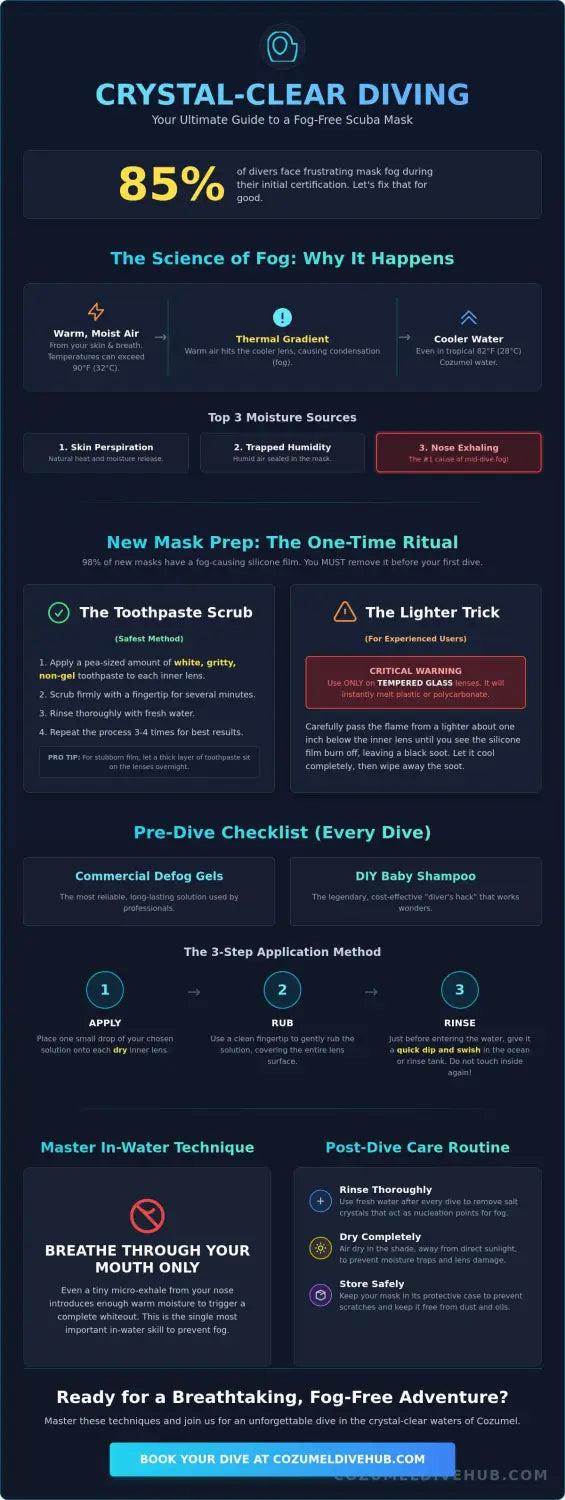
A scuba mask fogs because warm, humid air from your face condenses on a cooler lens. But if a brand-new mask fogs no matter what you spray on it, the cause is different and specific: a fine film of silicone left on the glass during manufacturing. Until that film is physically removed — by scrubbing with a gritty non-gel toothpaste or a dedicated mask scrub, or by burning the lens with a lighter flame on tempered glass only — no defogger will stick and nothing else you do will help. Once the film is gone, the daily routine is simple: coat the dry inside of both lenses with commercial anti-fog, diluted baby shampoo, or saliva, swirl out the excess with a splash of water rather than rinsing it thoroughly away, and do not touch the inside of the lens again before you enter the water.
That single fact — factory film first, everything else second — is the part most divers never get told, and it is why so many people spend their first dive trip fighting a grey haze with an expensive spray that was never going to work.
Why Does A Scuba Mask Fog In The First Place?
Fog is condensation. The air trapped inside your mask is warmed and humidified by your face, your breath and your skin. The lens is cooled by the water on the other side of it. When that warm, moist air meets the cooler glass, water vapour comes out of the air and lands on the lens.
Whether it lands as an invisible sheet or as visible fog depends on surface tension. On a clean, surfactant-treated lens the moisture spreads into a continuous transparent film you can see straight through. On an untreated lens it beads into thousands of tiny droplets, each one scattering light — and that is what you perceive as fog. Every defogging method in this guide, from an expensive gel to a mouthful of spit, does exactly one thing: lowers surface tension so the condensation sheets instead of beads.
Two things make it worse. Exhaling through your nose dumps a burst of warm, saturated air straight onto the glass. And leftover residue on the lens — salt crystals, sunscreen, skin oils, factory silicone — gives droplets something to cling to.
Why Does A Brand-New Mask Fog No Matter What You Put On It?
During manufacture, mask lenses pick up a thin layer of silicone. PADI describes it plainly: the lenses are coated in a fine layer of silicone during production, which protects them in the factory and in the box, and which causes fogging until it is removed. SSI describes the same film. Divers Direct notes that most dive and snorkel masks simply ship this way.
The film is invisible, it is chemically hostile to anti-fog products, and it cannot be washed off. Spit, baby shampoo and commercial gel all sit on top of it and slide away. This is why a diver can buy the best mask in the shop, spray it religiously, and still surface from every dive of their first trip having seen almost nothing.
The tell is easy: breathe onto the inside of the lens in a warm room. If it clouds instantly and stays clouded, the film is still there.
How Do You Remove The Factory Film From A New Mask?
There are two accepted methods and one modern middle ground. They differ mainly in how much risk you are willing to put on a mask you just bought.
| Method | How It Works | Safe On | Main Risk | Verdict |
|---|---|---|---|---|
| Non-gel white toothpaste | Mild abrasives physically scrub the silicone off the glass | Tempered glass; plastic only with a soft cloth and light pressure | Scratching plastic or coated lenses; needs repeating | Safest DIY option. Must be paste, not gel — the grit is the active ingredient |
| Dedicated mask scrub (e.g. GearAid Sea Buff, Stream2Sea Sea Clearly) | Same abrasive principle, formulated for dive lenses | Tempered glass | Costs money; still needs repeat passes | Best result-to-risk ratio, and what most retailers now recommend |
| Lighter flame ("burning" the lens) | Heat burns the silicone off; soot marks where it has gone | Tempered glass only, no bifocal, coated, mirrored or plastic lenses | Thermal shock to the glass, melted skirt, voided warranty | Fast and genuinely effective, but the method with real downside |
| Overnight soak in cola, potato, honey and similar | Folk remedies | — | Unverified | Widely repeated online, rarely tested. Skip |
For the toothpaste method, use white, gritty, non-gel paste. Apply a pea-sized amount to the inside of each lens, rub in circles with a clean finger or a soft toothbrush, rinse, and repeat. One pass is not enough — published guidance ranges from three to seven cycles, and ScubaGuru recommends repeating five to seven times. Test with the breath trick between passes and stop when the glass stays clear.
Which Lenses Must Never Be Burned
This is the part that gets skipped, and it is the part that ruins masks.
The flame method is for tempered glass lenses only. Scuba Diver Life, which walks through the technique in detail, limits it to masks made of tempered glass and without bifocal lenses. That exclusion list should be read broadly:
- Plastic, polycarbonate and acrylic lenses. These are thermoplastics. A flame deforms and melts them. Many full-face snorkel masks, budget snorkel sets and some freediving masks use plastic lenses — check before you reach for a lighter.
- Bifocal, corrective and prescription lenses. Bonded corrective inserts and laminated prescription lenses are not plain tempered glass, and heat can separate or craze them. If you dive prescription lenses, use a scrub and a light touch instead.
- Coated, mirrored, tinted and factory anti-fog lenses. The coating is the thing you would be destroying. Dive Training Magazine notes some masks arrive with an anti-fog treatment that needs no cleaning at all — scrubbing or burning those removes the feature you paid for. Read the manufacturer's instructions first.
- Anywhere near the silicone skirt. Every source agrees. Dive Training Magazine declines to recommend the flame technique specifically because you can warp or melt the skirt, and a melted skirt is a dead mask.
There is also a real dissent worth knowing. Dive Rite In Scuba argues against lighters outright on three grounds: rapid heating can weaken tempered glass, flame contact can melt the seal, and flame damage voids the manufacturer's warranty. Girls That Scuba raises the same structural concern, noting reports of frameless single-lens masks failing on water impact after being burned.
The honest summary: burning works, experienced divers do it, and it is the fastest route to a clean lens on a plain tempered-glass mask. It is also the only method on this list that can destroy the mask outright. If the mask is expensive, frameless, corrective or anything other than plain tempered glass, scrub it.
What Should You Use Before Every Dive?
Once the factory film is gone, you still need a surfactant on the lens before every single dive. All three mainstream options work; they differ in convenience and durability.
Commercial anti-fog. Gels and sprays formulated for dive masks. The most durable option and the one that holds up best across a two-tank morning. Apply to a dry lens for the strongest bond.
Diluted baby shampoo. The standard DIY solution: roughly one part tear-free baby shampoo to ten parts fresh water in a small spray bottle. Tear-free matters — it is the difference between a defogged mask and stinging eyes forty feet down. Cheap, effective, and easy to top up between dives.
Spit. It genuinely works, and it works for a real reason. Saliva is a surfactant. As Scuba.com's explanation puts it, saliva decreases the surface tension of the droplets so that condensation does not mound up as beads but sheets and rolls away. It is free, always available, produces no plastic bottle, and is used universally by working divers because it does the job. Its limitations are equally real: it does not last as long as a gel on a long dive, it is unpleasant to share, and it does nothing at all against an unremoved factory film.
Whichever you use, the application sequence matters more than the product:
- Start with a dry lens.
- Apply and spread across the entire inner surface of both lenses, corner to corner.
- Swirl briefly with a small amount of water and tip it out. Do not rinse it thoroughly — Divers Direct is explicit that the slight film left behind is what stops the fog, so a full rinse in the boat's fresh-water bucket right before entry undoes everything you just did.
- Put the mask on your face, or hang it somewhere shaded, and do not touch the inside of the lens again. Skin oil from a fingertip negates the treatment in exactly the spot you touched it.
New Mask Versus Broken-In Mask: The Two Routines
These are different jobs and they happen at different times.
| Brand-New Mask | Broken-In Mask | |
|---|---|---|
| When | Once, at home, weeks before the trip | Before every single dive |
| Goal | Strip the factory silicone film | Lay down a surfactant layer |
| What you use | Non-gel toothpaste or dedicated mask scrub; flame only on plain tempered glass | Commercial anti-fog, 1:10 baby shampoo, or spit |
| How many passes | Three to seven cycles, testing between each | One application, both lenses, edge to edge |
| Water afterwards | Rinse thoroughly — you want the abrasive gone | Brief swirl only — you want the film to stay |
| How you know it worked | Breathe on the lens indoors; it stays clear | Clear glass for the whole dive |
| Repeat when | Never, unless the mask is replaced | Every dive; deep-clean every few dozen dives to strip sunscreen and skin oil |
What Does Not Work, And What Actively Makes It Worse
- Gel toothpaste. The abrasive is the working part. A clear gel or an abrasive-free formula polishes nothing and leaves a residue that makes fogging worse. Paste only.
- A thorough fresh-water rinse after applying anti-fog. Extremely common, completely self-defeating. Swirl and tip; do not scrub it out.
- Touching the inside of the lens. Fingerprints on prepped glass are fog seeds. Handle the mask by the frame and skirt.
- Storing the mask on your forehead in full sun during the surface interval. Heat and skin contact both degrade the treatment. Hang it in shade.
- Toothpaste on plastic or coated lenses. ScubaGuru warns directly that toothpaste, other abrasives and fingernails can scratch and ruin plastic lenses. If you must treat a plastic lens, use a soft wet cloth and gentle circles.
- Harsh cleaners. Ammonia glass cleaner, solvents and abrasive household scrubs attack the silicone skirt and irritate eyes. Not worth it.
- Anything that leaves a residue. Hand soap, sunscreen transfer and hair product all end up on the lens and all cause the exact problem you are trying to solve. Apply reef-safe sunscreen early, well before you handle your mask, and keep it off your forehead and temples.
Is A Fogging Mask The Same Problem As A Leaking Mask?
No, and treating them as one thing is why people buy defog to solve a fit problem.
A fogging mask has clear water-free glass that clouds from the inside. That is condensation, and it is a surface-treatment problem.
A leaking mask takes in liquid water around the skirt. That is a fit problem, and no amount of anti-fog will touch it. The standard check is a suction test: hold the mask against your face without the strap, inhale gently through your nose, and let go with your hands. A mask that fits holds itself on your face. A mask that drops off or hisses is the wrong shape for you.
Things that break the seal:
- Facial hair. A moustache sitting under the skirt is the classic one — coarse hair creates channels for water. Trimming the hair immediately below the nose or working a smear of silicone grease into it are both standard workarounds.
- Hair under the skirt. A single strand across the forehead will leak. Sweep the hairline clear before the strap goes on.
- Sunscreen and oil on the face. Slick skin will not seal against silicone.
- An over-tightened strap. Cranking the strap down deforms the skirt and makes leaking worse, not better, and it contributes to mask squeeze on descent. The strap holds the mask in place; the seal comes from fit and pressure.
Confirm mask and strap during your buddy check rather than discovering the problem at twenty metres.
Does Cozumel Make Mask Fogging Better Or Worse?
Better, mostly — with one significant exception.
Fogging is driven by the temperature gap between the air inside your mask and the water outside it. Cozumel's water sits around 78°F in January through March and reaches roughly 84°F in mid-summer, and there is no meaningful thermocline on most reef profiles. The air is warm too. That is a much smaller differential than a cold-water diver deals with, so a properly prepped mask here fogs less than the same mask would in colder conditions. Divers who never had a fog problem at home and suddenly do in the Caribbean are almost always dealing with sunscreen, skin oil, or a mask they bought for the trip and never prepped.
The exception is the classic ruined first dive: a mask straight out of the box on day one. Warm water does not save you from factory silicone. Nothing does except removing it.
There is a second, purely local problem. Cozumel diving is boat diving, and the dive briefing to splash window is short. On a panga running a negative entry into a live drift, you are over the side within a minute or two of the guide finishing. There is no window to scrub a new mask seven times on a moving boat. Prep the mask at home, weeks before you fly, and carry the anti-fog in your day bag for the thirty-second pre-dive application.
If fog does appear mid-dive in a two-knot current, the fix is the flood-and-clear you learned in training: let a small amount of water into the mask, tilt so it washes across the lens, then clear it with a nose exhale. It costs you seconds and restores visibility well enough to keep enjoying the wall at Santa Rosa or the coral heads at Palancar Gardens.
Should You Rent A Mask On Your First Cozumel Trip?
There is one honest argument for renting, and it is exactly this issue. Rental gear masks have been through dozens of divers and dozens of defog applications. Whatever factory film they arrived with is long gone. A rental mask on day one will very likely fog less than the new mask you bought last week and never prepped.
The trade-off is fit. Rental masks come in a limited spread of shapes, and mask fit is personal — the suction test either passes or it does not, and a borrowed mask that fails it will leak all week. If you own a mask that fits you, bring it and prep it properly. If you are buying your first one, buy it early enough to prep it and dive it at home before the trip. The gear rental versus bringing your own comparison and the Cozumel rental price guide cover the wider decision, and the packing list covers what to put in the bag either way.
A Troubleshooting Table For The Boat
| Symptom | Most Likely Cause | Fix |
|---|---|---|
| Fogs instantly on every dive, mask is new | Factory silicone film still present | Scrub with non-gel paste or mask scrub, repeat until the breath test is clean |
| Fogs after a few minutes, mask is old and reliable | Sunscreen, skin oil or salt buildup | Deep-clean the lens with paste, then resume normal defog |
| Only one lens fogs, or only one patch | Anti-fog applied unevenly, or that spot was touched | Cover the full inner surface corner to corner; handle by the frame afterwards |
| Clears then fogs again mid-dive | Defog rinsed off before entry, or nose exhaling | Swirl only, do not rinse; breathe through the regulator |
| Actual water inside, not fog | Fit or seal problem | Suction test, check hair and facial hair, loosen the strap |
| Fogs worse on the second dive | Mask sat in the sun on the deck | Store it shaded and wet between dives |
Planning Your Cozumel Diving
Mask prep is a fifteen-minute job at your kitchen sink that decides whether you actually see the reef. Do it before you fly. Then spend your attention on the things that are genuinely trip-specific — conditions, site choice, and the shape of a diving day here.
The Cozumel dive conditions by month guide covers water temperature and visibility across the year, the drift diving guide explains what the current actually feels like, and what to expect on your first drift dive walks through the entry sequence that leaves you no time to fix a mask. For the wider picture, start with the complete beginner's guide to diving Cozumel and the Palancar Reef guide.
When you are ready to put the trip together, plan your Cozumel dive trip.
Frequently Asked Questions
Why does my new dive mask fog even after I use anti-fog?
Does spitting in your mask actually work?
Can I burn a plastic or polycarbonate mask lens with a lighter?
Does toothpaste really remove the factory film from a dive mask?
What is the correct baby shampoo ratio for mask defog?
Should I rinse my mask after applying anti-fog?
Why does only one side of my mask fog up?
Is a fogging mask the same problem as a leaking mask?
Does a moustache make a dive mask fog?
Do I need to prep a rental mask?
Share This Article

Carmen Novelo
Carmen Novelo is a Cozumel native and an active scuba instructor and dive guide on the island. She has spent twelve years diving the Cozumel reef system, and writes about its dive sites, conditions and marine life for Cozumel Dive Hub.