Cozumel Diving for Couples: The Ultimate Guide to Underwater Romance (2026)
Most diving couples are mismatched somehow, and every version is solvable. A non-diver rides the same boat for $55 to $85, Discover Scuba puts you both under the same morning, and a private guide at $85 to $110 a day fixes an experience gap.
Carmen Novelo · April 19, 2026 · 17 min read
Most couples who dive Cozumel are mismatched in some way, and every version of it is solvable without spending the trip apart. If one of you dives and one does not, the non-diver can ride the same boat as a snorkeller or a non-diving passenger for roughly $55 to $85 per trip on published 2026 Cozumel rate sheets. If neither of you is certified, Discover Scuba Diving puts you both underwater the same morning without a course. If one is certified and one is not, a full Open Water Diver course costs roughly $500 to $610 and eats two to three full days of a short trip. And if you are both certified but one of you has ten times the experience of the other, hiring a private guide at about $85 to $110 per day is the fix that actually works. This guide covers what each of those costs, how much holiday a course really consumes, and why the guide will probably not pair you with your partner underwater.
Which Couple Mismatch Do You Have?
Four situations account for almost every "we dive differently" problem on a Cozumel trip. The fix is different for each, and so is the cost.
| Your situation | The practical fix | Roughly what it adds |
|---|---|---|
| One dives, one does not, and the non-diver wants to be on the boat | Book them as a snorkeller or a non-diving passenger on the same two-tank dive | $55 to $85 per boat trip |
| One dives, one does not, and the non-diver would rather be on land | Beach club, an El Cielo trip, or the ferry to Playa del Carmen for the morning | Ferry roughly 350 to 380 MXN each way, plus port fee |
| Neither of you is certified | Discover Scuba Diving together, no certification involved | Around $185 for a two-dive experience at one shop's 2026 rate |
| One certified, one not | Certified partner joins fun dives while the other takes Open Water | $500 to $610, plus two to three full days |
| Both certified, wide skill gap | Private guide for the two of you | $85 to $110 per day on top of dive prices |
| Both certified, want the boat to yourselves | Private charter | $768 to $1,100 per day for the whole boat |
Figures are US dollars taken from published 2026 rate sheets at Cozumel dive centers, checked in August 2026, and exclude the marine park fee, which runs 225 MXN per person per day in cash. Rates move, and each shop sets its own, so treat these as the shape of the market rather than a quote. The broader picture is in the Cozumel diving cost breakdown.
One of You Dives and One Does Not: What Happens to the Morning?
This is the most common version of the problem and the easiest to underestimate. A Cozumel dive morning is not a two-hour outing. A standard two-tank trip leaves around 8:00 or 8:30am and gets back to the pier somewhere between 12:30 and 1:30pm, with a surface interval on the boat in between. That is most of the daylight half of the day, five or six days running if you have booked a package. Deciding what the non-diver does with that time is a real planning question, not an afterthought.
Can a Non-Diver Ride the Same Dive Boat?
Usually yes, and several Cozumel operators publish a price for exactly this. Rate sheets for the 2026 season list a snorkeller on the dive boat at $61 to $85 depending on the shop, and a non-diving passenger who stays aboard — variously called a rider or a bubble watcher — at $55 to $70. Not every operator offers it, and space depends on the boat, so it has to be arranged when you book rather than mentioned on the dock.
Whether it is a good idea depends entirely on the sites. Cozumel's famous dives are drift dives along a reef that sits well below snorkelling depth, and the guide's job is to run the dive, not to supervise a swimmer at the surface. Where it works well is the shallow reefs: the top of Palancar Gardens rises close enough to the surface for a snorkeller to see structure and fish, and Columbia Shallows and Paradise Reef are shallow enough to be worth swimming over. Where it does not work is a deep wall dive like Santa Rosa Wall, where the reef top is out of useful range and the surface is just open blue water. Ask which sites are planned before booking a snorkeller onto the trip, and be aware that Cozumel runs live boat pickups, so a snorkeller in the water is a second thing the crew has to track.
One more practical point: a boat with six divers and no shade is a long morning for someone who is not diving. A larger boat with a bench, a canopy and a toilet is a meaningfully better experience for a passenger than a small six-pack boat, which is the reverse of what most divers optimise for. That trade-off is worth talking through before you book, and the guide to avoiding crowded dive boats explains what you give up in each direction.
What the Non-Diver Can Do Instead
Cozumel gives a non-diver a genuinely good morning without the boat, and most of it lines up neatly with a dive schedule that ends at lunchtime.
- El Cielo. A shallow sandbar on the island's southern lee side, known for starfish, reached by boat tour rather than from shore. It is the single most popular non-diving water activity on the island and runs on the same morning clock as the dive boats. The full picture is in the El Cielo and starfish sandbar guide.
- Beach clubs on the west coast. Day passes, loungers, food and calm water within a short taxi ride of downtown, several with reef directly off the beach. Browse the beach clubs directory, and see the Sky Reef beach club guide for a shore-snorkel example.
- Snorkelling from shore. Cozumel's reef runs close enough to the coast that several beaches reach living coral without a boat, which is unusual in the Caribbean. Details in the Cozumel snorkelling guide.
- The ferry to Playa del Carmen. The crossing takes roughly 45 minutes, extending to an hour in rough seas, with departures around every hour from early morning to late evening on the combined Ultramar and Winjet schedules. Adult fares run roughly 350 to 380 MXN each way plus a port fee. It makes a comfortable half-day, though check the return timings against the cruise-ship calendar. Transport options are collected under getting around.
- Land activities. Ruins, the east coast, jeep and ATV tours and the island's food scene are covered in things to do in Cozumel for non-divers, with bookable options under activities and tours.
Where you sleep does most of the work here. A downtown base means the non-diver can walk to breakfast, shops and the waterfront while the other is at sea; a resort-zone base means they are dependent on taxis or the hotel's own facilities. The where to stay directory sets out the trade-off, and if the diving partner needs pickup, the dive boat hotel pickup guide covers which locations are practical.
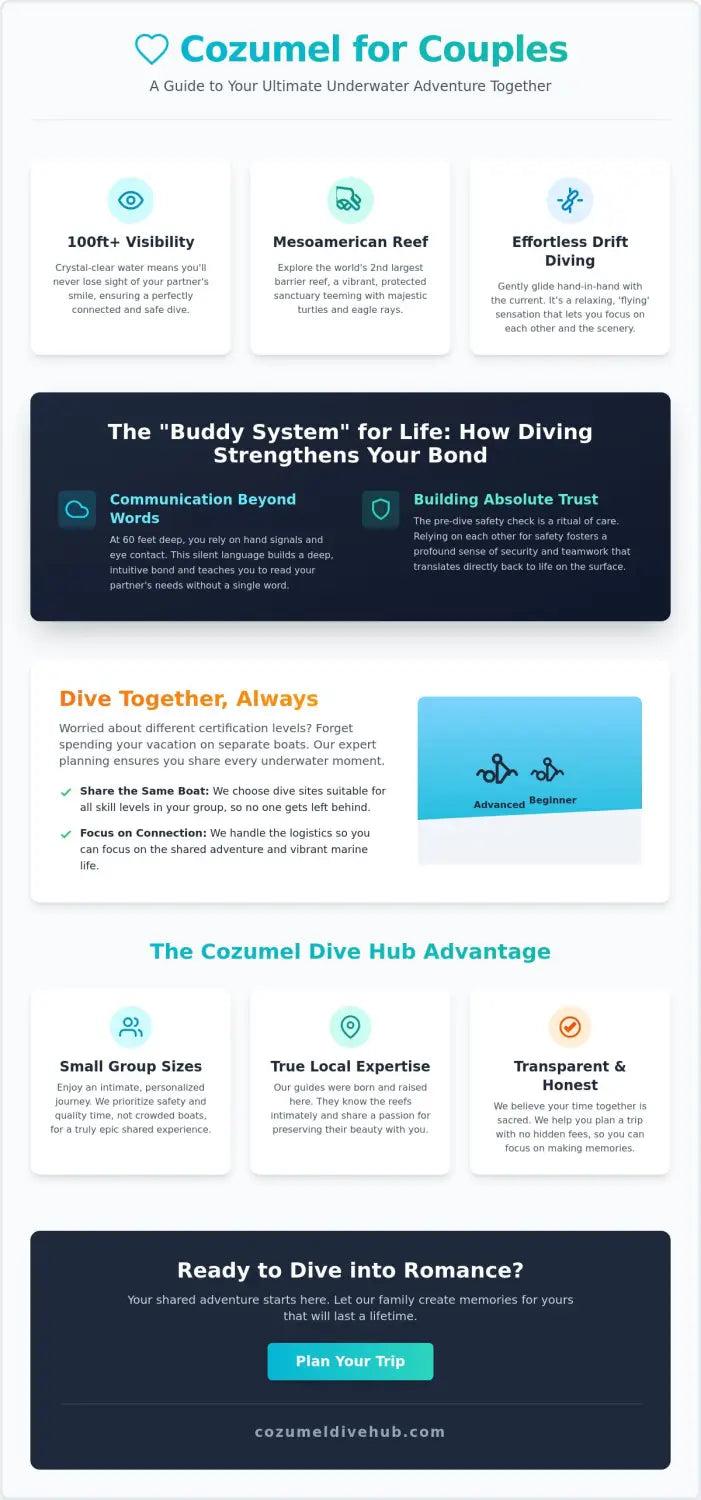
One of You Is Certified and One Is Not: Course or Discover Scuba?
This is the decision that most often gets made badly, because the honest time cost of a course rarely makes it into the planning conversation.
The Real Time Cost of an Open Water Course
Published 2026 Cozumel schedules put the Open Water Diver course at two to three days. One shop runs it across three days from 8:15am to 5:30pm; another lists two to three days at roughly 9:00am to 2:00pm. Prices in 2026 run around $497 for a shore-dive-only format and $607 for a version including boat dives at one operator, or 9,500 MXN including gear, materials and lunch at another. Certification card processing, the PADI manual and the daily marine park fee are sometimes charged separately.
On a seven-night trip that is survivable. On a four-night trip it is most of the holiday, and the certified partner spends it diving alone while the other kneels on a sandy bottom practising mask clears. Doing the eLearning theory before you fly is the single biggest lever: it does not remove the in-water days, but it removes the classroom hours from them. The full price detail is in the Open Water certification cost guide, and the course itself is described on the PADI Open Water Diver course page.
When Discover Scuba Is the Better Answer
Discover Scuba Diving is an introductory experience under direct instructor supervision, not a certification. It gets an uncertified partner underwater in a morning rather than three days, and if both of you are uncertified you can do it together, which is the one scenario where a couple genuinely shares the same first dive. One Cozumel shop's 2026 rate sheet lists a two-dive Discover Scuba experience at $185.
The limits matter. It is shallow, closely supervised, and it does not let the uncertified partner join the certified one on a drift dive along a wall. Treat it as a test of whether the person actually enjoys breathing underwater, before anyone commits $600 and three days to finding out. The comparison is laid out in Discover Scuba versus Open Water certification, and the experience itself on the PADI Discover Scuba Diving page.
If One of You Is Certified but Rusty
A partner who certified six years ago and has not dived since is a different problem from an uncertified one, and it is often the more dangerous of the two because nobody flags it. Cozumel's currents are not a place to rediscover buoyancy control. A refresher dive costs a fraction of a course and takes a morning; the Cozumel scuba refresher guide explains what it covers.
Should You Certify Together on a Honeymoon?
Only if both of you actually want to, and only if the trip is long enough to absorb it. Those two conditions decide the outcome, and neither is romantic enough to survive the brochure version.
How Much of the Trip Does It Take?
Published 2026 Cozumel schedules put the Open Water Diver course at two to three days, running mid-morning to mid-afternoon at some shops and from 8:15am to 5:30pm at others. Those are working days: kit assembly, confined water skills, four open water dives, debriefs and logbooks. Add getting to the shop and rinsing gear afterwards and the day is gone.
| Trip length | What the course leaves you | Verdict |
|---|---|---|
| 4 nights | One usable day, and no margin if a norte closes the port | Certify at home, or do Discover Scuba here |
| 5 to 6 nights | Two days, one of which cannot be the day before you fly | Workable, but only with the theory done before you land |
| 7 nights | Three or four days, including fun dives on the new card | The version that actually works |
| 10 nights or more | The course, fun dives and a day off the boat | Comfortable |
Doing the eLearning before you fly is the single biggest lever. It removes no in-water day, but it strips the classroom hours out of each of them. The second lever is the dive medical form: if either of you answers yes to anything on the questionnaire, a physician's sign-off is required, and finding a doctor on the island on your first morning costs a day you did not budget for.
Two shorter routes exist when the calendar is tight. The PADI Scuba Diver course is roughly half of Open Water, certifies you to dive to 12 metres alongside a professional, and upgrades later. A referral does the same job from the other end: complete the theory and pool sessions at home, then finish the four open water dives in Cozumel in about two mornings.
The Honest Part: Both of You Have to Want It
A certification course is not a couples activity. It is a class with an assessment, taught by an instructor who is responsible for both of you and paired with neither. For two or three days you are students rather than a couple, and the person running your dive is the instructor.
Parts of it are genuinely unpleasant the first time. Flooding and clearing a mask, taking the regulator out at depth and finding it again, hovering while someone watches and marks it — those are fine when you chose to be there. They are miserable when you are there because your partner booked it, and that is the version that ends with somebody certified who never dives again.
So apply a simple test before you book. Ask separately, not over dinner together, whether each of you would sign up for this course alone. If one answer is no, book a Discover Scuba morning instead and decide afterwards. It costs a fraction of the course, takes a morning rather than three days, and answers the only question that matters.
Plan for the split outcome as well, because on a short trip it is common: one partner finishes and one does not. An instructor issues a referral recording the skills and dives already completed, and the rest can be finished at another dive center, generally within twelve months. Agreeing in advance that this is an acceptable ending is what stops it being a bad one.
The diving is the romantic part. The course is not. Couples who arrive already certified spend the week diving together; couples who certify on arrival spend most of the week in a class and get the shared diving on the last day or two. Both are reasonable trips. Only one of them is what people picture when they book.
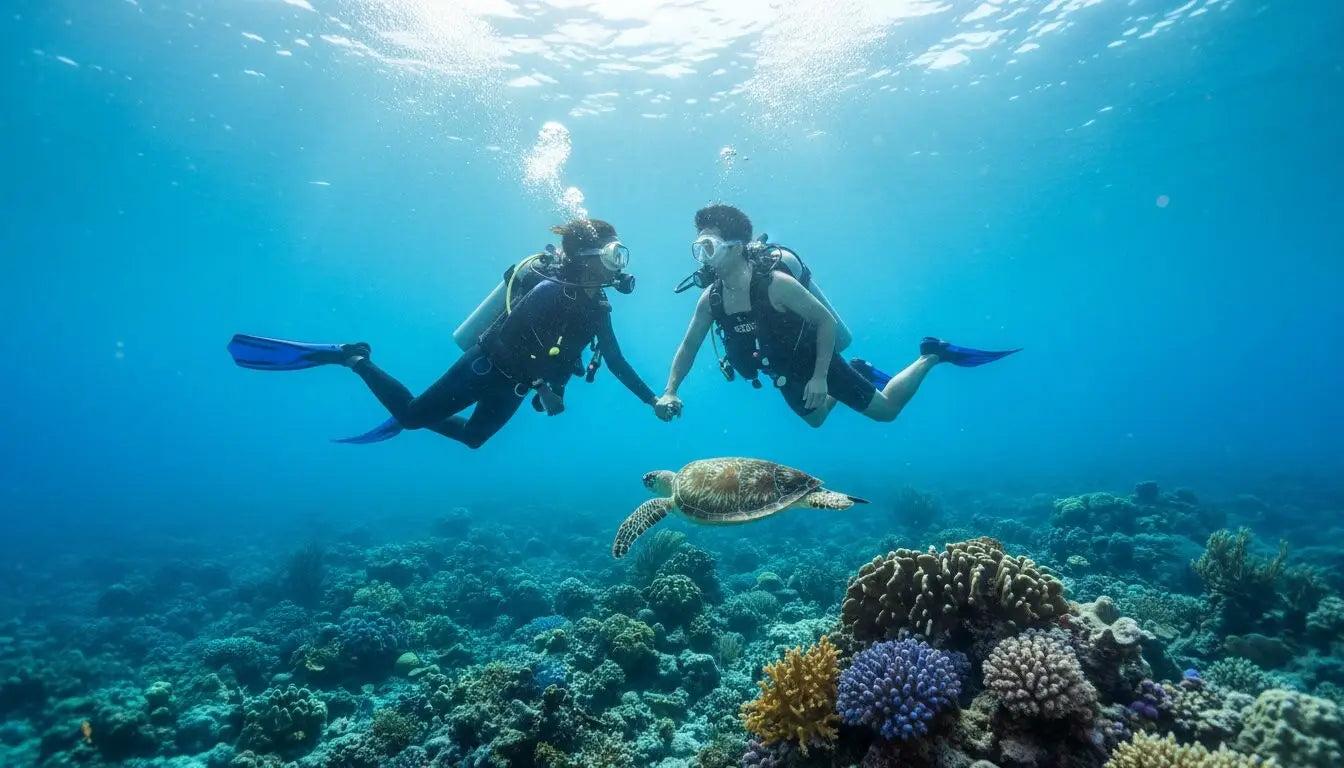
Both Certified, Very Different Experience: Does a Private Guide Actually Help?
Yes, and this is the mismatch that is most often left unaddressed because on paper both people are qualified.
What happens on a normal group boat when one partner has 400 dives and the other has 15 is that the experienced one stops diving and starts supervising. They watch the other's air consumption, correct their trim, hold their hand through the descent, and surface having seen very little. The less experienced partner, meanwhile, feels managed. Neither person gets the dive they came for, and the resentment usually shows up around day three.
A private guide solves this properly because it separates the two jobs. The guide takes responsibility for the less experienced diver — pace, depth, air, position in the current — which frees the experienced partner to actually dive rather than babysit. Both of you are still on the same reef, on the same boat, on the same schedule.
Published 2026 Cozumel rates for a private divemaster run about $85 for one or two divers at two operators, and $110 per person at another, added on top of the normal dive price. Against a two-tank trip of $105 to $149, that is a meaningful uplift, but it is small next to the cost of a week of diving that neither of you enjoyed. If you want the boat as well as the guide, private charters are listed at $768 for up to four people and $1,100 for up to six on 2026 rate sheets. The private diving in Cozumel guide goes into what is and is not included.
The cheaper version of the same fix is site selection. Ask the shop to schedule the gentler reefs while the gap closes: the shallower sections of Palancar, Columbia Shallows and Paradise Reef ask far less of a rusty diver than a deep wall does. A shop that will have that conversation with you before you book is telling you something useful about itself, which is most of what the guide to choosing a Cozumel dive shop is about.
Will You Be Buddied with Your Partner Underwater?
Often not, and it is worth understanding why before it happens on the boat and feels like a slight.
On a guided Cozumel dive the buddy system still applies, but the group also has a professional leading it. When a guide sees a nervous or inexperienced diver in the group, the standard move is to keep that person next to them for the whole dive rather than pairing them with a partner. If that nervous diver is half of a couple, the couple gets split.
This is a good outcome, not a bad one, for a specific reason: a partner is the worst possible buddy for a diver who is anxious. They have no professional training for it, they cannot fix a real problem underwater, and — most importantly — a struggling person's stress transmits straight to the person who loves them. Both divers' breathing rates go up together. A guide is emotionally neutral, has done this several thousand times, and can end one person's dive without ending the other's. Keeping the nervous diver on the guide's shoulder is the arrangement that protects both of you.
What you can reasonably ask for:
- Say it in the briefing, not underwater. If you want to dive as a pair, tell the guide during the dive briefing and say honestly what each of you has logged recently. Guides plan around information they are given.
- Do the buddy check with each other anyway. Even when you are not paired in the water, checking each other's gear on the boat is the part of the buddy system that matters most and takes ninety seconds.
- Accept the split when it is offered. If a guide moves your partner next to them, that is a professional judgement about the conditions that day, not a comment on your relationship.
- Know the separation procedure. Every briefing should cover what to do if you lose the group. Cozumel's drift conditions make this more relevant than at most destinations; the lost-your-group guide covers the standard drill.
What If Your Partner Is Reluctant or Nervous?
Start from the position that whether they dive is their decision and not a problem for you to solve. What you can do is remove the obstacles that are genuinely removable, and make sure their first exposure is a good one rather than a bad one somebody later has to undo.
Pressure is what ruins this. A partner talked into a dive they did not want arrives at the boat already tense, has a bad morning in front of strangers, and comes away with a settled opinion about diving that no future trip will shift. The failure mode is not that they say no. It is that they say yes, hate it, and are finished with it.
What Backfires, and What Works Instead
| What people do | Why it goes wrong | What works instead |
|---|---|---|
| Book a certification course as a surprise | Commits them to two or three days before anyone knows whether they like breathing underwater | A single Discover Scuba morning, booked as a one-off |
| Act as their buddy on the first dive | You cannot resolve a real underwater problem, and they will not want to admit fear to you of all people | An instructor supervising them directly, with you diving separately or riding along as a passenger |
| Answer "I am nervous" with "you will be fine" | The specific fear goes unaddressed and grows | Name the fear and treat it as a practical item to fix |
| Sell it with wall dives and current | Cozumel drift diving is the least reassuring version of the sport to describe to a beginner | A shallow, sheltered site on a flat morning |
| Go anyway on a rough day | Seasickness at the surface will define their entire opinion of diving | Move it. There is another morning |
| Ask again after a no | Turns a preference into an argument, and the argument into a position | Let it sit. An invitation stays open without being repeated |
The Fears That Come Up, Answered Plainly
- Ears. Equalisation is technique and timing rather than toughness: early, gently and often on the way down. Anyone congested should not dive that day, and saying that out loud in advance removes a surprising amount of anxiety.
- The mask. Most of what gets described as claustrophobia on a first dive is a badly fitting mask leaking and needing constant clearing. It is the most fixable item in the kit, and it is worth trying several in the shop rather than accepting whatever is handed over on the dock.
- Panic. On a Discover Scuba experience the instructor stays within arm's reach for the whole dive, and the dive ends the moment the participant wants it to. Knowing in advance that they can stop without a negotiation is usually what makes someone willing to start.
- Swimming. Discover Scuba has no swim test. The full Open Water course does — a 200 metre swim and a ten minute float, neither of them timed — which is worth knowing before anyone signs up for the wrong one.
- Glasses and contacts. Soft contact lenses are commonly worn under a mask, and prescription masks exist for stronger corrections. Ask the shop before the day rather than on it.
- What is down there. Cozumel's reefs are a marine park full of parrotfish, turtles and rays. The honest answer is that the animals are the reason to go, not a reason to stay on the boat.
Why Discover Scuba, With an Instructor, Is the Right Route
Discover Scuba Diving exists for exactly this situation. It is an introductory experience under direct instructor supervision — shallow, short, and not a certification — so nobody is committed to anything beyond the morning. The important part is who carries the responsibility: the professional does, not you.
That is the same reasoning as the buddy question above, and it matters more here. A partner is the worst available buddy for an anxious diver. Stress passes straight between people who care about each other, neither of you has the training to interrupt it, and the nervous one is diving next to the person they least want to disappoint. Hand that job to an instructor and both of you get a better morning.
Book it at a shallow site, on a calm day, as a private or small-group session if the budget stretches, with nothing else stacked behind it. Then take the answer at face value. Some people surface delighted and want the course. Some surface certain it is not for them, and that is information rather than a setback: it means you can plan the rest of the week properly around a non-diving partner, using the options set out earlier in this guide, instead of relitigating it every morning.
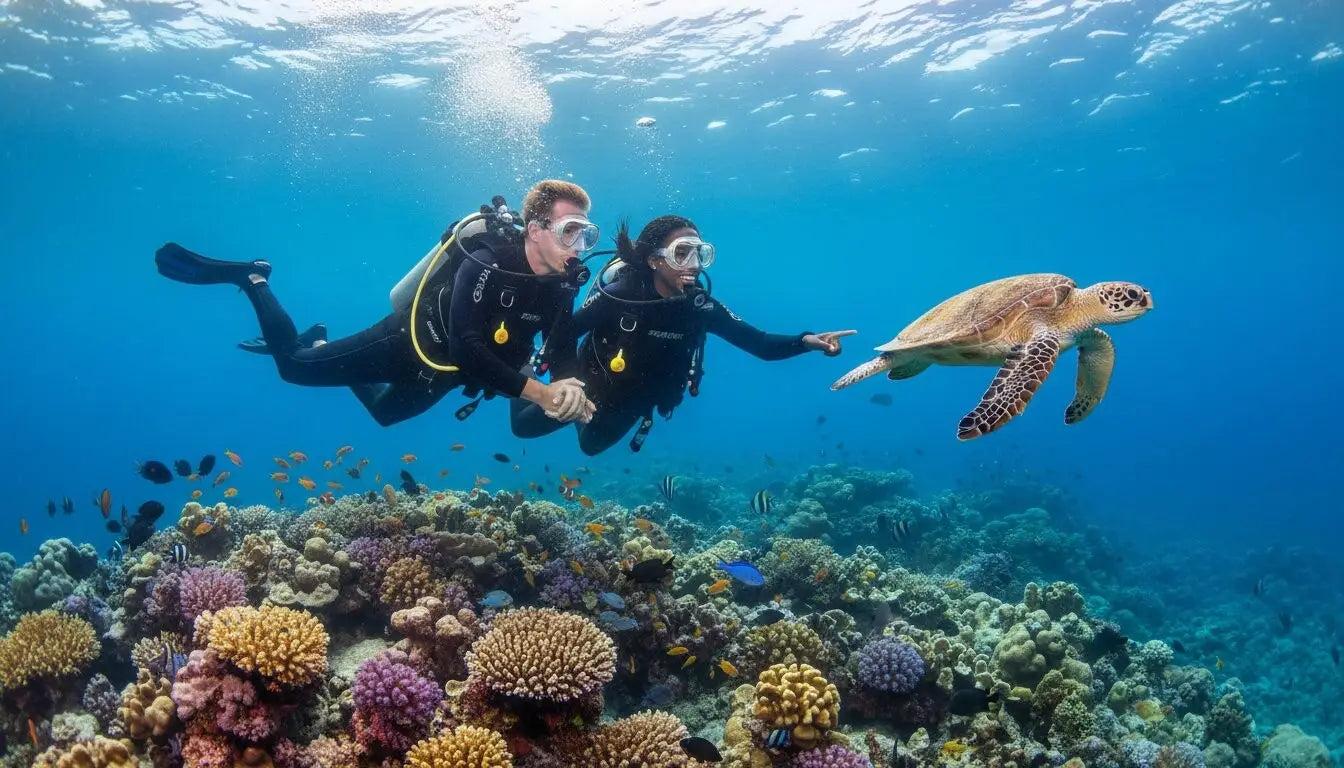
Honeymoons and Anniversaries: The Only Logistics That Matter
Almost everything written about honeymoon diving is decoration. Four things genuinely affect the trip.
Name on the certification card. If one of you changed their surname around the wedding, the certification card will not match the passport, and shops check both. Dive on the old card and travel with documentation of the change, or you will spend the first morning on the phone to a training agency instead of on a boat.
Flying after diving. This is the constraint that actually reshapes an itinerary. You need a surface interval before a flight, which means the last dive day cannot be the day before an early departure, and a diving honeymoon that continues to another destination has to be sequenced around it. The flying after diving guidelines set out the intervals.
Season. Between roughly November and March a norte can close the port and cancel a day of diving at no notice. If the trip has a fixed date attached to it, build in a spare day rather than assuming every booked morning happens. Month-by-month conditions are in the dive conditions guide.
Certifying on the trip. A course costs two to three of your days and only works if both of you genuinely want it. The time cost by trip length, and the test to apply before booking, are set out under "Should You Certify Together on a Honeymoon?" above.
If you want one evening that is genuinely different from the rest of the week, a night dive is the one to spend it on — provided both of you are comfortable enough in the water that the dark is interesting rather than stressful.
What a Week of Diving Costs Two People
A realistic five-day plan for a couple, using published 2026 Cozumel rates and assuming both dive.
| Line item | Per person | Two people |
|---|---|---|
| Five-day, ten-dive package | $475 to $600 | $950 to $1,200 |
| Marine park fee, five days, cash | roughly $70 | roughly $140 |
| Full equipment rental, five days | $120 to $200 | $240 to $400 |
| Private guide, if used, per day | $85 to $110 | $85 to $220 per day |
Package pricing is where the saving sits: five-day packages work out roughly 5 to 10 percent below the per-day rate at the shops surveyed, and both people pay the same per-person rate, so nothing about diving as a pair costs more than diving alone. Gear rental is the line most couples forget; bringing your own masks alone removes the most fit-critical item from the rental gear list.
Where to Base Yourselves as a Diving Couple
The choice between downtown San Miguel and the hotel zones is mostly a question of what the non-diving half of the day looks like. Downtown puts restaurants, shops and the ferry pier within walking distance, which matters enormously if one of you is off the boat at 1:00pm with an afternoon to fill. The southern hotel zone puts you closer to the marinas the southern reef boats leave from, at the cost of walkability. Both are workable; the where to stay directory lays out the options, and the eat and drink listings cover the evening half.
Plan the Trip Around the Mismatch, Not Around the Romance
The couples who have a good week in Cozumel are the ones who decided in advance what the less-experienced or non-diving partner is doing every morning, and paid for the thing that fixes it — a snorkeller seat, a private guide, a gentler set of sites, or a course started before departure rather than on arrival. The couples who have a bad week are the ones who assumed it would sort itself out on the boat.
Work out which mismatch you have, price the fix, and book it before you arrive. Start planning your Cozumel dive trip with the sites, conditions and operator information in one place.
Frequently Asked Questions
Can a non-diver come along on a Cozumel dive boat?
How much does a private dive guide cost in Cozumel?
How many days does the Open Water course take in Cozumel?
Should a couple do Discover Scuba or a full certification course?
Why is a partner a poor dive buddy for a nervous diver?
What can a non-diving partner do in Cozumel during a dive morning?
What is the best fix when one diver is far more experienced than the other?
Does a name change after a wedding cause problems with a dive certification card?
What happens if only one of us finishes the Open Water course?
How do we handle a partner who is nervous about diving?
Share This Article

Carmen Novelo
Carmen Novelo is a Cozumel native and an active scuba instructor and dive guide on the island. She has spent twelve years diving the Cozumel reef system, and writes about its dive sites, conditions and marine life for Cozumel Dive Hub.