Discover Scuba Diving Cozumel: Your First Underwater Adventure in 2026
Discover Scuba Diving is a supervised introductory dive, not a certification. You leave with no card and cannot book dives on your own afterwards. What it does give you is an honest answer to whether breathing underwater suits you.
Carmen Novelo · July 31, 2026 · 18 min read
Discover Scuba Diving is a supervised introductory dive. An instructor teaches you a handful of basic skills in shallow, calm water, then takes you on one dive under direct supervision. That is the whole thing.
It is not a certification. You do not leave with a card, you cannot rent gear or book a dive on your own afterwards, and the experience expires the moment it ends. What it does give you is an honest answer to one question: does breathing underwater feel wonderful or awful to you? For most people it is wonderful. For a few it is not, and finding that out in one afternoon is far cheaper than finding it out on day two of a four-day course.
In Cozumel there is a complication worth understanding before you book, and it is the reason this page exists. Cozumel is a drift diving island. The reefs run along a wall with a north-flowing current, and boats drop divers upstream and pick them up downstream. That is a superb way to dive once you know what you are doing. It is not automatically the right setting for someone taking their first ever breath from a regulator.
What The Agencies Actually Publish
Two agencies dominate Cozumel, and their introductory programmes are not identical. It is worth knowing which one you are being sold.
PADI calls it Discover Scuba Diving. SSI splits the same territory into two products: Try Scuba, which is pool or confined water only, and Basic Diver, which is the one that includes an open water dive.
| PADI Discover Scuba Diving | SSI Try Scuba | SSI Basic Diver | |
|---|---|---|---|
| Minimum age | 10 | 8 | 10 |
| Confined water depth limit | 6 m / 20 ft | 5 m | — |
| Open water dive depth limit | 12 m / 40 ft | Not included | 12 m |
| Student-to-instructor ratio | Set in the instructor manual, not published publicly | 8:1 in a pool, 4:1 in confined open water | 4:1, or 6:2 with one certified assistant |
| Is it a certification? | No | No, recognition only | No, explicitly not an entry-level certification |
| Credit toward Open Water Diver | First confined water dive and first open water dive, if you start the course within 12 months | Skills evaluated only if continuing to Basic Diver | One open water dive, if it reached at least 5 m for 15 minutes and you certify within 6 months |
Two things in that table deserve emphasis.
First, the ratio. SSI publishes its numbers openly; PADI keeps its DSD ratios in the instructor manual rather than on its consumer pages. That asymmetry matters because ratio is the single variable that most changes how a first dive feels. Four beginners to one instructor is a very different dive from eight. Ask the shop directly what ratio they run on introductory dives, and treat a vague answer as an answer.
Second, the credit, which almost nobody uses because almost nobody knows to ask. PADI's rule is that if your instructor knows in advance that you intend to certify, your confined water session and your open water dive can count as the first of each in the Open Water Diver course — leaving four more confined water dives and three more open water dives. That credit lasts twelve months. Start the course later than that and you redo both. SSI's Basic Diver credit is one open water dive and it lasts six months. In both cases you have to say so beforehand. Turn up, dive, and decide afterwards, and the paperwork was never set up.
If you want the fuller comparison of the two agencies, we have written it up at PADI vs SSI, with the individual course structures at PADI and SSI.
Why Cozumel Is A Slightly Awkward Place To Try Diving
Nothing about Cozumel is dangerous for beginners. Water is warm, visibility is famously good, and the reefs are shallow enough that you see a great deal at 12 metres. The awkwardness is structural: most Cozumel boats run a two-tank drift itinerary built around certified divers, and an introductory diver is often slotted into whichever site the boat was going to anyway.
On a moderate to strong drift, a first-timer spends the dive managing being moved rather than looking at the reef. They fall behind, they fin hard, they breathe fast, they surface early. It is not unsafe with an attentive instructor, but it is a poor version of a first dive, and it is entirely avoidable.
So ask for a sheltered mid-island or near-shore site. This is a reasonable request and a competent shop will accommodate it. What you want is shallow, mild current, and a wall of reef you can hover next to rather than fly past while you work on buoyancy for the first time.
Sheltered Sites That Suit A First Dive
These are drawn from our own site records, filtered to beginner-rated reefs with mild to moderate current and depths inside the 12 metre introductory limit or close to it.
| Site | Depth | Current |
|---|---|---|
| Paradise Reef | 30–40 ft | Mild to moderate |
| Chankanaab Reef | 35–40 ft | Mild to moderate |
| San Clemente | 30–40 ft | Mild |
| Playa Corona | 20–40 ft | Mild to moderate |
| Coral Princess Reef | 10–20 ft | Mild to moderate |
| Money Bar Reef | 10–20 ft | Mild to moderate |
| Tikkila Shallow Reef | 15–30 ft | Mild to moderate |
Paradise Reef is the traditional answer and remains a good one: close to town, shallow, forgiving, and busy enough with fish that nobody feels short-changed. San Clemente is the only beginner site in our records rated mild rather than mild to moderate.
Sites to be less enthusiastic about on a first dive, despite their beginner rating: Columbia Shallows, Yucab, Punta Dalila and Chankanaab Bolones all carry moderate to strong current. They are lovely dives. They are not first dives.
The Medical Questionnaire
Every introductory programme starts with the standard dive medical form — the RSTC Diver Medical Participant Questionnaire. It is a list of yes/no questions about heart, lung, ear and neurological history, medication, pregnancy and recent surgery.
Answering yes to something does not disqualify you. It means the form asks you to get a physician's sign-off before diving. This is worth knowing in advance, because the sign-off is hard to arrange at 7am on the dock and easy to arrange at home. PADI publishes the form for download so you can read it before you travel.
We are an editorial guide, not a medical authority, and we are not going to tell you whether your asthma or your blood pressure medication is compatible with diving. That is a conversation for a doctor who knows your history, ideally one familiar with dive medicine. Read the form early and take it seriously; it exists because pressure does things to the body that a hike does not.
The Cruise Ship Version Is The Worst Version
If you are on a ship, an introductory dive sold as a shore excursion is the weakest form of this experience, for reasons that have nothing to do with the reef.
The problem is the clock. All-aboard time governs everything, so the schedule is fixed, the group is large, and the operation is optimised for returning a hundred people to the pier on time rather than for giving any one of them an unhurried first dive. Nobody can slow down for the person who cannot equalize on the descent line, because the boat has a departure slot. Add the tender queue and the walk back and the actual underwater time is often twenty to thirty minutes.
It is not that cruise passengers cannot dive Cozumel well — plenty do, and we have written a whole guide to diving near the cruise port. It is that the introductory dive is precisely the product that suffers most from time pressure, because the entire value of it is the instructor having time for you. If your ship is in port for six hours and this is your first breath underwater, consider snorkelling instead and saving the dive for a trip where you control the schedule.
Or Skip It And Go Straight To Open Water
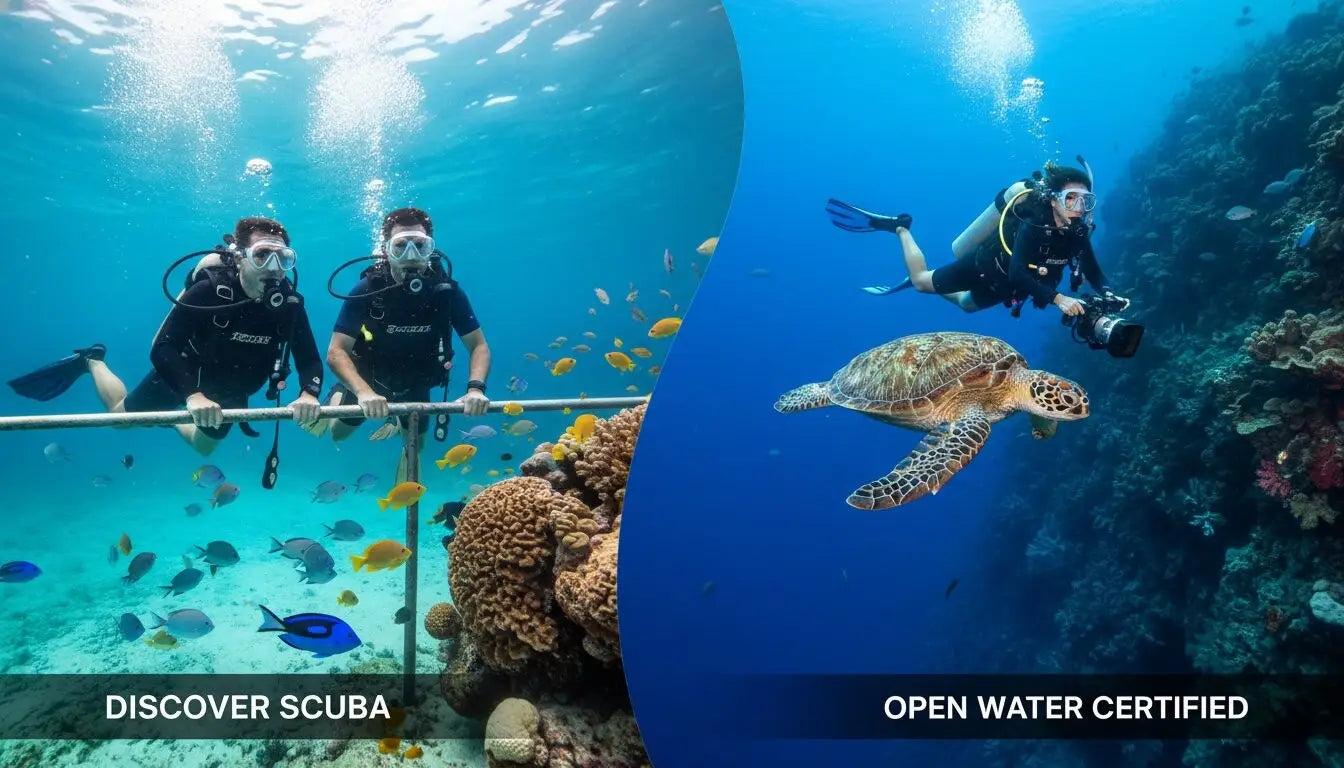
Here is the case nobody selling introductory dives makes: if you already suspect you are going to love this, the introductory dive is money spent on finding out something you already know.
| Introductory dive | Open Water Diver | |
|---|---|---|
| Time | Part of one day | Three to four days, less with eLearning done at home |
| Depth limit | 12 m / 40 ft | 18 m / 60 ft |
| Supervision | Direct instructor supervision, always | Certified, dive with a buddy |
| Dives included | Typically one, sometimes two | Four open water training dives |
| Cost | Roughly a day's diving | Several times that |
| Water skills required | Comfort in the water, no test | A 200 m swim, or 300 m with mask, snorkel and fins, plus a 10-minute float |
| What you leave with | A good afternoon and possible course credit | A certification that never expires |
Two useful comparisons: what Open Water certification costs in Cozumel, and how long it actually takes. Doing the eLearning before you fly compresses the in-water portion to roughly two days, which changes the holiday arithmetic considerably.
The honest split is this. Do the introductory dive if you are genuinely unsure about being underwater, if you are travelling with someone who is diving and you want to join for one day, or if you have no more than a single free day. Go straight to Open Water if you have three days, if you already know you like snorkelling and the water does not worry you, and if you expect to dive again in the next few years.
What To Ask Before You Book
Five questions separate a good introductory dive from a mediocre one, and all five have short answers a shop should give readily.
What is the ratio on the introductory dive? Which site are we going to, and what is the current there today? Is this one dive or two? If I decide to certify, will you set the paperwork up so this counts toward the course? And how many people are on the boat in total?
A shop that answers those crisply is a shop that has thought about beginners. Our dive centers directory covers who operates on the island and how they differ; the wider context on conditions, seasons and logistics sits in Cozumel drift diving and how strong the current really is.
Where To Go From Here
An introductory dive in the right conditions, with a low ratio and an instructor who is not watching a clock, is a genuinely lovely thing and quite often the start of something. The same dive on a strong drift with seven other beginners and a ship to catch is a story about swallowing seawater.
The difference is almost entirely in the booking, and the booking is the part you control. Work out which version you want, then plan the rest of the trip around it: start your Cozumel dive trip planning here.
Frequently Asked Questions
What is Discover Scuba Diving?
Do I get certified after a Discover Scuba dive?
How deep does a Discover Scuba dive go?
What is the minimum age for Discover Scuba Diving?
Can I try scuba diving if I am not a strong swimmer?
Does Discover Scuba Diving count toward the Open Water course?
How long does a Discover Scuba experience take?
Should I do Discover Scuba Diving or go straight to Open Water?
What is the medical questionnaire and why does it matter?
Is Cozumel's current a problem for a first dive?
Share This Article
Carmen Novelo
Carmen Novelo is a Cozumel native and an active scuba instructor and dive guide on the island. She has spent twelve years diving the Cozumel reef system, and writes about its dive sites, conditions and marine life for Cozumel Dive Hub.