Best Dive Centers in Cozumel in 2026
Cozumel's dive centers mostly sell the same morning boat, so four quieter answers decide your week: divers per guide, which dock you leave from, tank size, and what happens to your deposit when the port closes for wind.
Carmen Novelo · June 25, 2026 · 19 min read
Cozumel has dozens of dive centers in this site's dive center directory, and on paper most of them sell the same morning: a two-tank boat leaving between 7:30 and 8:30 a.m., tanks and weights included, marine park fee extra, back at the dock by early afternoon. The differences that actually change your week are quieter than that. How many divers share one guide. Whether the boat leaves from a hotel dock or the Fonatur marina. Whether the tanks are 80-cubic-foot aluminum or 100- to 120-cubic-foot steel. What happens to your deposit when the port closes for north wind. Those four answers predict your trip better than any ranked list.
Cozumel Dive Hub is an editorial guide, not a dive operator. This site runs no boats, employs no instructors and holds no PADI or SSI rating. It may earn referral income from some operators, which is exactly why what follows is a standard you can apply yourself rather than a "best of" list you have to take on faith. Every Cozumel shop worth booking will answer these questions cheerfully. The point is knowing which questions to ask.
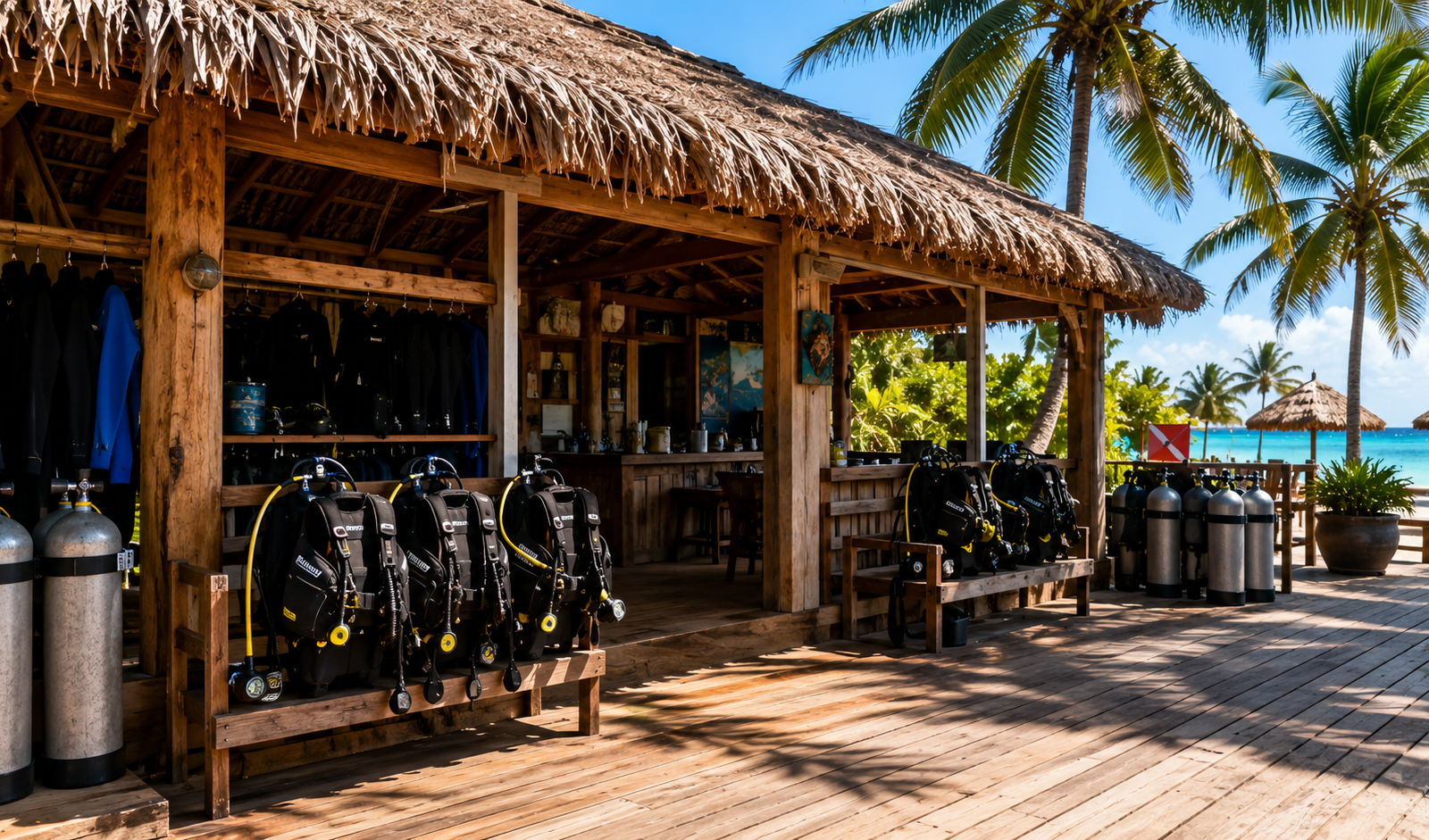
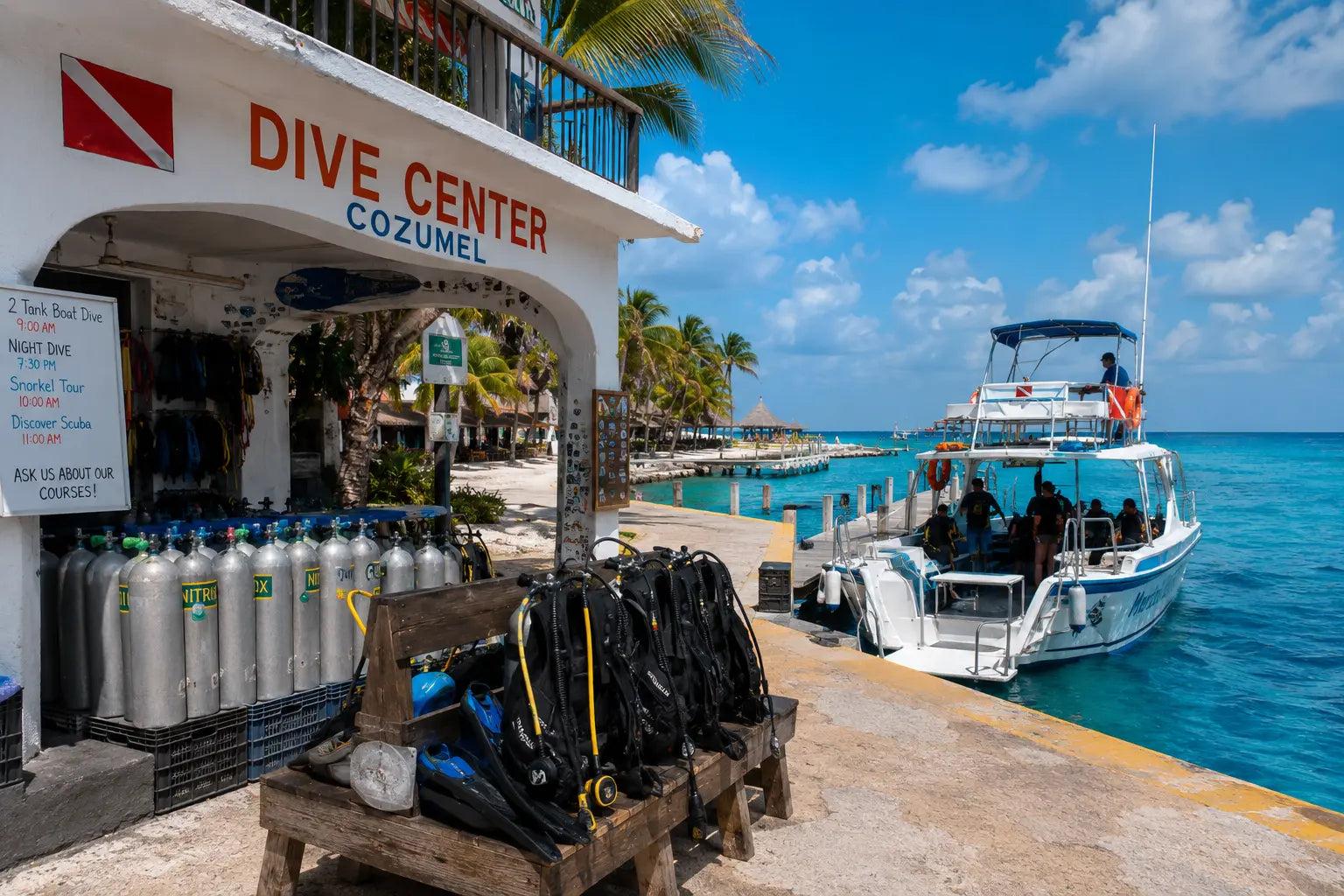
Cozumel dive centers range from resort-based operations to downtown shops, boutique small-group operators, private charters and training-focused academies.
The Five Things That Actually Separate Cozumel Dive Shops
Price is the least informative number on a Cozumel quote, because two operators charging within $15 of each other can run completely different days. These five factors do the real work.
| Factor | Why It Changes Your Dive | What To Ask Before Booking |
|---|---|---|
| Divers per guide | Sets how much attention you get in current, and how fast the group ascends on the shortest air | "What is your maximum per guide, not per boat?" |
| Departure point | A hotel dock can save 40 minutes of transfer each way versus a downtown meet | "Where exactly does the boat leave from, and what time do I need to be there?" |
| Tank type and size | An 80-cubic-foot aluminum tank and a 120-cubic-foot steel tank produce very different bottom times | "Aluminum 80s or steel? Is Nitrox available, and what does it cost?" |
| Experience matching | Whether a first post-certification diver and a 500-dive photographer end up in the same group | "How do you split groups, and what do you ask me before the first dive?" |
| Cancellation and weather terms | North winds close the port several times each winter, and terms vary widely | "What happens to my money if the port closes or I get sick?" |
An operator that answers all five in one email without hedging has told you most of what you need to know. One that redirects every question to price has told you something too.
Group Size Is the Single Biggest Variable
Cozumel is a drift diving destination. You are not swimming a route; the current carries you along the wall while the boat follows your bubbles. In that setting the guide's job is to keep a moving, spread-out group in sight, and that gets harder with every extra diver.
The published maximums on the island run roughly from 4 to 12 per guide. ScubaTony states a hard six-passenger limit per boat and runs three small fast boats with 7:30 a.m. and 1:00 p.m. departures. Aldora Divers also caps groups at six and states it matches divers by comparable experience and interests, while Eco Divers, family-run since 1995, publishes a 1:4 guide ratio. At the other end, Dive Paradise has operated since 1984 with a fleet of 11 boats, including larger vessels with sundecks and full bathrooms — a genuinely different proposition, and a better one if you value amenities, multiple daily departure times and the flexibility a large fleet allows.
Neither model is wrong. A confident diver with good air consumption may barely notice a group of eight. A nervous diver, a photographer who wants to stop, or anyone still working on buoyancy will notice immediately. The mistake is not choosing the large operator — it is not knowing which one you booked. There is more on this in the guide to small group diving benefits and on avoiding crowded dive boats.
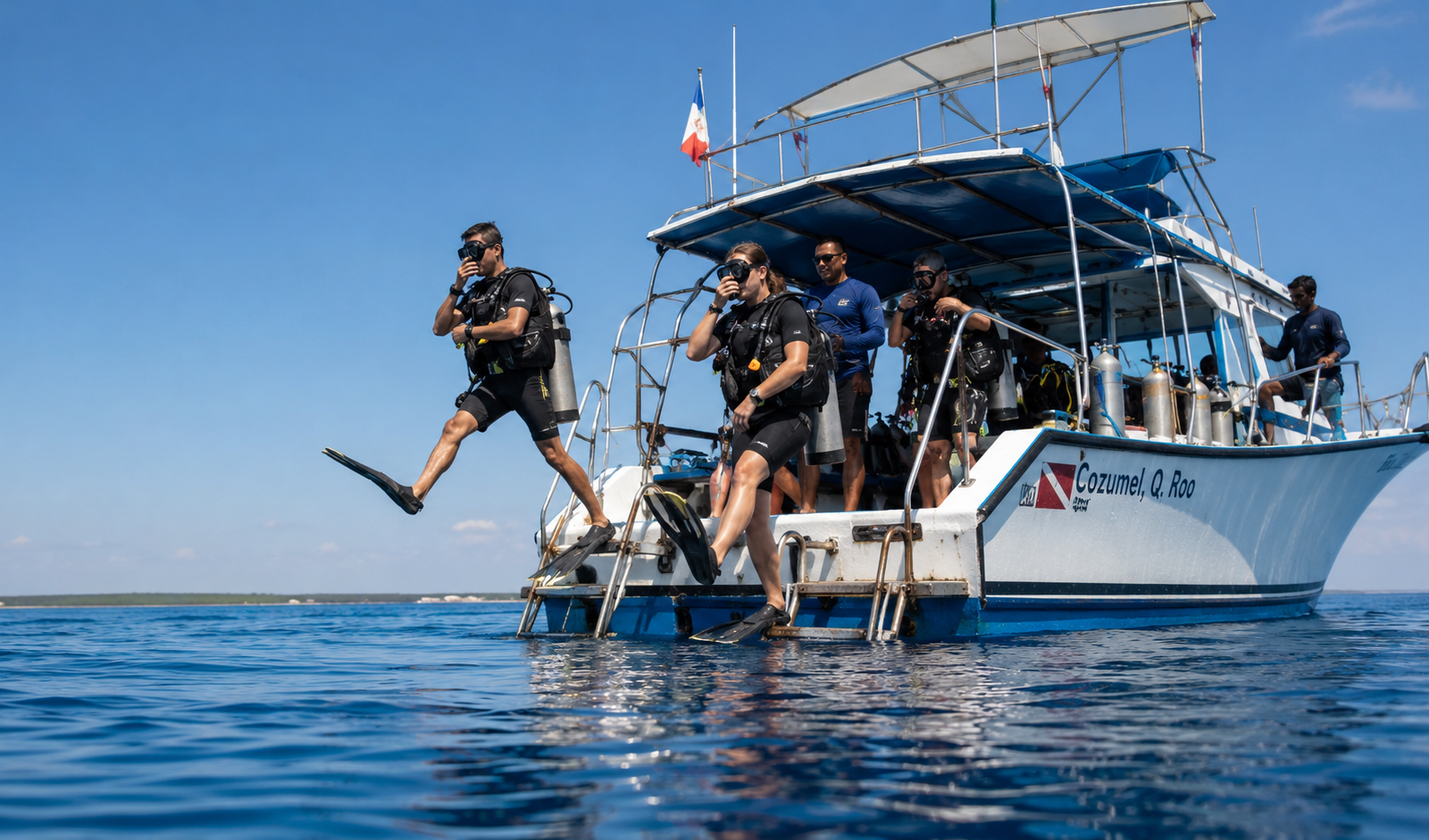
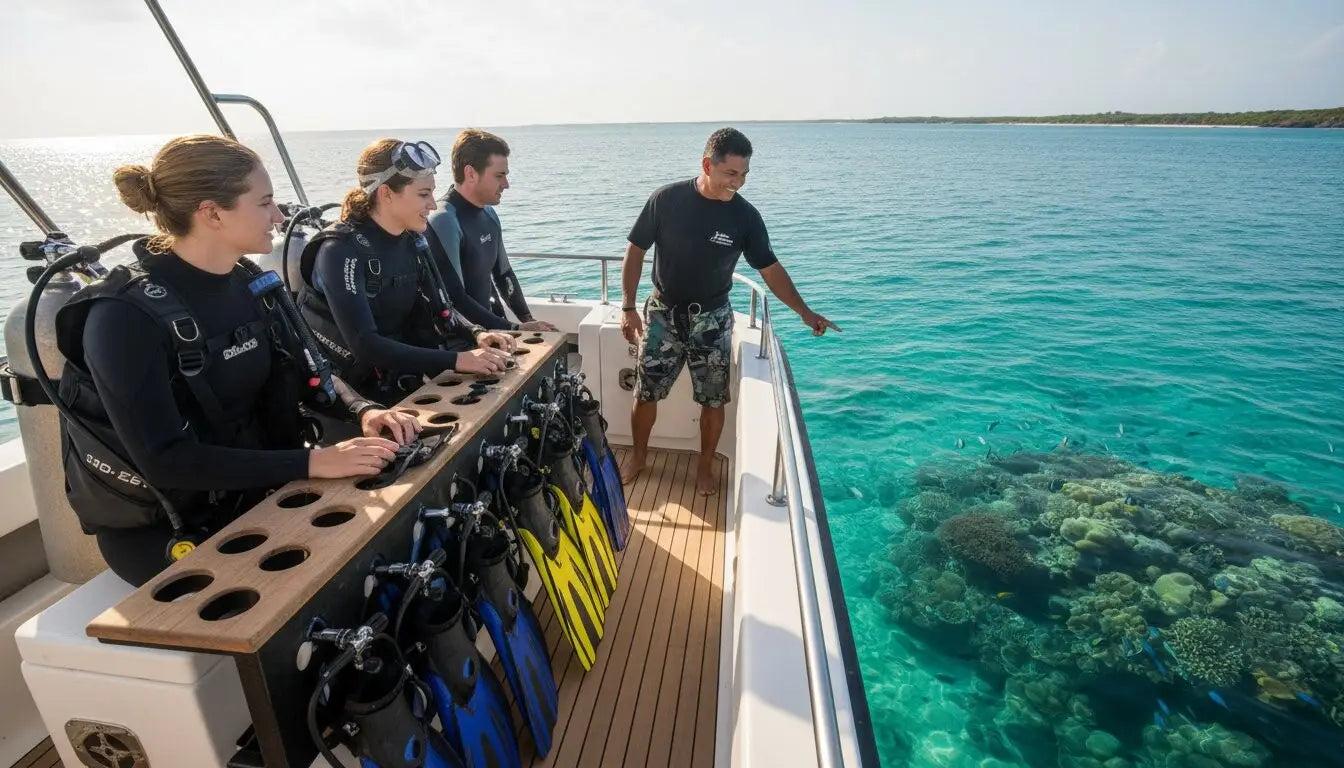
Boat style, departure point, group size and pickup logistics are the major practical differences between Cozumel dive operators.
Boats, Docks and Where the Day Actually Starts
Most Cozumel boats leave from one of three kinds of place: the Fonatur and ASIPONA marinas south of town, the downtown waterfront, or a hotel's own pier. That choice quietly sets your morning.
Blue Angel runs its own dock at its beachfront hotel with 8:00 a.m., 10:00 a.m. and 1:00 p.m. departures — you walk from your room to the boat. Dressel Divers is the in-house operation at Iberostar, and Scuba Du is based at the Presidente InterContinental, both with the same walk-on convenience for guests of those hotels. Marina-based operators such as Blue Note Scuba and Cozumel H2O start from Fonatur or ASIPONA, and Scuba Reef Divers from Marina Caleta, which usually means a short taxi or a scheduled pickup.
Ask specifically whether transfer is included, arranged, or your problem — the three answers are different and shops use them interchangeably. The dive boat pickup guide covers which hotels are on standard routes. Boat speed matters too: a fast boat reaching Palancar Gardens or Santa Rosa Wall in 25 minutes leaves more of the day intact than a slower one taking 50.
Tanks, Bottom Time and Gas
This is the most under-discussed difference on the island. The default Cozumel tank is an aluminum 80. Aldora Divers built its reputation on high-capacity 100- and 120-cubic-foot steel tanks, advertising roughly 50 percent more gas and a 70-minute average dive against the 40- to 50-minute norm. Steel also changes your weighting, so tell the shop in advance if you have never dived it.
Nitrox is widely available and typically costs extra per tank. On Cozumel's repetitive 60-to-80-foot reef profiles it buys real bottom time on the second and third dives of the day — see the Nitrox guide for whether it is worth it for your profile.
What Is Included, and What Almost Never Is
Comparing two quotes only works once you have normalized the extras. Roughly what to expect:
| Item | Usually Included | Usually Extra |
|---|---|---|
| Tank, weights, weight belt | Yes | — |
| Water and light snack | Yes | — |
| Marine park fee | No | About $15 (roughly 220 pesos) per day, often cash only |
| BCD, regulator, wetsuit, computer | No | Per-day rental gear charge |
| Nitrox fills | No | Per-tank surcharge |
| Far-south sites like Punta Sur or Maracaibo | No | Long-boat-ride surcharge is common |
| Crew tips | No | Budgeted separately |
The marine park fee is a government charge, not an operator markup, and applies to every diver on every day — the marine park fees guide explains how it is collected. For a full picture of what a week costs, see the Cozumel diving cost breakdown, the gear rental price guide and the tipping etiquette guide.
Devil's Throat Is the Honesty Test
Devil's Throat at Punta Sur is a swim-through complex bottoming out near 130 feet, and it is the clearest test of how an operator handles risk. Reasonable requirements you will see stated include Advanced Open Water certification, demonstrated buoyancy, a light, a computer and an SMB, a prior dive with the same guide so they can assess you, and calm conditions on the day. Punta Sur Divers and other advanced-focused shops publish requirements along these lines.
The useful signal is not whether a shop offers the dive — many do, competently. It is whether they ask you anything before saying yes, and whether they will call it off for wind or for a group that is not ready. A shop that qualifies you before selling you a deep swim-through will do the same on every other dive. The Punta Sur and Devil's Throat guide covers the site in detail, and the current guide explains what the drift actually feels like.
How to Judge the Guide, Not Just the Shop
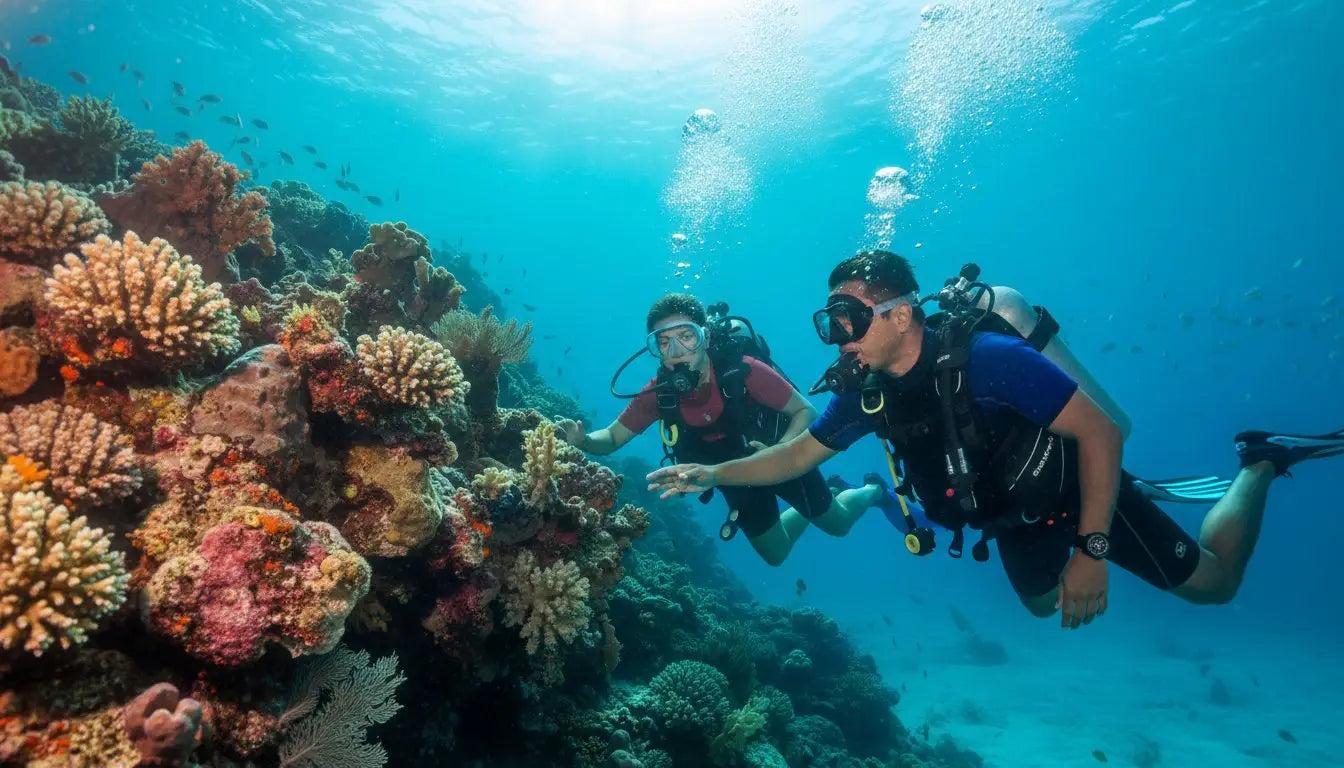
Inside Parque Nacional Arrecifes de Cozumel, recreational diving is done with an authorised guide, so the divemaster is not an optional extra. Booking a shop is really booking whoever it puts in the water with you, and the same operator can field a guide who makes the week and one who simply counts heads. Five things tell you which one you got, and four of them are visible before you descend.
The briefing is the clearest signal. A proper dive briefing covers the site profile and maximum depth, which way the current is running and how strong it is expected to be that morning, the entry type, the planned bottom time, the pressure at which you signal, how the ascent and SMB deployment will work, and what to do if you lose the group. Good ones also say what to look for, such as where the splendid toadfish hides under ledges. "Follow me, about forty minutes" is not a briefing.
Watch whether the plan bends to the group. Site lists in Cozumel are not fixed until the morning, because wind and current decide them. A guide who asks about your last dive, your logged experience, your air consumption and whether you are carrying a camera is gathering the information needed to pick a profile. A guide who takes two freshly certified divers onto a deep wall in a fast drift because that was the plan is not.
No-touch has to be enforced, not just announced. Park rules prohibit touching, standing on or removing anything from the reef, and gloves are discouraged by many operators for precisely that reason. The test is what happens after the briefing: a guide who signals a diver off the coral, keeps a respectful distance from turtles, and never poses anyone against a formation for a photograph is running the rule. A guide who steadies themselves on the reef has told you the briefing was decoration.
Positioning in the drift is a skill. A guide who sits slightly down-current of the group can see everyone at once and reach anyone who needs help, rather than leading from the front and discovering a problem at the safety stop. The same skill shows in the use of terrain: the still pocket behind a large coral head is where a group gets parked when someone needs a moment, and knowing where those pockets are on each reef is local knowledge that does not appear on any certification card.
What a good guide does when someone is low on air. This is the situation that separates competence from paperwork. A good guide asks the group for pressure at intervals rather than waiting to be told, and when one diver runs low, moves them shallower first, since the drift almost always allows it and shallower water stretches the remaining gas. From there it is either a second guide taking that pair up while the rest continue, or the whole group ascending together without anybody being made to feel responsible for it. Neither is a failure; on live boat pickup both are routine. Whether the boat carries a second guide for exactly this reason is a fair question to ask when booking, and it matters more than the maximum group size on its own.
Two smaller points. Most Cozumel dive professionals brief in both English and Spanish, but if anyone in your group needs another language, ask before booking rather than on the dock. And if a guide suits you, ask for them by name on the following days; most shops will try to accommodate it, and a guide who already knows your air consumption and comfort level starts the second day well ahead.
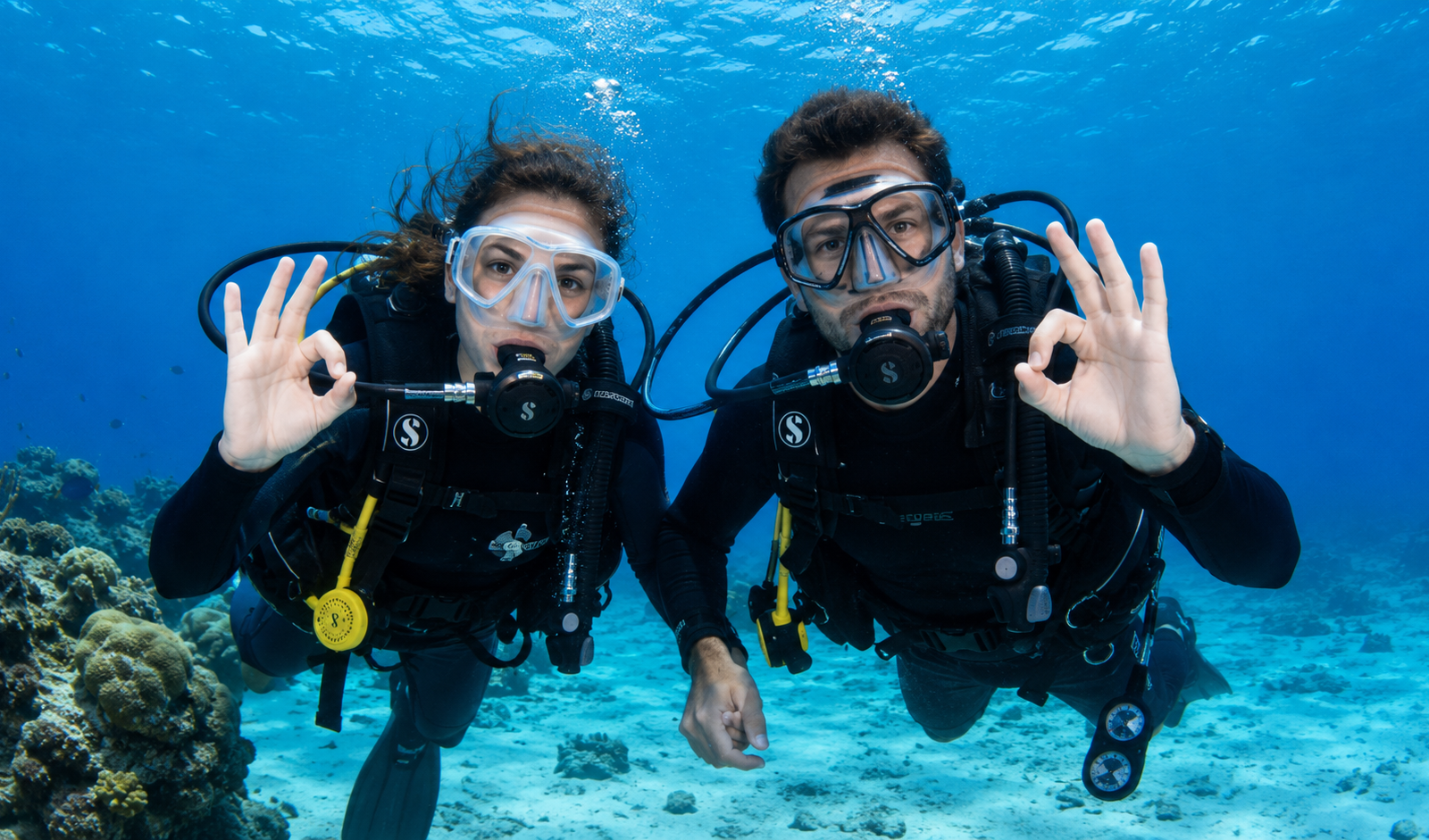
For beginners and course students, instructor fit, medical screening and group size matter far more than any ranking.
If You Are Learning, Judge the Instructor, Not the Shop
For a course, almost everything depends on the individual instructor and the student-to-instructor ratio, neither of which appears in a shop's marketing. Ask how many students are in the pool session, whether confined-water work happens in a pool or from a beach, which sites the open-water dives use, and what the medical questionnaire process looks like. Barefoot Dive Center and other small downtown shops tend to run low ratios; resort-based programs at Dressel Divers and ProDive International offer more structure and multilingual instruction.
Certification standards are identical across agencies, so the choice between PADI and SSI matters less than the person teaching. The Cozumel dive courses guide covers what each level involves and what it costs.
Cruise Days and Tight Turnarounds
If you are on a ship, timing outranks everything. What matters is the return buffer, whether the meeting point is walkable from the pier, and whether the operator has done cruise timing often enough to be conservative about it. Operators used to mixed groups, such as Cozumel Marine World, can also work when divers and snorkelers are traveling together.
Confirm ship time versus local time explicitly — they are not always the same — and be honest about the fact that a two-tank trip to Paso del Cedral plus surface interval is a four-to-five-hour commitment. The cruise port diving guide has the practical timings.
Where to Stay if You Want to Dive Every Day
Proximity is worth more than star rating when you are diving daily. Staying within walking distance of San Miguel puts you near the downtown shops and the ferry pier and lets you switch operators between days. Staying in the southern hotel zone puts you closer to the reefs the boats visit most and makes a hotel-dock operation genuinely convenient. Properties with an on-site dive operation, such as Blue Angel, Iberostar with Dressel, or the Presidente InterContinental with Scuba Du, remove the transfer entirely — which is either the whole point or an unnecessary constraint, depending on whether you want to dive with one shop all week. The where to stay guide breaks the island down by area.
Use the Directory, Not a Ranking
There is no single best dive shop in Cozumel, and any page claiming otherwise is ranking on something other than your trip. What there is: dozens of operators whose group sizes, docks, tanks and terms differ in ways you can check in a single email each.
Shortlist three from the dive center directory that match your priorities, send all three the same five questions from the table above, and compare the replies rather than the prices. The one that answers precisely and asks you something back is usually the right booking. Then read up on the reefs in the Cozumel dive sites guide — including the C-53 wreck — and the island overview in the best scuba diving in Cozumel guide.
Ready to put the week together? Start with Plan Your Cozumel Dive Trip for packages, current deals and a working itinerary.
Frequently Asked Questions
How many dive shops are there in Cozumel?
What group size should I expect on a Cozumel dive boat?
Is the marine park fee included in a Cozumel two-tank dive?
What is the difference between aluminum 80 and steel 100 or 120 tanks?
Do Cozumel dive shops pick you up at your hotel?
What certification do I need to dive Devil's Throat at Punta Sur?
Should I book a Cozumel dive shop before I arrive?
What happens if the port closes because of wind?
Is Nitrox worth paying for in Cozumel?
How can I tell whether a dive shop will match me to the right group?
Share This Article

Carmen Novelo
Carmen Novelo is a Cozumel native and an active scuba instructor and dive guide on the island. She has spent twelve years diving the Cozumel reef system, and writes about its dive sites, conditions and marine life for Cozumel Dive Hub.