
Deep Diver Specialty Cozumel: Explore the Abyss with Local Experts
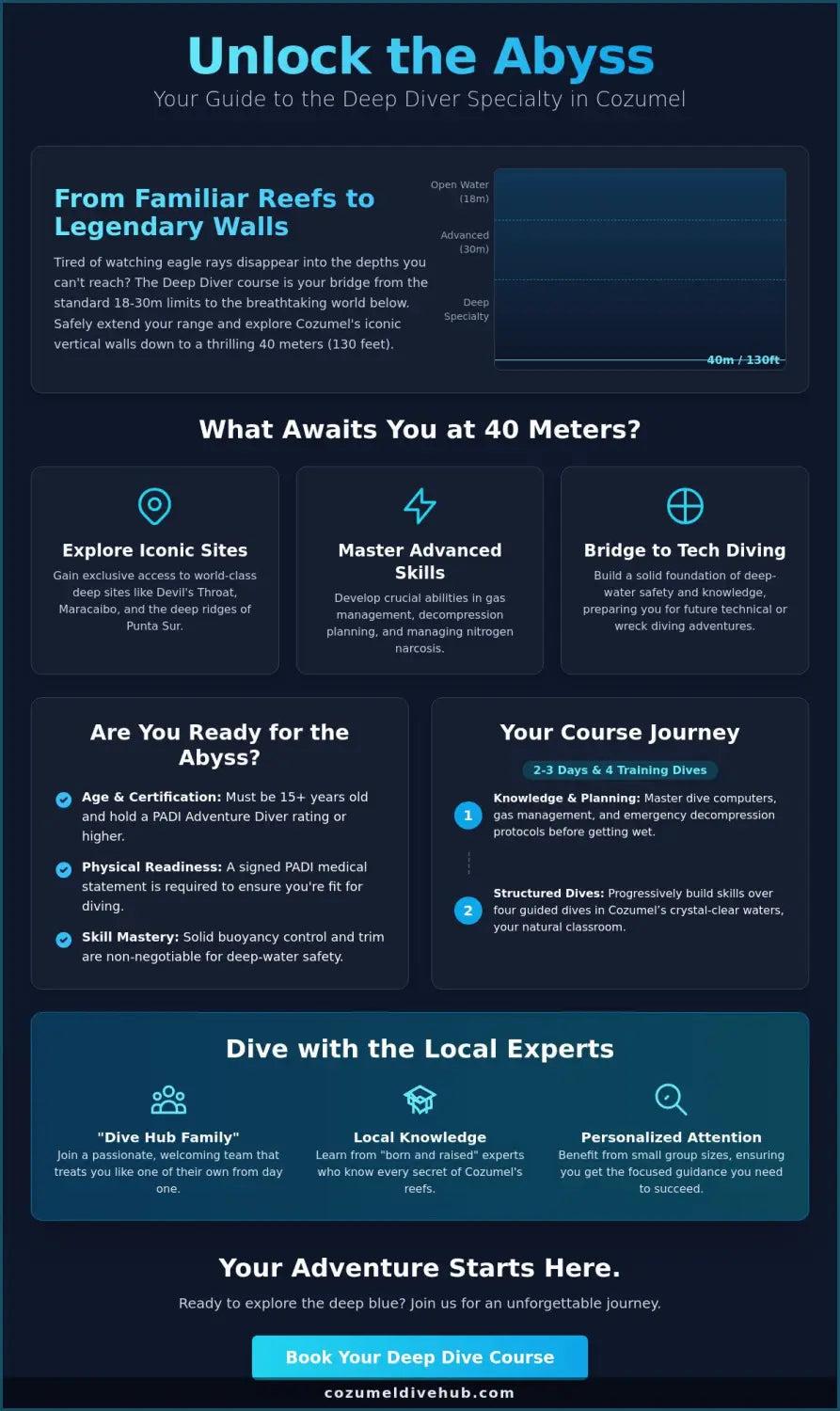
PADI Deep Diver certifies you to 40 metres over four training dives across at least two days, from age 15. In Cozumel it opens Devil's Throat, Punta Sur, Maracaibo and Colombia Deep, where the no-deco clock at 130 feet allows roughly ten minutes.
Carmen Novelo · April 24, 2026 · 16 min read
The PADI Deep Diver specialty certifies you to plan and conduct dives to 40 metres / 130 feet, the deepest limit in recreational diving. It runs over four training dives across a minimum of two days, and its prerequisites are PADI Adventure Diver (or equivalent) plus a minimum age of 15. In Cozumel it is the one card that opens the deep southern sites: Devil's Throat, Punta Sur, Maracaibo and Colombia Deep. What it does not do is make any of them safe on the strength of the card alone. At 130 feet the no-decompression clock allows roughly ten minutes, and once descent and ascent are subtracted most divers have less than that on the bottom. Deep diving here is a pass-through discipline, not a place to linger.
Cozumel Dive Hub is an independent editorial guide. It runs no boats, employs no instructors and holds no training-agency rating, which is why this page is free to say where a Deep card stops being useful.
This is the depth-focused companion to the Cozumel specialty course guide, which ranks the whole specialty menu against the island. Here the subject is one course, in detail.
What The PADI Deep Diver Course Actually Certifies You To Do
Advanced Open Water trains you to 30 metres / 100 feet. Deep Diver extends that to 40 metres / 130 feet and — more usefully — replaces "go deeper" with a planning method.
PADI states the Open Water limit as 18 m / 60 ft, Advanced Open Water as 30 m / 100 ft, and describes the Deep Diver specialty as preparing divers "for planning dives up to 40 meters (130 feet)", which it calls "the deepest you can go in recreational diving". PADI also confirms the specialty runs "over a minimum of two days and four open water dives" and takes Adventure Diver certification with a minimum age of 15, per its own course briefing.
| Item | PADI Deep Diver | Source |
|---|---|---|
| Minimum age | 15 | PADI |
| Prerequisite | Adventure Diver or equivalent | PADI |
| Training dives | 4, over at least 2 days | PADI |
| Certified depth | 40 m / 130 ft | PADI |
| Depth it replaces | 30 m / 100 ft (Advanced Open Water) | PADI |
| What it is not | An overhead or decompression qualification | PADI |
The syllabus is narrower than the marketing suggests. It covers deep dive planning, gas supply management, recognising and managing nitrogen narcosis, buddy contact procedures, buoyancy control at depth and emergency decompression procedures. It does not certify you for staged decompression, overhead environments or any form of technical diving — that pathway is covered separately in the technical diving guide for Cozumel.
Which Cozumel Dive Sites Actually Need The Depth?
This is the practical case for the course, and it is a short list. Most of Cozumel's reef sits well inside Advanced limits — the reef depth guide covers where the coral actually lives. These are the published sites on this guide with a maximum depth of 100 feet or more.
| Dive Site | Depth Range (ft) | Level | Current |
|---|---|---|---|
| Maracaibo Reef | 70–150 | Advanced | Moderate to strong |
| Devil's Throat | 80–130 | Advanced | Moderate to strong |
| Barracuda Wall | 90–130 | Advanced | Moderate to strong |
| Punta Sur Reef | 90–120 | Advanced | Moderate to strong |
| Colombia Deep | 60–120 | Advanced | Moderate to strong |
| Santa Rosa Wall | 50–120 | Advanced | Moderate to strong |
| Punta Tunich | 50–120 | Intermediate | Mild to moderate |
| Palancar Caves | 50–120 | Intermediate | Moderate |
| San Francisco Reef | 45–120 | Intermediate | Moderate |
| Palancar Horseshoe | 50–110 | Intermediate | Mild to moderate |
| Villa Blanca Wall | 50–100 | Intermediate | Moderate to strong |
| Paso del Cedral | 45–100 | Intermediate | Mild to moderate |
Read that table carefully and the argument for the course narrows further. Nine of the twelve sites have a maximum of 120 feet or less, which sits inside the Advanced limit of 100 feet only if you stay off the deepest part of the drop-off — and every one of them is normally dived as a multilevel profile that starts deep and works shallow. The three that genuinely require the extra ceiling are Maracaibo, Devil's Throat and Barracuda Wall. Everything else is a site where depth certification buys you margin rather than access.
Maracaibo is the outlier at a listed 150 feet — beyond the recreational limit entirely at its deepest, and a site where the sensible plan is a defined maximum well above the sand. The broader dive site index puts these in context against the shallower reef.
How Much Bottom Time Do You Get At 130 Feet?
Very little, and this is the number that should shape every deep plan you make in Cozumel.
Standard air no-decompression limits collapse with depth. The federal air no-decompression table published at 46 CFR Part 197, Appendix A gives 10 minutes at 130 feet. PADI's own recreational figures follow the same shape: it publishes a maximum bottom time of 56 minutes at 18 m and only 20 minutes at 30 m / 100 ft.
| Depth | No-Deco Limit (air) | What That Means In Practice |
|---|---|---|
| 90 ft / 27 m | 30 min | A full working dive on the wall |
| 100 ft / 30 m | 25 min | Advanced Open Water ceiling; a real dive |
| 110 ft / 33 m | 20 min | Descent and ascent start eating the plan |
| 120 ft / 36 m | 15 min | A visit, not a dive |
| 130 ft / 40 m | 10 min | A pass-through, minus descent and ascent |
Limits from the federal air table cited above; a personal dive computer running a modern algorithm will often be more conservative still, especially on the second or third day of repetitive diving. The dive computer guide covers what to look for.
Gas is the second clock, and it runs faster than most divers expect. At 40 metres you are breathing at five atmospheres of ambient pressure, so every breath draws five times the surface volume of gas. An aluminium 80 holds roughly 2,300 litres of free air at working pressure; leaving a sensible reserve, a diver with an ordinary surface consumption rate has somewhere around 17 to 23 minutes of usable gas at that depth before any ascent. That is more than the ten-minute no-deco allowance — which is the point. At 130 feet the tables stop you, not the tank. Your air consumption still matters enormously, because a diver breathing hard has no margin left for a problem, and the air consumption guide is worth reading before any deep day.
The honest conclusion: a 130-foot dive in Cozumel is a descent, a look, and an ascent. If you have pictured hanging in the blue at Maracaibo for twenty minutes, that dive does not exist on a single aluminium tank of air.
What Happens Across The Four Training Dives?
PADI structures the specialty as four open water dives over at least two days. The content is planning-led, and the two exercises divers remember are both diagnostic rather than skill-based.
| Dive | Focus | Why It Matters In Cozumel |
|---|---|---|
| 1 | Planning, descent technique, buddy contact, narcosis assessment | Wall entries here are often over blue water with no visual reference |
| 2 | Gas management, colour absorption, task loading at depth | Colour is gone before depth feels different |
| 3 | Emergency decompression procedures, ascent discipline | Contingency for an overrun no-deco limit |
| 4 | Applying the plan on a real deep profile | Usually the first genuine southern site |
Exact dive-by-dive content varies with the instructor and the sites available on the day; the structure above reflects PADI's published course description and the standard sequencing operators use. Confirm the plan with whoever is teaching before you pay.
How The Course Tests Nitrogen Narcosis
This is the part of Deep Diver that changes how divers think, and it is worth knowing about in advance because it is not a skill you can practise.
PADI describes the exercise directly: divers complete a reasoning task at the surface, then repeat a comparable task at depth, and the instructor "will record how long it takes you to complete both tasks". The purpose is to demonstrate that "the task is more confusing or takes longer to complete" underwater. PADI notes that susceptibility varies — "some divers feel the effects at 30m/98ft, while others won't feel anything until they reach the recreational limit of 40m/130ft" — and lists the common effects as impaired judgment, difficulty concentrating, drowsiness, overconfidence and euphoria, and feeling afraid. That guidance is set out in PADI's narcosis briefing.
The timed comparison matters because narcosis does not announce itself. The single most useful thing you learn is your own number — the depth at which your task performance measurably degrades. That number belongs in your dive planning for the rest of your diving life, and it is the strongest argument for taking this course at all.
The management response is unglamorous: ascend. Narcosis resolves on ascent with no lasting effect, which is why every deep plan should have a shallower shelf built into it rather than a hard bottom.
Why Colours Disappear Long Before The Depth Feels Deep
Water absorbs light by wavelength, and it does it fast. PADI puts it plainly: "light intensity decreases with depth, and more colours are absorbed by the water", so things get "progressively dark and blue" until you add artificial light.
In Cozumel this is more noticeable than most divers expect, because visibility here is exceptional. Clear water makes a 120-foot dive feel bright and shallow even as red, orange and yellow have already gone. Divers routinely misjudge their depth on the southern walls for exactly this reason — the light says 60 feet and the computer says 115.
Two practical consequences follow. First, carry a light on any deep Cozumel dive, not for navigation but to see what is actually in front of you: the sponges on Santa Rosa Wall are a different animal under a torch. Second, do not use ambient light as a depth cue. Use the gauge.
What Gas Planning And Contingency Planning Cover
These are the two least exciting parts of the syllabus and the two that do the most work.
Gas planning at depth means deciding, on the boat, what pressure you turn the dive at — not deciding in the water when you notice the pressure gauge is low. The course teaches you to work backwards from the ascent you will need, including a safety stop, and to hold a genuine reserve rather than a hopeful one. In a Cozumel drift, you cannot swim back to a mooring line to save gas — the Yucatán Current has already carried you past it, and the live boat collects you wherever you surface.
Contingency planning covers what you do when the plan fails. The two scenarios the course drills are an overrun no-decompression limit — requiring emergency decompression rather than a normal ascent — and separation from a buddy at depth. Both are more likely on a wall than on a reef, because there is no bottom to reference and the current separates people quickly. The current strength guide explains what the drift actually does at the southern sites.
Two additions worth making for Cozumel specifically: carry a surface marker buoy and know how to deploy it from depth, and understand where the island's recompression facilities are before you need them — the hyperbaric chamber guide has the locations. Confirm your dive insurance covers diving to 40 metres; several policies cap cover at 30.
Does A Deep Card Make You Ready For Devil's Throat?
No, and this is the most important sentence on this page.
Devil's Throat is a genuine overhead — a constricted, dark tunnel through the Punta Sur formation that you enter around 90 feet and exit deeper. Published accounts of the exit depth disagree: this guide lists the site at 80–130 feet, one long-standing Cozumel site reference puts the deepest passage at about 115 feet, and several operators describe the exit at 130 to 140 feet. That disagreement is itself the warning. You cannot build a gas and no-deco plan around a number that varies by twenty-five feet between sources, which means the dive is planned on the day, by someone who knows the formation, with your own computer as the authority.
A Deep specialty gives you a depth ceiling and a planning method. It does not give you overhead training, silt awareness in a confined passage, or the automatic buoyancy control that a narrow swim-through demands when you are simultaneously narced and short of no-deco time. Divers who handle Devil's Throat well tend to have a hundred-plus logged dives and unconscious trim, not a fresh card. The dedicated Punta Sur and Devil's Throat guide sets out what the dive actually asks for.
The same caution applies more mildly at Maracaibo and Barracuda Wall: strong current, no shallow escape, and a long way from the nearest boat if the plan goes wrong.
Does Nitrox Help On A Deep Dive?
Less than people hope, and the reason is worth understanding before you buy both courses together.
Enriched air extends no-decompression limits by reducing the nitrogen fraction — but its oxygen fraction sets a maximum operating depth, and standard 32% nitrox is generally unsuitable at 40 metres on oxygen exposure grounds. The blends that work at recreational deep limits are leaner, and lean blends give back much of the no-deco advantage. Where nitrox genuinely pays in Cozumel is the 60-to-100-foot repetitive diving that fills most of a week, not the single 130-foot pass. The Cozumel nitrox guide covers the trade in full, and the Enriched Air Diver course page has the certification detail.
Take nitrox for the week. Take Deep for the three sites. They solve different problems.
What Does Deep Diver Cost In Cozumel?
Published rates from Cozumel operator price lists, checked August 2026. Treat these as a range, not a quote — inclusions differ substantially and prices change.
| Operator | Programme | Published Price | Notes |
|---|---|---|---|
| Cozumel Dive School | PADI Deep Diver | $410 | 4 open water dives, 2 days; eLearning, park fees, gear and certification included |
| Deep Blue Cozumel | SSI Deep Diving | $420 | Listed on the operator specialty price list |
| Dive Paradise | PADI Deep | $504 | 3 boat dives; certification processing fee and daily park fee charged separately |
| Deep Blue Cozumel | PADI Deep Diving | $535 | Listed on the operator specialty price list |
Two costs sit outside most of those figures. Dive Paradise lists a separate PADI certification processing fee and a daily marine park fee, and states that textbooks and gear rental are not included — the marine park fee guide explains that charge. For comparison, a standard two-tank morning boat dive runs around $130 at 2026 island rates, so the course is roughly three diving mornings.
PADI Deep Diver Or SSI Deep Diving?
Functionally similar, and both are taught on the island. PADI's version is described above. SSI's Deep Diving programme is the direct equivalent, and SSI specialty pricing in Cozumel tends to run below the PADI equivalent for comparable content — the $420 versus $535 gap on one operator's own list is typical.
If you are mid-pathway with one agency, stay with it. If you are starting fresh, choose the instructor and the operator rather than the logo. The PADI Deep Diver course page and its SSI counterpart both list what is included locally.
How To Fit Deep Diver Into A Cozumel Week
Four dives over two days is a large share of a typical ten-dive week, so the sequencing matters.
- Before you fly: complete the knowledge development by eLearning. It is the only part that does not cost water time.
- Day one: dive normally. Sort your weighting and let the boat routine settle before adding a course.
- Day two: if your buoyancy is not automatic, spend the morning on it. Peak Performance Buoyancy is the single best preparation for deep work, and being over-weighted at 130 feet is the fastest way to lose a dive.
- Days three and four: the four training dives, ideally with the deeper southern profiles on the second day once you are acclimatised.
- Day five onward: dive the sites the card opened, at a considered pace.
Build slack into that. A norte can close the port for a day in winter and the southern sites are the first to be dropped when the sea is up, because the run is long and exposed — the conditions by month guide shows when that is likeliest. Deep dives also tighten your surface interval before a flight; the flying after diving guide covers the timings.
If you have not yet completed Advanced Open Water, that comes first — the Advanced Open Water course page lists prerequisites. Divers heading in the other direction, toward overheads and staged decompression, should look at the wreck specialty guide and then at technical training proper.
Is Deep Diver Worth It In Cozumel?
Take it if Maracaibo, Devil's Throat and the deep Punta Sur profiles are why you booked the trip. That is three sites, and they are genuinely worth a card.
Skip it if you are chasing a specialty count, or if depth simply sounds more advanced than the reef. Cozumel's best diving — Palancar's coral heads, the fish life, the long relaxed drifts — happens between 40 and 80 feet, where you get an hour instead of ten minutes. Depth here buys structure, not better reef.
And whichever way you decide, treat the certification as a planning qualification rather than a permission slip. The card sets a ceiling. Your logbook, your buoyancy and your honesty about your own narcosis threshold decide whether you should be near it.
Plan your Cozumel dive trip to work out how many dive days you actually have before committing four of them to training.
Frequently Asked Questions
What are the prerequisites for the PADI Deep Diver specialty?
How deep can you dive with a PADI Deep Diver certification?
How many training dives does the Deep Diver course include?
How much bottom time do you actually get at 130 feet?
Do you need Deep Diver certification to dive Devil's Throat?
What is the narcosis exercise in the Deep Diver course?
Why do colours disappear on deep Cozumel dives?
Does nitrox extend bottom time at 40 metres?
What does the Deep Diver specialty cost in Cozumel?
Is the Deep Diver specialty the same as technical diving?
Share This Article
Carmen Novelo
Carmen Novelo is a Cozumel native and an active scuba instructor and dive guide on the island. She has spent twelve years diving the Cozumel reef system, and writes about its dive sites, conditions and marine life for Cozumel Dive Hub.