How Deep Are Cozumel Reefs? A Diver's Guide to Depth and Marine Life
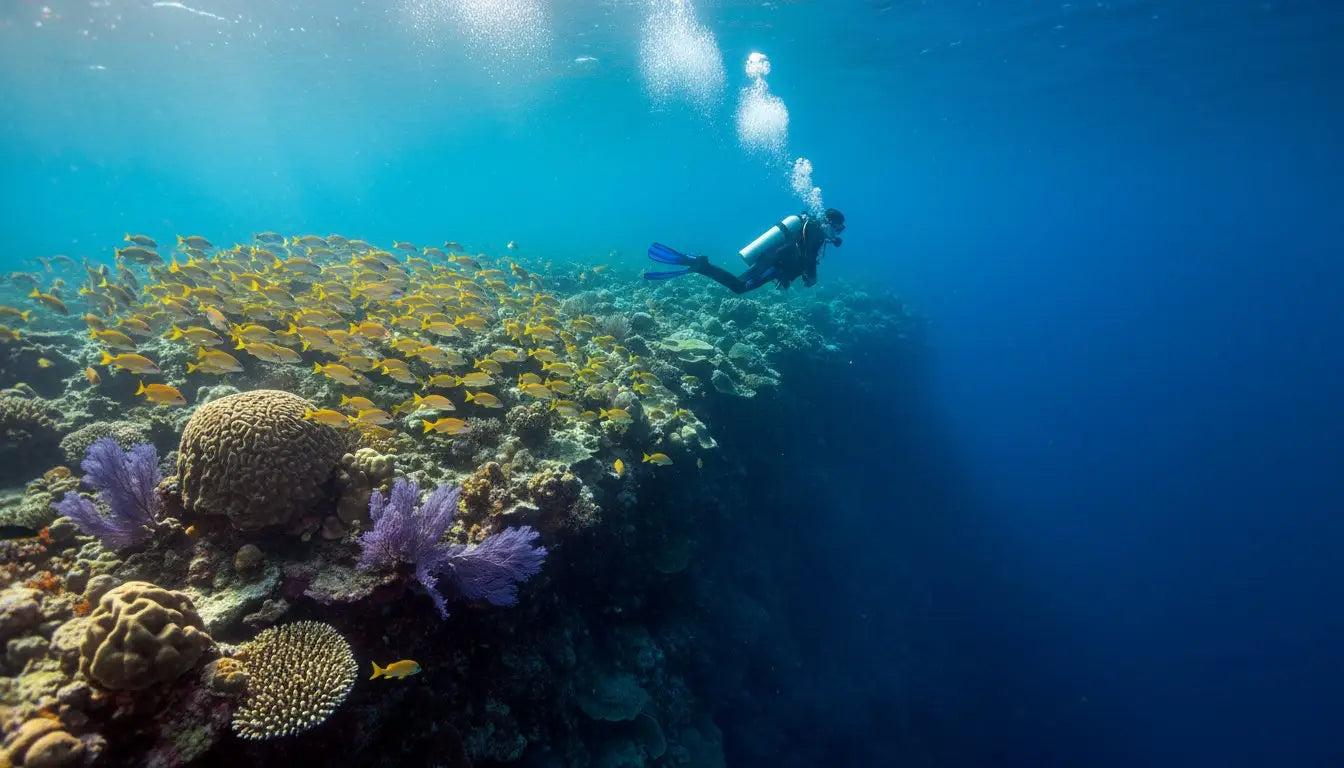
Cozumel reefs are tiered rather than one depth. Reef tops run from 5 ft at El Cielo to 90 ft at Punta Sur, and 25 of the 43 catalogued sites crest at 40 ft or shallower. The reef top decides your dive, not the maximum depth.
Carmen Novelo · March 19, 2026 · 5 min read
Cozumel's reefs are tiered rather than a single depth. Across the dive sites catalogued in this guide, reef tops start anywhere from 5 ft at El Cielo to 90 ft at Punta Sur, and maximum working depths run from 15 ft to 150 ft. The figure that actually decides your dive is the reef top, not the maximum: 25 of those sites have a reef crest at 40 ft or shallower, and 22 sites stay entirely inside the 60 ft Open Water limit. Beyond the outer reef line the seabed falls away into the Cozumel Channel, which is roughly 400 m (about 1,310 ft) deep and reaches around 500 m (1,640 ft) at its deepest — genuinely deep water, but far shallower than the "3,000-foot drop-off" figure repeated across dive marketing.
Cozumel Dive Site Depths, North To South
This is the full depth range for every west-coast site in the guide, ordered north to south along the reef line — the same order the boats run it. The first number is the reef top, which is where you spend most of the dive. The second is the deepest point the site offers, which most divers never touch.
| Dive Site | Depth Range (ft) | Skill Level | Current |
|---|---|---|---|
| Barracuda Reef | 45–80 | Advanced | Strong to very strong |
| Barracuda Wall | 90–130 | Advanced | Moderate to strong |
| Molas Shallow Reef | 20–40 | Beginner | Moderate to strong |
| San Juan Reef | 40–80 | Advanced | Strong to very strong |
| Cantarell Reef | 60–90 | Advanced | Mild to moderate |
| Casa Blanca | 30–60 | Beginner | Mild to moderate |
| Coral Princess Reef | 10–20 | Beginner | Mild to moderate |
| Villa Blanca Wall | 50–100 | Intermediate | Moderate to strong |
| Paradise Reef | 30–40 | Beginner | Mild to moderate |
| Las Palmas Reef | 40–70 | Beginner | Mild to moderate |
| Chankanaab Reef | 35–40 | Beginner | Mild to moderate |
| Chankanaab Bolones | 35–40 | Beginner | Moderate to strong |
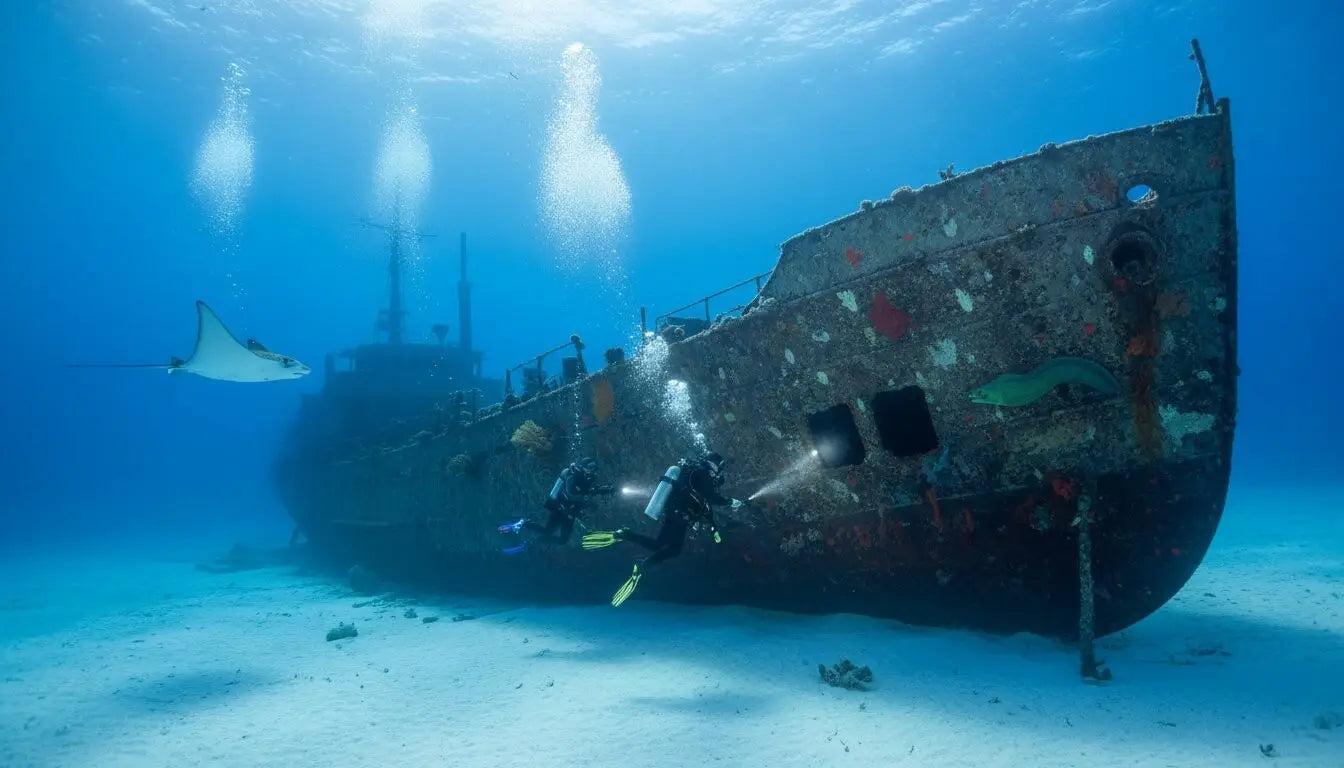
| C-53 Shipwreck | 40–55 | Intermediate | Moderate |
| Playa Corona | 20–40 | Beginner | Mild to moderate |
| El Presidente | 20–70 | Beginner | Mild to moderate |
| Tikkila Shallow Reef | 15–30 | Beginner | Mild to moderate |
| Money Bar Reef | 10–20 | Beginner | Mild to moderate |
| Tormentos Reef | 50–60 | Intermediate | Moderate |
| Yucab Reef | 50–60 | Beginner | Moderate to strong |
| San Clemente | 30–40 | Beginner | Mild |
| Punta Tunich | 50–120 | Intermediate | Mild to moderate |
| San Francisco Reef | 45–120 | Intermediate | Moderate |
| Yellow House Reef | 35–50 | Beginner | Mild to moderate |
| Santa Rosa Wall | 50–120 | Advanced | Moderate to strong |
| Paso del Cedral | 45–100 | Intermediate | Mild to moderate |
| La Francesa Reef | 30–60 | Beginner | Mild to moderate |
| Punta Dalila | 40–60 | Beginner | Moderate to strong |
| Palancar Gardens | 30–80 | Beginner | Mild to moderate |
| Palancar Horseshoe | 50–110 | Intermediate | Mild to moderate |
| Palancar Caves | 50–120 | Intermediate | Moderate |
| Palancar Bricks | 50–90 | Intermediate | Moderate |
| Colombia Shallows | 30–50 | Beginner | Moderate to strong |
| Los Atolones | 40–70 | Intermediate | Moderate |
| Colombia Deep | 60–120 | Advanced | Moderate to strong |
| El Cielo | 5–15 | Beginner | Mild to moderate |
| Punta Sur | 90–120 | Advanced | Moderate to strong |
| Devil's Throat | 80–130 | Advanced | Moderate to strong |
| Chun-Chacaab | 70–80 | Advanced | Moderate to strong |
| Maracaibo Reef | 70–150 | Advanced | Moderate to strong |
Read down that column and the pattern is obvious. The northern end opens deep and demanding, the middle of the island is a long shallow-to-moderate belt in the 20–60 ft range, and the far south returns to depth. Almost nothing in Cozumel is a flat-bottomed dive at a fixed number.
East Coast Depths
The windward side is a different environment entirely — shallow, wave-exposed, and only diveable on rare calm days. All four catalogued east-coast sites sit in the same narrow band.
| Dive Site | Depth Range (ft) | Skill Level |
|---|---|---|
| El Islote | 10–25 | Beginner |
| Chen Rio | 10–25 | Beginner |
| El Mirador | 10–25 | Beginner |
| Punta Morena | 10–25 | Beginner |
Why Cozumel Reefs Are Tiered, Not One Depth
Cozumel sits on a limestone insular shelf that steps down in stages rather than sloping evenly. Research on the island's shelf describes shallow coastal terraces with coral reef lines, then sandy plains, then a steep shelf slope beginning at roughly 35 m (115 ft) water depth. That structure is why a single site can be quoted as "30 ft" and "80 ft" at the same time and both figures be correct.
A typical outer-reef site has three tiers. The reef top is the coral platform where the structure begins, usually 30 to 50 ft. Below it the reef face descends as a reef slope or a vertical drop-off, typically to 80 or 120 ft depending on the site. Past that the shelf edge gives way to open channel water with no bottom in sight.
Because the reef top is where the coral, the fish and the light are, that number matters more than the maximum. Palancar Gardens is listed at 30–80 ft, but a diver who stays on the coral heads and sand channels will log it as a 40 ft dive. Santa Rosa Wall is listed to 120 ft, and a well-run profile on it still finishes shallow. For more on how the reef line behaves across the island, the Palancar Reef guide walks the complex section by section.
How Deep Is The Cozumel Wall?
The honest answer is that the wall drops far deeper than any recreational diver goes, and considerably less far than most marketing copy claims. The Cozumel Channel — the strait between the island and the Yucatán mainland — is about 18 km wide and roughly 400 m deep, with measurements reaching approximately 500 m. That is 1,310 to 1,640 ft. It is not a 3,000 ft abyss, and it is nowhere near the Cayman Trough, which lies far to the southeast between Cuba and Jamaica.
Parque Nacional Arrecifes de Cozumel, which protects the reef system, extends to the 100 m (328 ft) depth contour. Everything a recreational diver will ever see on a Cozumel wall happens in the top third of that protected band, and the visible reef structure on the wall face largely gives out before 130 ft anyway.
What that means in the water: at Santa Rosa Wall, Punta Tunich or Colombia Deep you hang beside a coral face with blue water on one shoulder and no floor beneath you. The sensation of infinite depth is real. The actual number is finite, measurable, and irrelevant to your dive plan, because your dive computer stops you long before the channel does.
The 130 ft (40 m) recreational limit is the practical ceiling. Below that you are into technical diving, which is a separate discipline with separate training, gas planning and decompression obligations — covered in the Cozumel technical diving guide.
Can An Open Water Diver Dive Cozumel?
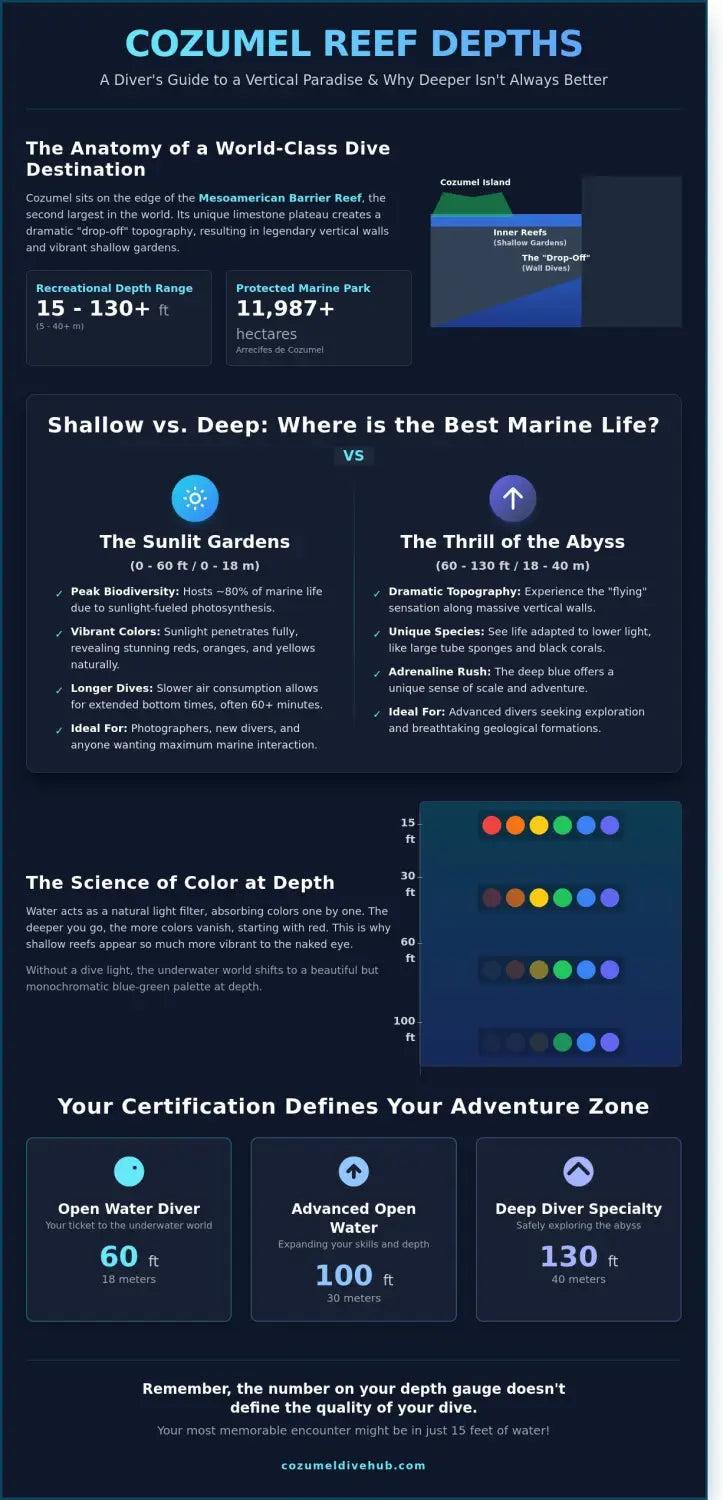
Yes, and with an unusually large menu. A PADI or SSI Open Water Diver certification carries a 60 ft (18 m) depth limit. Of the sites in the table above, 22 have a maximum depth of 60 ft or shallower, meaning the entire site is inside the limit with nothing to avoid. A further group of sites — Palancar Gardens, Las Palmas, El Presidente, Los Atolones — have reef tops well inside 60 ft and simply require staying on the upper structure.
| Certification | Depth Limit | What It Opens In Cozumel |
|---|---|---|
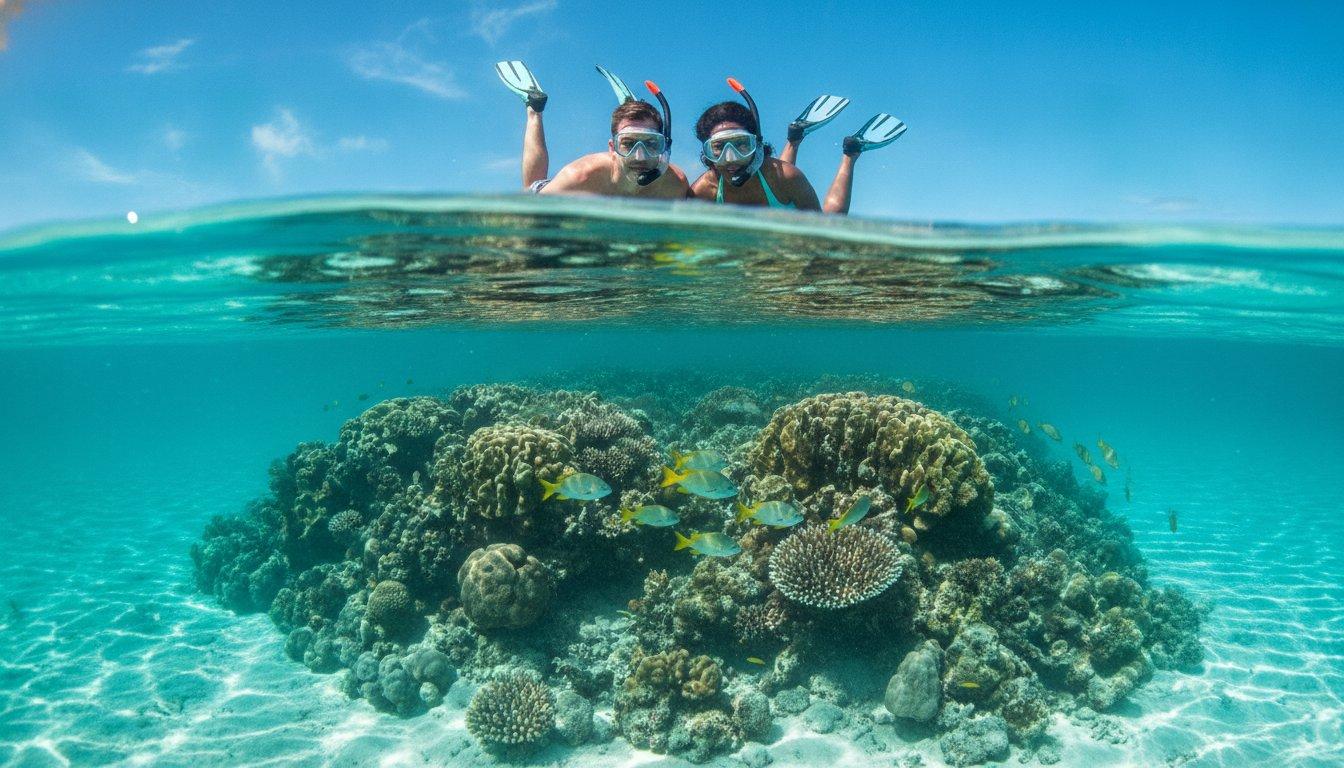
| Discover Scuba / intro dive | 40 ft (12 m) | Shallow inshore reefs: Paradise, Chankanaab, Playa Corona, Molas Shallow |
| Open Water Diver | 60 ft (18 m) | 22 full sites plus the shallow tier of most Palancar and mid-island reefs |
| Advanced Open Water Diver | 100 ft (30 m) | Santa Rosa Wall, Palancar Caves, Palancar Horseshoe, Paso del Cedral, Colombia Deep |
| Advanced plus Deep specialty | 130 ft (40 m) | Devil's Throat, Barracuda Wall, the deepest reach of Punta Sur and Maracaibo |
| Beyond 130 ft | Technical training required | Not recreational diving |
The three deepest reef tops on the island are the genuine exclusions for an Open Water card: Punta Sur at 90 ft, Barracuda Wall at 90 ft, and Devil's Throat at 80 ft. These sites have no shallow tier to work — the structure begins deep, so there is no version of the dive that fits inside 60 ft. Everything else on the island offers a profile you can legitimately dive at your level.
New divers weighing whether the island suits them will find a fuller picture in the beginners' guide to Cozumel diving and in what to expect on a first drift dive.
Do You Need Advanced Open Water For Cozumel?
Not to dive the island well, but it removes the ceiling on roughly a third of it. Ten of the 43 catalogued sites are rated Advanced, and another ten are Intermediate with depth ranges that extend past 60 ft. An Advanced Open Water Diver certification raises your limit to 100 ft (30 m), which is enough for Santa Rosa Wall, Palancar Caves, Palancar Horseshoe, Colombia Deep and Paso del Cedral as they are normally dived.
Two things push you past 100 ft and into Deep specialty territory. Devil's Throat at Punta Sur is a chimney swim-through that exits onto the wall in the 120–130 ft range, and Maracaibo Reef at the island's southern tip runs to 150 ft, which is past recreational limits at its deepest. The Punta Sur and Devil's Throat guide covers what that dive actually demands, and the Advanced Open Water in Cozumel guide covers the certification itself.
Depth also brings nitrogen narcosis into play, which typically becomes noticeable below about 30 m (100 ft), and it accelerates air consumption sharply — at 100 ft you breathe roughly four times the surface volume of gas per minute compared to about two times at 33 ft. That physics, not a rule on a card, is why deep Cozumel dives are short and shallow ones are long.
What You Actually See At Each Depth
Nothing underwater is guaranteed, and depth shifts the odds rather than promising anything. That said, the reef does have rough neighbourhoods, and knowing them helps you pick a site with intent.
| Depth Band | Typical Sightings | Representative Sites |
|---|---|---|
| 5–25 ft | Juvenile reef fish, sergeant majors, parrotfish, sea fans, seagrass turtle feeding areas | El Cielo, Money Bar, Coral Princess, east-coast reefs |
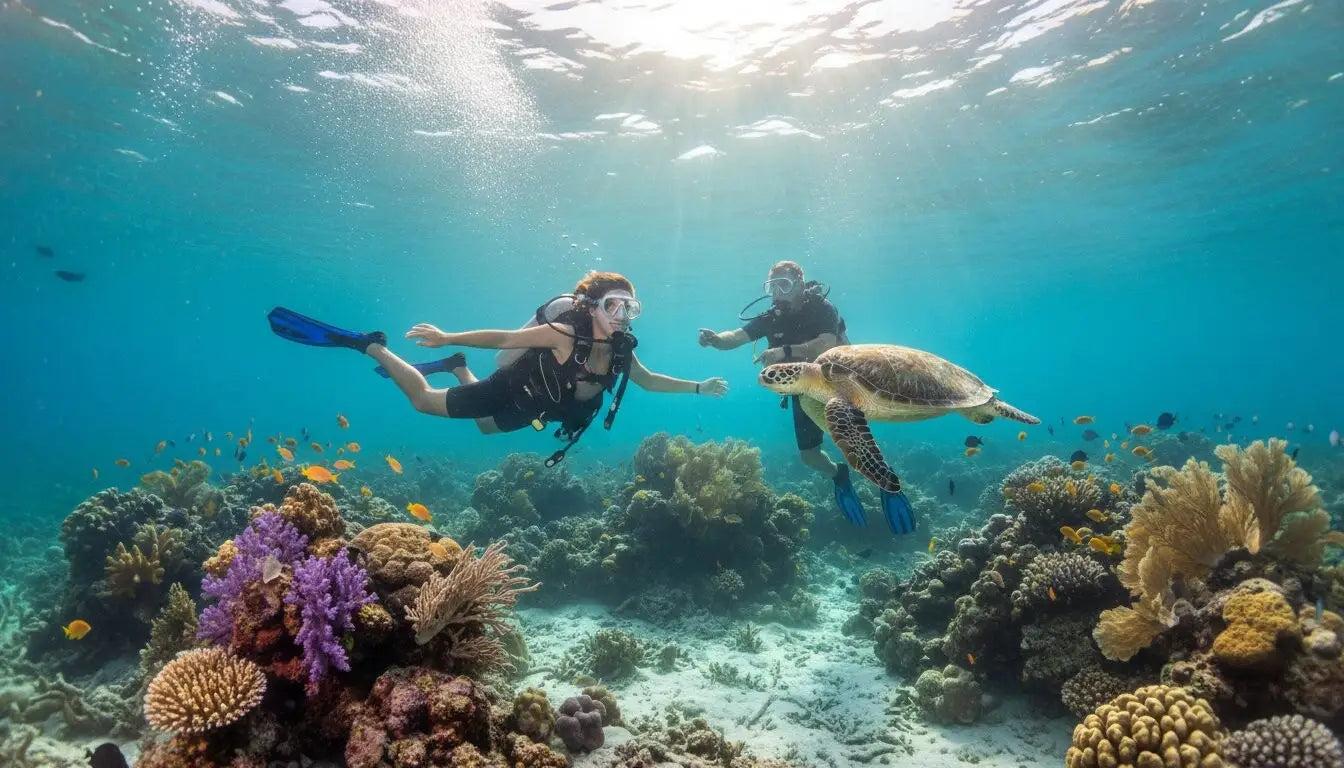
| 25–60 ft | Hawksbill and green turtles, southern stingrays, splendid toadfish under ledges, moray eels, schooling grunts | Paradise, Yucab, Tormentos, Colombia Shallows, Palancar Gardens |
| 60–100 ft | Larger barrel and tube sponges, black grouper, swim-throughs and overhangs, spotted eagle rays passing along the wall | Santa Rosa Wall, Palancar Caves, Colombia Deep, Cantarell |
| 100 ft+ | Deep coral structure, low ambient light, occasional larger animals in the blue | Devil's Throat, Maracaibo, Barracuda Wall |
The two species most people arrive hoping for both sit shallow. The splendid toadfish is endemic to this region and lives tucked under reef ledges on mid-depth reefs — the splendid toadfish guide covers where and how to look. Turtles feed on seagrass and sponges in the shallows, and the Cozumel sea turtle guide explains the seasonal pattern.
Spotted eagle rays are the classic deep-water hope, most often seen cruising the wall edge or crossing open blue water in the cooler months. They are a seasonal phenomenon more than a depth phenomenon — see the eagle ray season guide. Sharks follow the same logic: nurse sharks rest under shallow ledges, and the Cozumel shark guide sets realistic expectations for the rest.
Light is the practical constraint. Red wavelengths are absorbed within the first few metres and are largely gone by 60 ft, so a reef at 30 ft looks vivid to the naked eye while the same coral at 90 ft reads blue and grey without a dive light. Photographers who want colour without strobes stay shallow. That is a physics constraint, not a preference.
Why Bottom Times Are Long If The Dives Are Deep
This is the part that confuses divers arriving from destinations with fixed-depth profiles. Cozumel dives are almost always multilevel dives: you drop onto the deepest part of the site first, work gradually up the reef structure as the current carries you, and finish shallow.
A Santa Rosa Wall dive might touch 90 ft at the start, average 55 ft across the dive, and end at 25 ft. Your no-decompression limit is calculated against actual tissue loading, not against your maximum depth, so a computer-tracked multilevel profile buys you far more time than a square profile at the same maximum. Sixty-minute dives on sites listed at 120 ft are routine here for exactly that reason.
The Yucatán Current does the rest of the work. Because you are drifting rather than swimming, your workload is low and your gas lasts. The dive ends when air or NDL runs out, and on a well-shaped dive profile that is usually air. The Cozumel drift diving guide explains the mechanics, and the current guide covers how much water movement to expect.
Three things extend bottom time further. Good buoyancy and correct weighting reduce the effort of holding depth. Slow, deliberate breathing matters more than fitness — the air consumption guide has the practical detail. And nitrox extends NDL at the 60–100 ft depths where the limit, not the tank, is what ends the dive.
Planning Your Dives Around Depth
Depth planning in Cozumel is really site sequencing. Standard practice on a two-tank morning is the deeper site first — Santa Rosa Wall, Palancar Caves, Colombia Deep — followed by a shallow second dive on Yucab, Tormentos, Paso del Cedral or Colombia Shallows after the surface interval. That order keeps nitrogen loading conservative across the day and it is why the shallow mid-island reefs get dived so often.
If you are certified to 60 ft, ask which sites the boat is running before you board rather than after. If you are working toward Advanced, the wall sites are the reason to do it. And whatever your level, the safety stop at 15–20 ft on a Cozumel reef is rarely a chore — the shallows here are where the fish are. For the full site-by-site reference, see the Cozumel dive sites guide, and for depth-appropriate training, the dive courses in Cozumel overview lists what each certification opens up.
Ready to build a dive week around the right depths? Plan your Cozumel dive trip.
Frequently Asked Questions
How deep are Cozumel's reefs?
How deep is the wall in Cozumel?
Can an Open Water diver dive in Cozumel?
Which Cozumel dive sites are the shallowest?
Do I need Advanced Open Water to dive Cozumel?
Why are Cozumel bottom times so long if the dives are deep?
How deep is Santa Rosa Wall?
What is the deepest dive site in Cozumel?
Does staying shallow mean seeing less marine life in Cozumel?
How deep is the C-53 shipwreck in Cozumel?
Share This Article
Carmen Novelo
Carmen Novelo is a Cozumel native and an active scuba instructor and dive guide on the island. She has spent twelve years diving the Cozumel reef system, and writes about its dive sites, conditions and marine life for Cozumel Dive Hub.