Are There Sharks in Cozumel? What You'll Actually See
Sharks at Cozumel dive sites are almost always nurse sharks, lying motionless under a coral ledge and ignoring you entirely. The island's documented bite record is two incidents, both in the 1990s, across hundreds of thousands of dives.
Carmen Novelo · April 12, 2026 · 17 min read
Yes. There are sharks on Cozumel's reefs, and for a recreational diver that almost always means one animal: a nurse shark lying motionless under a coral ledge, ignoring you entirely. Caribbean reef sharks appear occasionally on the deeper southern walls and usually move off before you get close. The documented shark-bite record for Cozumel consists of two incidents, both involving divers, both in the 1990s, with nothing comparable in the three decades since — across a marine park that logs hundreds of thousands of dives a year.
That is the short answer to the question most people arrive here with. What follows is the long one: what the record actually says and where it comes from, how these animals behave, what to do if one swims toward you, and which of the famous species are not here at all. For species identification, seasonality and the sites where sharks turn up most reliably, the Cozumel shark diving guide covers that ground separately.
What the Shark Attack Record for Cozumel Actually Says
Two databases get quoted in this argument, and they are not equivalent.
The International Shark Attack File. Maintained by the Florida Museum of Natural History at the University of Florida, ISAF is the conservative global standard. It investigates cases individually and classifies each one — unprovoked, provoked, scavenging, boat incident, or unconfirmed. Its most recent worldwide summary, covering 2025, recorded 65 confirmed unprovoked bites globally, nine of them fatal, spread across sixteen locations. Mexico is not among them, and does not appear regularly in those annual tables at all.
The Global Shark Attack File. GSAF and the public databases built from it cast a wider net: press reports, historical accounts, incidents ISAF would reclassify or reject, sea disasters, and cases of post-mortem scavenging. Those listings carry a small number of entries for the whole of Quintana Roo — the coastline from Cancún to the Belize border — spread over more than sixty years, and most of them are beach incidents near Cancún rather than anything that happened on a reef.
For Cozumel specifically, the entries reduce to two events.
| Date | Site | What is on record | How it is usually read |
|---|---|---|---|
| 11 June 1993 | Santa Rosa Shallows | A night dive. A 42-year-old American diver died; the autopsy recorded asphyxiation, and the recovered remains showed severe trauma consistent with a large shark | The one Cozumel case reasonably read as a genuine attack. Night diving on the island was briefly suspended afterwards |
| 15 August 1997 | Santa Rosa | Two divers disappeared attempting an extreme-depth dive on air, far outside recreational limits. One body was recovered showing shark trauma; the other was never found. Databases attribute it to a tiger shark | Long argued within the diving community to be a deep-air fatality with post-mortem scavenging. Nitrogen narcosis and oxygen toxicity at that depth make survival implausible. Never formally resolved |
Stated plainly: one incident in the Cozumel record is reasonably read as a shark attack, it happened at night in 1993, and nothing comparable has been recorded since. That is not the same claim as "sharks here are harmless", and it is not a promise about your dive. It is simply what the record contains.
A word on the odds you will see quoted. Dive shop pages like to open with a figure — one in eleven million, more likely to be hit by a falling coconut, and so on. Those numbers are back-calculated from United States beach attendance data and have nothing to do with diving a Mexican Caribbean reef. There is no published bite rate for divers inside this marine park, because the numerator is close to zero and nobody counts the denominator properly. A precise-sounding probability on this subject is marketing, not statistics.
Which Sharks Do Cozumel Divers Actually Encounter?
| Species | How likely | Where | What it does |
|---|---|---|---|
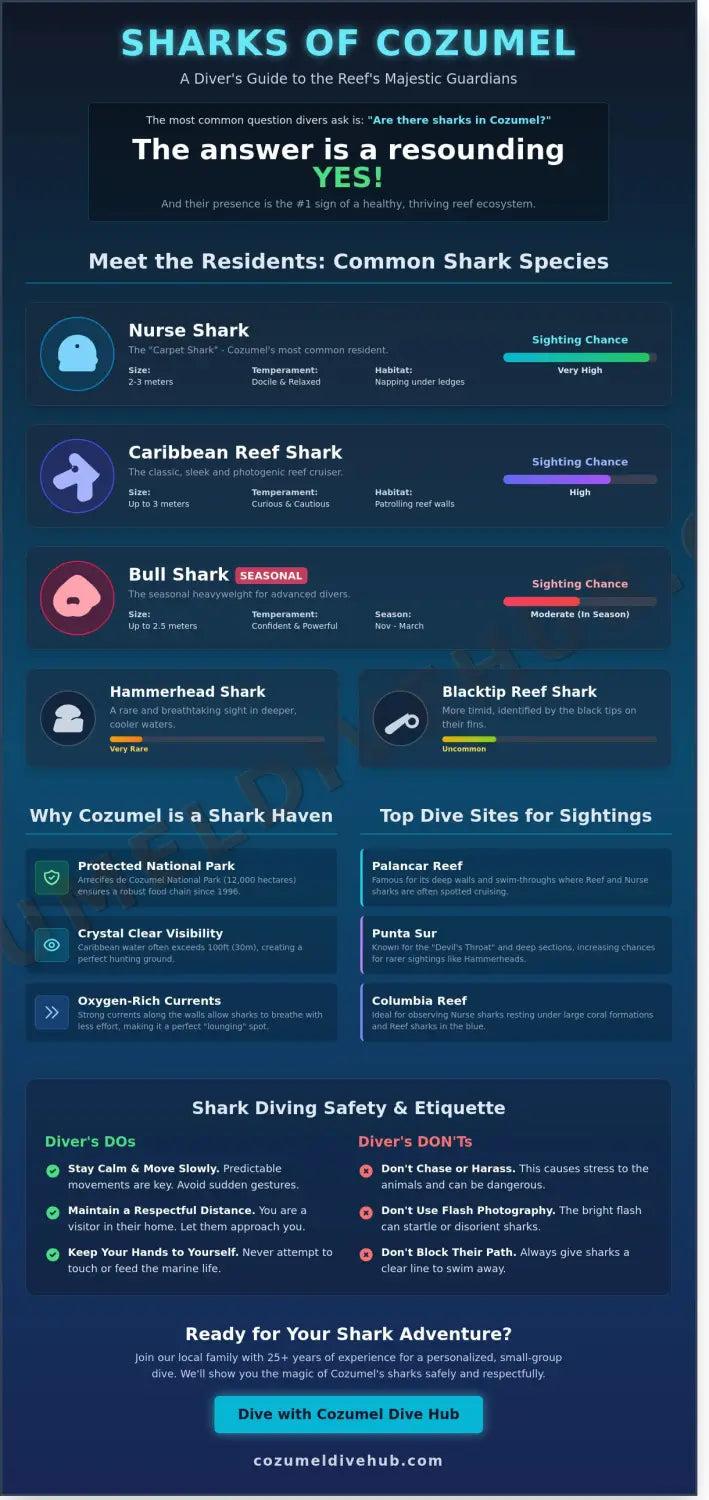
| Nurse shark | Common, year-round | Under reef ledges, inside swim-throughs, on open sand | Sleeps through the day. Ignores divers |
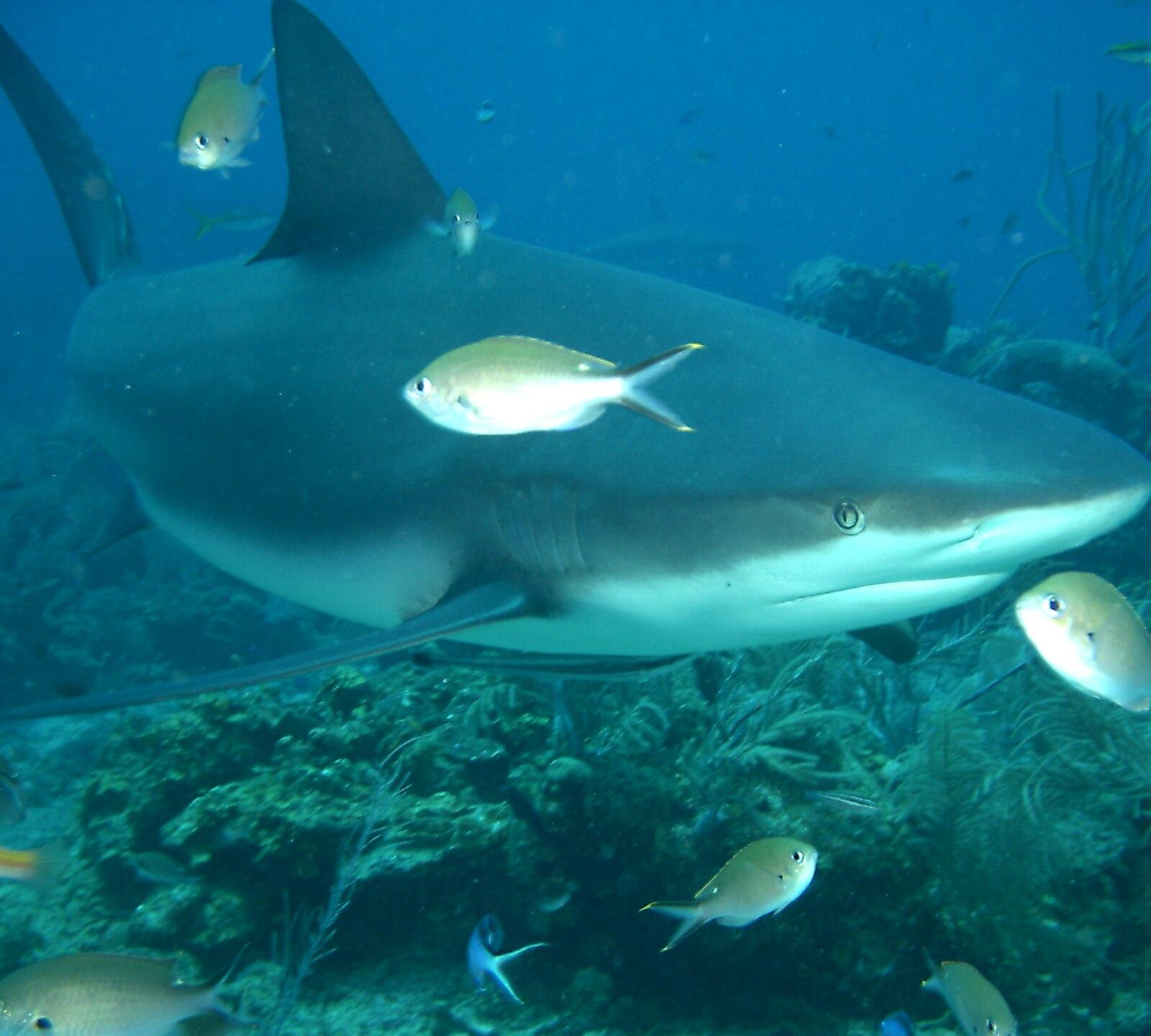
| Caribbean reef shark | Occasional, not reliable | Deeper southern reefs and walls, usually below 20 m | Patrols the drop-off briefly, then leaves |
| Hammerhead | Rare | Blue water off the southern walls | A distant silhouette. A genuine event |
| Bull shark | Not on Cozumel's reefs | Playa del Carmen, mainland, Nov–Mar | Needs a separate day trip |
| Whale shark | Not on Cozumel's reefs | Isla Mujeres and Holbox, summer | Snorkel excursion, several hours away |
The realistic expectation for a week of two-tank days is nurse sharks on several dives and nothing larger. If sharks are what you came for, the reefs are the wrong target, and the marine life site guide sets more honest expectations for what this island genuinely does well — turtles, rays, eels, the endemic splendid toadfish and enormous volumes of reef fish.
Are Nurse Sharks Dangerous to Divers?
Not unless you handle one, and that qualification carries the whole answer.
Nurse sharks are bottom-dwelling suction feeders. They spend daylight hours motionless under overhangs, wedged into crevices, or lying flat on sand channels in the shade of a coral head, and they feed after dark on molluscs, crustaceans and small fish drawn out of holes. Their teeth are built for crushing shells, not for slicing. Caribbean adults commonly run 2 to 2.5 m. A diver drifting past one at Yucab Reef or Palancar Caves is usually the only party in the encounter that notices anything happening.
The exception is consistent worldwide. Recorded nurse shark bites follow a narrow pattern: someone grabbed the tail, sat on the animal, pinned it for a photograph, cornered it in a hole, or stepped on one in shallow water. Nurse sharks also have a strong bite-and-hold reflex, which is why the rare incidents tend to be messier than the species' temperament would suggest — the animal does not release quickly.
Inside Parque Nacional Arrecifes de Cozumel, no-touch diving is a federal rule administered by CONANP, not an etiquette preference. Touching, chasing, feeding or handling marine life is prohibited. The regulations guide covers what that means in practice, and the reef conservation guide covers why it exists.
What Should You Do If a Shark Swims Toward You?
The correct response is almost entirely about not doing things.
- Stop and hold position. Stabilise your buoyancy, stay upright or slightly angled, keep your hands in close. Sudden retreat and thrashing are what change an animal's behaviour, not your presence.
- Keep it in sight. Turn slowly to track it rather than putting your back to it. A shark you can see is a shark that is behaving normally.
- Do not chase it. Reef sharks leave when approached. Swimming after one to get a photograph converts a calm encounter into a pursuit and separates you from your group.
- Do not corner it. Never position yourself between a shark and open water, and never block the mouth of a ledge a nurse shark is resting in. Cornering is the single most reliable way to provoke a defensive bite.
- Do not touch, ride or grab. This includes tails, fins and "just for the photo". It is illegal here as well as stupid.
- Do not feed or bait. Hand-feeding conditions animals to associate divers with food and is prohibited inside the park.
- Let the current do the work. On a drift dive you are moving anyway. Most encounters last seconds because the water carries you apart, and fighting the current to stay with an animal is both futile and a good way to lose the group.
If an encounter genuinely unsettles you, signal your buddy, hold a stable depth and continue the dive normally. Bolting for the surface is a real hazard on these reefs; a shark passing at 25 m is not.
Which Sharks Are Not in Cozumel?
Worth stating plainly, because these are the species people are actually picturing.
- Great white sharks. Absent. White sharks are cool- and temperate-water animals; the western North Atlantic population ranges along the eastern United States and into the Gulf of Mexico, and the Caribbean sits outside their normal range. There is no record of one on Cozumel's reefs, and no white shark diving anywhere in the Mexican Caribbean.
- Tiger sharks. Present in the wider region but extremely rare here and not a species divers encounter on these reefs.
- Oceanic whitetips. An offshore, deep-water animal. Not a reef species and not part of Cozumel diving.
- Bull sharks on the reef. They exist in the Mexican Caribbean but as a mainland winter aggregation, not as Cozumel residents.
Are Bull Sharks a Cozumel Dive?
No. Bull shark diving is a mainland activity that Cozumel operators sell as a day trip, not a dive on the island's reefs.
The aggregation forms offshore from Playa del Carmen, reached by ferry from Cozumel. The animals are pregnant females resting through the last months of gestation before pupping in coastal waters, and they leave when that is finished. The season runs roughly November to March, with December and January the peak, and the dive sits at about 24 to 27 m on a sand bottom. Advanced Open Water or equivalent is the normal minimum, for the depth and because current at the site can be significant.
From Cozumel it is a full day, with a ferry crossing of roughly 45 minutes each way on top of the diving. The bull shark season guide and the bull shark day trip listing cover the logistics.
Can You Dive With Whale Sharks From Cozumel?
No, for two separate reasons.
They are not near Cozumel. The Caribbean aggregation forms off Isla Mujeres and Holbox at the northern tip of the Yucatán Peninsula, which from Cozumel means a ferry, ground transport north and a boat out to the feeding grounds — a very long day.
Scuba is also prohibited. Mexican regulation restricts whale shark encounters to snorkelling at the surface, with strict limits on swimmers in the water, mandatory flotation, no touching, and capacity limits inside the protected zone. Tanks are not permitted. The season is set annually by CONANP and runs roughly mid-June to mid-September. The whale shark season guide and the whale shark tour listing cover costs, timing and the honest downsides, including how rough the crossing can be.
Is Snorkelling in Cozumel Safe From Sharks?
Yes, and the reasoning is straightforward. Snorkelling happens over shallow reef and sand in water that commonly gives 25 to 30 m of visibility. The resident nurse sharks stay tucked under coral through the day, and the deeper species are on the southern walls well below snorkelling depth. No snorkeller or swimmer bite is on record at Cozumel.
The genuine hazards on shallow sites near town are different ones: boat traffic in and around the channel, current on exposed stretches, and fire coral for anyone who touches the reef.
What Actually Causes Diving Incidents in Cozumel?
If your underlying question is whether Cozumel is safe rather than whether sharks are, the answer is that the risk factors here have nothing to do with marine life.
| Factor | Why it matters | Where to read more |
|---|---|---|
| Current | The Yucatán Current runs north along the reefs and can be strong. Separations happen when divers fight it instead of flying with it | Current guide |
| Depth | The southern walls drop away past recreational limits, and the visibility makes depth deceptive | Reef depth guide |
| Certification limits | Sites like Punta Sur, Colombia Deep and Santa Rosa Wall are advanced dives, whatever the booking page says | Safety and conditions guide |
| Experience | Drift diving is a skill. A first Cozumel dive is not the place to discover that | Beginner's guide |
| Night diving | Reduced references and orientation, not marine life, is what makes night dives demanding | Night dive guide |
Sharks do not appear on that list because they do not belong on it.
Diving Cozumel Without Worrying About Sharks
The summary is short. You will probably see a nurse shark. It will be asleep. You should look, photograph from a respectful distance, and leave it alone. If something larger passes in the blue on a deep southern dive, that is a good day, not a problem — hold position, keep it in sight, and let it go.
Start with plan your Cozumel dive trip for timing, certification and logistics. The dive site index lists depth and skill level for every reef, the dive center directory covers operators, and the wider dive news archive has the conditions and seasonality guides. For days off the water, explore Cozumel covers the rest of the island.
Frequently Asked Questions
Has there ever been a shark attack in Cozumel?
Are the sharks in Cozumel dangerous to divers?
What should I do if a shark swims toward me while diving?
Are there great white sharks in Cozumel?
Are nurse sharks aggressive?
Can I dive with bull sharks in Cozumel?
Are there whale sharks in Cozumel?
Is snorkelling in Cozumel safe from sharks?
How often will divers see a shark in Cozumel?
What actually causes diving accidents in Cozumel?
Share This Article

Carmen Novelo
Carmen Novelo is a Cozumel native and an active scuba instructor and dive guide on the island. She has spent twelve years diving the Cozumel reef system, and writes about its dive sites, conditions and marine life for Cozumel Dive Hub.