Swimming with Cozumel Sea Turtles: Your Ultimate 2026 Guide
Two species do nearly all the work on Cozumel's west-side reefs: hawksbills picking at sponges and green turtles grazing the shallows, both there every month of the year. There is no turtle season, and you watch rather than swim with them.
Carmen Novelo · January 30, 2026 · 4 min read
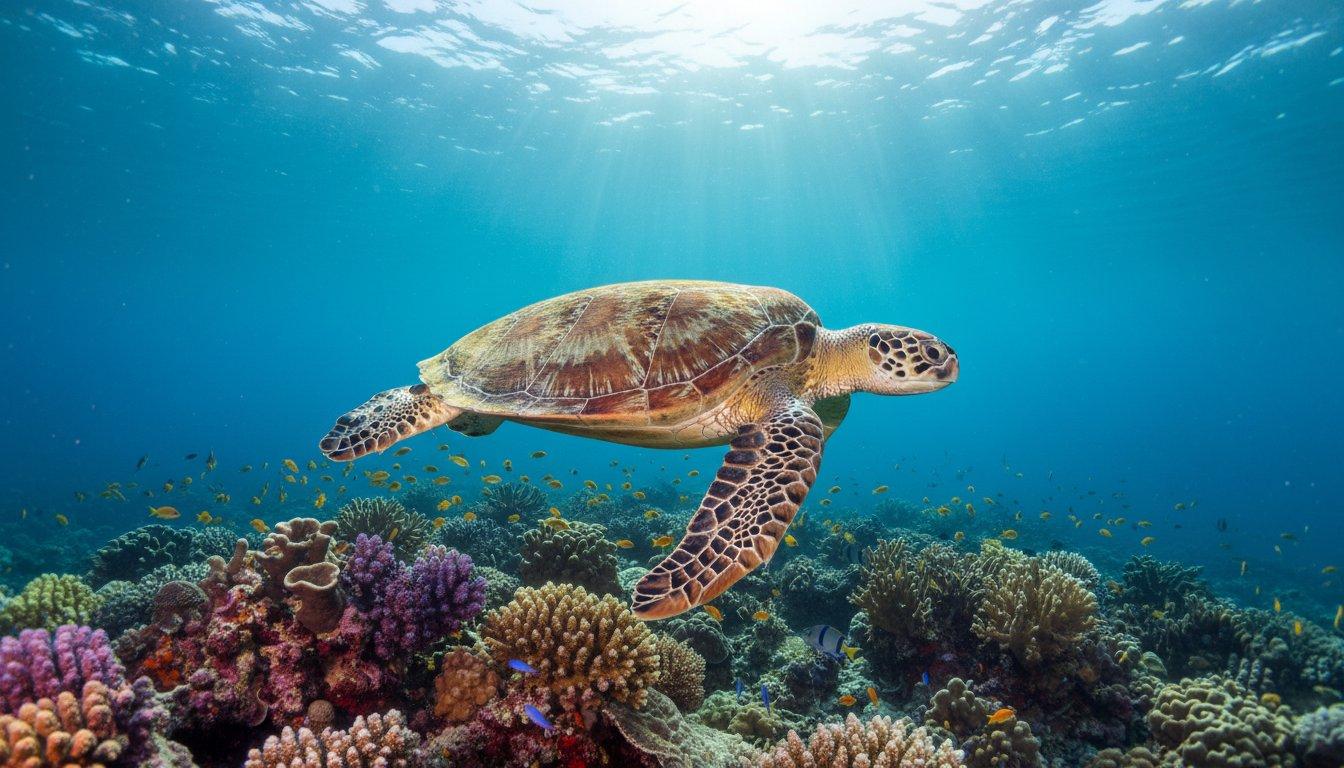
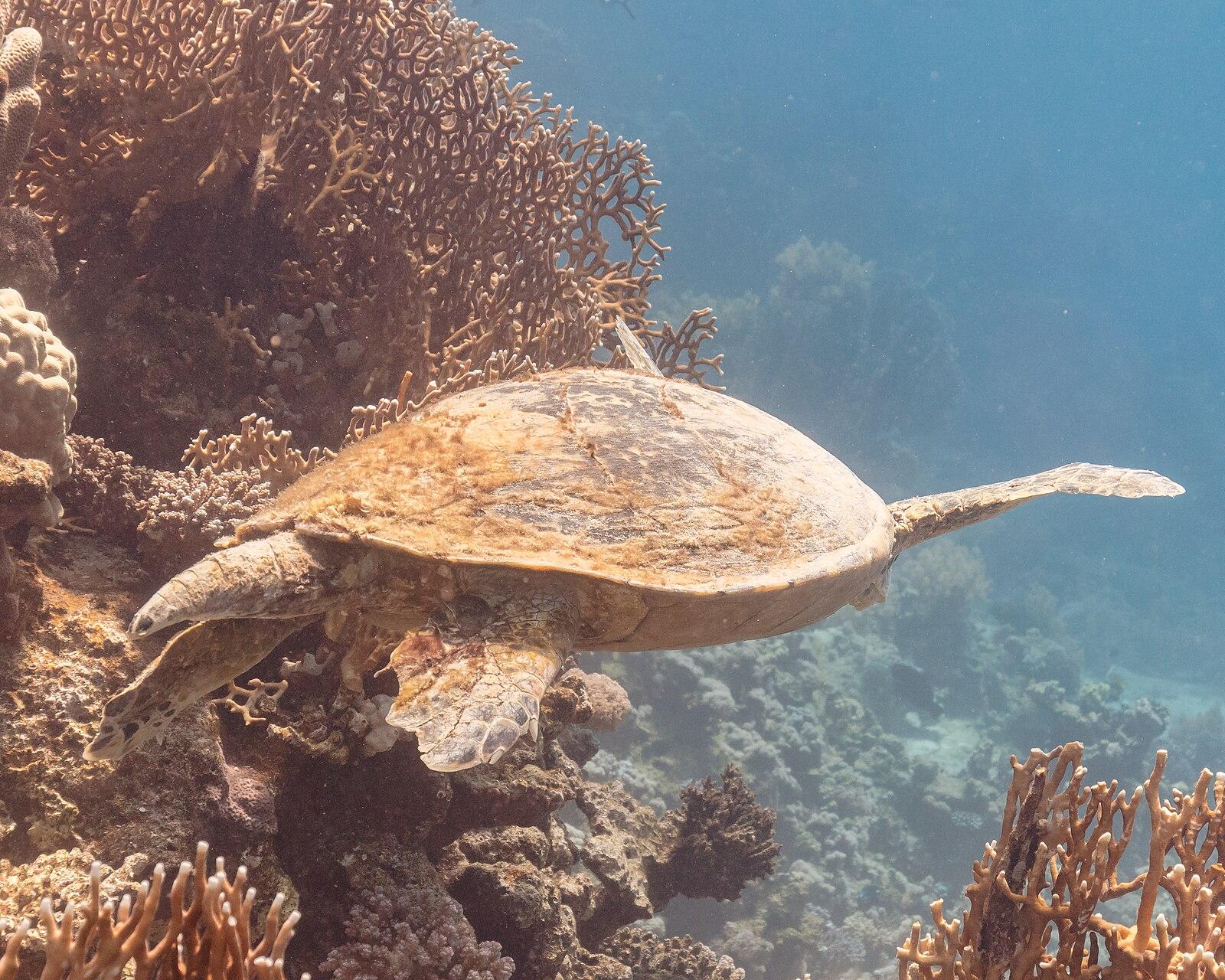
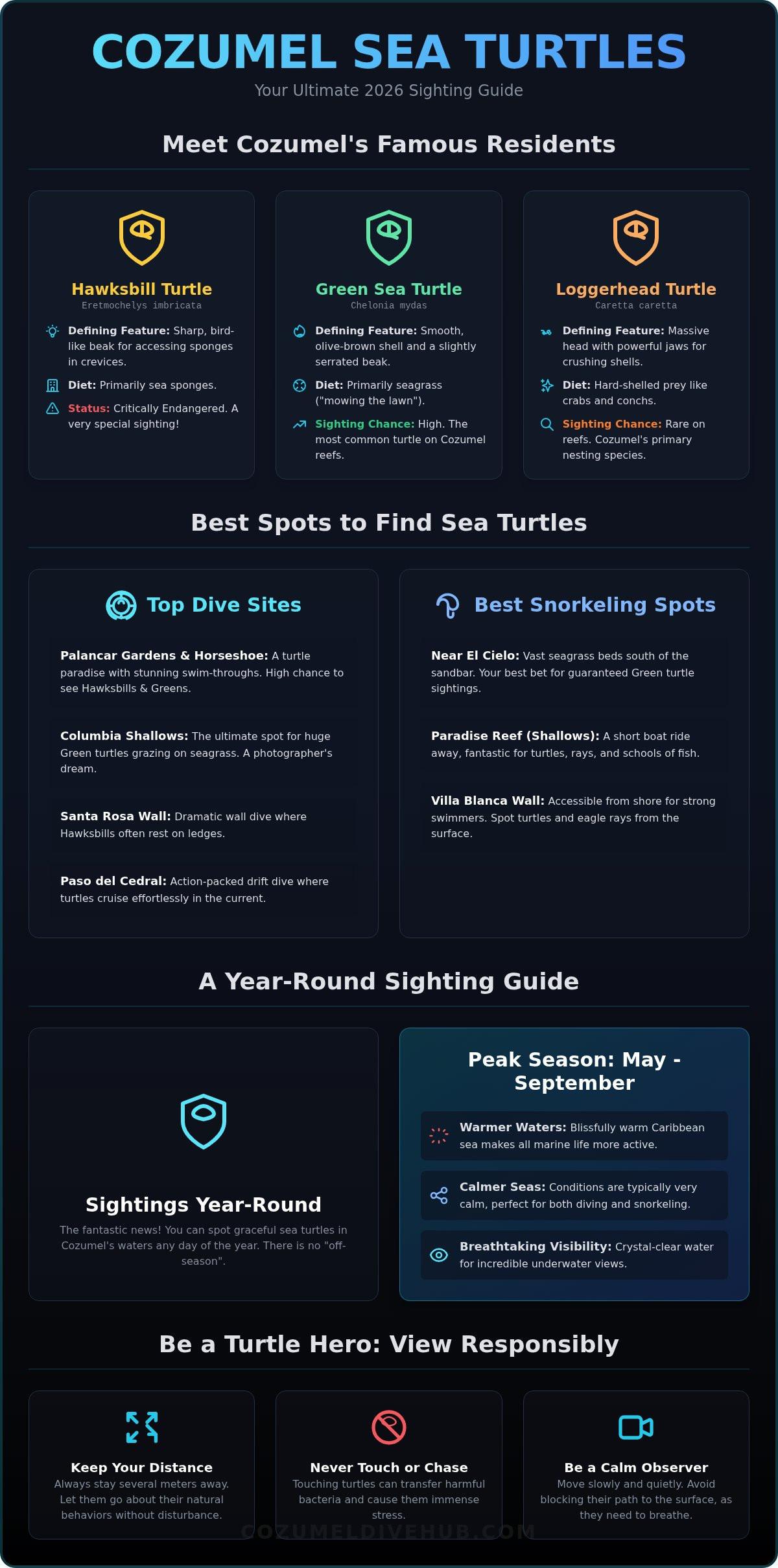
Two species do nearly all the work. On Cozumel's west-side reefs you will see hawksbill turtles picking at sponges on the coral, and green turtles grazing seagrass and sand flats in the shallows. Both are there every month of the year — there is no turtle season on the reef. Loggerheads are the third species in Cozumel's waters, but they belong to the wild eastern beaches, where they are the dominant nester and where divers essentially never go.
The phrase "swimming with Cozumel sea turtles" is a marketing invention and it sets you up to be disappointed. You do not swim with a turtle. You hang back and watch one that has decided you are not worth reacting to. The single biggest factor in how many turtles you see, and how long you get to watch each one, is whether you approach them. Follow a turtle and it leaves. Stay put and it feeds in front of you for ten minutes.
The Three Species, Compared
| Hawksbill | Green | Loggerhead | |
|---|---|---|---|
| Scientific name | Eretmochelys imbricata | Chelonia mydas | Caretta caretta |
| Where you meet it | On the reef itself, wedged into ledges and sponge gardens | Seagrass and sand in the shallows; also cruising reef tops | Nesting on eastern beaches at night; rare on the dive sites |
| Adult size | 2–3.5 ft, 100–150 lb | 3–4 ft, 250–400 lb | 2.5–3.5 ft, 200–350 lb |
| Diet | Mainly sponges — the only sea turtle that can live on them | Seagrass and algae as an adult | Hard-shelled prey: conch, whelks, crabs |
| Tell it apart by | Narrow pointed beak, overlapping shell plates, serrated rear edge | Small rounded head, single pair of scales between the eyes | Disproportionately large blocky head |
| IUCN Red List | Critically Endangered | Endangered | Vulnerable |
| US ESA status | Endangered throughout its range | Threatened (North Atlantic population) | Threatened (Northwest Atlantic population) |
Sizes and diets are from NOAA Fisheries species profiles. The practical identification shortcut underwater: if the head comes to a point and the animal is nose-down in a sponge, it is a hawksbill. If it looks like it is mowing a lawn, it is a green.
Where Divers See Turtles
Turtles turn up on essentially every reef on the leeward side, so the useful question is not "which site has turtles" but "which site puts you at the depth they use." Hawksbills spend a lot of time tucked under ledges on the reef structure; greens spend more time in the shallows and over sand.
- Palancar Gardens — 30 to 80 ft, beginner-friendly, mild to moderate current. Big coral heads with sand channels between them. The most consistently productive turtle dive on the island because the profile covers both reef and open sand.
- Santa Rosa Wall — 50 to 120 ft, advanced, moderate to strong current. Hawksbills park themselves in the overhangs and tunnels. Watch the ledges rather than the blue water.
- Paso del Cedral — 45 to 100 ft, intermediate. A drift along a low reef finger with heavy fish traffic; turtles are routine here.
- Yucab — 50 to 60 ft, beginner, moderate to strong current. Small site, undercut ledges, hawksbills resting out of the flow.
- Tormentos — 50 to 60 ft, intermediate. Coral heads on sand, good for spotting a grazing green from a distance before you get close.
- Colombia Shallows — 30 to 50 ft, beginner, moderate to strong current. Sunlit coral pinnacles and sand. Long bottom times at shallow depth mean more chances per tank.
Depths, skill grades and current ratings above come from this site's own dive site records. If you are picking sites purely on marine life, the marine life site guide sorts them by what each one actually holds.
Where Snorkellers See Turtles
You do not need a tank. Greens feed in water shallow enough that a snorkeller is often better placed than a diver — you can hover over a grazing turtle without the noise and bubbles.
- Chankanaab — 35 to 40 ft at the reef, but the seagrass inshore is far shallower. Easy entry, turtles most mornings.
- Paradise Reef — 30 to 40 ft, mild to moderate current, reachable from shore in the right conditions. Turtles work the sand and grass edges.
- Money Bar — 10 to 20 ft. Shallow enough that you can free-dive down and still be well clear of the animal.
- Playa Corona — 20 to 40 ft, mild to moderate. A straightforward shore entry with reef close in.
- El Cielo — 5 to 15 ft over sand and seagrass. Famous for starfish; the grass beds nearby are green turtle feeding ground.
A note on El Cielo: it is a boat destination and it gets crowded, which is exactly the condition under which turtles stop feeding and leave. Go early. The El Cielo guide covers the logistics, and the snorkelling spot roundup has the shore-access options.
Still deciding between mask and tank? The snorkelling versus diving comparison lays out the trade-offs. For turtles specifically, snorkelling wins on greens and diving wins on hawksbills.
Month By Month: Sightings and Nesting
| Period | Reef and shallows | Nesting and hatching |
|---|---|---|
| January – March | Hawksbills and greens present daily. Cooler water, occasional norte winds close the boats for a day or two | None |
| April | Same. Settling weather | First loggerhead nests can appear late in the month — the 2026 season's first were marked on 27 April |
| May – June | Best all-round conditions starting. Long visibility | Official protection season opens 15 May. Nesting builds |
| July – August | Warmest water, calmest seas, peak sightings simply because you get more dives in | Peak nesting; first hatchlings emerge |
| September – October | Excellent underwater, hurricane season is the real variable | Peak hatching and release activity |
| November | Sightings unchanged | Protection season closes 15 November |
| December | Sightings unchanged. Norte season begins | None |
The nesting figures make the split clear. In the 2025 season the island's turtle camp logged 216 nests: 158 loggerhead and 58 green. Hawksbills, the turtle you are most likely to photograph on a reef dive, are not a significant nester here at all. You meet them as foragers, not as mothers.
There is genuinely no bad month for Cozumel sea turtles. Choose your dates for weather, crowds and price instead — the trip planning guide covers that properly.
What The Law Actually Says
Every sea turtle in Mexican waters is a protected species, and this is not a soft guideline.
Under Article 420 of the Federal Penal Code, capturing, harming or killing a sea turtle carries one to nine years in prison and a fine equivalent to 300 to 3,000 days' minimum wage. If the offence happens inside a protected natural area or for commercial gain, the sentence increases by up to three additional years and up to 1,000 additional fine days.
Cozumel's reefs sit inside the Parque Nacional Arrecifes de Cozumel, a federal marine park administered by CONANP. That means the aggravating clause applies by default: an offence here is an offence inside a protected natural area. The park's management programme prohibits touching, handling, chasing and feeding marine fauna. PROFEPA is the enforcement agency, and your marine park fee is what pays for the regime.
In plain terms, and with no ambiguity:
- Do not touch a turtle. Not the shell, not a "gentle" hand on the way past.
- Do not ride one. People still try. It is a criminal offence, not a photo opportunity.
- Do not chase or herd one. Pursuit is harassment.
- Do not block its path to the surface. These are air-breathing reptiles. Cutting off a turtle's ascent is the most common thing tourists do wrong and it is genuinely dangerous for the animal.
- Do not touch, move or dig at a marked nest on the eastern beaches.
Any operator or guide who encourages otherwise is exposing you to a federal offence. If you are choosing between shops, that is a fair thing to ask about — the dive center directory lists what each one runs.
How To See More By Doing Less
The ethical rule and the practical rule are the same rule. Here is why.
A turtle that has not registered you as a threat keeps doing what it was doing: chewing sponge, cropping grass, dozing under a ledge. That behaviour is the thing worth watching, and it can last as long as your gas does. The moment you close distance, the turtle stops, lifts its head, and swims. You get thirty seconds of a turtle's back leaving, and so does everyone behind you.
What works:
- Stop moving. Fin once to hold position, then stop. Turtles habituate to a stationary object far faster than a moving one.
- Stay level or above, never in front. Approaching head-on reads as a predator. Sitting above and behind reads as debris.
- Hold about three metres. Closer than that and most turtles disengage.
- Fix your buoyancy first. Divers who are sculling and finning to hold depth are broadcasting movement constantly. A diver who is properly weighted and still is nearly invisible to a feeding turtle.
- No flash. It startles the animal and, on nesting beaches at night, disorients hatchlings that navigate by light.
- Let it surface. If a turtle starts to rise, drop and give it the whole water column.
- Wear reef-safe sunscreen and keep gauges and cameras clipped, so you are not wrecking the habitat you came to look at.
Photographers get this backwards most often. The best turtle images from Cozumel are made by people who chose a spot, settled, and waited for the turtle to come to them.
Nesting Season and the San Martín Turtle Camp
The nesting side of the story happens on the other island — the undeveloped, windward eastern coast, where there are no hotels and no boat diving.
Cozumel's protection programme runs from 15 May to 15 November. The work is done by the Campamento Tortuguero San Martín, operated by the municipal Subdirección de Ecología, which has patrolled the eastern beaches continuously since 1987 and covers more than 20 km of coast. CONANP runs a second camp at Ixpalbarco, and the Fundación de Parques y Museos de Cozumel runs one at Punta Sur. Patrols locate nests overnight, mark and record them, relocate those at risk, and monitor them through incubation.
The public rules on those beaches are simple: do not touch nest markers, keep dogs leashed, take your rubbish, and report any turtle or nest you find to the authorities rather than handling it yourself. No torches or phone lights on the beach after dark during the season — artificial light turns nesting females around and sends hatchlings inland.
Hatchling releases happen mainly in September and October. They are conservation fieldwork with limited numbers, not a scheduled attraction, so they are arranged locally and depend on what actually hatched that day. The nesting season guide goes into more depth, and the turtle sanctuary explainer untangles what the various "sanctuary" tours are actually selling.
If you do find yourself on the east side, Chen Rio is one of the few sheltered spots there — 10 to 25 ft, and only enterable in calm conditions.
There Is No Turtle Tour Worth Paying Extra For
This part is worth saying flatly. Cozumel has no turtle encounter facility, no feeding station, no habituated animals, and nothing you can book that meaningfully raises your odds beyond a normal dive or snorkel trip in the right place.
What is sold as a "turtle tour" is a boat trip to the same shallow seagrass and reef that every other boat visits. What is sold as a "guaranteed turtle experience" is a standard two-tank dive with a different name on the invoice. The people who see the most turtles on Cozumel are not the ones who paid a premium; they are the ones diving in a small group, on a shallow site, in the morning, who know how to stay still.
Book an ordinary dive or snorkel trip from the dive center directory, pick a shallow reef, ask for a small group, and the turtles take care of themselves. If you want the mechanics of diving here — currents, boats, drift technique — that is a separate and more useful thing to research.
Where To Start
If you have one thing to take from this: pick the site by depth, go early, and stop swimming when you find one. Everything else is noise.
Set your dates around weather rather than turtles, since the turtles are there regardless. Then work out logistics — sites, operators, marine park fees, how many days of diving you actually want — in the Cozumel dive trip planner.
Frequently Asked Questions
Which sea turtle species live around Cozumel?
When is the best time of year to see sea turtles in Cozumel?
Can you touch a sea turtle in Cozumel?
Is diving or snorkelling better for seeing turtles?
Is there a sea turtle tour in Cozumel worth booking?
When is sea turtle nesting season in Cozumel?
Are Cozumel's sea turtles endangered?
What should you do if a sea turtle swims towards you?
Why do sea turtles swim away from divers and snorkellers?
Share This Article

Carmen Novelo
Carmen Novelo is a Cozumel native and an active scuba instructor and dive guide on the island. She has spent twelve years diving the Cozumel reef system, and writes about its dive sites, conditions and marine life for Cozumel Dive Hub.