Snorkeling vs. Diving Cozumel: Which Underwater Adventure is Right for You? (2026 Guide)
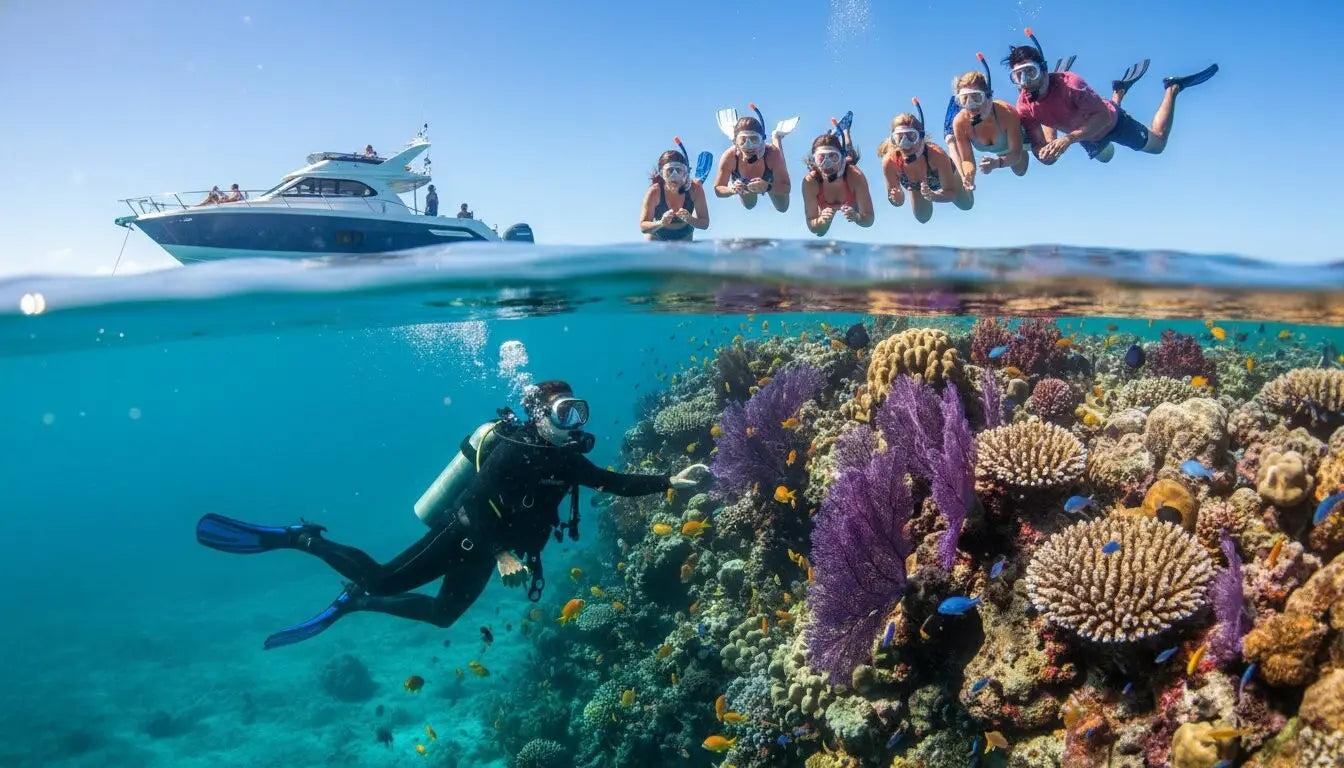
Snorkeling in Cozumel is genuinely excellent, but it shows you a different reef. The buttresses and swim-throughs of Palancar and Santa Rosa start at 30 to 50 feet, out of reach from the surface, so snorkellers get the shallow end of the same system.
Carmen Novelo · March 29, 2026 · 15 min read
Snorkeling in Cozumel is genuinely excellent, but it shows you a different reef than diving does. The coral structure Cozumel is famous for — the buttresses, sand chutes and swim-throughs of Palancar, Santa Rosa and Punta Sur — starts at 30 to 50 feet and falls well past 100, which puts it out of reach from the surface. What snorkelers get instead is the shallow end of the same reef system, and it is not a consolation prize: El Cielo's starfish sandbar sits in 5 to 15 feet of water, several reef tops break 10 to 20 feet, and the visibility is good enough that a 30-foot bottom reads clearly from above. Choose snorkeling if you want a half-morning in warm, bright water with no training and no paperwork. Choose diving if the wall structure and the deeper reef life are the reason you came.
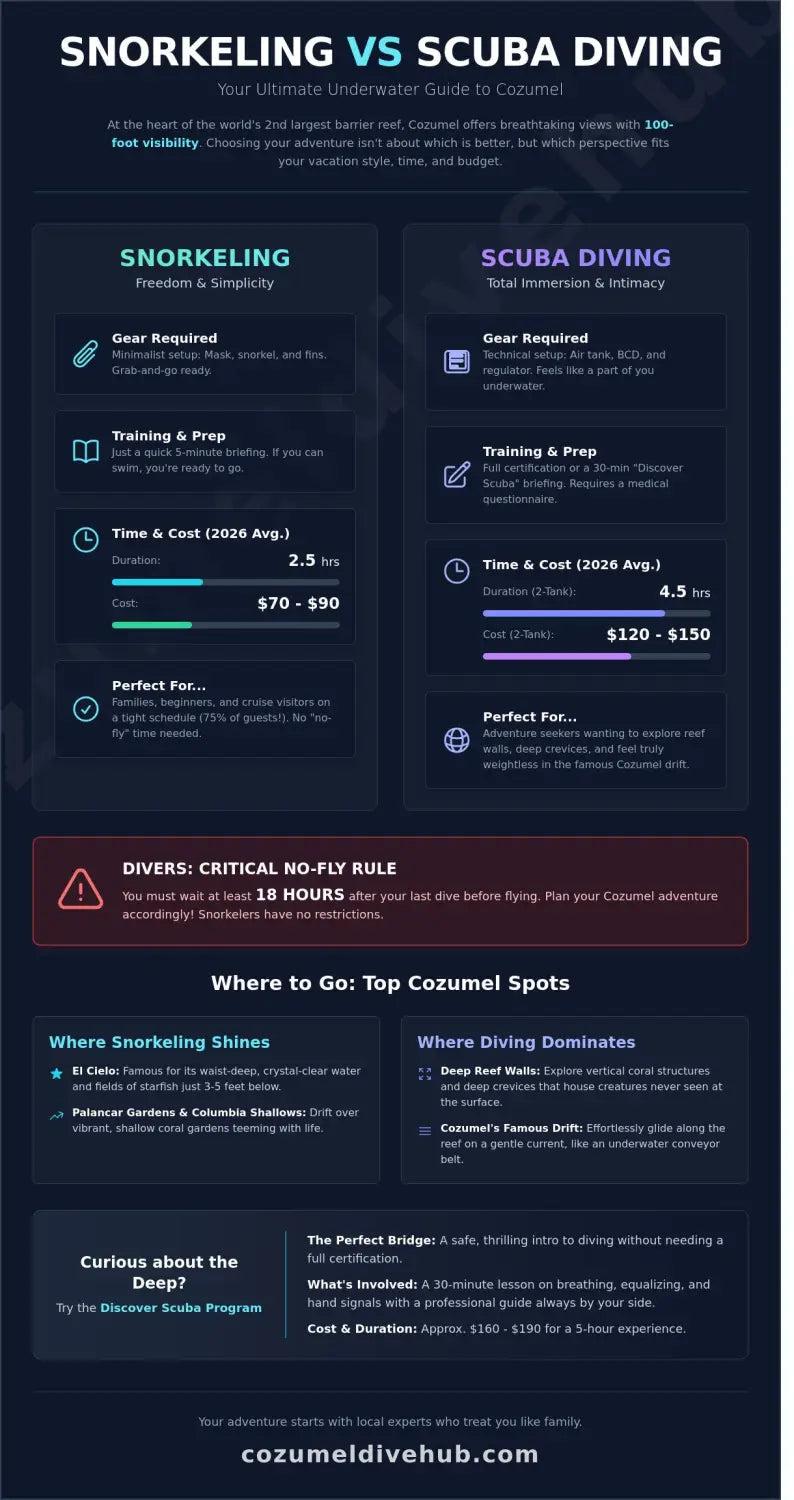
| Snorkeling | Scuba Diving | |
|---|---|---|
| Training needed | None. Comfort in water is enough | Certification, or a supervised intro dive |
| Depth you experience | Surface, with breath-hold dips of a few feet | 30–110 ft depending on the site and your level |
| Reef you actually see | Shallow reef tops, sandbars, seagrass, El Cielo | Coral buttresses, walls, drop-offs, swim-throughs |
| Typical trip length | 2.5–4 hours | 5–7 hours for a two-tank morning |
| Typical 2026 cost | $65–$79 USD (verified operator rates, checked August 2026) | $118–$149 USD for two tanks |
| Medical screening | None | Yes, a dive medical questionnaire |
| Flying afterwards | No restriction | Wait before flying; the interval depends on your dives |
| Suits you if | Short on time, travelling with non-swimmers or kids, unsure about gear | You want depth, structure, bottom time and deeper marine life |
What You Actually See From The Surface Versus At Depth
Cozumel's reef sits along the leeward west coast in a long chain of separate sites, and the single most useful number for this decision is the depth at which each reef top begins. On the southern sites that fill the postcards, that number is 30 feet at the shallowest and 50 to 90 feet at most of them. From the surface you would be looking down at the crown of a structure whose scale is entirely vertical — a 60-foot coral buttress read from above is a brown-green shape, not a canyon. That is the honest limit of snorkeling on the famous reefs.
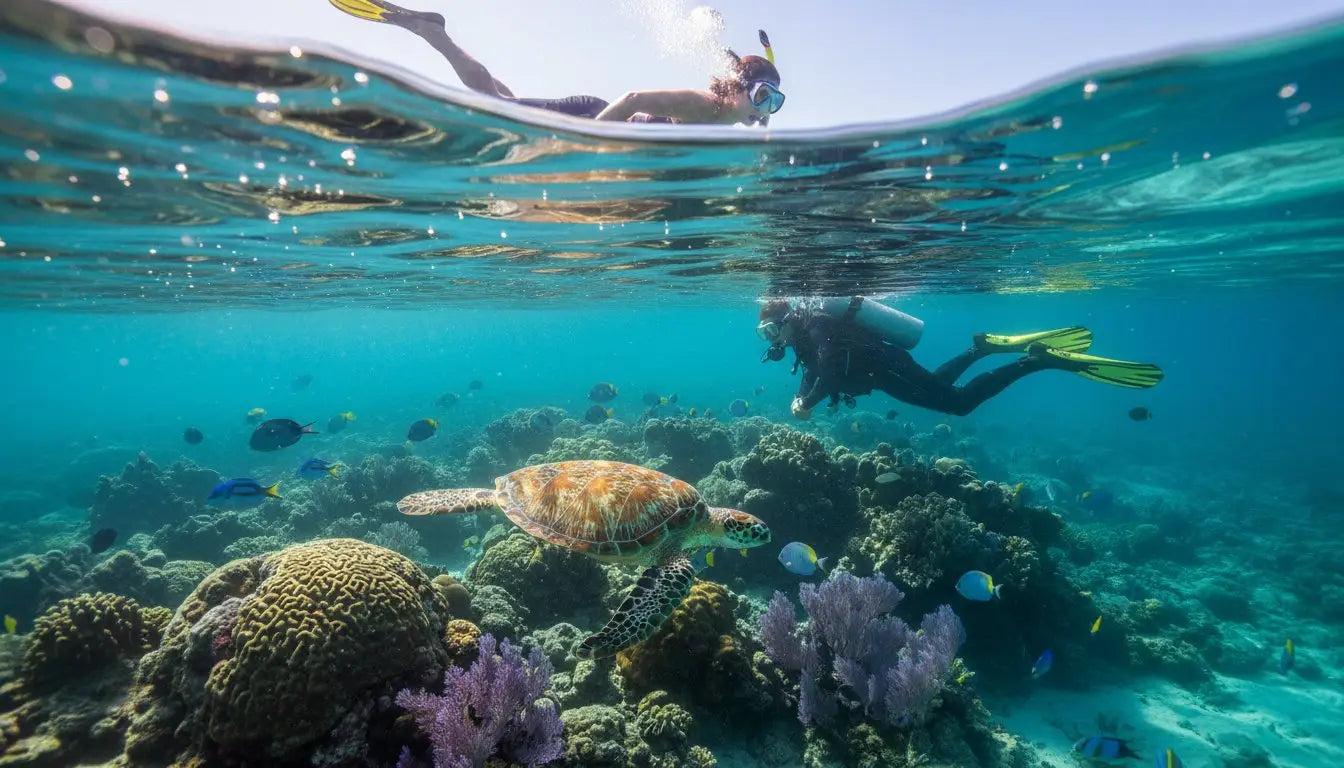
What snorkeling does deliver is the top of the reef in full colour with no equipment between you and the light. In 10 to 20 feet of water, red and orange still survive; at 80 feet they are gone unless someone brings a torch. Snorkelers see parrotfish grazing, sergeant majors, schooling grunts, sea fans moving in the surge, rays crossing sand, and — over the turtle grass beds on the shallow shelf — green turtles feeding, which is one of Cozumel's most reliable wildlife sightings and requires no tank at all.
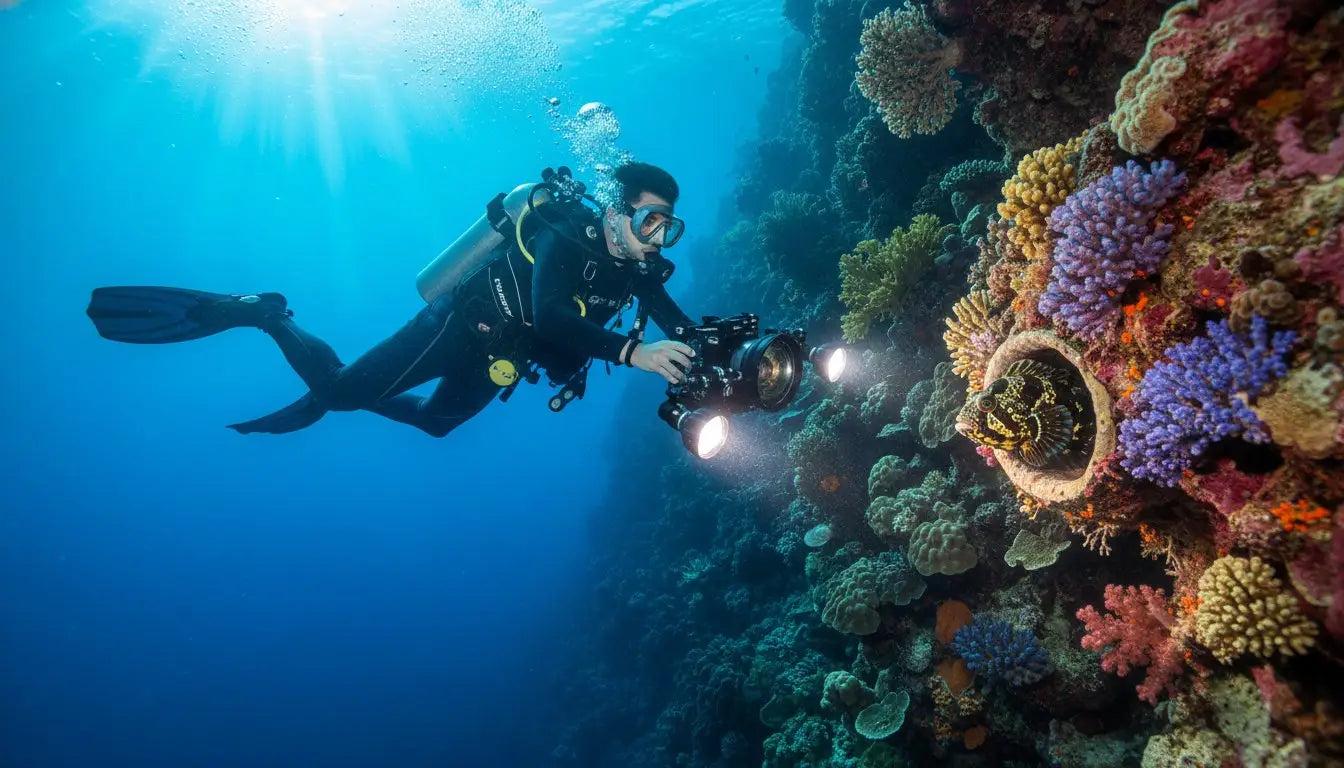
Divers get three things snorkelers cannot have. The first is time: 40 to 60 minutes suspended at one level rather than a series of breath-holds. The second is the structure itself — the drop-off edge, the swim-through, the sand chutes between coral heads. The third is the species that live below 40 feet, including the endemic splendid toadfish, which hides in ledges and crevices and is essentially never seen from the surface.
Neither activity is the "real" Cozumel. They are two depths of the same reef, and plenty of people who have done both still book snorkeling because it is easier, cheaper and more sociable.
Which Cozumel Sites Genuinely Work For Snorkeling?
Not every site described as shallow is snorkelable, and the difference matters. The two variables are how far down the reef top starts and how hard the water is moving. A reef in 30 feet with a moderate-to-strong current is a fine beginner dive and a poor snorkel. The sites below are drawn from the site data on this guide, with depths as recorded rather than as marketed.
| Site | Depth range | Current | Snorkeling verdict |
|---|---|---|---|
| El Cielo | 5–15 ft | Mild to moderate | The best snorkeling on the island. Sandbar, starfish, waist-to-chest depth |
| Money Bar Reef | 10–20 ft | Mild to moderate | Excellent. Shore access on the west coast, reef within swimming distance |
| Coral Princess Reef | 10–20 ft | Mild to moderate | Excellent shallow reef top, easy to read from the surface |
| Tikkila Shallow Reef | 15–30 ft | Mild to moderate | Very good. Shallow enough that structure is visible throughout |
| Playa Corona | 20–40 ft | Mild to moderate | Good from shore; the shallow shelf is the snorkeling part |
| El Presidente | 20–70 ft | Mild to moderate | Good at the shallow end only; the reef falls away quickly |
| Chankanaab Reef | 35–40 ft | Mild to moderate | Marginal. Visible but distant; the seagrass and turtles are the draw |
| Paradise Reef | 30–40 ft | Mild to moderate | Marginal from the surface, superb as a first dive |
| Molas Shallow Reef | 20–40 ft | Moderate to strong | Shallow but the current is the problem, not the depth |
| Colombia Shallows | 30–50 ft | Moderate to strong | Frequently mislabelled as a snorkel site. It is a dive site |
| Palancar Gardens | 30–80 ft | Mild to moderate | Not a snorkel site. The structure is below you and stays there |
Two corrections worth making, because both appear constantly in Cozumel trip planning. Colombia Shallows is "shallow" only relative to Colombia Deep next door; it begins at 30 feet and runs to 50 with a moderate-to-strong current, and it is not a snorkeling destination. And Palancar Gardens, for all that the name suggests a shallow flower bed, starts at 30 feet and reaches 80 — beautiful, beginner-friendly diving, invisible from a mask at the surface.
The east coast sites — El Islote, Chen Rio, El Mirador, Punta Morena — sit in 10 to 25 feet and look perfect on paper. They face the open Caribbean, which means they are snorkelable on calm days and dangerous on most others. Treat them as a conditional option, checked on the day, not a plan.
How Much Do Snorkeling And Diving Cost In Cozumel In 2026?
Published operator rates give a clean comparison. The figures below are taken from two Cozumel operators' own 2026 price lists, checked in August 2026. They are illustrative of the market, not a guarantee — always confirm current pricing directly.
| What you book | Published 2026 rate | Time it takes |
|---|---|---|
| Guided snorkel tour, boat | $79 USD per snorkeler (Scuba XOC) | Roughly 3 hours |
| Snorkeler riding a dive boat | $65 USD, gear not included (Dive Paradise, standard 8:30 trip) | Full dive-boat morning, 5+ hours |
| Two-tank certified dive | $118 USD standard, $149 USD signature (Dive Paradise) | 5–7 hours |
| Two-tank certified dive | $129 USD per diver (Scuba XOC) | 5–7 hours |
| Discover Scuba from shore | $129 USD per diver (Scuba XOC) | Half day |
| Discover Scuba from a boat | $189 USD per diver (Scuba XOC) | Most of a day |
| Marine park fee | 225 MXN cash per person per day (2026 CONANP rate) | — |
The money gap is real but it is not the whole story. The time gap is larger and less negotiable. A snorkel tour is a half-morning: you are back on land by lunch with the afternoon intact. A two-tank dive is the day. Boat out, first dive, an hour of surface interval, second dive, boat back, gear rinsed — five to seven hours before you are free, and then a slow afternoon because you are tired in the way diving makes you tired.
Add the constraints. Divers complete a medical questionnaire; conditions such as asthma or recent surgery may require a doctor's sign-off. Divers cannot fly immediately after a dive, which quietly removes the last day of most trips. Snorkelers have neither restriction, which is exactly why snorkeling is the right choice for a departure morning. A fuller breakdown of what diving costs across operators is in the Cozumel diving cost guide, and the park fee itself is covered in the Cozumel marine park fees guide.
Why Cozumel Snorkeling Is Usually Drift Snorkeling
This is the detail that surprises people most, and it belongs near the top of any honest comparison. The Yucatán Current runs north through the channel between Cozumel and the mainland, and it moves water along the whole west coast. Cozumel's reputation for drift diving comes from it. What is less advertised is that boat-based snorkeling on the same coast is usually drift snorkeling for exactly the same reason.
In practice this means you go in over the reef, the water carries you along it, and the boat follows and collects you further down — a live boat pickup, the same procedure divers use. You do not swim back to where you started. You cannot easily stop to look at something twice. For most people this is pleasant, effortless and the reason they see so much reef in one session. For a nervous swimmer, a parent watching a child, or anyone expecting to float in one place, it is a genuine surprise, and it is worth asking the operator directly whether their snorkel site is drifted or anchored.
Two practical consequences. First, flotation matters more here than in still water; most boats hand out vests and you should take one even if you swim well. Second, site choice changes with conditions — the same current that makes a site lovely at mild strength makes it unmanageable when it picks up. If drift is the part that worries you, El Cielo and the sheltered shore-access sites are the calmer options, and the Cozumel current guide explains how the drift behaves through the year.
Can Snorkelers And Divers Go On The Same Boat?
Yes, and for a mixed group this is usually the practical answer. Many Cozumel operators sell a snorkeler seat on a standard dive boat at a reduced rate — Dive Paradise publishes $65 USD for a snorkeler riding the standard 8:30 AM two-tank trip, against $118 USD for a diver on the same boat, with snorkel gear not included in the snorkeler price (rates checked August 2026). The snorkeler gets the boat, the crew, the sites and the day; the divers get their dives; nobody splits up.
The trade-off is honest and worth stating. The boat's schedule is built around the divers. Sites are chosen for diving, which on the southern reefs means the snorkeler is floating over structure that is 40 to 80 feet below them and mostly out of visual range. Surface intervals are long. Sun exposure is high. A snorkeler on a dive boat is buying company and convenience, not the best snorkeling available on the island — the best snorkeling is at El Cielo and the shallow reef tops, and a dedicated snorkel tour goes there instead.
So the sensible version for a mixed party is often two trips rather than one: everyone on the dive boat one morning, everyone on a shallow snorkel trip another. If you only have one day, there are two ways to keep everyone on one hull.
A snorkeler seat on a standard dive boat, as above: cheapest, easiest to find, and entirely built around the divers.
A combo trip, which some operators sell as a product in its own right rather than as an add-on. One boat carries both groups, a guide goes down with the divers while a second stays on the surface with the snorkelers, the sites are picked so the reef top is shallow enough to be worth looking at, and the whole thing typically runs four to five hours across two stops. Private charter versions of the same thing let a family or a group set the sites and the timing outright. Expect it to cost more per head than adding a snorkeler to a dive boat, and less than booking two separate trips.
It suits three situations in particular: families with children too young to certify, couples where one dives and one does not, and groups off a ship with one fixed window and no time for two excursions.
The limits are the same limits under a friendlier name, and any operator worth booking will say so:
- The snorkeler waits. Two dives plus two surface intervals is most of the day, and the surface group is in the water for a fraction of it unless a guide is dedicated to keeping them in.
- The site list still leans toward divers unless you specifically ask otherwise. Shallow reef tops, Colombia Shallows and El Cielo are the ones that work from the surface; the southern walls are not.
- It is a long day on a boat in the sun for someone doing 40 minutes of snorkeling, so bring shade, water and a rash guard.
Worth asking before you pay: is there a second guide in the water with the snorkelers or does the surface group wait alone, which sites and how deep is the reef top at each, is snorkel gear included in the snorkeler price, how long is each in-water session for the surface group, and does the marine park fee appear on both tickets.
Should You Do A Discover Scuba Dive Instead?
Not automatically. Discover Scuba Diving is a supervised introductory experience for people who are not certified, run under direct instructor supervision at shallow, sheltered sites. It is a real option and Cozumel's warm, clear water makes it about as forgiving as an introduction gets. It is also frequently pushed as the obvious upgrade to snorkeling, and it is not obvious at all.
Reasons it might genuinely suit you: you have wanted to dive for years, you have a full day free, you are comfortable being told what to do underwater, and you would rather find out now than book a course blind. In that case the Discover Scuba experience in Cozumel is a sound way to test it, and the Discover Scuba guide covers what the day involves.
Reasons it might not: it costs roughly twice a snorkel tour and takes three times as long. Depth is capped and the site is chosen for supervision, not scenery — you will not be diving Palancar's walls. Some people find breathing off a regulator claustrophobic and no amount of enthusiasm changes that. And if the point of the day was for a family to be in the water together, splitting one person off into an instructor-led group defeats it.
If you already know you want to dive properly, skipping the intro and going straight to certification is often better value — that comparison is laid out in the Discover Scuba versus Open Water guide, and the PADI Open Water course is the standard route. And if you are anxious about the water rather than about diving specifically, the Discover Scuba for non-swimmers guide addresses that directly.
Preferring snorkeling is not a failure of nerve. Some people simply like the surface, the light, the ability to lift their head and talk, and the absence of equipment. That is a legitimate preference and Cozumel rewards it.
Choosing By Situation: A Straight Answer
You have one cruise day in port. Snorkel. A dedicated snorkel trip fits comfortably inside a port window with margin for delays; a two-tank dive fits too but leaves far less room for error. If you are set on diving, the Cozumel cruise port diving guide covers the timing.
You are travelling with young children or non-swimmers. Snorkel, at El Cielo or a shore-access shallow site. Minimum ages apply to diving, and the practical family logistics are covered in the family diving guide.
You are certified and have a week. Dive, and use the shallow snorkel sites on your no-fly day at the end.
You are certified but rusty. Dive, but book a refresher and ask for a mild-current beginner site first. The beginner diving guide sets realistic expectations.
Your group is split down the middle. Book the snorkeler seat on the dive boat for one day and a shallow snorkel trip for another, rather than forcing one compromise trip.
It is your last day and you fly tomorrow. Snorkel. This is not a preference, it is a safety rule — see the flying after diving guidelines.
You want the reef Cozumel is famous for and nothing less. Dive. There is no surface substitute for a wall.
Planning The Water Time Around Everything Else
Whichever you choose, three island-specific variables shape the day. Conditions vary by month: winter Norte winds can close the port and cancel boats outright, which affects snorkelers and divers equally, and the month-by-month picture is in the dive conditions guide. Sargassum affects the surface and the shoreline far more than the reef at depth, which in a bad season tips the balance toward diving. And the marine park fee applies to water activities inside the park regardless of whether you are wearing a tank.
Bring reef-safe sunscreen or, better, a rash guard — snorkelers spend hours face-down in direct sun and burn far worse than divers do. If you want to go deeper on the surface option specifically, the complete Cozumel snorkeling guide covers technique and logistics, best places to snorkel in Cozumel ranks the locations, what to book on a snorkeling tour covers operators and formats, and the El Cielo starfish sandbar guide covers the single best shallow site on the island.
There is no wrong answer here, only a mismatch between what you booked and what you wanted. Work out how much of your day you are willing to give the ocean, how deep the thing you want to see actually sits, and book accordingly. Start planning your Cozumel trip with the depths and the timings in front of you rather than the brochure photographs.
Frequently Asked Questions
Is snorkeling or diving better in Cozumel?
Can you see Palancar Reef while snorkeling?
Which Cozumel sites are genuinely good for snorkeling?
Is snorkeling in Cozumel drift snorkeling?
Can snorkelers ride along on a Cozumel dive boat?
How much does snorkeling cost in Cozumel compared to diving?
Do you need to be a strong swimmer to snorkel in Cozumel?
Should a beginner do a Discover Scuba dive instead of snorkeling?
Can you snorkel in Cozumel on the day you fly home?
Do snorkelers have to pay the Cozumel marine park fee?
Share This Article
Carmen Novelo
Carmen Novelo is a Cozumel native and an active scuba instructor and dive guide on the island. She has spent twelve years diving the Cozumel reef system, and writes about its dive sites, conditions and marine life for Cozumel Dive Hub.