Scuba Diving in Cozumel with Kids: The Ultimate Family Adventure Guide
Scuba diving in Cozumel with kids works if you plan around three things: an operator that has genuinely taught children, a sheltered mid-island reef rather than a famous southern wall, and a schedule that assumes the youngest finishes first.
Carmen Novelo · April 26, 2026 · 17 min read
Cozumel works well for a family dive trip if you plan it around three things: an operator that has genuinely taught children before, a sheltered mid-island reef rather than a famous southern wall, and a daily schedule that assumes the youngest diver will be finished before everyone else is. The age and depth rules are fixed island-wide and settled by the training agencies — they are set out in full in the minimum age guide for Cozumel. What actually decides whether the week goes well is everything that sits around those numbers: who you book with, where they take the child, where you sleep, and what the non-diving half of the family does while the diving half is on a boat.
This guide covers the running of the trip. It assumes you already know which programme your child is eligible for and are now trying to work out how to make a week on the island function for everybody in it.
How Do You Vet A Cozumel Dive Operator For A Child?
Every dive center on Cozumel works to the same minimum ages, so asking about them tells you nothing. Four questions separate the shops that are set up for children from the shops that will take the booking anyway.
What ratio do you run when a minor is in the group? The answer you want is a specific number, and ideally a dedicated professional for that child rather than a place in a group of six. A shop that says "it depends on the day" is describing its scheduling, not its policy.
Which instructor would be with my child, and how many children have they taught? Teaching a ten-year-old is a different skill from teaching an adult. Nervousness in a child arrives faster, shows differently, and is resolved by patience rather than explanation. An instructor who has done it dozens of times is worth more than a higher certification level.
Will you do a pool or shallow confined water session before the ocean? Not every Cozumel shop has a pool. Those that do, or that have a calm shallow shore entry they use for the same purpose, can find a mask-fit problem or an equalisation problem somewhere it costs nothing. Those that do not will find it on the boat.
What happens if my child wants to stop after eight minutes? The correct answer is that the dive ends, without discussion and without an attempt to persuade. If the reply hedges — reassurance about how quickly children settle, a suggestion that they usually carry on — that is your answer about how the shop will behave at the moment it matters.
A fifth question is worth asking because the reply is so revealing: which specific site would you take my child to, and why that one? A named reef with a reason attached means somebody has thought about it. "Wherever conditions are best" means they will decide on the morning, along with everything else. The broader guide to choosing a Cozumel dive shop covers what else distinguishes operators here, and much of it applies doubly with a child aboard.
Boat size matters more than most families expect. A six-pack boat means the group can wait while a child sorts out a mask; a cattle boat means the group moves at group pace and the dive ends when the first person hits their reserve. If the budget stretches to a private guide, that is where the money is best spent on a family trip — more than on gear, more than on the hotel. The Cozumel diving cost breakdown shows what the difference typically amounts to, and the guide to avoiding crowded dive boats explains how to tell the two formats apart before you pay.
Two administrative points to settle in the same conversation: the cancellation policy, because children get colds and ear congestion at inconvenient moments, and whether marine park fees are included in the quoted price.
Which Cozumel Dive Sites Actually Suit A Child?
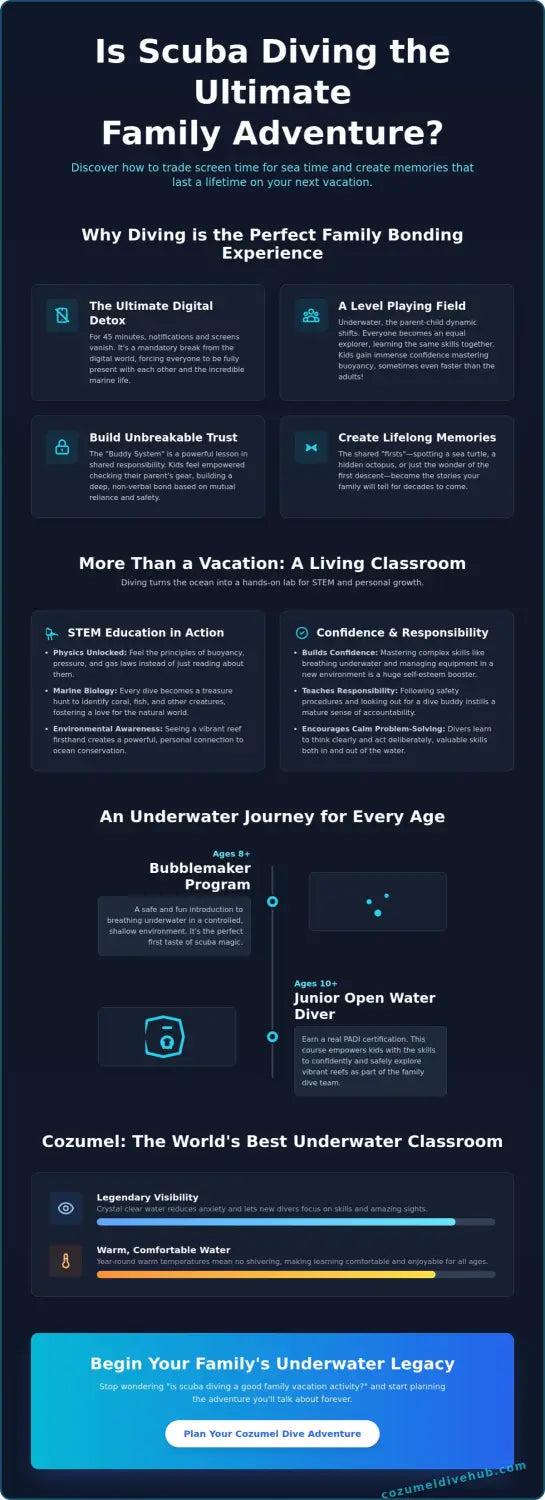
The word "beginner" on a Cozumel site listing describes the terrain, not the water. Several reefs classified as beginner-level carry moderate to strong current, because the reef itself is simple and shallow while the Yucatán Current still runs across it. A shallow, easy site can move a forty-kilogram diver considerably faster than they would like.
The sites below are drawn from the published depth and current data for each reef. The ones marked as suitable are the sheltered mid-island and near-town reefs; the ones marked otherwise are frequently described as beginner sites and are the ones to decline politely.
| Dive Site | Depth Range | Current | Suits A Child? |
|---|---|---|---|
| San Clemente | 30–40 ft | Mild | Yes — the calmest reef on the island's list |
| Money Bar Reef | 10–20 ft | Mild to moderate | Yes — shallow, shore-accessible, generous margin |
| Coral Princess Reef | 10–20 ft | Mild to moderate | Yes — same shallow profile |
| Tikkila Shallow Reef | 15–30 ft | Mild to moderate | Yes — a good first ocean dive |
| Playa Corona | 20–40 ft | Mild to moderate | Yes — shore entry, easy to abort |
| Paradise Reef | 30–40 ft | Mild to moderate | Yes, but at the 40 ft ceiling |
| Chankanaab Reef | 35–40 ft | Mild to moderate | Yes, at the ceiling |
| El Cielo | 5–15 ft | Mild to moderate | Snorkelling, not a dive — see below |
| Palancar Gardens | 30–80 ft | Mild to moderate | Only the shallow coral heads, not the wall |
| Chankanaab Bolones | 35–40 ft | Moderate to strong | Depth fine, current wrong |
| Columbia Shallows | 30–50 ft | Moderate to strong | No, despite the name |
| Yucab Reef | 50–60 ft | Moderate to strong | No — too deep and too fast |
| Punta Dalila | 40–60 ft | Moderate to strong | No |
Columbia Shallows is the one that trips families up. The name suggests exactly what a young diver needs, and it is routinely recommended for beginners, but the current across it runs moderate to strong and the bottom sits between 30 and 50 feet. It is a fine site for a comfortable adult and a poor choice for a nervous eleven-year-old.
Palancar Gardens is the other. Its coral heads begin around 30 feet, so the top of the reef is legally within a junior 40-foot limit, but the structure drops past 80 feet and the swim-throughs that appear in every photograph are below the cap. A child can dive Palancar Gardens without diving the part of it they have seen pictures of, which is worth saying out loud beforehand. The full Cozumel dive sites guide has the detail on each reef.
What Actually Goes Wrong On A Family Dive Trip?
This is the part most family diving pages skip, and it is the part parents remember.
Drift diving is a lot for a nervous child. Cozumel is a drift diving island. The group moves with the current, the boat follows from the surface, and there is no line to hold and no fixed point to swim back to. For a confident, water-comfortable child this is the best thing they have ever done. For a child who is already uncertain, being carried somewhere they cannot return to under their own power is precisely the wrong introduction. The Cozumel drift diving guide and the honest assessment of how strong the current actually gets are both worth reading before you commit to a boat day.
A cold or a blocked ear ends the day, and there is no way around it. Children pick up congestion easily, and the flight down plus a week of air-conditioning is a reliable way to produce it. If a child cannot equalise comfortably, the descent stops — forcing it risks ear barotrauma, which will end the trip rather than the dive. The ear equalisation guide covers the techniques worth practising at home, in a pool, weeks before you travel rather than on the boat.
Children get cold faster than adults. Smaller bodies lose heat quicker, and Cozumel water sitting in the high 70s Fahrenheit through winter is warm for an adult and not warm for a nine-year-old on their second dive of the morning. A full wetsuit is normal here for a child even in summer. A cold child stops enjoying a dive long before they say anything about it.
Boat time is longer than dive time. A two-tank morning is roughly four hours, of which maybe eighty minutes are underwater. The rest is transit, kitting up, and a surface interval bobbing in the sun. That is where the day is won or lost, and seasickness is a real risk on a choppy morning — the seasickness guide is worth reading before the first boat rather than after it.
A child who does not want to dive should not be talked into it. This is the one that matters most. A child pushed through a dive they were frightened of does not come out the other side converted; they come out with a firm and lasting opinion about scuba. Snorkelling over the same reef is not a consolation prize — it is a genuinely good day, and it leaves the door open. If the reluctance is nerves rather than refusal, working through fear of diving is a slower route that tends to hold.
Gear that does not fit is the most common preventable failure. An adult mask on a child's face leaks continuously, and a leaking mask ends more first dives than current does. Confirm before booking that child sizes are physically in stock — masks, fins, wetsuits and buoyancy jackets — rather than assumed. The gear rental versus bringing your own comparison makes the case for travelling with at least a mask that has already been tried on a face, and the Cozumel packing list covers the rest.
How Should You Structure The Days?
The mistake is booking the family as one unit. A week where everyone does everything together produces a bored non-diver, a rushed child, and adults who never got a proper dive. Splitting the group deliberately works better, and the youngest diver's limit should set the shape of the week rather than being fitted into it.
The sample below assumes a family of four: two diving adults, one eleven-year-old working under a 40-foot cap, and one seven-year-old too young for the ocean.
| Day | Young Diver | Adults | Youngest / Non-Diver |
|---|---|---|---|
| 1 | Arrive, hotel pool, gear fitting, mask tried on | Arrive, confirm the week with the shop | Arrive, beach, nothing scheduled |
| 2 | Pool or confined-water session, no ocean | One dives, one watches the pool session | Pool session alongside, then beach |
| 3 | First ocean dive, one tank, sheltered mid-island reef | One adult buddies the child, one dives separately | Snorkelling from shore above the same reef |
| 4 | Rest day — no diving | Two-tank boat morning, southern reefs | El Cielo sandbar or a beach club |
| 5 | Second ocean dive, same or similar reef | Both adults on the same boat | Shore day with one adult on rotation |
| 6 | Optional third dive, or snorkelling instead | Two-tank morning if the child opts out | Town, ruins, or the east coast |
| 7 | No diving — flying tomorrow | No diving — flying tomorrow | Whatever they have been asking for all week |
Three principles hold that schedule together. One dive a day for a child, not two — a second tank in the same morning is where tiredness, cold and reluctance compound. A rest day mid-week, which is also your buffer when a Norte closes the port. And no diving on the final day, because the flying-after-diving interval applies to a child exactly as it does to an adult, and a cancelled dive is easier to absorb than a missed flight.
Doing the theory before you travel helps too: the eLearning route moves the classroom portion of a Junior Open Water certification home, which is worth several days of a holiday.
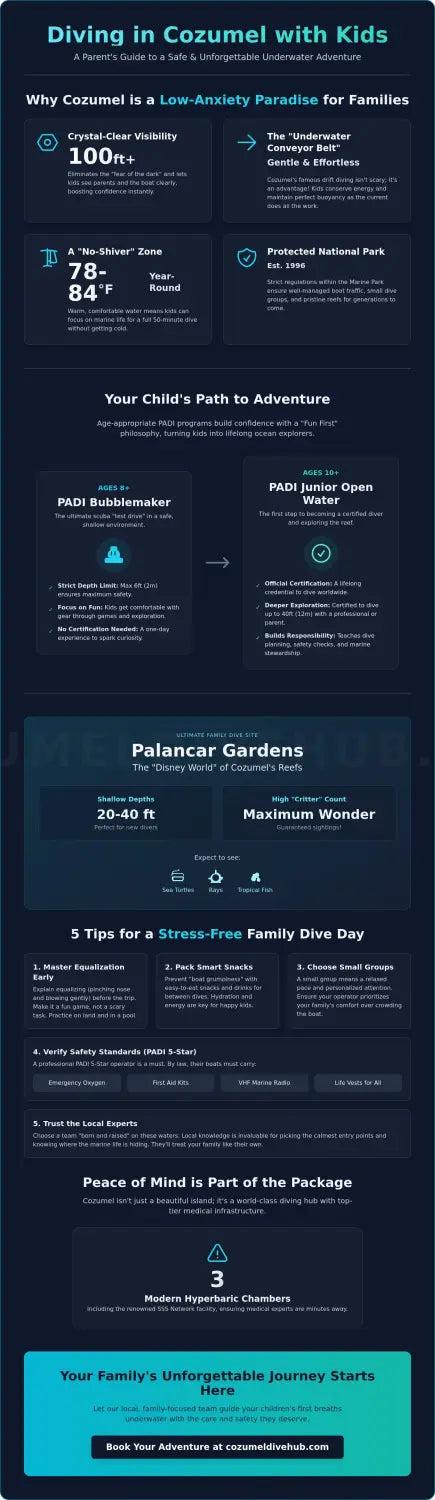
If your child is not certifying and simply wants to try it, a Discover Scuba Diving experience is one supervised dive with no commitment attached and can be repeated later in the week if it goes well. For under-tens, Bubblemaker and Seal Team are pool-based and slot neatly into a morning without touching the boat schedule at all.
Where Should A Family Stay For A Cozumel Dive Trip?
Where you sleep changes how workable the whole plan is, and on a family trip it matters more than it does for two adults who can absorb an early start and a long transfer. Four things are worth checking before the nightly rate.
How far it is from the pier the boat leaves from. Most operators depart from the waterfront in San Miguel or the marinas immediately south of it, typically between 7:30 and 8:30 in the morning. A hotel close to that stretch turns an early departure into a normal morning; a property at the far southern end of the island, or anywhere on the east coast, adds a transfer at both ends of every diving day. Many west-coast hotels sit on operators' hotel pickup routes, which removes the taxi problem entirely — the dive boat pickup and hotel logistics guide sets out how those runs work and which stretches of coast they cover.
Whether there is a pool. A pool is not a luxury on this trip, it is training infrastructure. It is where a child gets a mask to seal, practises clearing it, and works out equalising without an audience. It is also where the non-diving members of the family spend the afternoon while the divers sleep off a boat morning.
Whether there is shore access to a reef. The western shore is where the reef comes closest to land, and a hotel or beach club with a ladder or a sand entry gives snorkellers something to do that requires no booking, no boat and no schedule. That single feature does more for a mixed family than an extra star of hotel rating.
Breakfast timing and somewhere to rinse gear. Boats often leave before a resort restaurant opens. Ask whether an early breakfast or a packed one is possible, because a child who boards without eating will be miserable by the second tank. A ground-floor room, a balcony or an outdoor rinse tank keeps wet gear out of the room for the week.
| Where You Stay | Rough Transfer To The Piers | Why It Suits A Family | The Trade-Off |
|---|---|---|---|
| San Miguel town | Walking distance to short taxi | Shortest mornings, restaurants and pharmacies on the doorstep, easy to abandon a plan | Town rooms rarely have shore reef access or a large pool |
| Northern hotel zone | Around 10 minutes | Calm shallow water for paddling, pools, close enough for pickups | Reef is further out; less snorkelling straight off the beach |
| Southern hotel zone | Around 15 to 30 minutes | Best shore snorkelling on the island, closest to the southern reefs | Longer taxi rides for anything in town, earlier alarms |
| East coast | 30 minutes or more | Dramatic beaches for a rest day | Open ocean, no diving, impractical as a base for a boat schedule |
All-inclusive resorts solve the food-and-boredom problem well for a family with non-divers, and several on the island have a dive operation on site or a long-standing arrangement with one — the all-inclusive Cozumel dive resorts guide covers which format suits which kind of trip. A small hotel near town costs less and puts you nearer the boats but leaves the family catering for itself. Neither is wrong; they fail differently. The where to stay guide sets out the practical differences between the zones in more detail.
Can Divers, Snorkellers And Non-Divers Share The Same Boat?
Sometimes, and it is worth establishing which arrangement you are buying before you pay a deposit, because it decides what the mornings feel like for the half of the family that is not diving.
| Arrangement | How It Works | Suits | Watch Out For |
|---|---|---|---|
| Everyone on one boat | Non-divers ride along and snorkel above the group or stay on deck | Families who want to stay together, shallow-site mornings | Only works if the planned sites are shallow; riders usually pay a reduced fee, agreed at booking |
| Split across days | Adults take the two-tank boat one morning, the child dives a separate one-tank another | Families with a big spread of ages and abilities | Needs a longer trip; someone is always on child duty |
| Private charter | The family is the entire manifest and the itinerary is set around it | Mixed groups, nervous children, tight schedules | Costs considerably more than per-person rates; still bound by the same depth limits |
If everyone is on one boat, three details decide whether it works. The sites have to be shallow enough that a snorkeller on the surface can actually see the divers — that rules out the southern walls and points back at the mid-island reefs. The boat needs shade, drinking water and somewhere to sit, because a rider is aboard for the same four hours as the divers with none of the distraction. And a non-diver is exposed to seasickness on a choppy morning without the relief of getting in the water, which is a good reason to plan the first ride-along for a flat day rather than an ambitious one.
Chartering the whole boat removes most of this, and it is the arrangement most often recommended for families for a reason: the departure time, the sites and the length of the day all become yours to set, and a dive can end when the youngest diver is finished rather than when six strangers are. It is not a safety upgrade in itself — the depth caps, ratios and paperwork are identical — but it removes the pressure of keeping up with a group, which is the thing that most often goes wrong with a child aboard. The private diving guide covers what a charter typically involves, and the cost breakdown puts it against the per-person alternative so you can see at what family size the two converge.
Decide the buddy pairing before the boat, too. The adult who buddies a young diver is not going to get much of a dive of their own — they will spend it watching a gauge that is not theirs — so alternate that role between the adults rather than defaulting it to the same parent every time. Some operators run combined dive and snorkel trips built for exactly this mix, which is the neatest solution when the group spans certified adults, one junior diver and a child who only wants a mask.
What Do The Non-Diving Family Members Do?
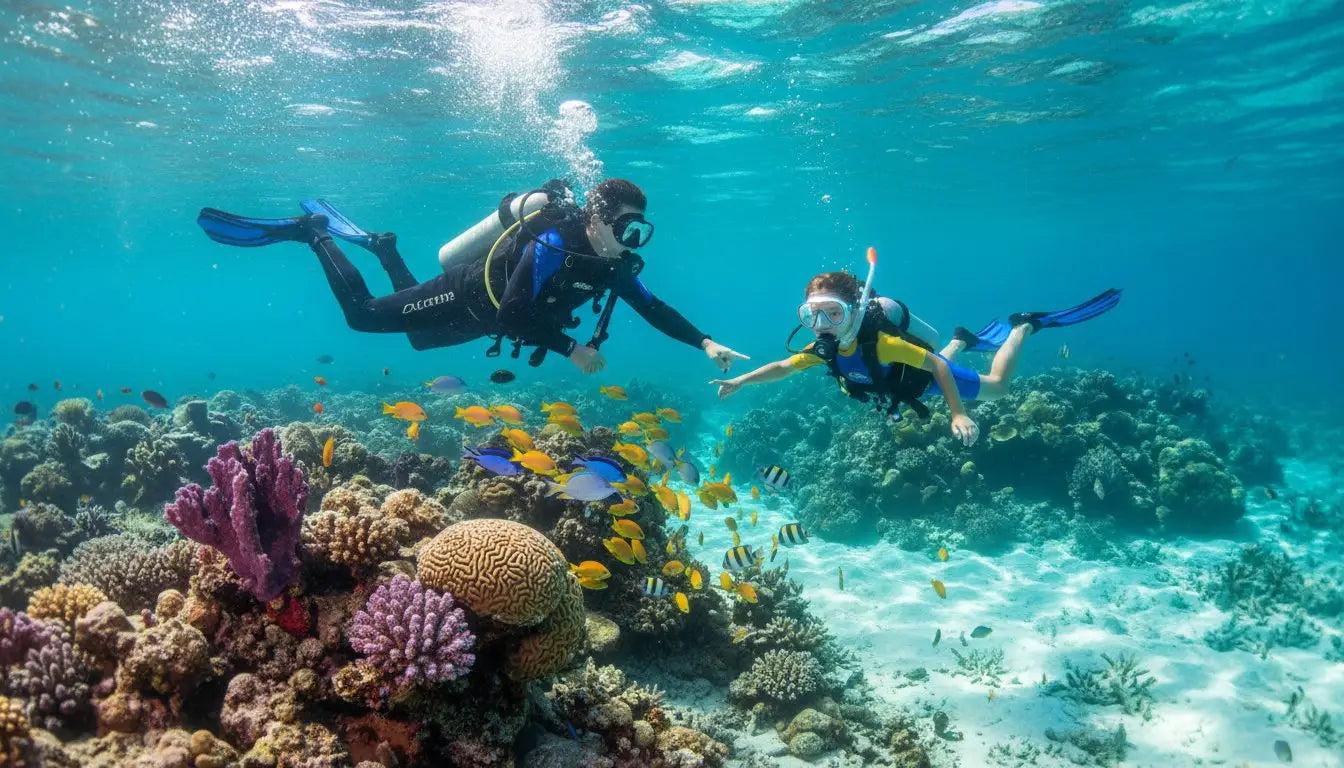
A great deal, and this is the strongest argument for Cozumel over most dive destinations. The reef runs close enough to shore that a snorkeller floats above the same coral the divers are on, which keeps the family in the same place rather than in different halves of the island.
The first thing to understand is the shape of a dive morning, because the non-diving half of the family is planning around a fixed four-hour block rather than a vague absence.
| Time | The Diving Half | The Non-Diving Half |
|---|---|---|
| 7:00–7:45 | Breakfast, pickup, gear loaded at the pier | Slow breakfast; the hotel is quiet and the beach is empty |
| 8:00–9:00 | Transit and first tank | Shore snorkel or pool while the sun is still low |
| 9:00–10:00 | Surface interval on the boat | Beach club, or the walk into town before the cruise crowd lands |
| 10:00–11:00 | Second, shallower tank | Lunch booked somewhere near the pier for the boat's return |
| 11:30–12:30 | Boat in, gear rinsed, tanks handed back | Meet the divers; the rest of the day is a family day |
That is the practical reason a rest day matters as much for the non-divers as the divers: the diving half is unavailable every morning it is on a boat, and predictable mornings are much easier to plan around than uncertain ones.
El Cielo is the obvious destination — a sandbar in 5 to 15 feet of sheltered water on the west side, known for its starfish, and shallow enough that a child who cannot really swim can stand up. The El Cielo sandbar guide covers how to get there without arriving at the same time as the cruise crowd.
Beach clubs solve the logistics problem better than anything else, because they combine reef access, food, shade and somewhere to leave a bag. Sky Reef is the standard example, with living coral a short swim from the ladder. The Cozumel snorkelling guide and the roundup of the best snorkelling spots list the shore-accessible options, and the snorkelling versus diving comparison is a useful read for a child deciding which they want.
Away from the water there is more than a dive-focused family usually expects: the east coast beaches, San Gervasio, the town square in the evening. The things to do for non-divers list and the wider Cozumel for non-divers guide cover the island properly, and Explore Cozumel is the starting point for the rest. When the boat comes in, the lunch spots near the dive piers are where the two halves of the family meet back up.
What Paperwork Comes Before Any Of This?
Every participant completes the standard dive medical form before in-water training, adult or child. For anyone under 18 a parent or guardian signs it rather than the participant, and if any question is answered "yes" the normal process is a physician's sign-off before diving — the same procedure that applies to adults.
That is the administrative picture and nothing more. Whether a particular child should dive is a question for their own doctor, ideally settled weeks before you fly rather than at a shop counter on the morning of a boat departure. Arriving with a completed and signed form removes the single most common reason a family is turned away on the day. The minimum age and paperwork guide sets out which programme each age band is eligible for.
When Is The Best Time Of Year To Bring A Family?
Water temperature barely moves — roughly 79°F in February to 85°F in September, a swing of about six degrees — so warmth is not the deciding factor. Two other things are.
The first is the Norte season, running roughly October through March with the strongest activity between December and February. A Norte brings north winds, rough surface conditions, and a harbour-master port closure that stops all boats, usually for a few hours to a day and occasionally two. That is a genuine risk to a short family trip built around a fixed number of dive days, and it is the main argument for booking a rest day you can move.
The second is surface conditions on the boat. Calmer water means a happier child on a two-tank morning, and the flattest months tend to be the late spring window before the summer heat and the hurricane season build. Sargassum affects the east-facing beaches in summer rather than the west-coast dive sites, so it is a beach-day consideration rather than a diving one.
For a first family trip, late April through early June tends to give the best combination: warm water, settled surface conditions, the Norte season finished, and the peak of hurricane season still ahead. The month-by-month guide goes through each in detail.
Is Cozumel The Right Place For A First Family Dive Trip?
For most families, yes — with the caveat that it is a drift-diving destination and the itinerary has to be built accordingly. The advantages are unusually strong for children: warm water year-round, visibility that removes the fear of not being able to see, a reef that starts in shallow water, an island small enough that nothing is more than half an hour away, and enough for a non-diving sibling to do that nobody is stuck waiting.
The caveat is real though. A family that books southern wall sites because they are famous, runs two tanks a day, and treats a reluctant child as a scheduling problem will have a difficult week in a place that should have been easy. A family that books a sheltered mid-island reef, one dive a day, a hotel near the pier and a shop that answered the ratio question with a number will have a very good one. The beginner assessment of Cozumel and the first-time diving experience guide are both useful sanity checks if the adults are new to diving as well.
Start with Plan Your Cozumel Dive Trip to put the dates, the sites, the hotel and the shop questions together in one place.
Frequently Asked Questions
How do I know if a Cozumel dive operator is genuinely good with children?
Which Cozumel dive sites are calm enough for a young diver?
Where should a family stay in Cozumel for a dive trip?
What happens if my child panics underwater?
Should a child do two dives in one day?
Can non-diving family members come along on the dive boat?
What can non-diving family members do while the others dive?
When is the best time of year to bring a family to Cozumel?
Is Cozumel a good choice for a first family dive trip?
How many days should a family allow for a Cozumel dive trip?
Share This Article

Carmen Novelo
Carmen Novelo is a Cozumel native and an active scuba instructor and dive guide on the island. She has spent twelve years diving the Cozumel reef system, and writes about its dive sites, conditions and marine life for Cozumel Dive Hub.
