Discover Scuba Diving Cozumel For Non Swimmers Today
Yes, a non-swimmer can do Discover Scuba Diving in Cozumel: no swim test, direct instructor supervision, 12 metres maximum. Certifying is a different standard, requiring a 200 metre swim and 10 minutes of treading water with no aids.
Carmen Novelo · February 21, 2026 · 15 min read
Yes — a non-swimmer can do a Discover Scuba Diving experience in Cozumel. PADI's Discover Scuba Diving programme and SSI's Try Scuba equivalent have no swim test and no watermanship requirement, participants are under direct instructor supervision throughout, and the maximum depth is 12 metres / 40 feet. What a non-swimmer cannot do is get certified: the PADI Open Water Diver course requires a watermanship assessment — a 200 metre/yard swim with no aids or a 300 metre/yard swim with mask, fins and snorkel, untimed and continuous, plus 10 minutes of floating or treading water with no aids. So the honest answer splits in two. Trying diving: open to you. Certifying: not until you can meet that standard. And the variable that actually decides whether an introductory dive goes well is not swimming ability at all — it is how you feel with your face in water.
What PADI and SSI Actually Require
The two programmes are governed by different standards, and the difference is the whole reason this question has a yes in it.
| Discover Scuba Diving / Try Scuba | Open Water Diver Certification | |
|---|---|---|
| Swim test | None | Required watermanship assessment |
| Float or tread requirement | None | 10 minutes, no aids |
| Outcome | An experience; no certification card | A certification valid for life |
| Supervision | Direct instructor supervision throughout | Progresses toward independent diving with a buddy |
| Maximum depth | 12 m / 40 ft | 18 m / 60 ft |
| Medical questionnaire | Required | Required |
| Typical duration | Half a day | Three to four days |
A Discover Scuba Diving experience is exactly that — an experience. It begins in confined water or shallow, sheltered water where you can stand, covers a short set of basic skills, and then, if you are comfortable, moves to one open-water dive. It does not certify you to dive on your own, and it does not pretend to. SSI's equivalent runs under the Try Scuba course name with the same absence of a swim requirement.
If you want the fuller comparison of what each pathway costs in time and money, the guide to Discover Scuba Diving versus Open Water certification sets them side by side.
The Open Water Watermanship Standard, Precisely
This is the part most articles get vague about, so here it is in full.
To certify as a PADI Open Water Diver, a student must complete a watermanship assessment consisting of both of the following:
- A surface swim, either 200 metres/yards using any stroke with no swim aids, or 300 metres/yards wearing mask, fins and snorkel. There is no time limit and no style requirement, but it must be continuous — you cannot stop and hold the wall or the pool edge.
- Ten minutes of floating or treading water, using no swim aids and no support.
The two parts may be done in either order and are usually spread across the confined-water sessions rather than done back to back. The Recreational Scuba Training Council sets a comparable watermanship minimum for entry-level certification across member agencies, and SSI's Open Water Diver course applies its own version of the same requirement. If you are choosing between agencies, the comparison of PADI and SSI certification in Cozumel covers the differences that actually matter; the swim requirement is not one of them, because both have one.
What this means in practice: the assessment is untimed, and that changes who can pass it. A slow, inefficient breaststroke that gets you 200 metres in fifteen minutes is a pass. Many people who describe themselves as non-swimmers can, in fact, keep themselves moving and afloat without aids — they simply cannot do it quickly or elegantly. Others genuinely cannot, and for them the honest answer is that certification waits until they can. Learning to swim well enough is an entirely achievable project; it is just a different project, and it belongs before the course rather than during it.
There is one more thing worth saying plainly: the standard exists for a reason. Certification means diving with a buddy rather than an instructor, and it means being able to look after yourself on the surface if something goes wrong. It is not paperwork.
Comfort in Water Is the Real Variable
Swimming ability and water comfort get conflated constantly, and they are not the same thing.
Plenty of competent swimmers hate having their face in water. Plenty of people who cannot swim a length are perfectly relaxed floating in a pool with a mask on. Scuba equipment removes almost all of the swimming: the BCD provides flotation at the surface, weights and buoyancy control handle depth, and fins handle propulsion. What the equipment cannot do is make you calm.
The thing that goes wrong on introductory dives is almost never a swimming problem. It is a breathing-through-a-regulator-with-your-face-underwater problem, or a mask-fills-with-water problem, or a not-being-able-to-see-the-bottom problem. Those are anxiety responses, and they happen to swimmers and non-swimmers alike.
So the useful self-assessment is not "can I swim 200 metres". It is closer to this:
- Can you put your face in water and breathe out through your nose without flinching?
- Can you wear a mask with your face submerged and keep your eyes open?
- Have you ever been in water deeper than you are tall without holding something?
- If water went up your nose right now, would you find it annoying or frightening?
Someone who finds those questions unremarkable is a good candidate for an introductory dive regardless of stroke technique. Someone for whom those questions produce a genuine fear response should not be talked into it — not by a website, not by a travel companion, and not by a shop. A person who panics in water should not be persuaded into a scuba experience. Panic underwater is the mechanism behind most serious diving incidents, and "they'll be fine once they're in" is not a plan. A snorkelling trip, or a session in a pool with a mask before the trip, is a far better first step; the Cozumel snorkelling guide covers what that looks like here.
What Actually Helps a Nervous Non-Swimmer
If you decide to go ahead, a handful of specific arrangements make a large difference. None of them are exotic — they are simply things worth asking for rather than hoping for.
Start in water you can stand up in. Every credible introductory programme does the skills portion in confined or shallow water first. Being able to put your feet down and stand up removes the single biggest source of anxiety. If a shop proposes going straight into open water from the boat, that is a reason to book elsewhere.
Ask the guide to hold your BCD. An instructor holding the shoulder strap or tank valve of your BCD, physically, for the whole dive, is standard practice with nervous first-timers and costs nothing to request. It converts an abstract promise of supervision into something you can feel.
Go last, and go slowly. Entering the water after everyone else means nobody is waiting on you, and you can take the descent at your own rate. Descending along a line or a sloping bottom, rather than into open blue, gives you a visual reference the whole way down.
Establish an abort signal, and get an explicit promise that it will be honoured without discussion. Thumb up means the dive ends — for you and for the person supervising you — immediately and without any negotiation. Agree this during the dive briefing, out loud, before you get in. The ability to stop at any point with no argument is the thing that makes it possible to start.
Ask about group size. One instructor with two participants is a different experience from one instructor with six. Agency standards cap the ratio for the open-water portion of an introductory dive well below what applies to certified fun dives, but the exact number the shop will run is a fair question to ask before booking. Small-group diving is worth paying for here.
Learn the hand signals properly. Not being able to communicate is itself a source of anxiety. Five signals — okay, not okay, up, down, and problem-with-my-ear — cover almost everything a first dive needs.
Do not skip equalisation practice. Ear pain on descent is the most common reason a first dive gets cut short, and it has nothing to do with swimming. Ask to be shown the technique on land first.
The Medical Questionnaire Still Applies
Every participant in a Discover Scuba Diving experience, certified or not, swimmer or not, completes the Diver Medical Participant Questionnaire before entering the water. Both PADI and SSI use it, and it is the same form used across the recreational training agencies.
The form asks about a defined list of conditions — respiratory, cardiac, neurological, ear and sinus, diabetes, pregnancy, recent surgery, and certain medications, among others. A "yes" answer to any of the screening questions means a physician needs to review it and sign off before you dive. That is the whole mechanism: the questionnaire is a routing tool, not a verdict.
Two neutral points about it. First, it is a legal document and answering it inaccurately does not make a condition go away; it simply removes the safety net. Second, the review must be done by a physician who knows your history, ideally one familiar with diving medicine. Nothing on this page, and nothing a dive shop tells you at the counter, is medical advice about you personally. If you have a condition on that list, get it assessed before you travel rather than on the morning of the dive, when the alternative to a signature is losing the booking. You can read the definition of the dive medical form in the terminology guide.
Cozumel's Honest Complication: This Is a Drift-Diving Island
Here is the part that generic "can non-swimmers dive" articles cannot tell you, because it is specific to this island.
Cozumel's reputation is built on drift diving. The standard dive here is from a boat: you enter, descend, and the current carries you along the reef while the boat follows and collects you wherever you surface — a live boat pickup. On stronger days some operators use a negative entry, where you deflate and descend immediately rather than gathering on the surface first.
For a confident diver, this is the best thing about Cozumel. For a nervous non-swimmer on a first dive, every element of it is an added difficulty:
- You surface away from the boat, in open water, and wait for pickup.
- You cannot stop, hold position, or stand up at any point.
- The entry is from a moving boat rather than a beach.
- There is no fixed reference and often no visible bottom during descent.
A drift dive from a boat is a substantially bigger ask than a sheltered shallow-site or shore-entry introductory dive. That does not make it wrong — many introductory divers do exactly this and love it. But it should be a choice made deliberately, not a default you discover on the boat. The guides to how strong the current in Cozumel gets and what to expect on your first drift dive describe the conditions honestly. If boats themselves are a worry, the seasickness guide is worth reading before you book a two-tank trip.
The alternative is a sheltered site — a shallow reef close to shore, mid-island, reached by a short boat ride or by walking in from a shore dive entry. Not every shop offers this, which is exactly why you say so in advance.
"Beginner" Does Not Mean "Calm": Cozumel Sites to Avoid on a First Dive
Site difficulty ratings describe the diving, not the diver's nerves. Several Cozumel reefs classed as beginner-suitable carry moderate-to-strong current, because moderate current is unremarkable for a certified diver here. They are the wrong choice for a first introductory dive by someone who cannot swim.
| Site Rated Beginner | Depth (ft) | Current | Why It Is Wrong for a Nervous First Dive |
|---|---|---|---|
| Yucab Reef | 50–60 | Moderate to strong | Deeper than an introductory profile needs, and a genuine drift |
| Columbia Shallows | 30–50 | Moderate to strong | Far south, longer boat ride, real current |
| Punta Dalila | 40–60 | Moderate to strong | Fast-moving drift along the reef edge |
| Molas Shallow Reef | 20–40 | Moderate to strong | Shallow, but northern water moves |
| Chankanaab Bolones | 35–40 | Moderate to strong | Adjacent to a gentle site but noticeably livelier |
The point is not that these are dangerous reefs. They are lovely reefs. It is that "beginner-friendly" on a site listing means "suitable for a newly certified diver", and a newly certified diver has already done the 200-metre swim.
Sheltered Shallow Sites That Suit a First Dive
These are the ones to name when you talk to a shop. All sit on the protected western side of the island, all are shallow, and all carry mild to moderate current rather than moderate to strong.
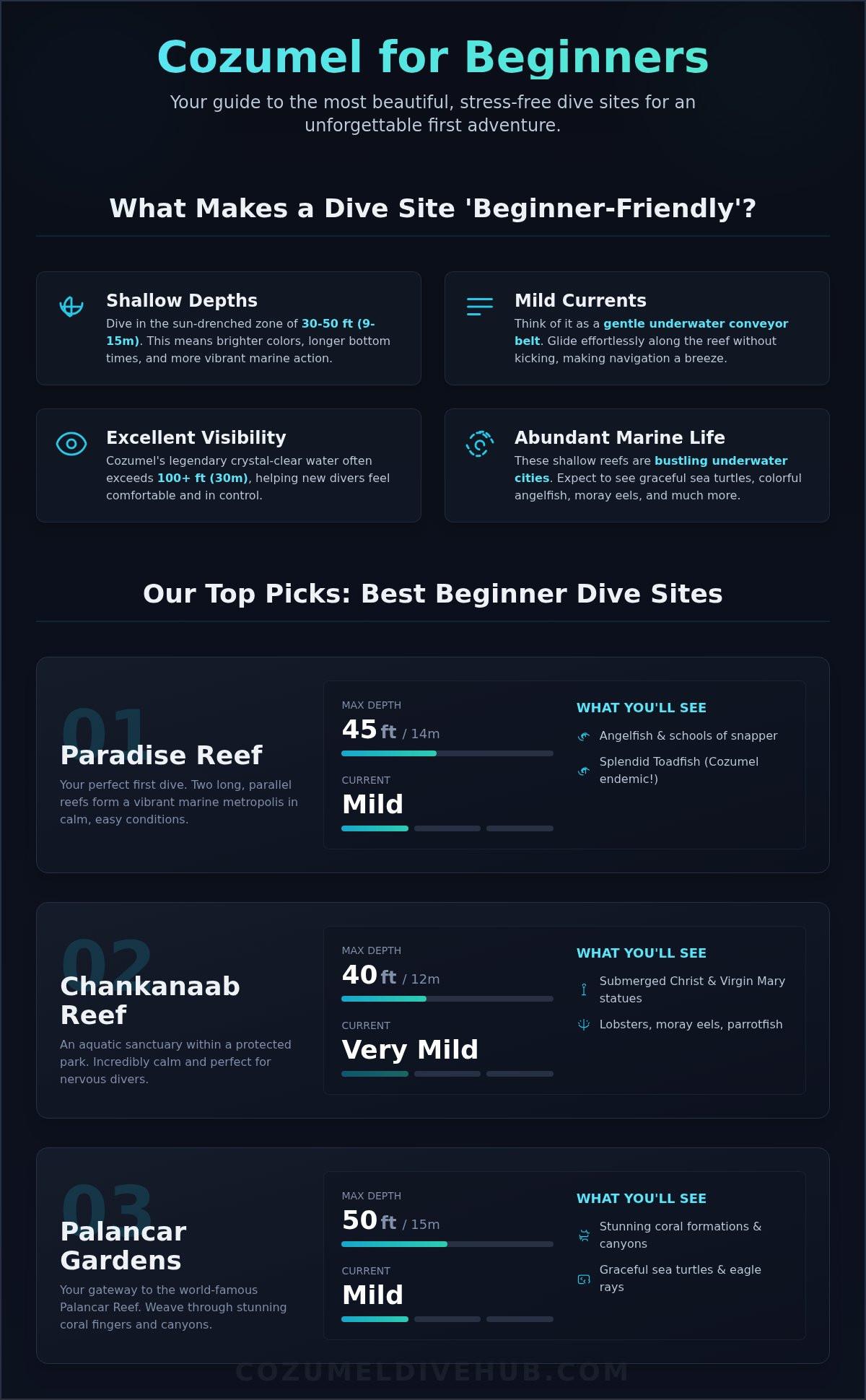
Beginner-friendly dive sites around Cozumel, most of them on the sheltered western shore.
| Site | Depth (ft) | Current | Why It Works |
|---|---|---|---|
| Chankanaab Reef | 35–40 | Mild to moderate | Sheltered mid-island bay, shallow, easy access |
| Paradise Reef | 30–40 | Mild to moderate | The classic first-dive reef, close to town |
| Money Bar Reef | 10–20 | Mild to moderate | Very shallow, shore-accessible, stand-up depth nearby |
| Coral Princess Reef | 10–20 | Mild to moderate | Shallowest option with real reef structure |
| Playa Corona | 20–40 | Mild to moderate | Walk-in entry from the beach, no boat required |
| San Clemente | 30–40 | Mild | The mildest current rating of any beginner site on the island |
| Tikkila Shallow Reef | 15–30 | Mild to moderate | Shallow and sheltered, less traffic |
Playa Corona and Money Bar deserve particular mention because they allow a shore entry. Walking into water that gets gradually deeper, with the option of stopping and standing at any moment, is psychologically different from rolling backwards off a boat into open water. For a genuinely nervous first-timer, that difference is worth more than any reef.
The full picture of what is where, and which sites suit which level, is in the Cozumel dive sites guide.
Tell the Shop in Advance — And What to Say
This is the single most useful action in this article. Disclosing that you cannot swim is not an admission that gets you refused; it is information that lets a shop plan a dive that works. Turning up and mentioning it at the dock, when the boat is loaded and six other people are waiting, is what produces a bad morning.
Say it in writing, when you book, in roughly these terms:
- I am not a swimmer and I am nervous in water.
- I would like the confined or shallow-water portion in water I can stand up in.
- I would prefer a sheltered shallow site rather than a drift dive, and a shore or short-boat entry if you offer one.
- I would like the guide to hold my BCD during the dive.
- I want to be able to end the dive at any point without discussion.
- What will the instructor-to-participant ratio be?
A good shop will answer all of these without hesitation and may suggest better options. A shop that brushes the questions aside has told you something useful. The directory of Cozumel dive centers is a starting point, and the guide to whether Cozumel diving is good for beginners covers what to look for more broadly.
One more option worth knowing about: surface-supplied air systems — helmet diving and SNUBA, both available on the island — let you breathe underwater at a few metres while walking or floating, with the air coming down a hose from the surface. There is no tank on your back, no certification, and the depth is minimal. It is not scuba and it does not lead anywhere, but as a way of finding out how you feel with your head underwater, before committing to a dive, it is a legitimate half-step.
If You Want to Certify Later
Discover Scuba Diving is deliberately a dead end in one narrow sense — it produces no certification card. But the confined-water skills you complete can usually be credited toward a full Open Water Diver course if you continue within the agency's stated window, so ask the instructor to sign the paperwork before you leave, even if you have no plans.
If the experience goes well and you want to certify, the swim requirement is the thing to work on, and it is genuinely workable. It is untimed. Any stroke counts. Mask, fins and snorkel are allowed on the 300-metre version, which many people find far easier than a 200-metre bare swim. A few months of lessons at a local pool is a smaller undertaking than most people assume, and it happens at home, not on holiday.
When you are ready, the practical path is set out in the guide to getting your PADI certification in Cozumel and the PADI Open Water Diver course page. Those who want to certify but cannot commit the full three to four days sometimes look at the shorter PADI Scuba Diver course, though it carries a watermanship requirement of its own and does not remove the swim.
For a wider view of what a first trip involves — costs, timing, what to pack, how the days are structured — start with the complete beginner's guide to scuba diving in Cozumel, the account of a first-time diving experience here, and the deeper look at Discover Scuba Diving in Cozumel. When you are ready to put a trip together, the full Cozumel dive trip planner covers the logistics.
A last word on expectation-setting. Not being able to swim does not close the ocean to you, and the programme that lets you try it is real, standardised and widely run. What it does mean is that you should choose the gentler version of a Cozumel dive rather than the famous one, say so in advance, and keep the right to stop. Those three things, taken together, are what turns a nervous first dive into a good one.
Frequently Asked Questions
Can a non-swimmer do Discover Scuba Diving in Cozumel?
Is there a swim test for Discover Scuba Diving?
What is the swim requirement for PADI Open Water Diver certification?
Can a non-swimmer get scuba certified?
Is the Open Water Diver swim test timed?
How deep does a Discover Scuba Dive go in Cozumel?
Do you still need a medical questionnaire if you are only trying scuba?
Are Cozumel drift dives suitable for a non-swimmer's first dive?
Which Cozumel dive sites suit a nervous first-time diver?
Can you stop a Discover Scuba Dive if you feel uncomfortable?
Share This Article
Carmen Novelo
Carmen Novelo is a Cozumel native and an active scuba instructor and dive guide on the island. She has spent twelve years diving the Cozumel reef system, and writes about its dive sites, conditions and marine life for Cozumel Dive Hub.