
Paradise Reef Cozumel Snorkeling Guide: Tips, Marine Life & Logistics
Three low coral ridges in 30 to 40 feet of water, a few hundred metres off the shoreline between the cruise piers. Paradise Reef snorkeling is shallow, clear and dense with fish, and it is also the busiest reef on Cozumel.
Carmen Novelo · August 12, 2026
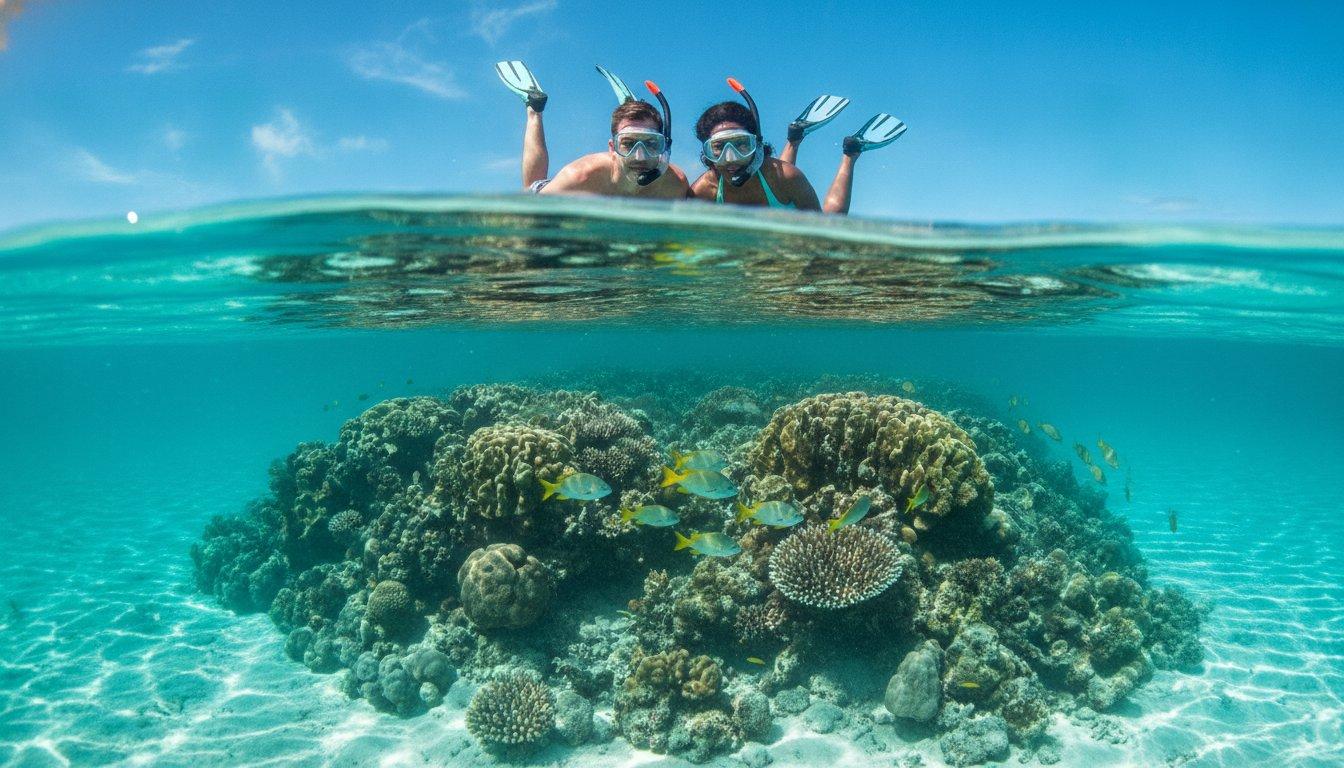
Paradise Reef — Paraíso on Spanish charts — is the shallow reef immediately south of San Miguel, sitting in 30 to 40 feet of water a few hundred metres off the shoreline between the cruise piers. It is three low coral ridges running parallel to the beach, with mild to moderate current and a beginner rating, which is why almost every dive operation on the island uses it for first dives, checkout dives and night dives, and why most half-day snorkel boats stop there first. For a snorkeller the appeal is straightforward: the reef top is shallow, the water is clear, and the fish are dense. The cost is equally straightforward — it is the busiest reef on Cozumel and it sits in the middle of the island's working boat corridor.
This page covers what that trade-off actually looks like in the water. For the island-wide picture of where snorkelling works and where it does not, start with the Cozumel snorkelling guide.
Where Is Paradise Reef and How Do You Reach It?
Paradise sits on the west coast reef line between Villa Blanca Wall to the north and Las Palmas to the south, roughly opposite the stretch of hotels and cruise terminals south of town. The full site record is on the Paradise Reef dive site page.
Practically, there are three ways people get onto it.
By snorkel boat. The standard route. Half-day snorkel trips from the downtown marinas reach Paradise in under fifteen minutes, and it is usually stop one of three. The boat drops you up-current and follows while you drift over the ridges. This is by a wide margin the easiest and safest way to see it.
By dive boat, as a snorkeller. Some dive operations will take a snorkeller along on a two-tank morning. You get the same water but you wait out two dives on the surface, which is a long morning if you are not diving.
From the shore. Possible in theory, a poor idea in practice. The reef is a few hundred metres out across open water inside an active boat channel, the current runs south to north, and nothing is following you. Snorkelling near the International Pier or Puerta Maya is not a reasonable proposition — those are working cruise berths with ships manoeuvring on thrusters. For shore snorkelling go further south: Money Bar, Sky Reef or Playa Corona, with more collected under Cozumel beach clubs.
How Deep Is Paradise Reef and How Strong Is the Current?
| Attribute | Paradise Reef |
|---|---|
| Logged depth range | 30–40 ft |
| Current strength | Mild to moderate |
| Skill level | Beginner |
| Reef structure | Three low ridges running parallel to shore |
| Access | Boat (shore entry not recommended) |
| Position on the reef line | Between Villa Blanca Wall and Las Palmas |
| Typical snorkel time | 35–45 minutes per drift |
Thirty to forty feet is the sand bottom. The ridges and coral heads rise well above it, so from the surface you look down at structure rather than a flat plain, and on a clear morning you pick out individual fish without difficulty. You are not swimming through the reef — that is a scuba experience — but Cozumel's visibility makes the reef read clearly from above.
Mild to moderate is the site's rating, not a promise. Cozumel's drift is driven by the Yucatán Current and runs south to north, varying day to day. On a boat that is an advantage: you float and the reef moves past. From the shore it is why people end up hundreds of metres north of their exit without noticing. See how strong the current in Cozumel really is.
What Do You Actually See at Paradise Reef?
The site record logs barracuda, green moray eel, grouper, grunt, nurse shark, queen angelfish, seahorse, snapper and spotted moray. From the surface the realistic list is narrower — eels sit in holes, nurse sharks under ledges, and a seahorse is a lucky dive sighting rather than a snorkel one.
| What you see | How likely from the surface | Where to look |
|---|---|---|
| Sergeant majors and grunts | Near certain | Schooling over and beside the ridges |
| Stoplight parrotfish | Near certain | Grazing on the coral tops, audible crunching |
| Blue tang and French angelfish | Very likely | Around coral heads, often in pairs |
| Queen angelfish | Likely | Coral-rich sections of the middle ridge |
| Snapper schools | Likely | Hanging off the ridge edges |
| Barracuda | Occasional | Motionless in mid-water, often above the reef |
| Southern stingray | Occasional | In the sand channels between ridges |
| Green moray or spotted moray | Uncommon from above | Head out of a hole in the reef |
| Nurse shark | Uncommon from above | Resting under reef ledges |
| Splendid toadfish | Realistically a dive sighting | Deep under ledges and in crevices |
Be sceptical of any page promising you a toadfish from a snorkel. Cozumel's endemic species sits in the dark under coral at 30 feet and below, and spotting one usually means a guide with a light hovering a metre from the hole. The splendid toadfish guide covers where they genuinely turn up.
Turtles are a different matter — green and hawksbill turtles move through this stretch of coast and are a genuine surface sighting, most reliably over seagrass rather than over the reef itself. The Cozumel sea turtle guide covers seasons, behaviour and the rules that apply when you meet one.
Is Paradise Reef Crowded? An Honest Answer
Yes. Paradise is the most heavily used reef on the island, and there is no version of this page that pretends otherwise.
The reasons are structural. It is the closest reef to both the town marinas and the cruise terminals, it is shallow enough for beginners, and it is the default second-tank and night-dive site for much of the island's dive center fleet. On a heavy cruise day you can have snorkel boats, dive boats and glass-bottom boats working the same three ridges at once.
- Go early. A boat leaving at 8:00 or 8:30 gets the reef close to empty. By 10:30 it is not.
- Check the cruise schedule before you book. A day with one small ship is a completely different reef from a day with four. The cruise port diving guide explains how the ship calendar drives everything on the west coast.
- Consider going elsewhere. If your priority is a quiet reef rather than a convenient one, ask about Las Palmas or Chankanaab instead. Same shallow character, less traffic.
Boat Traffic at Paradise Reef: The Part Most Pages Skip
This matters more than the crowding. Paradise sits inside the busiest stretch of water on Cozumel: cruise ships berthing at two terminals, dive boats running north and south all morning, snorkel boats, water taxis and tenders. A swimmer face-down at the surface, in a dark rash guard, is close to invisible from a helm position.
The practical rules:
- Stay with the group and inside the reef line. The captain is watching a cluster of people. Drift away from it and you become a lone head in chop.
- Wear something bright. A high-visibility rash guard, vest or float does more for your safety here than any other single item.
- Carry or tow a marker if you snorkel independently. A float or a surface marker buoy is standard practice for a reason.
- Never cross open water or a boat channel on the surface. This rules out the swim from the pier area entirely.
- Look up before you move. Sound direction is unreliable underwater; a boat can be much closer than it sounds.
None of this is unusual — it is what a working waterway requires.
What Does It Cost to Snorkel Paradise Reef?
Figures checked against published operator and park pages in August 2026. They describe the shape of the market, not a quotation.
| Item | Typical published price | Notes |
|---|---|---|
| Marine park fee | 225 MXN per person per day | Mandatory for everyone entering the water inside the park; often collected at the marina |
| Small-group snorkel boat (3 stops) | From about $50 USD per person | Paradise is normally stop one; gear usually included |
| Larger group snorkel tour | From about $63 USD per person | Bigger boats, park fee frequently extra |
| Snorkeller riding a dive boat | Around $73 USD per person | You wait out two dives |
| Private charter | From roughly $600 USD for the boat | Up to about 12 people |
| Gear rental if not included | Around $10–15 USD per day | Mask, snorkel, fins |
Always confirm whether the park fee is inside or outside the headline price — it is the single most common surprise at the dock. The marine park fee guide has the current detail, and what to book on a Cozumel snorkel tour compares boat types.
When Is the Best Time to Snorkel Paradise Reef?
Time of day. Early. The surface is flattest before mid-morning, the light is good from about 9:00, and the reef is emptiest before the cruise excursions land. Late afternoon is the second-best window once the excursion fleet has finished.
Time of year. May to September gives the lightest current, warmest water and calmest surface — the snorkeller's season, with hurricane season as the caveat. December to March brings the best visibility but stronger current and the nortes, winter north winds that chop the surface and occasionally close the port. Month-by-month numbers are in the conditions guide.
Sargassum. Sargassum is mainly an east coast problem and rarely affects this stretch of reef, though it can drift onto west coast beaches in spring and summer.
Who Is Paradise Reef Right For?
| Snorkeller | Verdict |
|---|---|
| First-time snorkeller on a guided boat | Excellent — shallow, calm, fish-rich, short crossing |
| Nervous swimmer with a vest and a guide | Good on a small boat; ask for a vest without embarrassment |
| Family with children | Good on a boat trip; not a shore option for kids |
| Cruise passenger with limited hours | Ideal — closest reef to the piers, quickest turnaround |
| Photographer wanting an empty reef | Poor — go early or go south |
| Independent shore snorkeller | Wrong site. Use a beach club reef instead |
| Someone who wants to see the walls | Wrong site, and wrong activity — that needs scuba |
If the surface view leaves you wanting to be down there, Discover Scuba Diving is the same-day option with no course attached, and Paradise is one of the reefs it is most often run on. The trade-offs between the two are laid out in snorkelling versus diving in Cozumel.
Marine Park Rules That Apply at Paradise Reef
Paradise sits inside Parque Nacional Arrecifes de Cozumel, administered by CONANP. The rules apply to snorkellers exactly as they do to divers.
- The park fee is per person, per day, for anyone entering the water inside the park.
- No touching, no standing, no holding on. Standing on coral kills it, and fire coral teaches the lesson faster than any sign.
- Mineral sunscreen only. Oxybenzone and octinoxate are not permitted. A rash guard beats any lotion when you float face-down for an hour.
- No gloves, no feeding, no collecting. Nothing leaves the water.
- No anchoring on reef. Legitimate operators use moorings.
Fitting Paradise Reef Into a Cozumel Trip
Use Paradise as an opener, not a destination. Take an early boat, see it while it is quiet, then spend the rest of the trip somewhere with more character — the El Cielo sandbar in the far south, a shore session at a beach club, or the shallow southern reefs on a longer boat day. Browse the dive site index to see how the reef line changes going south, and use the Cozumel trip planner to order the days.
Frequently Asked Questions
Where is Paradise Reef in Cozumel?
How deep is Paradise Reef?
Can you snorkel Paradise Reef from the shore?
Is Paradise Reef good for beginners and nervous swimmers?
What fish will you see snorkelling Paradise Reef?
Is Paradise Reef crowded?
Do snorkellers have to pay the Cozumel marine park fee?
What is the best time of day to snorkel Paradise Reef?
Can you see a splendid toadfish while snorkelling at Paradise Reef?
How much does a Paradise Reef snorkelling trip cost?
Share This Article

Carmen Novelo
Carmen Novelo is a Cozumel native and an active scuba instructor and dive guide on the island. She has spent twelve years diving the Cozumel reef system, and writes about its dive sites, conditions and marine life for Cozumel Dive Hub.
