Master the Depths: PADI Wreck Diver Specialty in Cozumel 2026
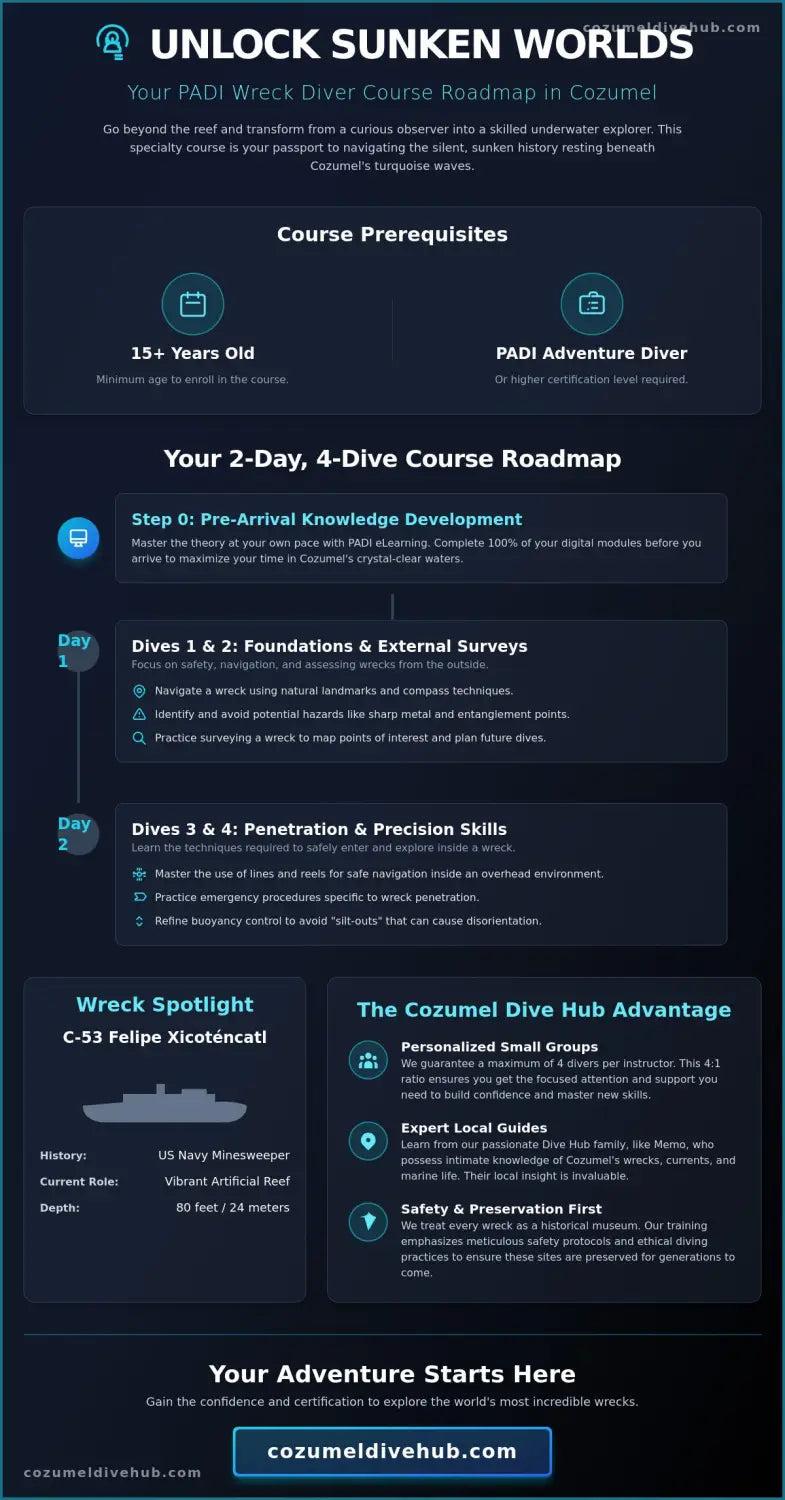
PADI Wreck Diver is four open water dives across at least two days, from age 15, with penetration limited to the wreck's light zone on a continuous guideline. Cozumel has exactly one wreck, so all four dives happen on the same hull.
Carmen Novelo · April 25, 2026 · 16 min read
The PADI Wreck Diver specialty takes four open water dives across a minimum of two days, requires PADI Adventure Diver (or equivalent) and a minimum age of 15, and covers limited penetration inside a wreck's light zone using a continuous guideline, with the distance back to the exit and then to the surface capped at 40 metres / 130 feet. Full wreck penetration — going beyond the light zone into true overhead — is a separate technical discipline with its own training and equipment. In Cozumel there is one honest complication: the island has exactly one wreck, the C-53 Felipe Xicoténcatl. Four training dives means seeing the same 184-foot hull four times, and for most visitors this specialty is better taken somewhere with a fleet of wrecks to practise on.
Cozumel Dive Hub is an independent editorial guide. It runs no boats, employs no instructors and holds no training-agency rating, which is why this page can tell you to spend the course fee somewhere else.
This is the wreck-specific companion to the Cozumel specialty course guide, which ranks the full specialty menu against the island. Here the subject is one course and one wreck, examined properly.
What The PADI Wreck Diver Course Actually Certifies You To Do
The recreational Wreck Diver specialty is a limited-penetration qualification, not an overhead qualification. That distinction is the entire course.
| Item | PADI Wreck Diver | Verified Against |
|---|---|---|
| Minimum age | 15 | PADI / Scuba Diving magazine |
| Prerequisite | Adventure Diver or equivalent | PADI |
| Training dives | 4 open water dives, minimum 2 days | PADI |
| Penetration allowed | Limited, within the light zone, on a continuous guideline | PADI standards |
| Distance limit | Route to exit plus route to surface not to exceed 40 m / 130 ft | PADI |
| Additional recommendation | Deep Diver advised if the training wreck is deeper than 18 m | PADI |
| Not covered | Penetration beyond the light zone; decompression; technical overhead | PADI |
Scuba Diving magazine's summary of the certification states the prerequisites plainly: "PADI Adventure Diver (or equivalent) certification is a prerequisite", minimum age 15, and four open water wreck dives with an instructor. It also draws the line on scope, noting that "diving deeper into wreck penetration — exploring a ship's interior beyond the sunlight zone — introduces additional risks and requires technical training and specialized equipment for overhead environments."
The syllabus itself covers researching a wreck before diving it, hazards and entanglement, specialised equipment including lights, reels and penetration lines, survey and mapping, limited-visibility technique and emergency procedures. Buoyancy and finning are treated as core rather than incidental: frog kick, precise trim, and enough control to hold position without touching anything. The PADI Wreck Diver course page lists what local operators include.
What "Limited Penetration Within The Light Zone" Actually Means
This phrase does most of the work in the standards, and it is worth unpacking because divers routinely read it as permission to explore a ship's interior.
Three constraints apply at once.
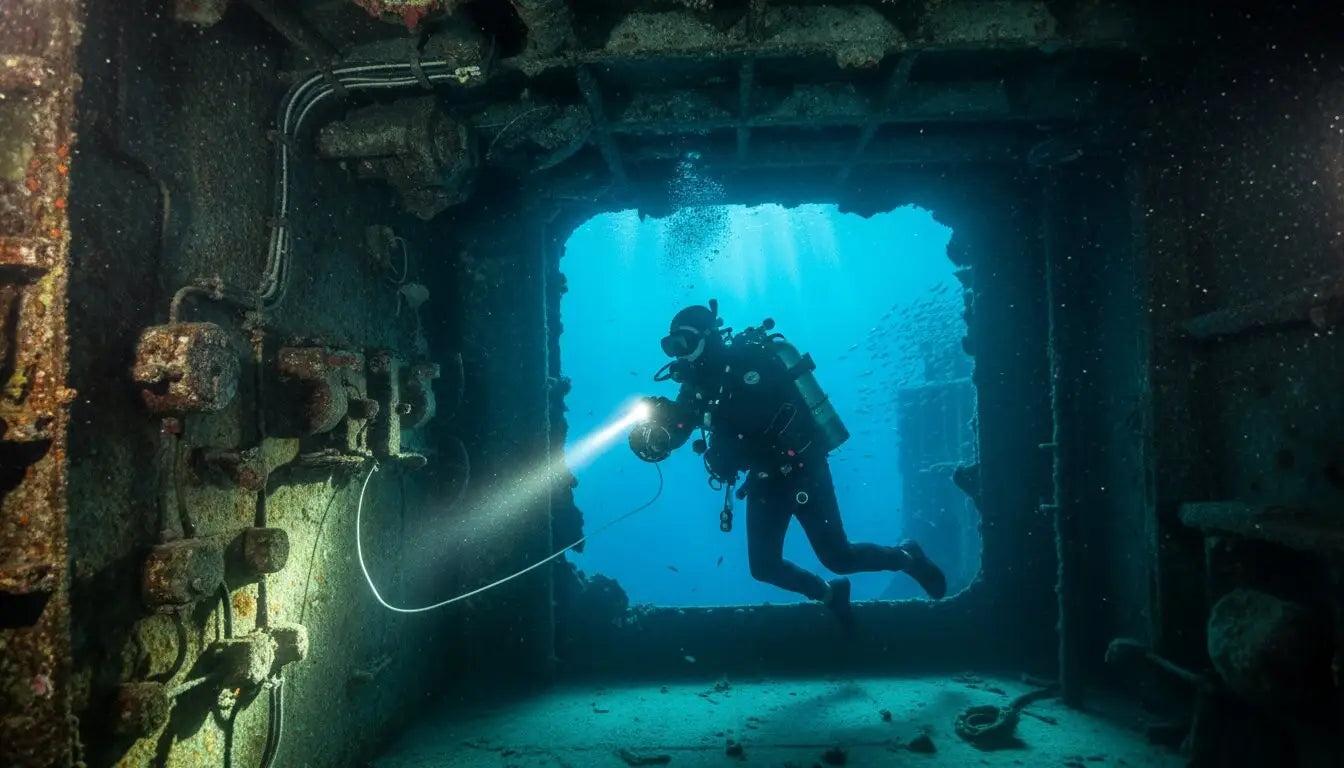
The light zone. You stay where natural daylight from the entry point is continuously visible. PADI's own professional guidance describes the requirement in operational terms: the path "should be well lit and free of obstacles, entanglements or silt." The moment ambient light is out of sight, you are in a true overhead and outside the specialty.
A continuous guideline. A line is run from open water to your position and stays continuous. PADI states that divers "must run a line to ensure a safe return to the exit." This is not a navigation aid you deploy if conditions look tricky — it is the thing that makes a limited penetration survivable if the visibility collapses.
A 40 metre / 130 foot total distance limit. Published PADI course standards limit wreck penetration training dives "to within the light zone and within 40 metres from the surface", and PADI's professional guidance frames it as a combined distance: "the distance to the exit and then to the surface should not exceed 40 metres/130 feet." That is depth plus linear penetration, not penetration alone. On a wreck sitting in 24 metres of water, that arithmetic leaves you very little horizontal room.
| Allowed Under The Recreational Specialty | Requires Technical Wreck Training |
|---|---|
| Exterior survey and mapping | Penetration beyond visible daylight |
| Entry within continuous natural light | Long horizontal runs into the hull |
| Continuous guideline to open water | Complex line work, jumps and gaps |
| Combined route within 40 m / 130 ft of surface | Deeper wrecks and extended range |
| Single-cylinder recreational configuration | Redundant gas, stage cylinders, sidemount or twins |
| No decompression obligation | Planned decompression stops |
The practical consequence: what a Wreck Diver card lets you do inside the C-53 is close to what a competent guide would take you through anyway. The difference is that you understand why the line is there, and what happens if it is not. Wreck penetration proper belongs to technical diving, covered in the Cozumel technical diving guide.
Is The C-53 Really Cozumel's Only Wreck?
Yes. Every wreck itinerary, wreck specialty and wreck photograph on this island is the same ship.
The C-53 General Felipe Xicoténcatl began as the USS Scuffle (AM-298), an Admirable-class minesweeper commissioned on 2 May 1944 and transferred to Mexico on 1 October 1962. It was redesignated Felipe Xicoténcatl in 1994 and scuttled deliberately as an artificial reef off Chankanaab. Sources disagree on the date: several Cozumel references give June 2000, while Wikipedia's entry on the Scuffle and at least one dive-guide publisher record 1999. Treat it as 1999–2000 rather than picking one.
| C-53 Felipe Xicoténcatl | Detail |
|---|---|
| Former identity | USS Scuffle (AM-298), Admirable-class minesweeper |
| Commissioned | 2 May 1944 |
| Transferred to Mexico | 1 October 1962 |
| Length | 184 ft / 56 m; beam approximately 10 m |
| Sunk as artificial reef | 1999–2000, sources differ |
| Location | Off Chankanaab, west coast |
| Orientation | Upright on sand |
| Sand depth | Approximately 24 m / 80 ft |
| Typical working depth | 40–55 ft on deck and superstructure |
| Shallowest structure | Around 10–12 m / 33–40 ft |
| Current | Mild to moderate |
The nearby reef sites — Chankanaab Bolones, Chankanaab Reef and Villa Blanca Wall — are what most operators pair the wreck with on a two-tank morning, because a wreck-only day does not exist here. The dive site index shows how thoroughly reef-dominated the island is.
What Condition Is The C-53 In Now?
Better than a quarter-century underwater might suggest, and that is deliberate.
The ship was stripped of hazardous and contaminating material before it was sunk, and it was chained to the sandy seabed specifically to stop it moving in storms — an unusual precaution that has kept it upright and roughly where it was placed through several severe hurricane seasons. Large openings were cut into the decks, hull and corridors before scuttling to give divers straightforward routes in and out, and the engine room, galley, officers' quarters, heads and radio room are the compartments operators typically show.
It is now a working artificial reef. Sponges and hard coral have formed thick colonies on the metal, and the structure holds reef fish, green moray and the occasional splendid toadfish tucked into the plating. For photographers, that biological growth is the reason to dive it — the underwater photography guide covers the technique the site rewards.
What has not changed is the silt inside. Fine sediment sits on every horizontal surface in the interior, and a single careless flutter kick will put it into the water column and leave the compartment behind you unnavigable. That is the genuine skill the C-53 teaches, and it teaches it honestly. Full detail on diving the ship itself sits in the C-53 wreck diving guide and the C-53 dive listing.
Can Four Training Dives On One Hull Teach Wreck Diving?
Partly, and the honest answer depends on what you want from the certification.
What four dives on the C-53 genuinely teach: silt-conscious finning in a real interior, running and following a line where getting it wrong has consequences, buoyancy control in confined space, and the discipline of planning an exit before an entry. Those skills are portable and they are worth having. The C-53 is also an unusually forgiving classroom for them — upright, structurally sound, with cut openings, mild to moderate current and warm clear water.
What four dives on one hull cannot teach: adaptation. Wreck diving as a discipline is about reading an unfamiliar structure — working out where a passage goes, whether a deck is sound, how a list changes your orientation, what a collapsed section means for your exit. You learn that by diving different wrecks. Doing the whole specialty on one ship means you finish knowing the C-53 rather than knowing wrecks.
There is also a scheduling cost. Four dives is roughly two of a typical ten-dive Cozumel week, spent on a site that is not what the island is famous for. Those same two mornings on Palancar Gardens, Santa Rosa Wall or Paso del Cedral are what people fly here for.
PADI Wreck Diver Or SSI Wreck Diving?
These two programmes are not equivalent, and the difference is larger than the usual PADI-versus-SSI naming gap.
| PADI Wreck Diver | SSI Wreck Diving | |
|---|---|---|
| Prerequisite | Adventure Diver or equivalent | Open Water Diver |
| Minimum age | 15 | 10 |
| Training dives | 4 | 2 |
| Maximum training depth | 40 m / 130 ft combined route | 30 m / 100 ft |
| Penetration | Limited, within light zone, on a guideline | Non-penetration only |
| Penetration pathway | Technical wreck training separately | SSI Advanced Wreck Diving separately |
SSI's Wreck Diving programme is explicitly a non-penetration course: its own course description states divers are taught "how to safely conduct non-penetration dives around wrecks and artificial reefs, up to a depth of 30 meters", across two open water sessions. Penetration sits in SSI's separate Advanced Wreck Diving programme.
If limited penetration is the reason you want the card, the PADI version is the one that includes it. If you simply want to dive around wrecks competently, SSI's shorter, cheaper, non-penetration course is an honest fit — and on a single-wreck island, arguably the more proportionate purchase.
Do You Need The Specialty To Dive The C-53?
No. This is the point that quietly undermines the whole case for taking the course here.
The C-53 is a standard stop on Cozumel two-tank itineraries. The sand sits at roughly 24 metres, so an Advanced Open Water diver is comfortably within their depth limit on the wreck, and operators generally want Advanced certification — or equivalent experience — if you intend to go inside at all. A guided pass through the light-zone compartments on a normal dive is the experience most visitors are actually after, and it costs one tank rather than four.
The specialty adds three things: you understand the line rather than following someone else's, you can plan a limited penetration rather than being taken on one, and you hold a card that travels to destinations with real wreck diving. Whether those are worth two mornings and several hundred dollars in Cozumel is a genuine question, not a rhetorical one.
If your buoyancy is the weak link — and on a silty interior it usually is — Peak Performance Buoyancy is a half-day course that will do more for your wreck diving than the wreck specialty will.
What Does The Wreck Specialty Cost In Cozumel?
Published Cozumel operator rates, checked August 2026. The most informative thing about this table is how short it is.
| Operator | Programme | Published Price | Included |
|---|---|---|---|
| Cozumel Dive School | PADI Wreck Diver | $490 | 3 days, 6 dives (1–2 shore, 2 boat dives to the C-53, 2 further boat dives); eLearning, park fees, gear with computer, certification |
| Deep Blue Cozumel | Wreck specialty | Not published | Specialty price list carries nitrox, deep, navigation, night, buoyancy, drift and currents — no wreck entry |
| Dive Paradise | Wreck specialty | Not published | Specialty certification page lists deep, but no wreck option |
Two of the island's larger operators publish detailed specialty price lists that do not include a wreck course at all. That is not an oversight — it reflects demand on an island with one wreck. Where the course is offered, expect to add the daily marine park fee and, on some PADI programmes, a separate certification processing fee; the marine park fee guide and the gear rental guide cover both. For scale, a standard two-tank morning runs around $130 at 2026 island rates, so $490 is close to four diving mornings.
Where The Wreck Specialty Is A Better Buy Than Cozumel
The skills this course teaches are real. The place to buy them is somewhere the training dives happen on different ships.
Destinations with multiple accessible wrecks — purpose-sunk fleets, harbour clusters, or historic wreck grounds with several hulls inside recreational depth — let the four dives do what they are designed to do: put you on unfamiliar structures and make you read them. On a multi-wreck site, dive four is a genuinely different problem from dive one. On the C-53, dive four is the same corridor you swam on dive two.
The reasonable Cozumel strategy is therefore the reverse of the usual advice. Dive the C-53 here, once or twice, guided, as part of a normal week. Take the certification on a trip where wrecks are the point. Then come back and dive the C-53 again with the training behind you, which is by far the best version of that dive.
What To Take Instead On A Cozumel Week
The island's diving is drift diving over wall and reef, and the courses that change it are the ones that improve every dive rather than unlocking one site.
- Buoyancy first. It protects reef, stretches a tank in a drift, and is the prerequisite skill for any interior work you do later.
- Nitrox second. Enriched air pays across repetitive days at Cozumel depths and costs almost no water time.
- Deep only if the southern walls are the goal. The Deep Diver guide sets out exactly which sites need it and how little bottom time they give.
- Sidemount if you are heading toward overheads. The configuration matters more for real wreck penetration than the recreational wreck card does — see the sidemount guide and the sidemount course page.
A reliable dive computer matters on the wreck more than on the reef, because a penetration profile is harder to eyeball than a wall drift; the dive computer guide covers the options. Conditions also decide when the C-53 is worth doing — it sits close to shore and stays diveable when the southern run is closed, which the conditions by month guide explains, and the current guide covers what to expect on the day.
Is The PADI Wreck Diver Specialty Worth It In Cozumel?
Take it here if you already know you love wreck diving, you want the limited-penetration training done properly, and you have enough dive days that four of them on one hull does not cost you the reef. The C-53 is a good teaching wreck: upright, stable, cut for access, warm, clear and forgiving.
Skip it here if you are choosing a specialty for a one-week trip. One wreck cannot teach you to read wrecks, two of the island's larger operators do not even list the course, and the same money buys four mornings on the reef that made Cozumel's reputation.
And be clear about what the certification is. It is a limited-penetration card with a light-zone boundary, a mandatory guideline and a 40-metre total distance ceiling. It is not a licence to go inside a ship. That capability lives in technical training, and no recreational specialty is a shortcut to it.
Plan your Cozumel dive trip and count your actual dive days before you commit four of them to a single hull.
Frequently Asked Questions
What are the prerequisites for the PADI Wreck Diver specialty?
How much penetration does the recreational Wreck Diver course allow?
Is full wreck penetration covered by the specialty?
How many wrecks does Cozumel have?
What was the C-53 before it was sunk?
How deep and how large is the C-53?
What condition is the C-53 in today?
Do you need a wreck certification to dive the C-53?
How does SSI Wreck Diving compare with PADI Wreck Diver?
What does a wreck specialty cost in Cozumel?
Share This Article

Carmen Novelo
Carmen Novelo is a Cozumel native and an active scuba instructor and dive guide on the island. She has spent twelve years diving the Cozumel reef system, and writes about its dive sites, conditions and marine life for Cozumel Dive Hub.