Palancar Gardens versus Horseshoe Best Cozumel Dive 2026
The depth band is the whole difference: Palancar Gardens runs 30 to 80 feet on a beginner rating, Horseshoe 50 to 110 feet on an intermediate one. At Gardens your air ends the dive; at Horseshoe depth does it first.
Carmen Novelo · March 5, 2026 · 15 min read
Palancar Gardens runs 30 to 80 feet and is rated Beginner; Palancar Horseshoe runs 50 to 110 feet and is rated Intermediate. Both carry mild to moderate current. That single difference in depth band decides almost everything else. Gardens is a reef drift over separated coral heads on white sand, shallow enough that a newly certified diver can hold a comfortable profile and still surface with gas to spare. Horseshoe is a deep drift into a curved amphitheatre with a seaward wall and a genuine drop-off, where the interesting structure sits at 80 to 110 feet and your bottom time is governed by depth rather than by your air. Neither is the better site. The right question is which one matches your certification, your air consumption and what you came to look at — and because the two sit close together on the reef line, boats frequently pair them on one two-tank morning, so it is often not either/or at all.
This is a spoke off the complete Palancar Reef guide, which covers all four sections — Gardens, Horseshoe, Caves and Bricks — and how they sit along the three miles of reef. Read that first for the overview. This page goes deeper on the two sections people actually agonise over.
Palancar Gardens Versus Palancar Horseshoe: The Site Data
| Palancar Gardens | Palancar Horseshoe | |
|---|---|---|
| Depth range | 30–80 ft | 50–110 ft |
| Skill level | Beginner | Intermediate |
| Current | Mild to moderate | Mild to moderate |
| Dive classification | Reef drift dive | Deep drift dive |
| Reef top starts at | 30 ft | 50 ft |
| Defining feature | Separated coral heads on open sand | Curved amphitheatre with a seaward wall |
| Overhead structure | Minimal; wide sand channels between heads | Coral formations, ledges and a wall edge |
| Position on the reef | Northernmost Palancar section | Immediately south of Gardens |
| Governed by | Your gas supply | Your depth and no-stop time |
Two things in that table do more work than the rest. The first is that the reef top at Horseshoe starts where Gardens finishes — 50 feet against 30. You cannot dive Horseshoe shallow, because there is nothing shallow to dive. The second is the classification: Gardens is recorded as a reef drift dive and Horseshoe as a deep drift dive. That is not marketing language, it is a different kind of dive with a different set of constraints.
The Topography: Coral Heads On Sand Versus A Curved Wall
Descriptions of Palancar tend to collapse into the same adjectives, so it is worth being concrete about what the two sites physically are.
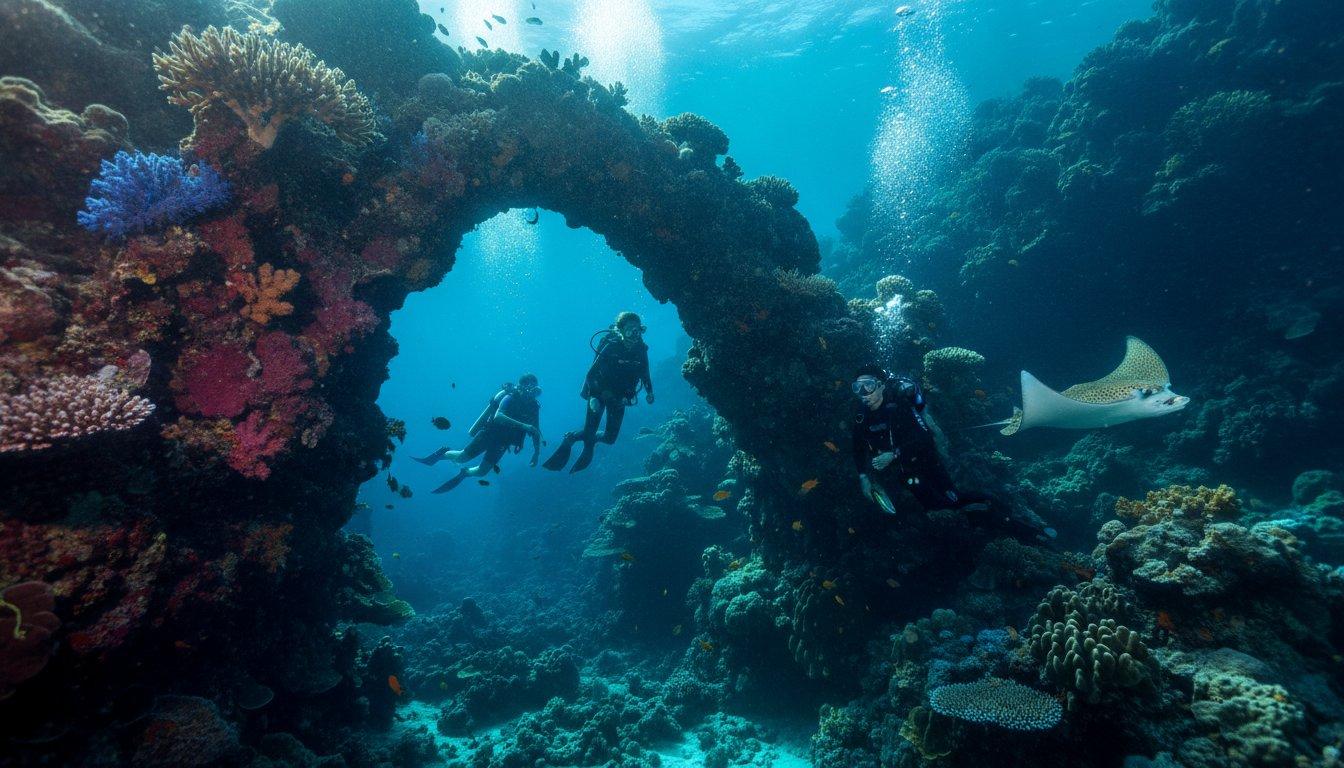
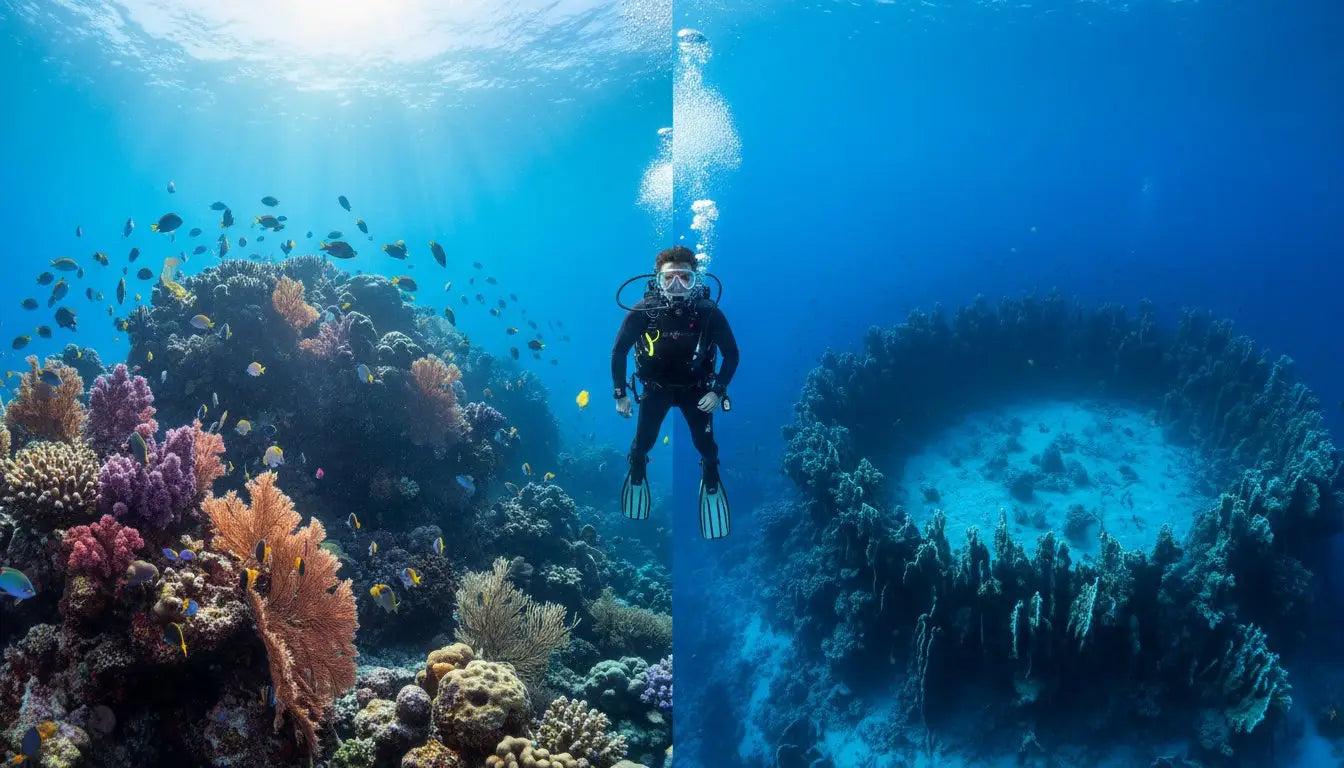
Gardens is a field of separated coral structures sitting on white sand. The heads rise off the bottom in clumps with wide, bright channels of sand between them. Nothing closes over your head. Light comes down and bounces back up off the sand, so the whole dive is lit from two directions and the colours stay saturated — at 40 feet, red and orange are still red and orange without a torch. Navigation is trivial: reef on one side, blue on the other, sand below, drifting north. You can stop at a coral head, look under a ledge and let the group catch you up without losing anything.
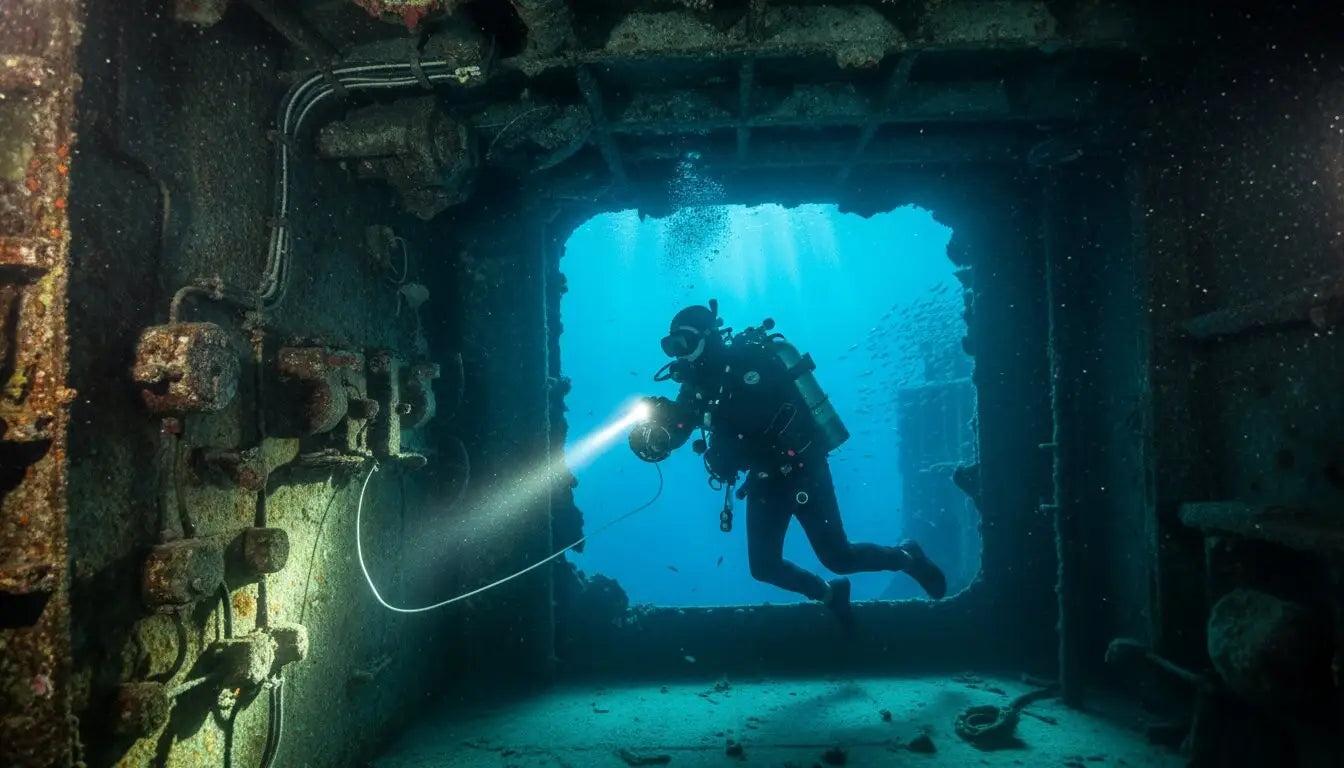
Horseshoe is a single continuous formation bent into a curve, open to the sea. Divers typically enter over the shallower inner arc and work outward toward the seaward edge, where the reef stops and the bottom falls away into open water. That edge is the site. Standing at the lip of a drop-off looking down into water with no visible floor is a specific, slightly vertiginous sensation, and it is what people come here for. The structure is taller, more enclosed, more shadowed, and it reads vertically — you are moving up and down through it as much as along it.
The practical consequence: Gardens forgives an imprecise dive and Horseshoe does not. On a horizontal dive over sand, drifting five feet high or low costs you nothing. On a curved wall, five feet of uncontrolled descent at the lip becomes twenty in the time it takes to notice, and you are now at 100 feet with a different set of numbers to manage. Neutral buoyancy is a nice-to-have at Gardens and a requirement at Horseshoe.
What The Depth Difference Actually Costs You
This is the part most comparisons skip, and it is the part that decides the dive. Depth costs you gas and it costs you no-stop time, and the two costs compound.
Gas first. Air consumption scales with absolute pressure, which rises by one atmosphere every 33 feet of seawater. A diver at 40 feet is breathing at roughly 2.2 atmospheres; the same diver at 90 feet is breathing at roughly 3.7. That is about 70 percent more gas for every identical breath. Move to 110 feet, the bottom of Horseshoe's range, and you are at roughly 4.3 atmospheres — more than double the consumption rate of a shallow Gardens profile. Nothing about your breathing has changed. The physics has.
No-stop time second. On standard recreational air tables, the no-decompression limit at 60 feet is roughly 55 minutes; at 80 feet roughly 30; at 100 feet roughly 20; at 110 feet roughly 16. A dive computer working a multilevel profile will usually give you more than a flat table does, because you are not sitting at maximum depth for the whole dive. But the direction is fixed, and at the deep end of Horseshoe you can be looking at a no-stop clock that runs out before your tank does.
| Profile | Approximate gas use versus 40 ft | Approximate no-stop limit on air |
|---|---|---|
| Gardens, 40 ft | Baseline | Effectively not the limiting factor |
| Gardens, 60 ft | About 1.3× | Roughly 55 minutes |
| Gardens deep end, 80 ft | About 1.5× | Roughly 30 minutes |
| Horseshoe, 90 ft | About 1.7× | Roughly 25 minutes |
| Horseshoe, 100 ft | About 1.8× | Roughly 20 minutes |
| Horseshoe deep end, 110 ft | About 2.0× | Roughly 16 minutes |
Read the table as a pair of columns rather than two separate facts. At Gardens the constraint is how much gas you carry, and a shallow multilevel profile stretches a single tank a long way. At Horseshoe the constraint switches to nitrogen loading and depth — and for a diver with heavy air consumption, both constraints bite at once and the dive ends early. If you are the person who is always first to signal a low tank, Horseshoe will cut your dive short in a way Gardens will not. Working on that is worth more than any gear upgrade; the air consumption guide is the practical version.
Nitrox changes one half of this and not the other. Enriched air extends your no-stop time at Horseshoe depths meaningfully; it does nothing at all for how fast you empty the tank. If your dives end because the computer says so, nitrox helps — the nitrox diving guide and the PADI Enriched Air course cover it. If your dives end because the gauge says so, it does not.
Why Gardens Is Rated Beginner And Horseshoe Intermediate
The ratings are not arbitrary and they are not about how impressive the site is. They track three things.
Depth against certification. A PADI Open Water Diver is trained and certified to 60 feet. Gardens tops out at 80 but the entire top of the reef sits at 30, so an Open Water diver can run the whole dive inside their training limits and still see the site properly. Horseshoe starts at 50 and the structure that defines it sits below 80. An Open Water diver at Horseshoe is either diving a fraction of the site or diving outside their certification. That is the whole rating in one sentence. Advanced Open Water extends the trained limit to 100 feet, which is why it is the sensible prerequisite here rather than a formality — the Advanced Open Water guide explains what the deep dive actually teaches.
Consequence of error. Both sites carry mild to moderate current, so that is not the differentiator people assume it is. The differentiator is what happens when something goes slightly wrong. A buoyancy lapse at 40 feet over sand is an inconvenience. The same lapse at the lip of a wall at 90 feet is a rapid deepening with a compressing wetsuit accelerating it. Gardens absorbs mistakes; Horseshoe converts them into depth.
Task loading. At Gardens you are looking at reef. At Horseshoe you are looking at reef while also watching a computer that is counting down, tracking a wall edge, managing trim in a more three-dimensional structure, and keeping an eye on a gauge that is dropping faster than you are used to. None of that is hard. All of it is more than a diver on their eighth dive should be handling at once.
Two courses genuinely move the needle if Horseshoe is the goal: Peak Performance Buoyancy for the control, and the Deep Diver specialty for depth-specific planning — the deep diver specialty guide covers what it involves.
What You Will Actually See At Each Site
The recorded marine life for the two sites overlaps heavily and then diverges in a way that is worth knowing.
| Species | Gardens | Horseshoe |
|---|---|---|
| Barracuda, grouper, grunt, jacks, snapper | Yes | Yes |
| Parrotfish | Yes | Yes |
| Nurse shark | Yes | Yes |
| Octopus | Yes | Yes |
| Reef shark | Yes | Yes |
| Spotted eagle ray | Yes | Yes |
| Splendid toadfish | Yes | Not recorded |
| Southern stingray | Yes | Not recorded |
| Lobster | Yes | Not recorded |
| Sea fan | Yes | Not recorded |
The pattern is consistent with the topography rather than a coincidence. The four species recorded at Gardens and not at Horseshoe are all shallow-and-sand animals: the splendid toadfish lives under ledges and in burrows in the sand-and-coral-head environment, southern stingrays work sand flats, lobster tuck into low ledges, and sea fans grow where there is enough light and water movement at moderate depth. Gardens has all of that. Horseshoe, being deeper and more vertical, does not.
So if your goal is the endemic toadfish — the one animal in Cozumel that genuinely exists nowhere else — Gardens is the better ask, and the splendid toadfish guide covers how to look. If your goal is macro, small stuff and colour, Gardens again: at 40 feet you have the light for it. If your goal is scale, blue water and the chance of something large crossing the drop-off, Horseshoe, where spotted eagle rays working along the wall in winter are the classic sighting. Neither site is a reliable big-animal destination; the Cozumel shark guide is honest about what actually turns up.
Which One Should You Ask For?
You finished Open Water in the last year and have under twenty dives. Gardens. This is not a compromise — it is the site that lets you see the reef instead of managing your gauges. Ask the guide to keep the profile between 40 and 60 feet and you will have a long, bright, unhurried dive. The first drift dive guide covers what the drift itself feels like.
You are Open Water certified but comfortable and good on air. Gardens, or the shallow inner arc of Horseshoe if the guide is willing and the group is small. Do not let a boat put you on a 90-foot Horseshoe profile because everyone else is going.
You are Advanced Open Water with reasonable buoyancy. Either. Horseshoe is the one you cannot do at Gardens, so if you are only diving Palancar once, take it.
You burn through a tank fast. Gardens. A heavy breather at 90 feet gets a fifteen-minute dive and a long, resentful safety stop. The same diver at 45 feet gets fifty minutes.
You dive with a camera. Gardens for macro and colour; Horseshoe for wide-angle and scale. If you want the wall shot, go wide, get shallow enough that ambient light still means something, and expect to work — the underwater photography course guide covers the technique.
You get anxious about depth or blue water. Gardens, without hesitation. A wall edge with nothing below it is not a neutral experience and there is no reason to find out the hard way at 90 feet.
You want the thing Cozumel is famous for. Horseshoe. The drop-off is the reason the southern reef has its reputation, and there is no shallow version of it.
You May Not Have To Choose At All
Gardens and Horseshoe are adjacent sections of the same reef, which is why operators routinely run both on a single two-tank morning rather than picking one. If that is on offer, it resolves the question entirely.
The order matters, and it is always the same: deep first, shallow second. Horseshoe on the first tank, when you are fresh and carrying no residual nitrogen and your no-stop time is at its longest, then a long surface interval, then Gardens on the second tank as a shallow multilevel drift. Doing it the other way round shortens the deep dive substantially and is the wrong way to plan a repetitive pair. If a boat proposes Gardens first and Horseshoe second, ask why.
Two things to check before you assume you are getting both. First, that the operator is diving Horseshoe rather than diving Gardens twice and describing the morning as "Palancar" — the sections are distinct sites and the pillar guide explains why the label alone tells you nothing. Second, that the boat's plan matches the least experienced person on it, because it will regardless of what you asked for. A mixed-certification group tends to get two Gardens-depth profiles no matter what the schedule said, which is the correct call for safety and a disappointment if you booked for the wall.
If Palancar is fully booked out or conditions push the boat elsewhere, the nearest equivalents are worth knowing. For a Gardens-like shallow reef drift, La Francesa at 30 to 60 feet or Paso del Cedral at 45 to 100. For a Horseshoe-like wall, Santa Rosa Wall at 50 to 120, though it carries a stronger current and is rated Advanced. And if you want the swim-throughs specifically rather than the wall, that is Palancar Caves next door, not Horseshoe.
Asking For The Site You Want
Site selection in Cozumel is made on the day by the captain and guide, based on conditions, the marine park's mooring allocations and the composition of the group. You are not choosing from a menu. But you have more influence than most divers use, provided you do three things.
Say it when you book, not on the boat. By the time the boat leaves the pier the plan is set. Be specific about the reason rather than the name — "I want a shallow site, I use air quickly and I would rather have fifty minutes at 45 feet than twenty at 90" gives a guide something to work with in a way that "we want Palancar" does not.
Be honest about your logbook. Overstating your experience to get on a deeper site is how divers end up at 100 feet without the training for it, and the guide has no way of knowing until it is happening. Understating it is also unhelpful — say how many dives, how recently, and how you are on gas.
Ask what the fallback is. Conditions change and the honest answer is often that the site will be decided at the mooring line. A good operator will tell you that plainly. The dive briefing guide covers what the briefing should contain, and conditions vary considerably by month — winter Norte winds can close the southern sites entirely.
Neither site is best. Gardens is the better dive for most divers most of the time, because most divers get more from fifty relaxed minutes in good light than from eighteen tense ones at depth. Horseshoe is the better dive when you have the certification, the buoyancy and the gas discipline to spend your bottom time looking at the wall rather than at your computer. Work out honestly which of those describes you today, and ask for that one. Start planning your Cozumel dive trip with the depths, the ratings and your own logbook in front of you.
Frequently Asked Questions
What is the difference between Palancar Gardens and Palancar Horseshoe?
Is Palancar Gardens suitable for beginner divers?
How deep is the Palancar Horseshoe dive site?
Do you need an Advanced Open Water certification for Palancar Horseshoe?
Can you dive both Palancar Gardens and Horseshoe in one day?
Which Palancar site should you dive first on a two-tank morning?
Are the currents stronger at Palancar Horseshoe than at Palancar Gardens?
Where are you more likely to see a splendid toadfish at Palancar?
Can snorkelers visit Palancar Gardens or Palancar Horseshoe?
Does diving nitrox help at Palancar Horseshoe?
Share This Article
Carmen Novelo
Carmen Novelo is a Cozumel native and an active scuba instructor and dive guide on the island. She has spent twelve years diving the Cozumel reef system, and writes about its dive sites, conditions and marine life for Cozumel Dive Hub.