Cozumel Dive Boat Pickup Hotels: Your Stress-Free Logistics Guide for 2026
A hotel with its own dock saves you a taxi and about half an hour every morning, but you usually pay a per-person fee to walk down it. At a few properties that fee is set high enough to work as a fence around the shop in the lobby.
Luisa Carmona · May 3, 2026 · 17 min read
Here is the trade-off nobody puts in the brochure. A hotel with its own dock saves you a taxi ride and roughly half an hour of faffing every morning. In exchange, you usually pay a per-person fee to walk down that dock, and at a handful of properties the fee is set high enough that it is not really a fee — it is a fence, built to keep you diving with the shop in the lobby.
That is the whole decision. Everything else on this page is detail about how the fence is built in each part of the island, what it costs to walk around it, and when the convenience is genuinely worth it.
One thing to fix first: pier access, taxi fares and the marine park fee are three separate charges, and only one of them is usually in the price you were quoted. Sorting them out before you book a room is easier than sorting them out at 7:40 a.m. with a boat idling at the end of the dock.
The Three Charges, Kept Straight
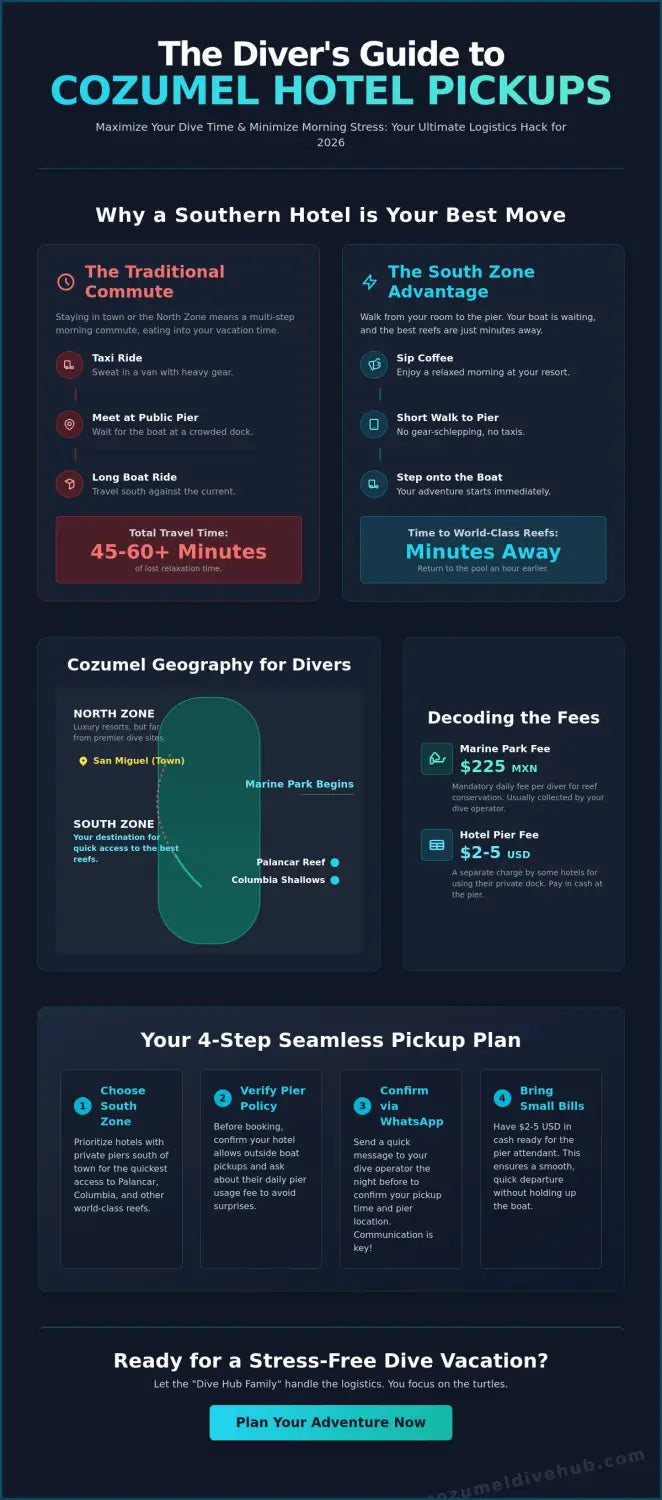
The marine park fee is federal. Every diver entering Parque Nacional Arrecifes de Cozumel pays it, once per day, regardless of where you sleep or who you dive with. Operators currently quote it at 225 pesos per person per day — it rose sharply at the start of 2025, from 108 pesos to 218.32, and has crept up with the annual adjustment since. Some shops fold it into the price, most collect it in cash on day one. Our breakdown of the 2026 marine park fees covers the annual pass, which pays for itself somewhere around the eighth dive day.
The pier fee is private. It goes to the hotel or marina that owns the dock, not to the park and not to your operator. It is charged per person, per day, and it exists because the property maintains the structure and pays the insurance.
The taxi fare is the third, and it is the one that quietly disappears if your pier works out.
| Charge | Who collects it | Typical amount | Usually in the quoted price? |
|---|---|---|---|
| Marine park fee | Federal park authority, via your operator | ~225 MXN per diver per day | Sometimes — ask explicitly |
| Hotel or marina pier fee | The property that owns the dock | ~$2–5 USD (about 100 MXN) per diver per day; far higher at a few resorts | Rarely |
| Taxi to a pier or shop | Driver, fixed rate by zone | ~65–300 MXN each way | No |
| Public cruise-pier access | Pier operator | ~$1–2 USD per person | Sometimes |
How the Pier Fee Actually Works
At most properties this is unremarkable. Around 100 pesos — call it five dollars — per diver per day, paid in cash at the dock or added to your room folio. Operators that run hotel pickups publish which piers they can use and how the fee is settled: at some resorts the dive shop coordinates and passes the charge through, at others you settle directly with the hotel before the boat arrives. Smaller operations run pickups too: Aquamarinas, a German-run centre that caps groups at six divers per guide, lists hotel pickup as standard. Dive With Martin, for example, lists Iberostar, Occidental and Allegro as coordinated through the shop, while Villa Blanca, Park Royal, El Cid, Secrets Aura, Sunscape Sabor, Residencias Reef and Dreams are paid directly by the guest.
Bring small bills. The attendant will not have change for a 500, and the boat will not wait while you find some.
Then there is the other kind of fee. When Cozumel Palace introduced a pier charge of $25 USD per person per day for guests using outside operators — while exempting anyone diving with the in-house shop, which the resort owns — it caused a well-documented uproar among divers, precisely because $25 a head is not cost recovery. It is a toll designed to make the in-house option the only sensible one. Set against the roughly $3.50 a day reported at a neighbouring resort, the intent is hard to miss.
Very few properties price it that aggressively. But it is why "does the hotel have a pier?" is the wrong question, and "what does the hotel charge an outside boat's guests to use it?" is the right one. Ask before you book the room, in writing, and ask for the number — not for whether outside boats are "allowed."
The In-House Dive Shop Trade-Off
Several Cozumel hotels have a shop on the property, sometimes a very good one. Dressel Divers operates out of Iberostar, Blue Angel runs its own resort with a house reef at the end of the dock, and Scuba Du and Aqua Safari are long-established names attached to properties.
The convenience is real and worth naming: your gear stays rinsed and hanging in their room, you walk out in a rash guard, nobody carries a tank anywhere. Over five or six days that adds up.
The cost is optionality. Once you are on a property with an in-house shop, switching operators mid-week means either paying the outside-boat pier fee or taking a taxi. That matters more than it sounds, because the fit between diver and operator is not knowable in advance. Group size, boat speed, how hard the guides push depth, whether the day is a compact morning that has you back by one o'clock or a long haul on a crowded cattle boat — you find that out on day one. If day one goes badly and you are locked in by geography and a fee schedule, that is your week.
The practical answer: if you already know the operator you want, book the hotel that lets you reach them cheaply. If you do not, stay somewhere with a real choice within a short taxi ride, and browse the Cozumel dive centers directory before you commit to a full-week dive package.
Zone by Zone
Cozumel's reefs run down the leeward side, and the famous ones — Palancar, Colombia, Punta Sur — sit at the southern end. Boats start downtown or at the marinas and run south. That single geographic fact drives everything below.
Two operators independently describe the same practical boundary: pickups run from just south of downtown through the southern resort zone, and not north of town. Living Underwater's published pricing includes pier pickup "for most locations south of town." Dive With Martin's runs from Hotel Barracuda southward and includes Iberostar. North of San Miguel, you are getting in a taxi.
North Zone
Hotels north of San Miguel are pleasant, often better value, and wrong for logistics. Boats do not usually come this far up, because running north to collect you and then back south past town burns close to 40 minutes of engine time before the first dive.
You will taxi. Roughly 100–200 pesos into town or to a marina, ten to twenty minutes. Budget the same coming home, or plan on a taxi from the shop.
The trade-off: you give up about an hour a day, and two taxi fares, for a nicer room at a lower rate and a quieter beach. For a one- or two-day dive trip that is fine. For six days it is six hours.
Downtown and San Miguel
Staying in town is underrated. Most shops are here, the marina meeting points are here, and the walk to a boat is often under ten minutes. No pier fee, because you are not using a hotel's pier.
Taxi cost is frequently zero. When you do need one, the in-town minimum applies — currently around 65–100 pesos.
The trade-off: you are furthest from Palancar by boat, adding maybe fifteen minutes each way, and you sleep in a town rather than on a beach. In return you have the widest operator choice on the island and nothing locking you to any of them.
Near South — Barracuda to the Cruise Terminals
This is the sweet spot for most divers. Properties along this stretch — Villa Blanca, Casa del Mar, El Cid, Blue Angel, Park Royal — have working piers, sit inside the standard pickup range, and are ten minutes from town by cab.
A pier fee applies at most of them, in the ordinary $2–5 range. A taxi into town runs roughly 95–150 pesos, so switching operators stays cheap if you want to.
The trade-off: almost none, which is why it costs more. You get boat pickup at the dock and a taxi option that is genuinely affordable if the pickup does not work out.
Far South — Cruise Terminals Down to the Iberostar Stretch
The all-inclusive belt: Iberostar, Allegro, Occidental, Secrets Aura, Sunscape Sabor, the Residencias Reef condos. Closest to Palancar and Colombia, and the shortest boat rides on the island.
Pier fees apply and are usually coordinated through whichever shop serves the property. Taxis into town are the expensive part — roughly 200–300 pesos each way, more from the deep-south properties — which is precisely what makes the in-house shop feel inevitable once you are down there.
The trade-off: the best water access on the island in exchange for the least flexibility. Worth it if you have already chosen your operator and they serve that pier. Expensive if you have not.
| Zone | Boat pickup at a hotel pier? | Taxi each way | Be ready by | Main trade-off |
|---|---|---|---|---|
| North Zone | Rarely | ~100–200 MXN | 7:00–7:15 a.m. | Cheapest rooms, longest mornings |
| Downtown | Not applicable — walk or short cab | 0–100 MXN | 7:30 a.m. | Widest operator choice, longest boat ride |
| Near South | Usually, ~$2–5 fee | ~95–150 MXN | 7:45 a.m. | Best balance; priced accordingly |
| Far South | Usually, fee via the shop | ~200–300 MXN | 7:45–8:00 a.m. | Shortest boat rides, least flexibility |
Taxis Are Fixed Rate by Zone, Not Metered
There is no meter in a Cozumel taxi. Fares are set by zone under a tariff authorized by the Quintana Roo state transport authority, and drivers carry a printed rate card. You are entitled to see it, and asking is normal rather than rude.
What travellers actually report paying, in pesos: an in-town minimum around 65–100; downtown to the near-south hotels around 95–150; downtown to the far-south properties and beach clubs 200–300; north-zone hotels 100–200. Surcharges exist for phone-dispatched rides, pickups at the fiscal pier and late-night trips.
Two practical notes. Pay in pesos — drivers who accept dollars set their own exchange rate, and it is never in your favour. And agree the fare before you get in, not at the destination with your gear already out of the trunk.
How Early to Be Ready
Morning boats generally leave between 8:00 and 8:30. Work backwards from there.
If you are getting a pier pickup, be standing on the dock — assembled, wetsuit half on, pier fee in hand — ten minutes before the stated time. A pier stop is a rolling schedule; the boat may have three more to make and cannot absorb your delay. If you are taking a taxi, add fifteen minutes of buffer, because cabs cluster at the cruise terminals when a ship is in and thin out everywhere else.
Whichever it is, confirm the meeting point the evening before. Pier gates get locked, boats get reassigned, and the pickup point named in your booking email is not always the one being used on the day. This matters even more for a night dive, when many hotel piers are dark or closed and the meeting point moves by default.
If Your Hotel Has No Pier
Nothing is lost. Most operators will meet guests at a public dock or a marina — the ASIPONA marina is a common one — and the walk from a cruise pier to a shop is often ten to twenty minutes. Public piers carry their own small access charge, on the order of $1–2 per person, and some of them include beach and pool access for the day.
If you are in a condo or a rental, this is the normal arrangement rather than a workaround, and it costs you one taxi fare each way.
What Changes When The Dive Shop Owns The Pier
A hotel pier is a dock you pay to walk down. A shop-owned pier is a different arrangement: the operator boards divers from a dock it owns or controls, usually immediately outside its own premises, rather than from a shared public marina slip or somebody else's hotel dock. A minority of Cozumel shops work this way, and what it changes is the shape of your morning, not the quality of the diving.
What it removes is transit and waiting. On a typical marina morning you go to the shop first for gear, paperwork and a briefing, then travel again to the marina where the boat is berthed. That is two journeys before you are on the water. Boats at a busy public dock also work a rotation: slips are shared, loading order is not yours to set, and departure happens when the queue allows. Boarding from the shop's own dock collapses both of those into a walk.
| What A Shop-Owned Pier Removes | What It Puts In Its Place |
|---|---|
| A second taxi or shuttle from the shop to the marina | One journey: taxi to the shop, gear up, walk to the boat |
| A per-person pier fee paid to a hotel or marina | No third-party boarding charge, though confirm it is not simply folded into the dive price |
| Waiting for a slip in a shared public dock rotation | Departure when the boat and the divers are ready |
| Hauling wet gear back to the hotel every afternoon | Kit rinsed and stored on site overnight for multi-day divers |
| A briefing delivered over the noise of a working harbour | A quiet, stable place to be briefed and to check a camera rig |
The gear-storage point is the one that compounds. Across five or six diving days, not carrying a wet bag twice a day is worth more than the twenty minutes saved on any single morning. It is the same argument that makes an in-house hotel shop attractive, arrived at from the other direction.
What A Private Pier Does Not Change
This is where the marketing tends to run ahead of the facts, so it is worth being blunt.
It does not make the diving better. The dive is decided by the guide-to-diver ratio, who chooses the sites, and how the group is run underwater. A shop with its own dock can still put twenty divers on one hull behind two guides. If group size is what you care about, that is a separate question with separate answers, set out in the guide to avoiding crowded dive boats.
It can mean a longer boat ride. This is the counterpoint nobody advertises. Cozumel's best-known reefs sit at the southern end of the island. A pier in or north of San Miguel is further from Palancar and Colombia than the southern marinas are, so twenty minutes saved on land can come straight back as extra transit on the water, twice a day. Ask where the pier sits relative to the sites on that day's schedule before counting the convenience as a net gain.
It does not waive the marine park fee. That is federal, charged per diver per day, and owed wherever you board.
It does not beat the weather. When the Port Captain closes the port in a norte, nothing leaves any dock, private or public.
And "private pier" is not a defined term. Some shops own their dock. Others have an arrangement to use a hotel's, which is a normal and perfectly workable setup but is not the same thing and can carry the same access politics described above. Ask who owns it, where it is, and whether anything is charged to board.
| The Claim | What To Check |
|---|---|
| "Private pier, no crowds" | The number of divers on the boat and the number per guide |
| "Direct boat access from our shop" | Whether the shop and the pier are actually the same address |
| "No marina fees" | Whether a boarding charge is separate, included, or genuinely not applicable |
| "Faster to the reef" | Where the pier sits relative to the southern sites you want to dive |
| "Gear storage included" | Whether overnight storage and rinsing are offered, or merely implied |
For divers arriving by ship the calculation is sharper, because port time is fixed and a shop you can reach in one taxi and board from directly beats the shop-then-marina shuffle. The cruise port diving guide covers that timing, and the dive centers directory is the place to check where an operator actually boards its divers.
Deciding
Three honest cases.
You already know your operator. Book a hotel on a pier they serve, confirm the fee in writing, and stop thinking about it. This is the cheapest and calmest outcome.
You have not chosen yet and want to keep your options open. Stay downtown or in the near south. The taxi is cheap enough that a bad first day costs you a hundred pesos instead of your week. Compare shops in the dive centers directory, and read up on how drift diving here actually works before you pick one.
You are on an all-inclusive and diving is one part of the trip. Use the in-house shop. Between the outside-boat pier fee and a 250-peso cab each way, the arithmetic is not close, and the shops attached to the big southern resorts are competent.
For the wider question of which neighbourhood suits your trip beyond the dive logistics, the where to stay in Cozumel guide covers food, beaches, noise and walkability. The trip planning checklist has the pre-arrival sequence, and the US-based trip guide covers flights and arrival timing.
One last note on the current: none of this matters on a day the port is closed. Winter northers shut down boat traffic several times a season, and a hotel pier does not exempt you. Build one flexible day into any trip shorter than a week, and read the hurricane and weather guide if you are travelling between June and November.
Ready to line up the pier, the shop and the room so they actually agree with each other? Start with the Cozumel dive trip planner.
Frequently Asked Questions
Share This Article
Luisa Carmona is a PADI Master Scuba Diver Trainer living and working in Cozumel. She has been diving its reefs most of her life and has thousands of dives logged here. She knows the reefs season by season and the marine life that comes with them, and has great friendships and relationships with the shops and guides working the island. Each year her knowledge helps hundreds of visitors get more out of diving in Cozumel.
@cozumelmermaid