Diving Near Cozumel Cruise Port: A Cruise Passenger's Guide (2026)
Why settle for a crowded "cattle boat" with 30 other divers just because you're worried about your ship's 5:00 PM departure? We know that for many travelers, the dream of exploring Cozumel's pristine reefs often gets overshadowed by the fear of being left behind or hit with hidden fees for gear and
Luisa Carmona · April 28, 2026 · 18 min read
Every other decision about diving on a cruise day is downstream of one number: your all-aboard time. Not the price, not the reef, not the shop's review count. The deadline decides which sites are physically possible, which boat you can be on, and how much slack you have before a delay turns into a very expensive afternoon.
That is an uncomfortable place to start a guide, but it is the truth of the thing. Cozumel is one of the easiest cruise ports in the Caribbean to dive from — the reef runs parallel to the coast a few minutes offshore, the water is warm, and there are more dive centres per square kilometre than almost anywhere else in Mexico. What it is not is forgiving of a diver who books the wrong itinerary. Get the timing right and a port day is two excellent dives with hours to spare. Get it wrong and you are standing on the pier watching your ship's stern.
This page is about getting it right, and about being straight with you regarding what you are actually taking on.
What the Ship Actually Guarantees
The folk version of this rule — "the ship waits for its own tours and leaves everyone else" — is close enough to be useful and wrong enough to be worth stating properly.
Cruise lines publish the policy plainly. Royal Caribbean's own FAQ states that if you book a shore excursion through the line and the tour is delayed, the ship will wait for you, and that if the delay is severe enough that it genuinely cannot wait, the line will make the arrangements to get you back to the ship at no cost to you. The same page is equally plain about the other case: the ship will not wait for a guest travelling on their own, because being aboard before scheduled departure is that guest's responsibility.
Read carefully, the guarantee is not really "the ship waits." It is the line accepts the liability. When the tour is contracted by the cruise line, the line knows precisely where you are, how late you are, and what it will cost to reunite you with the ship — so it absorbs that cost. When you book independently, nobody on the bridge knows you exist as a problem until the manifest comes up short, and the cost of solving it lands on you.
The practical consequences of missing the ship in Cozumel are worth spelling out, because divers routinely underestimate them:
- The ship's local port agent becomes your point of contact. You will be given that agent's details in the daily programme — photograph the page.
- You arrange and pay for your own flights to the next port, plus a hotel if the timing demands one.
- Your passport becomes essential. Plenty of people sail closed-loop itineraries out of US ports on a birth certificate and photo ID, which is legal for the cruise but not sufficient for an international flight. The US State Department's standing advice is that every cruise passenger carry a passport book precisely because you need one to fly home from a foreign port in an emergency.
- Your luggage, medication, and everything else stays on the ship.
None of this makes independent booking a bad idea. It makes it a decision with a real, quantifiable downside that you can engineer around — which is exactly what the rest of this page is for.
| Ship's Excursion | Independently Booked | |
|---|---|---|
| If the tour runs late | Line holds the ship or gets you to the next port at its expense | Ship sails; you make your own arrangements |
| Group size | Typically large, mixed-ability | Usually smaller, often six divers or fewer |
| Sites | Chosen for schedule certainty, often shallow | You have a say, within the deadline |
| Cost | Higher | Generally lower |
| Who carries the risk | The cruise line | You |
The Three Piers and What Each One Means for Your Morning
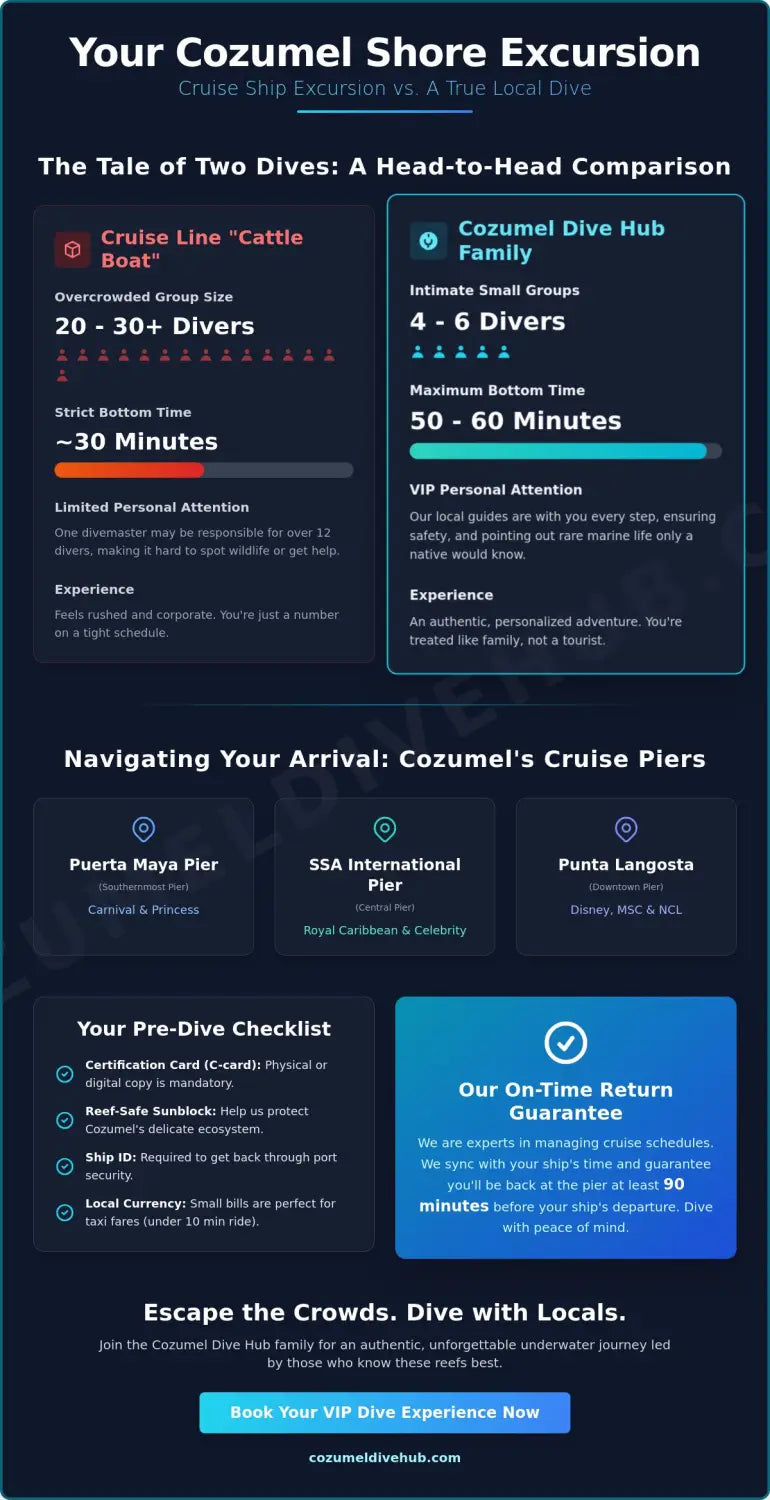
Cozumel has three cruise berths, and which one you are assigned changes your first thirty minutes ashore more than anything else.
| Pier | Where It Sits | Usually Serves | Getting to Town |
|---|---|---|---|
| Punta Langosta | In downtown San Miguel, on the waterfront | MSC, Disney, some NCL and Celebrity ships | You are already there — step off and you are on the malecón |
| International Pier (SSA/TMC) | Roughly 4 km (2.5 miles) south of downtown | Royal Caribbean, Celebrity, NCL, Holland America, Princess | Taxi, about 10 minutes |
| Puerta Maya | Immediately south of the International Pier, roughly 5 km (3 miles) from downtown | Carnival and its sister brands | Taxi, about 10–15 minutes |
Two things follow from that table.
First, Puerta Maya and the International Pier are neighbours. If your ship is at one and your dive shop's meeting point is at the other, that is a short walk along the coast road, not a crisis. Punta Langosta is the outlier — it is a genuinely different part of the island, several kilometres north.
Second, and counterintuitively, the two southern piers are closer to the diving than downtown is. The reef line runs south along the west coast, and the first named sites begin almost directly offshore of the International Pier. A Punta Langosta passenger has a slightly longer transfer to most boats; a Puerta Maya passenger is already at the right end of the island.
Pier assignments do move. Port traffic, weather, and schedule changes reshuffle berths, and a ship that "always" docks at Puerta Maya can be sent to the International Pier for the day. Check your daily programme the night before rather than assuming, and give your dive shop your ship's name rather than a pier name so they can look it up themselves.
Where the Dive Shops Sit Relative to the Piers
Dive centres cluster in three broad places: along the downtown waterfront within walking distance of Punta Langosta, around the marinas and hotel piers just south of town, and further south near the resort strip. You can browse the full picture in the Cozumel dive centre directory, and the criteria that actually separate a good operation from a mediocre one are covered in the guide to choosing a Cozumel dive shop.
For a cruise day, though, proximity is close to a red herring. Ten minutes of taxi time is trivially recoverable; a boat that departs forty minutes late is not. A shop fifteen minutes further from your pier that leaves the dock at 8:15 sharp will get you back earlier than a shop next door that waits for stragglers until 9:30. Ask about the departure time, not the address.
A Realistic Cruise-Day Timeline
Most ships reach Cozumel between 7:00 and 9:00 in the morning and post an all-aboard 30 to 60 minutes before the scheduled sailing. A standard Cozumel two-tank morning runs roughly three and a half to five hours dock to dock, with boats typically leaving between 8:00 and 9:00 and returning somewhere between 1:00 and 3:00 in the afternoon.
Lay those two facts side by side and the shape of the day becomes obvious.
| Clock (ship time) | What Should Be Happening |
|---|---|
| 7:30 | Ship alongside; you are near the gangway, not still at breakfast |
| 7:45 | Ashore, through the terminal, in a taxi or walking to the meeting point |
| 8:15 | At the shop, paperwork and gear fitting done or nearly done |
| 8:30 | Boat casts off |
| 9:00 | First dive, deeper site of the two |
| 10:00 | Surface interval under way |
| 11:15 | Second dive, shallower reef |
| 12:30 | Back at the dock |
| 13:15 | Back inside the terminal |
| 16:30 | All-aboard — with roughly three hours of margin you never needed |
That margin is the entire point. It is not wasted time; it is the thing you are buying when you depart early. A blown compressor, a passenger with an ear that will not clear, a port closure that delays the boat's return by an hour — all of these are survivable at 12:30 and none of them are survivable at 15:45.
If your ship is in port for less than about six hours, or arrives after 11:00, do not book two tanks. Book a single tank or a guided shore dive and enjoy it without watching the clock.
Why Palancar and Punta Sur Are Off the Table
This is the part an operator's booking page rarely says out loud: on a cruise day, you are not diving Cozumel's famous southern sites, and you should stop trying to.
Palancar Gardens and its neighbouring sections, Punta Sur and Devil's Throat sit well down the island's southwest corner. The run there adds roughly half an hour in each direction over a mid-island site, and that is only the first cost. The bigger one is the profile: Punta Sur runs 90 to 120 feet and Devil's Throat 80 to 130, both rated advanced with moderate to strong current. A deep first dive forces a longer surface interval before the second, and the whole schedule stretches by an hour or more. Add a boat that leaves fifteen minutes late and you have quietly built a day that finishes at 15:30 instead of 12:30.
Some operators will run south for cruise passengers on a long port call, and on an eleven-hour day with an 8:00 departure it can work. On a normal day it is a bet you do not need to place. Save the southern walls for a land-based trip, read the Palancar guide as homework, and dive something excellent and close instead.
The Mid-Island Sites That Actually Work
Cozumel's reputation rests on the southern reefs, but the stretch between the cruise piers and roughly the midpoint of the island is not a consolation prize. These are real reefs with real structure, and several of them are among the best shallow dives in the Caribbean. They also happen to be twenty minutes or less from the boat's dock.
| Site | Depth (ft) | Level | Current |
|---|---|---|---|
| Villa Blanca Wall | 50–100 | Intermediate | Moderate to strong |
| Paradise Reef | 30–40 | Beginner | Mild to moderate |
| Las Palmas | 40–70 | Beginner | Mild to moderate |
| Chankanaab Reef | 35–40 | Beginner | Mild to moderate |
| C-53 Shipwreck | 40–55 | Intermediate | Moderate |
| Tormentos | 50–60 | Intermediate | Moderate |
| Yucab | 50–60 | Beginner | Moderate to strong |
| Santa Rosa Wall | 50–120 | Advanced | Moderate to strong |
A sensible cruise-day pairing is one of the deeper options first and a shallow reef second. Villa Blanca Wall followed by Paradise Reef is a classic and sits entirely within the pier zone. The C-53 Felipe Xicoténcatl, a former minesweeper deliberately sunk in 2000, is shallow enough at 40 to 55 feet to leave your no-decompression limits comfortable and makes a genuinely memorable first dive. Santa Rosa Wall is further south and more demanding, but it is still reachable on an early departure if the group is experienced.
Every one of these is a drift dive with live boat pickup — the boat follows your bubbles and collects you wherever you surface. If you have never done that, the drift diving guide is worth ten minutes before you fly out. It is easier than it sounds and it is why Cozumel dives are so relaxed.
How to Actually Reduce the Risk
Flagging the risk is easy. Here is what genuinely mitigates it.
Take the earliest departure the shop runs. This is the single highest-value decision on the page. Everything else is a rounding error by comparison.
Say the words "cruise passenger" when you enquire, and give them your ship's name and all-aboard time in writing. A shop that dives cruise guests regularly will immediately ask which pier and what time you sail. One that does not ask is telling you something.
Agree the sites in advance. "Mid-island, back at the dock by 13:00" is a specific commitment. "We'll see what conditions look like" is not, and on a cruise day you cannot afford the flexibility.
Build a buffer and treat it as untouchable. Aim to be back through terminal security 90 minutes before all-aboard. If the plan does not leave that gap on paper, it is the wrong plan.
Check the cancellation and weather terms. Winter nortes close the port for a day or two at a time, and a closed port means no diving regardless of who you booked with. Understand the cancellation policy before you pay a deposit, and read the hurricane season notes if you are sailing between June and November.
Carry dive-specific travel insurance. Standard cruise insurance frequently excludes scuba, and the insurance guide covers what to look for.
Ship Time, Local Time, and the Hour That Eats Port Days
Cozumel sits in Quintana Roo, which has run on UTC-5 year-round since 2015 and does not observe daylight saving. Cruise ships frequently stay on their home port's clock for the whole voyage.
Between mid-March and early November, a ship keeping US Eastern time is therefore an hour ahead of the island. A ship on Central time can be an hour behind. Either way, the number that matters is the one printed in the daily programme, because that is the clock the gangway closes on. Set your watch and your phone to ship time the moment you board, tell your dive shop your all-aboard in local time so there is no ambiguity on their end, and confirm it back to them.
This one mistake strands more passengers than late boats do.
Flying After Diving Does Not Apply. Something Else Might.
A cruise ship stays at sea level, so the usual post-dive altitude problem does not arise when you reboard. That is genuinely one worry you can drop.
Two related ones survive it.
The first is the flight home. Divers Alert Network recommends a minimum 12-hour surface interval before flying after a single no-decompression dive, and at least 18 hours after repetitive or multi-day diving. Count forward from your last dive to your actual departure flight, not to your debarkation time — the flying after diving guide has the detail. If Cozumel is the last stop before you disembark and fly out the following morning, do the arithmetic before you book two tanks.
The second is the next port. If your itinerary includes another dive day, you are now on repetitive multi-day profiles and your limits tighten accordingly — bring your own dive computer rather than relying on a rental you have never seen. And if a later port offers a high-altitude excursion, a volcano road or a mountain zipline, check the elevation against the same guidance.
What to Take Off the Ship
- Your certification card, physical or in the agency's app. No card, no dive.
- Your ship ID card — you cannot get back through the terminal without it.
- Your passport if you brought one.
- Cash in small bills for the taxi and the marine park fee, which is charged per diver per day and is not always included in a quoted price. The marine park fee guide explains the current position, and the currency guide covers pesos versus dollars.
- A photograph of the daily programme page listing the port agent's phone number.
- Reef-safe sunscreen, and a windbreaker for the ride back.
Leave the heavy gear on the ship. Rental kit in Cozumel is generally good and the rental versus bringing your own guide makes the case better than we can here; a mask and a computer are the two things worth carrying.
If You Are Not Certified
An introductory dive is a reasonable use of a port day, with one caveat: it takes longer than an experienced diver expects, because the pool or shallow-water skills session comes first. Budget the same four to five hours, expect a maximum depth around 40 feet, and expect a shallow site close to the piers. The Discover Scuba Diving guide sets out what the session actually involves.
A full certification course cannot be completed in a single port call. If that is the goal, it belongs on a land-based trip.
Before You Book
Cozumel is a wonderful port to dive, and booking independently is usually cheaper, quieter, and better than the alternative. What it is not is risk-free, and no operator can make it so — the ship's departure is not negotiable and the liability, on an independent booking, is genuinely yours.
The mitigation is not complicated. Leave early, dive mid-island, choose an operator who asks about your ship before you have to mention it, and protect a buffer you expect never to use. Do those four things and the odds of a problem drop to something close to background noise.
When you are ready to put the day together properly — sites, timing, costs, and what to confirm before you pay — start with the Cozumel dive trip planner. If you would rather work backwards from budget, the cost breakdown shows what a two-tank morning realistically runs, and the pier-side lunch guide covers what to do with the three hours you will have left over.
Frequently Asked Questions
Share This Article
Luisa Carmona is a PADI Master Scuba Diver Trainer living and working in Cozumel. She has been diving its reefs most of her life and has thousands of dives logged here. She knows the reefs season by season and the marine life that comes with them, and has great friendships and relationships with the shops and guides working the island. Each year her knowledge helps hundreds of visitors get more out of diving in Cozumel.
@cozumelmermaid