Splendid Toadfish: Cozumel's Endemic Fish and Where to Find It
On October 12th, a diver on our morning boat spent six minutes peering into a limestone overhang at Palancar Reef without seeing a thing. It wasn't until Memo pointed his light toward a deep, narrow c
Luisa Carmona · March 7, 2026 · 21 min read
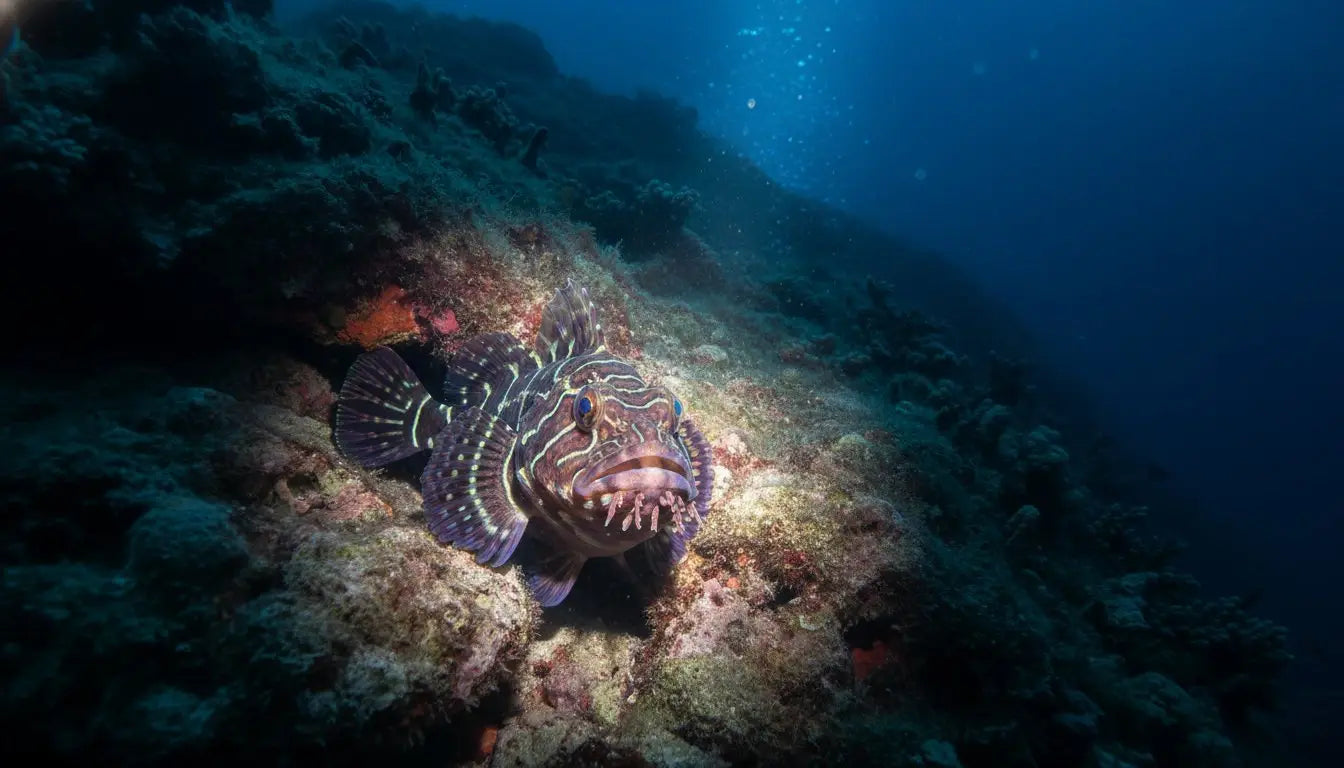
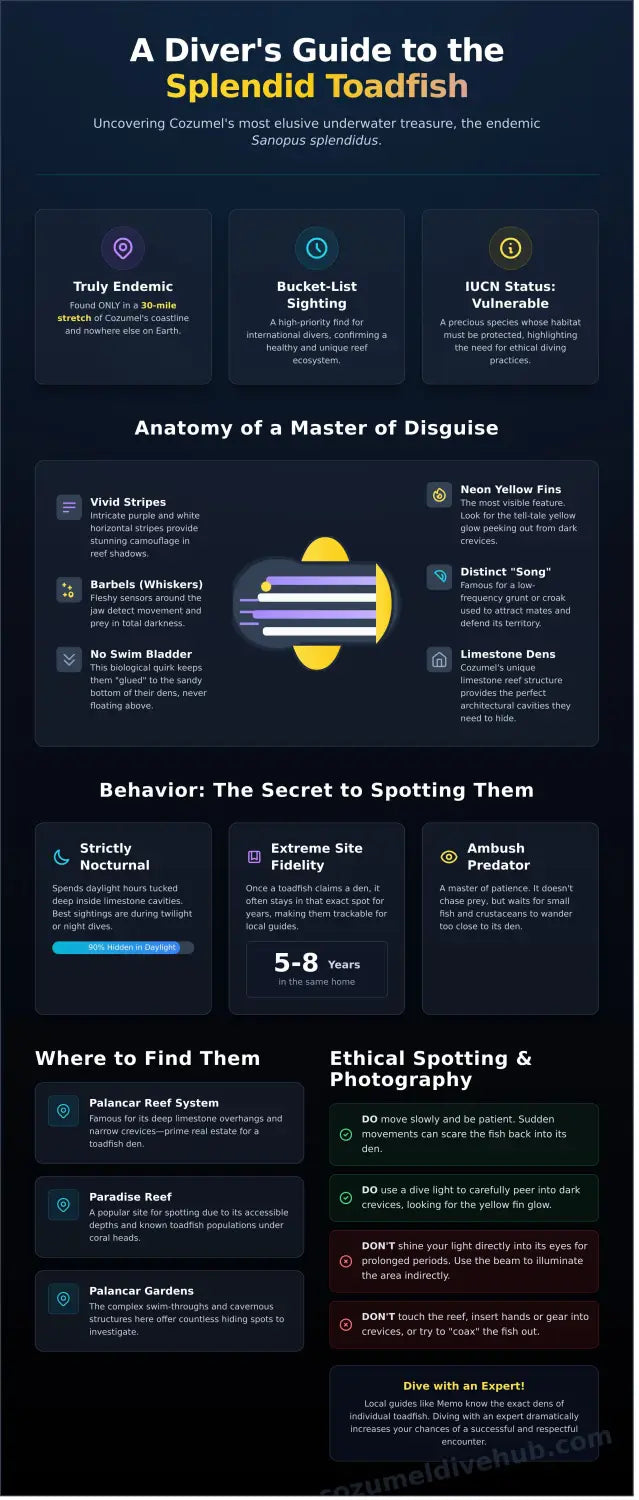
The splendid toadfish (Sanopus splendidus) is a small, flat-headed ambush predator found on Cozumel's reefs and almost nowhere else. Divers see it wedged under coral overhangs and in the shaded gap where a coral head meets sand, usually between 8 and 25 m and most often at 10 to 15 m. You identify it by the vivid yellow margins on its fins and the black-and-white stripes across its head. It is not rare in the sense of being scarce — it is cryptic, motionless and almost entirely hidden by day, which is a different problem.
The fish is common on the reefs it occupies. Whether you see one depends on whether anybody slows down and looks under things.
What Is the Splendid Toadfish?
It is a member of the Batrachoididae, the toadfishes — broad-headed, bottom-sitting fish with large upward-facing mouths and a habit of living in holes. The Cozumel species was formally described in 1974 by Collette, Starck and Phillips.
| Feature | Detail |
|---|---|
| Scientific name | Sanopus splendidus (Collette, Starck & Phillips, 1974) |
| Family | Batrachoididae (toadfishes) |
| Maximum size | Around 24 cm total length; most divers see animals well short of that |
| Depth range | 8–25 m (26–82 ft), usually 10–15 m (33–50 ft) |
| Habitat | Rocky and coral caves, undercut ledges, rubble at the base of coral heads |
| Diet | Small fish, gastropods and polychaete worms, taken by ambush after dark |
| Range | Cozumel and Belize; Cozumel is the centre of it |
| IUCN Red List | Endangered |
| Activity | Nocturnal. Sits in the den by day, hunts at night |
What you actually see. In most encounters only the head is out of the hole; the body stays back in the recess. The features arrive in this order:
- Yellow fin margins. The dorsal, tail, anal and pectoral fins are edged in a bright yellow-orange that no other fish on the reef produces, and the pelvic fins are yellow throughout. This is what your eye catches first, as a flash of colour in a dark gap.
- Head stripes. Horizontal black and white bands running back across a head much broader than the body.
- Barbels. Fleshy tags fringing the lower jaw and the corners of the mouth.
Why Does It Live Only Around Cozumel?
The species has one of the smallest ranges of any Caribbean reef fish, and the reason is a combination of two traits that both limit dispersal.
Adults barely move. Toadfish are poor swimmers, built for sitting rather than cruising. They hold a small home range around a single den and leave it only to feed, at night, over a short distance.
The young do not drift. Most reef fish broadcast eggs into the water column, and the larvae spend weeks in the plankton, which is how species colonise reefs hundreds of kilometres apart. Splendid toadfish do the opposite: the female attaches adhesive eggs to the wall of the den, the male guards them, and the young stay on the bottom until the yolk sac is absorbed, then disperse by crawling. There is no planktonic stage to carry them anywhere.
Add the geography. Cozumel is separated from the Yucatán mainland by a deep, fast channel — the Yucatán Current runs north through it at speed. For a fish that neither swims far nor sends its young out to drift, that channel is a wall.
Is it strictly endemic to Cozumel? Almost every dive shop says so, and it was the accepted position for decades. It is no longer quite accurate. The species has been recorded at Glover's Reef in Belize, and reference works now give the range as Cozumel and Belize rather than Cozumel alone. Its two close relatives, the whitelined and whitespotted toadfish, are Belize animals. What has not changed is where you actually see one: Cozumel is the centre of the range and the only place divers encounter it with any regularity.
Is the Splendid Toadfish Endangered?
Yes. The IUCN Red List assessment for Sanopus splendidus, published in 2012, lists the species as Endangered. Some older references still quote a Vulnerable listing from an earlier assessment round, so you will see both categories in circulation; Endangered is the current one.
The driver is not fishing pressure but the arithmetic of a tiny range. A species confined to the reefs of one island and a handful of Belize sites has no refuge if those reefs degrade. Cozumel's west coast carries heavy dive and cruise traffic, coastal development, anchor and vessel activity, and the coral bleaching pressure affecting the whole Mesoamerican system.
There is a noise dimension too. A 2021 study in Conservation Science and Practice looked at the vocal behaviour of the species on Cozumel and at the potential for vessel noise to mask its calls. Because males use sound to attract females to the den, anything that drowns that signal is a reproductive problem, not just a nuisance.
Which Cozumel Dive Sites Have Splendid Toadfish?
The pattern is consistent: low-profile reef, coral heads separated by sand and rubble, undercut edges to hide beneath. These sites list the species among their resident marine life.
| Dive site | Depth | Why it works |
|---|---|---|
| Playa Corona | 20–40 ft | Shallow shore site, scattered heads over sand, long bottom times |
| Chankanaab Reef | 35–40 ft | Shallow, forgiving, easy to hover and search |
| Chankanaab Bolones | 35–40 ft | Large boulders with undercut bases |
| Yellow House Reef | 35–50 ft | Low relief, plenty of rubble margin |
| La Francesa | 30–60 ft | Classic ledge habitat, moderate current |
| Las Palmas Reef | 40–70 ft | Sand channels between coral heads |
| Tormentos Reef | 50–60 ft | Undercut edges, scattered heads, current can be strong |
| Yucab Reef | 50–60 ft | Textbook ledge habitat; steady current limits hovering |
| Palancar Gardens | 30–80 ft | Big structures — search the base, not the top |
| Paso del Cedral | 45–100 ft | Ledges and rubble; look in the shallower half |
| Punta Tunich | 50–120 ft | Sand and rubble at the reef base, shallower sections only |
| Cantarel | 60–90 ft | Rubble and sand flats; better known for eagle rays |
| Barracuda Wall | 90–130 ft | Advanced site, strong current; the fish sit above the deep sections |
One thing to take from the table: the productive sites cluster in the 30 to 60 ft band, which matches the species' actual 8 to 25 m depth range — on the deeper sites listed, you find them in the shallower portion, not on the wall. The dive site index carries depth and skill level for every reef on the island, and the marine life site guide covers what else the same reefs hold.
How Do You Actually Find a Splendid Toadfish?
Look down and under, not ahead. This is the single biggest change most divers need to make. The fish is never in open water and rarely in open sand. It is in the shadow line where a coral head, a reef ledge or a boulder meets the bottom. Swimming the reef at eye level, you will pass a dozen of them.
Look for the yellow, not for the fish. The body is camouflaged and the head is in shadow. The fin margins are not camouflaged at all. What you register first is a short line of yellow-orange in a dark recess, and only then does it resolve into a face.
Carry a dive light. The recesses are dark at every depth, including 30 ft at midday. Sweep the beam across the gap rather than aiming it into the hole.
Check sand-and-rubble margins. Dens are often marked by a small sloping apron of sand at the entrance, cleared by the fish. Once you learn that shape, you start finding holes before you find fish.
Hold buoyancy instead of touching down. Searching close to the bottom is exactly where fin damage and hand-planting happen. If you cannot hover steadily at 60 cm off the reef, work the site higher up until you can.
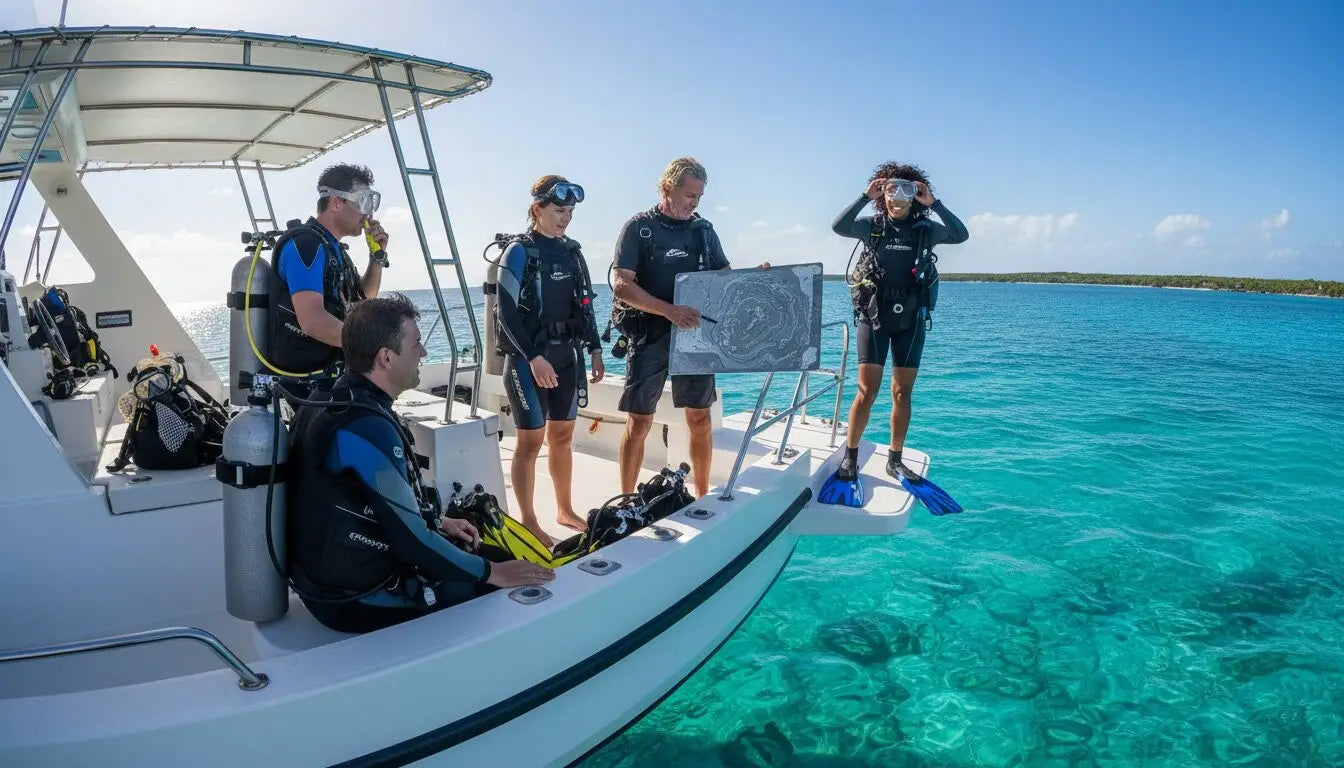
Slow down — which is a booking decision. On a standard drift itinerary you are moving with the current at the group's pace, and the current is doing the deciding. Operators running fixed cruise-schedule departures cannot hold a group for macro searching whatever they say at the dock, because the boat has to be back. If this fish matters to you, say so when you book and ask directly whether the guide will stop. The dive centre guide covers how to ask, and the dive centre directory shows who runs small groups. The current guide explains why some days make searching impossible regardless.
What Sound Does a Splendid Toadfish Make?
Males call. They contract specialised muscles against the swim bladder to produce a low, resonant hum, usually described as a boat whistle or a foghorn, and it is loud enough that divers hear it clearly and regularly mistake it for a boat engine or their own equipment. The toadfish call is an advertisement signal: the male sits in the den and broadcasts to draw a female in to spawn on his ceiling.
For a diver this is a genuine search tool. Sound is hard to localise underwater by ear alone, but hearing the call tells you there is an occupied den within a short radius. Stop, hold position, and search the ledges around you rather than swimming on.
Calling is most obvious around dusk and after dark, which is one reason a night dive on shallow reef is the highest-yield way to encounter the species.
How Do You Photograph One Without Harming It?
The rules here are not etiquette. Parque Nacional Arrecifes de Cozumel is administered by CONANP, every diver pays a marine park fee, and no-touch diving is a federal condition of being in the water.
- Do not touch the fish, and do not touch the coral it lives under. Moving live structure for a better angle damages habitat, and doing it to an Endangered species inside a national park is indefensible.
- Do not shine a torch straight into the hole. Light the scene from the side or bounce it. A beam directly into the den is a disturbance to an animal whose whole strategy is sitting in the dark.
- Do not try to coax it out. No poking, no tickling, no waving a finger at the entrance, no bait. It will not come out for you, and pressuring it costs the animal energy and shelter.
- Do not block the entrance. If the fish is backing further in, you are too close. Reverse and shoot from an angle.
- Two or three frames, then leave. Repeated close-range strobe on a shade-dwelling ambush predator is a disturbance even when the animal does not bolt.
- Keep your fins off the bottom. Most reef damage around toadfish holes comes from divers steadying themselves to compose a shot.
The underwater photography course guide covers what the training actually teaches, and the reef conservation guide and the park regulations guide cover the rules that apply to everything you point a camera at here.
When Is the Best Time to Look?
Year-round. The species does not migrate, because it has nowhere to go. There is no season in which Cozumel does not have splendid toadfish.
What changes is your ability to search rather than their presence.
| Condition | Effect on your odds |
|---|---|
| Dusk and night dives | Best. The fish emerge from the den and call frequently |
| Calm days, good visibility | Better. Searching shadow requires light and stable water |
| Strong current days | Worse. You cannot hold position long enough to search a ledge |
| Small group, unhurried operator | The largest single variable, and it is a booking choice |
| Shallow sites, long bottom time | Better than a deep wall dive with 20 minutes of no-stop time |
A calm day with good visibility on a shallow reef beats a theoretically ideal month in ripping current, every time.
The Honest Part: Nobody Can Guarantee You One
There is no site where the fish is guaranteed and no guide who can promise it. What experienced local guides genuinely have is a mental map of specific holes that have been occupied for years, and that is why divers who search with someone who knows the reef find them and divers who drift past at group pace often do not. That is knowledge, not luck, and it is worth asking about when you choose an operator.
If you finish a week without seeing one, that is a normal outcome and it does not mean the fish was not there. It usually means the itinerary never slowed down. Snorkellers should set expectations accordingly as well: the species sits below comfortable free-diving depth on most sites, so shallow snorkel spots like the reef covered in the Paradise Reef snorkelling guide are not where you will find one.
Before you book, plan your Cozumel dive trip covers timing, certification and logistics, and the beginner's guide covers what a first week here actually involves. The rest of the dive news archive has conditions and seasonality, and explore Cozumel covers the island above water.
Frequently Asked Questions
Share This Article
Luisa Carmona is a PADI Master Scuba Diver Trainer living and working in Cozumel. She has been diving its reefs most of her life and has thousands of dives logged here. She knows the reefs season by season and the marine life that comes with them, and has great friendships and relationships with the shops and guides working the island. Each year her knowledge helps hundreds of visitors get more out of diving in Cozumel.
@cozumelmermaid